
LeonBlack08
INT'L MOD


View attachment 175938
Bangladesh lags behind competing countries in attracting foreign direct investment (FDI). The situation has worsened further since the political transition.
The interim government created a stir by flying in young banker Ashik Chowdhury from Singapore to appoint him to the top post at the Bangladesh Investment Development Authority (BIDA).
However, despite generating attention in other areas, Ashik Chowdhury has failed to make an impact in attracting foreign investment over the past 16 months.
The interim government has restored a degree of stability to the financial sector, which had reached the brink during the tenure of the ousted Awami League government. The decline in foreign currency reserves has also been checked.
However, the investment climate has not improved to a satisfactory level. Instead, new foreign investment has declined. The rate of registration of domestic and foreign investment proposals has also fallen. Many small, medium and large factories have shut down, resulting in millions of people losing their jobs.
Private sector investment as a share of GDP stood at 23.51 per cent in fiscal year 2023–24. In fiscal year 2024–25, the rate fell to 22.48 per cent. Capital machinery imports amounted to USD 2.81 billion this year, which is 19 per cent lower than the previous year.
Credit growth in the private sector has also remained below 7 per cent for six consecutive months, whereas growth in this area was more than 10 per cent even in the final month of the ousted government.
Rupali Haque Chowdhury, President, FICCI
Mustafizur Rahman, distinguished fellow of the private research organisation Centre for Policy Dialogue (CPD), told Prothom Alo that new investment stalls if problems arise in any area related to investment. Many entrepreneurs may have obtained land at low cost, but they are not receiving quality electricity or gas in line with demand. High bank interest rates and overall business costs have also not seen major changes. As a result, no improvement is being seen in terms of investment.
Mustafizur Rahman also said that the interim government has taken some steps, but a major plan was needed to resolve the gas crisis. He said that digitising institutions where businesses have to go in person to receive services would have reduced harassment. He also commented that initiatives were needed to cut the time required for loading and unloading goods at Chittagong Port.
New investments decline
Although net FDI has increased, new investment inflows have declined. The situation has reached a point where new investment is lower than even during the Covid period. While Bangladesh is facing a drought in FDI, competing countries continue to attract investment.
According to Bangladesh Bank data, net foreign investment amounted to USD 1.42 billion in fiscal year 2023–24. In the outgoing fiscal year, it rose by 19 per cent to USD1.69 billion. Net FDI increased mainly due to reinvestment of profits earned from existing operations of foreign companies and higher borrowing from affiliate companies. In contrast, new investment, or equity capital, declined.
In the outgoing fiscal year 2024–25, new foreign investment amounted to USD 550 million, the lowest in the past five years. This represents a decline of nearly 17 per cent compared to the previous year. During the Covid period, new investment stood at USD 720 million in fiscal year 2020–21. It rose to USD 1.14 billion the following year. In fiscal years 2022–23 and 2023–24, new investment amounted to USD 710 million and USD 670 million respectively.
While Bangladesh has struggled, India, Vietnam and Indonesia have continued to attract substantial FDI each year. Even Pakistan has received more than Bangladesh. Although two years ago the country was behind Bangladesh in attracting FDI.
According to the latest World Bank data, Bangladesh received USD 1.53 billion in FDI in 2024. In the same year, India attracted USD 27 billion, Indonesia USD 21 billion, and Vietnam USD 20 billion.
Among these countries, Vietnam’s FDI has increased for three consecutive years. Meanwhile, Bangladesh had received USD 1.63 billion in FDI in 2022, while Pakistan received USD 1.46 billion. The following year, Pakistan surpassed Bangladesh. In 2024, Bangladesh received USD 1.5 billion in FDI, whereas Pakistan received USD 1 billion more than Bangladesh.
Ashik Chowdhury, Executive Chairman, BIDA
No improvement in investment climate
In August 2024, following the political transition, Ashik Chowdhury, who was serving as associate director of the Real Estate Finance Division at multinational The Hongkong and Shanghai Banking Corporation (HSBC) in Singapore, was appointed chairman of BIDA. At the same time, he was also given the responsibility of executive chairman of the Bangladesh Economic Zones Authority (BEZA). In April last year, BIDA chairman Ashik Chowdhury was accorded the rank of state minister.
A month after assuming office, Ashik Chowdhury said at an event that he had spoken to 235 chief executives and officials of domestic and foreign companies to understand entrepreneurs’ problems.
Investors expressed that they want policy continuity and accurate information on asset availability. They are also concerned about corruption. At that time, he said he was keen to remove all business obstacles and develop the investment climate with transparency and accountability.
Despite promises to improve the business environment, little has actually been achieved. In October, the Bangladesh Business Climax Index (BBX) for fiscal year 2024–25 was published, which stated that there has been no significant improvement in Bangladesh’s business climate.
On the contrary, over the past year, six indicators—access to legal information, infrastructure facilities, labour regulation, trade facilitation, technology adoption, and environmental control and standards—have deteriorated.
Businesspeople from various sectors say that corruption and mismanagement remain as before. Gas and electricity shortages have increased. Loan interest rates have reached 14–15 per cent. Charges at Chattogram port have risen. Companies are burdened with advance income tax and withholding tax.
With little improvement in the domestic business environment and global challenges growing day by day, they are struggling more to sustain existing businesses than to attract new investment.
When asked, Rupali Haque Chowdhury, president of the Foreign Investors’ Chamber of Commerce and Industry (FICCI), told Prothom Alo that the government is developing several economic zones, and many investors have taken land there.
However, these zones are not yet ready. Revenue policies are not investment-friendly, and gas and electricity prices are high. Moreover, no one will invest under the current political situation. She added that Bangladesh’s competing countries are not sitting idle.
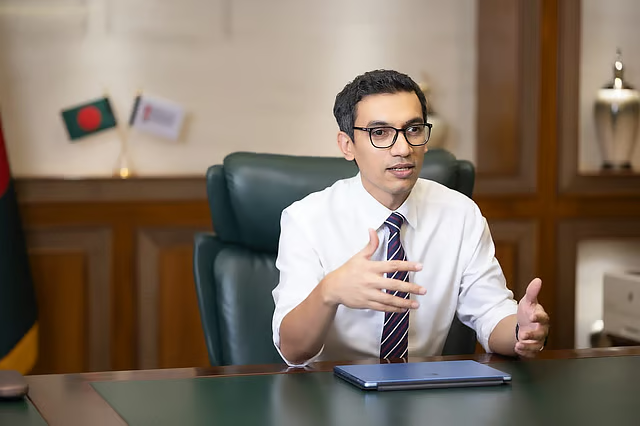
BIDA Executive Chairman Ashik Chowdhury.File Photo
No investment breakthrough under Ashik
After assuming his responsibilities, Ashik Chowdhury had told Prothom Alo in an interview that “from the beginning of next year (2025), significant improvement in new investment inflows will be seen.”
However, that has not materialised. According to the Bangladesh Economic Survey 2025, in fiscal year 2024–25, investment proposals worth Tk 660 billion in the private sector were registered with BIDA, nearly 58 per cent less than the previous year. During the Covid period, in fiscal year 2019–20, investment proposals worth Tk 1.05 trillion had been registered.
In the outgoing fiscal year, investment proposals worth USD 140 billion from foreign sources were registered. In the previous year, USD 320 billion had been registered. This means foreign investment proposals declined by nearly 56 per cent in the outgoing fiscal year. Meanwhile, domestic investment proposals worth USD 520 billion were registered last fiscal year. In the previous year, USD 1.24 trillion in domestic investment had been registered.
Ashik Chowdhury held a four-day investment conference last April to attract investment. The opening ceremony of the conference, and his presentation, generated considerable discussion on social media. In the end, investment proposals worth only USD 31 billion were received at the conference.
Apart from holding investment conference in the country, Ashik Chowdhury also visited several countries officially. However, no effective results have been seen, and in fact FDI from several countries has declined.
In March last year, the bida executive chairman visited the UK to attract investment. During the visit, he held meetings with government officials as well as British companies and expatriate Bangladeshis. However, FDI from the country amounted to USD 300 million in the last fiscal year. In the preceding year, FDI from the UK stood at USD 510 million. This represents a 41 per cent decline in FDI from that country.
Masrur Reaz, Chairman, Policy Exchange Bangladesh
In January last year, the BIDA executive chairman visited the USA. In the outgoing fiscal year, more investment was repatriated than what arrived from the USA. This means net FDI plummeted by 131 per cent. In March last year, the chief adviser visited Beijing. Three months later, Ashik Chowdhury visited the country. Nevertheless, FDI inflows from the country declined by approximately 3 per cent in the last fiscal year.
Apart from holding investment conference in the country, Ashik Chowdhury also visited several countries officially. However, no effective results have been seen, and in fact FDI from several countries has declined.
In March last year, the bida executive chairman visited the UK to attract investment. During the visit, he held meetings with government officials as well as British companies and expatriate Bangladeshis. However, FDI from the country amounted to USD 300 million in the last fiscal year.
In the preceding year, FDI from the UK stood at USD 510 million. This represents a 41 per cent decline in FDI from that country. In January last year, the BIDA executive chairman visited the USA. In the outgoing fiscal year, more investment was repatriated than what arrived from the USA.
This means net FDI plummeted by 131 per cent. In March last year, the chief adviser visited Beijing. Three months later, Ashik Chowdhury visited the country. Nevertheless, FDI inflows from the country declined by approximately 3 per cent in the last fiscal year.
Ashik Chowdhury skydives in between his professional commitments. On 25 May 2024, he secured a world record by leaping from an aircraft at an altitude of 41,795 feet in Memphis, USA. To commemorate the 54th anniversary of victory, 54 paratroopers skydived while brandishing the national flag on 16 December as part of a special government initiative. Ashik Chowdhury was amongst them. This feat has since been enshrined in the Guinness World Records.
When approached for comment, the BIDA executive chairman Ashik Chowdhury told Prothom Alo on 19 January, “Investment growth typically turns negative or grinds to a halt following a mass uprising. However, in our country, the opposite has occurred, with figures actually rising. It is something of a miracle.
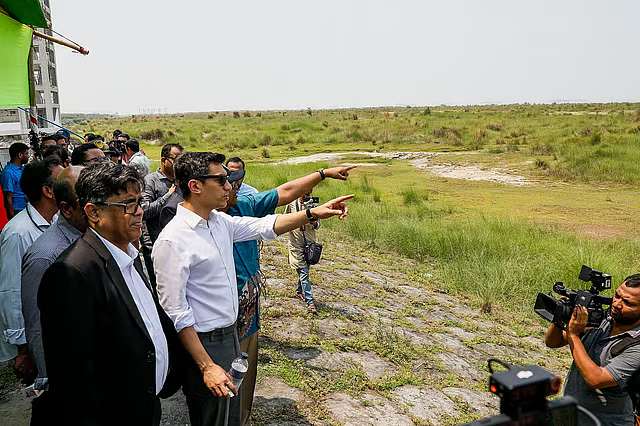
BIDA Executive Chairman Ashik Chowdhury inspects various project sites at Chattogram port on 8 May 2025.File Photo
As a foreign investor, having witnessed the events of 2024, why would anyone choose to invest in 2025? The nation's trajectory remained shrouded in uncertainty. Yet, investment has increased nonetheless. This suggests that investors harbour no doubts regarding the country's potential. The primary concern now is whether we can cultivate a suitable environment for them.”
Courageous Reforms Required
Business leaders across various sectors contend that the interim government has failed to implement any significant reforms over the past year and a half to improve the investment climate.
Furthermore, the pace of ongoing commerce remains sluggish due to a myriad of factors, including the failure to bring the law and order situation to a satisfactory level, high inflation, gas and power crises, and elevated interest rates. Consequently, fresh investment in the country has stagnated.
When approached for comment, Masrur Reaz, chairman of the private research organisation Policy Exchange Bangladesh, told Prothom Alo that the interim government had prioritised reform upon assuming office.
Initially, it adopted distinctive measures, such as appointing an individual from outside the bureaucracy as the BIDA executive chairman. We had anticipated courageous reforms to bolster the business and investment environment; however, no substantial progress has been observed over the last eighteen months. The reforms that have materialised are merely piecemeal and largely insignificant
Please include the source of your article.


