Bangladesh - India News / Discussions

To view this content we will need your consent to set third party cookies.
For more detailed information, see our cookies page.


To view this content we will need your consent to set third party cookies.
For more detailed information, see our cookies page.


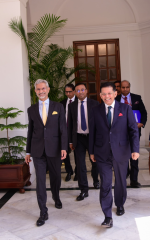
The Bangladeshi foreign minister has recently attended a meeting on multi-lateral regional co-operation amongst Indian Ocean states and has met Indian officials.

1775935811574.png
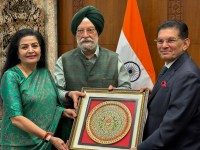
This included meeting with the Indian energy minister (centre of picture).

He also met Indian foreign minister Jaishankar 3 days ago.

1775935921838.png
 
So former NSA Khalil is no longer a US agent now I assume? I seem to recall BAL supporters being very vocal about how he was going to sell Bangladesh to US, and now they are praising him because he is meeting with Indians.

Good comedy.
 
So former NSA Khalil is no longer a US agent now I assume? I seem to recall BAL supporters being very vocal about how he was going to sell Bangladesh to US, and now they are praising him because he is meeting with Indians.

Good comedy.

Please refrain from making false statements. By virtue of your post you can only be referencing me.

1. I am not a BAL supporter, so please stop lying about that as I have criticised them heavily, if you continue to do that I will take this to GCHQ, as you do not have the right to lie about posters and defame them.

2. I have never even spoken about Khalil ur Rahman and @MNZGamerX I think was critical of him and spoke about his American links. However nor is @MNZGamerX an Awami League supporter and he has been anti-Hasina and anti-Indian for decades, a fact clearly attested by the fact (not slurs, lies by internet trolls on message boards) that he wrote a book called 'The India doctrine.'

3. I did not praise Khalil ur Rahman but merely posted what is publicly available content what the foreign ministers of India and Bangladesh have been doing as the name of this thread is 'Bangladesh - India News Discussions'. So naturally this should feature in such a thread.

Stop with the lies and insults.
 
Please refrain from making false statements. By virtue of your post you can only be referencing me.

1. I am not a BAL supporter, so please stop lying about that as I have criticised them heavily, if you continue to do that I will take this to GCHQ, as you do not have the right to lie about posters and defame them.

2. I have never even spoken about Khalil ur Rahman and @MNZGamerX I think was critical of him and spoke about his American links. However nor is @MNZGamerX an Awami League supporter and he has been anti-Hasina and anti-Indian for decades, a fact clearly attested by the fact (not slurs, lies by internet trolls on message boards) that he wrote a book called 'The India doctrine.'

3. I did not praise Khalil ur Rahman but merely posted what is publicly available content what the foreign ministers of India and Bangladesh have been doing as the name of this thread is 'Bangladesh - India News Discussions'. So naturally this should feature in such a thread.

Stop with the lies and insults.

My post was general towards Awami League supporters.

If you drag it towards you to make it about you, then that's on you. Feel free to take it wherever you want.
 
So former NSA Khalil is no longer a US agent now I assume? I seem to recall BAL supporters being very vocal about how he was going to sell Bangladesh to US, and now they are praising him because he is meeting with Indians.

Good comedy.

Okay, since this has become issue and someone has already raised this matter I should provide a clarification. Khalilur Rahman was a member of what we know as the Choton Gang which was pro-American group but there were some who secretly maintained a pro-Indian sentiment and stance and this includes the current Law Minister Md. Asaduzzaman who was also a Choton Gang member. So from inside the Interim Government Asad and his then boss Asif Nazrul literally sabotaged the reforms process by creating legal loopholes which the BNP is now exploiting. In this plan Asad was in constant touch with TR who had in London come under the grip of RAW. Another part of the plan was to bring in people like Khalilur Rahman into the BNP fold and Asad was rewarded with the Law Ministry while Khalil obtained the Foreign Ministry and is now working on an Indian agenda. Both Asad and Khalil appear to have betrayed their Choton Gang associates of 30 years and some have fled the country. I have been warning about this since 2024 and was shocked that the Jamaat-e-Islami could join hands with the Choton Gang for power.
 
Okay, since this has become issue and someone has already raised this matter I should provide a clarification. Khalilur Rahman was a member of what we know as the Choton Gang which was pro-American group but there were some who secretly maintained a pro-Indian sentiment and stance and this includes the current Law Minister Md. Asaduzzaman who was also a Choton Gang member. So from inside the Interim Government Asad and his then boss Asif Nazrul literally sabotaged the reforms process by creating legal loopholes which the BNP is now exploiting. In this plan Asad was in constant touch with TR who had in London come under the grip of RAW. Another part of the plan was to bring in people like Khalilur Rahman into the BNP fold and Asad was rewarded with the Law Ministry while Khalil obtained the Foreign Ministry and is now working on an Indian agenda. Both Asad and Khalil appear to have betrayed their Choton Gang associates of 30 years and some have fled the country. I have been warning about this since 2024 and was shocked that the Jamaat-e-Islami could join hands with the Choton Gang for power.

Thanks for the explanation.

I am seeing BAL accounts/personal affiliations in social media take a 180 degree turn regarding Khalilur Rahman.

Your explanation makes sense why the change in stance.


India names BJP leader envoy to Bangladesh as ties thaw

Reuters
April 27, 2026

1777292569609.png

India named veteran politician Dinesh Trivedi as its next high commissioner to Bangladesh on Monday, in a rare appointment of a non-foreign service officer as New Delhi seeks to reset ties with its eastern neighbour.

Ties between the countries soured after a popular uprising forced Bangladesh’s long-serving Prime Minister Sheikh Hasina to flee to New Delhi in 2024, where she remains.

Trivedi’s appointment highlights India’s push to rebuild trust with Bangladesh as it faces stiff competition from China for influence and business.

Trivedi, 75, a former railways and health minister, joined Prime Minister Narendra Modi’s Bharatiya Janata Party (BJP) in 2021 from a regional party in West Bengal, a border state that plays a key role in India’s ties with Bangladesh and where Modi has been seeking to expand his party’s influence in ongoing local elections.

“He is expected to take up the assignment shortly,” India’s Ministry of External Affairs said in a statement about Trivedi.
 
Relations between the two countries began improving only after an election in February brought Tarique Rahman of the Bangladesh Nationalist Party to power, replacing an interim government that had veered strongly towards China.

Bangladesh’s foreign minister visited Delhi this month seeking increased fuel and fertiliser supplies, closer energy cooperation and eased travel restrictions, but one of the biggest sticking points remains India’s refusal so far to extradite Hasina.
 
Relations between the two countries began improving only after an election in February brought Tarique Rahman of the Bangladesh Nationalist Party to power, replacing an interim government that had veered strongly towards China.

Bangladesh’s foreign minister visited Delhi this month seeking increased fuel and fertiliser supplies, closer energy cooperation and eased travel restrictions, but one of the biggest sticking points remains India’s refusal so far to extradite Hasina.

Why is pakistan voncrned when bd is not concerned. Their attitude was always making a big noise without seeking serious extradition. Seems more of a priority for pakistan than bd
 
Last edited:

Bangladesh summons Indian envoy to protest remarks by Assam CM Himanta Sarma​

DHAKA: Bangladesh on Thursday summoned acting Indian High Commissioner to Bangladesh Pawan Badhe and protested the remarks made by Assam chief minister Himanta Biswa Sarma, and stressed avoiding comments that might hurt bilateral ties.

Director General (South Asia) Ishrat Jahan conveyed Dhaka’s position to the acting Indian high commissioner during a meeting at the ministry of foreign affairs (MoFA). Bangladesh described the remarks as disparaging to Bangladesh-India relations and expressed its displeasure to India, said a diplomatic source. The MoFA, however, did not issue any official statement.
Sarma on April 26 said 20 foreign nationals were apprehended in Assam and pushed back to Bangladesh.

“Rude people don't understand soft language. We continuously remind ourselves of this prophetic line when we expel infiltrators from Assam who don't leave themselves. For instance, these 20 illegal Bangladeshis who were PUSHED BACK last night,” Sarma said in a post on X, according to Indian media reports.

Bangladesh stressed that public statements capable of straining ties between the two neighbours are counterproductive, and highlighted the importance of exercising restraint when addressing sensitive bilateral issues.

Link:


My comment: Our government summoned the Modi regime's representative to Dhaka and spoke to him.

The BJP should understand they are playing with fire.

We have our limits and our patience is not unlimited, if the BJP push us or target our brethren in India especially Assam and West Bengal, there will be severe consequences. There are some who still lament 71 till this day, and there may be others in Delhi and Ahmedabad who will lament similarly if they go too far.
 
To view this content we will need your consent to set third party cookies.
For more detailed information, see our cookies page.


The Gujaratis occupying power in New Delhi and their surrogates in the north-east are playing with fire.
 
India’s Bangladesh Policy Quagmire: Big Brother’s Recalcitrance and the Chinese Embrace

The BJP, or its allies, are now in power in all five Indian states that share a border with Bangladesh.

By Shanthie Mariet D’Souza
May 08, 2026

thediplomat_2024-11-11-074143.jpg

With its victories in the recent state assembly elections in West Bengal and Assam, the Bharatiya Janata Party (BJP), or its alliance partners, are in power in all five Indian states that share a border with Bangladesh. This should make New Delhi’s task of implementing its Bangladesh policy an easy cake walk, since it will no longer attract opposition from the state governments. However, it doesn’t necessarily mean a reset in India-Bangladesh ties. In fact, a mismanaged hardline policy, lacking in nuance, could alienate Dhaka further, disincentivizing its present mood to repair ties with India.

The new Bangladesh Nationalist Party (BNP) in Dhaka congratulated the BJP on its victory in West Bengal, which unseated the Trinamool Congress (TMC) party. The BNP described defeated Chief Minister Mamata Banerjee as an “impediment” to the signing of the Teesta River water-sharing agreement and expressed hope that the new BJP government in the state would be different. At the same time, it voiced apprehension regarding the possible growth of Indian attempts at “pushing in” people who New Delhi describes as illegal Bangladeshi migrants. Border Guard Bangladesh (BGB) personnel will stay alert for such incidents, Dhaka’s Home Minister Salahuddin Ahmed announced. Foreign Minister Khalilur Rahman was stern, promising that “Dhaka will act” against such moves.

Pushing out so-called illegal Muslim migrants from Bangladesh has been a priority for the BJP. Promises of forcible deportations may have contributed to the party’s electoral victory in West Bengal, making it expedient for the new state government to attempt, in tandem with the directives from India’s Home Ministry, to execute such a policy. However, in the absence of a consensus between New Delhi and Dhaka on the issue, the latter isn’t expected to take such action kindly.

India, in April, appointed Dinesh Trivedi, a BJP politician from West Bengal, as its new envoy to Dhaka, parting ways with a long tradition of placing only career diplomats in that position. The reason behind the move wasn’t articulated by the Ministry of External Affairs (MEA). Perhaps, in New Delhi’s calculation, a politician is better suited than a diplomat to attempt to smooth feathers in Dhaka ruffled by India’s refusal to extradite former Bangladeshi Prime Minister Shaikh Hasina. However, as long as the BJP’s domestic politics continue to cast Bangladesh as a country that tolerates the persecution of minority Hindus and BJP leaders refer to Bangladeshi migrants as “termites” who threaten India’s national security under a sinister policy of demographic invasion, Trivedi’s room for maneuver will remain limited.

Extraditing Hasina, who has been awarded a death sentence in absentia for her role in the violence accompanying the July 2024 uprisings that deposed her, is a priority for the BNP, but not necessarily an issue on which it will let its ties with India worsen to the point of no return. Bangladeshi Foreign Minister Rahman came to India in early April with a set of requests that included the Hasina issue, but also the supply of higher volumes of diesel and fertilizer and sorting out the delay in issuing visas to Bangladeshi citizens by the Indian High Commission and consulates in Bangladesh.

India’s response, especially to the diesel and fertilizer issue, was reportedly positive, but bereft of the warmth that one expects to see concerning a neighbor reeling under the impact of the closure of the Strait of Hormuz. India’s petroleum minister told Rahman that such supplies will be made only after India’s own demands are met. India has a dedicated refinery in Assam and an agreement to supply diesel to Bangladesh, but is currently supplying a reduced volume of the fuel to the country.

New Delhi’s assessment seems to be that Dhaka has little option but to reconcile itself to the fact that India is an irreplaceable neighbor that alone can fulfil Bangladesh’s critical needs of energy, water, raw materials, essential commodities, health services, and more. These are well-established areas of cooperation, which can also be weaponized, as Bangladesh is now experiencing.

Bangladesh isn’t alone. Not surprisingly, there are more anguished neighbors than friends in India’s vicinity. Despite its much touted “neighborhood first” policy, New Delhi continues to act like a big brother and remains indifferent to its neighbors’ needs – until these countries seek a solution to their problems by engaging with China. India’s past foreign policies toward Nepal, Sri Lanka, and Maldives are instructive.

Dhaka, under the BNP government, is willing to go down the same road. Rahman proceeded with a three-day official visit to China on May 5, at the invitation of Chinese Foreign Minister Wang Yi. Before his departure, he delivered some sharp words for New Delhi. Expressing his frustration over the delays in negotiating the Teesta River water-sharing agreement with India, Rahman said that his country will discuss development projects with China instead of waiting for the deal to happen. Rahman is expected to discuss trade, low-interest loans, extended repayment periods, and new investments with the Chinese side.

Beijing, slow to act in the two years since the downfall of the Hasina government, is clearly revamping its activities in Dhaka. It may jolt New Delhi out of its slumber. But it will be a case of hitting the track when the other competitor is already running.

 
India’s Bangladesh Policy Quagmire: Big Brother’s Recalcitrance and the Chinese Embrace

The BJP, or its allies, are now in power in all five Indian states that share a border with Bangladesh.

By Shanthie Mariet D’Souza
May 08, 2026

View attachment 196502

With its victories in the recent state assembly elections in West Bengal and Assam, the Bharatiya Janata Party (BJP), or its alliance partners, are in power in all five Indian states that share a border with Bangladesh. This should make New Delhi’s task of implementing its Bangladesh policy an easy cake walk, since it will no longer attract opposition from the state governments. However, it doesn’t necessarily mean a reset in India-Bangladesh ties. In fact, a mismanaged hardline policy, lacking in nuance, could alienate Dhaka further, disincentivizing its present mood to repair ties with India.

The new Bangladesh Nationalist Party (BNP) in Dhaka congratulated the BJP on its victory in West Bengal, which unseated the Trinamool Congress (TMC) party. The BNP described defeated Chief Minister Mamata Banerjee as an “impediment” to the signing of the Teesta River water-sharing agreement and expressed hope that the new BJP government in the state would be different. At the same time, it voiced apprehension regarding the possible growth of Indian attempts at “pushing in” people who New Delhi describes as illegal Bangladeshi migrants. Border Guard Bangladesh (BGB) personnel will stay alert for such incidents, Dhaka’s Home Minister Salahuddin Ahmed announced. Foreign Minister Khalilur Rahman was stern, promising that “Dhaka will act” against such moves.

Pushing out so-called illegal Muslim migrants from Bangladesh has been a priority for the BJP. Promises of forcible deportations may have contributed to the party’s electoral victory in West Bengal, making it expedient for the new state government to attempt, in tandem with the directives from India’s Home Ministry, to execute such a policy. However, in the absence of a consensus between New Delhi and Dhaka on the issue, the latter isn’t expected to take such action kindly.

India, in April, appointed Dinesh Trivedi, a BJP politician from West Bengal, as its new envoy to Dhaka, parting ways with a long tradition of placing only career diplomats in that position. The reason behind the move wasn’t articulated by the Ministry of External Affairs (MEA). Perhaps, in New Delhi’s calculation, a politician is better suited than a diplomat to attempt to smooth feathers in Dhaka ruffled by India’s refusal to extradite former Bangladeshi Prime Minister Shaikh Hasina. However, as long as the BJP’s domestic politics continue to cast Bangladesh as a country that tolerates the persecution of minority Hindus and BJP leaders refer to Bangladeshi migrants as “termites” who threaten India’s national security under a sinister policy of demographic invasion, Trivedi’s room for maneuver will remain limited.

Extraditing Hasina, who has been awarded a death sentence in absentia for her role in the violence accompanying the July 2024 uprisings that deposed her, is a priority for the BNP, but not necessarily an issue on which it will let its ties with India worsen to the point of no return. Bangladeshi Foreign Minister Rahman came to India in early April with a set of requests that included the Hasina issue, but also the supply of higher volumes of diesel and fertilizer and sorting out the delay in issuing visas to Bangladeshi citizens by the Indian High Commission and consulates in Bangladesh.

India’s response, especially to the diesel and fertilizer issue, was reportedly positive, but bereft of the warmth that one expects to see concerning a neighbor reeling under the impact of the closure of the Strait of Hormuz. India’s petroleum minister told Rahman that such supplies will be made only after India’s own demands are met. India has a dedicated refinery in Assam and an agreement to supply diesel to Bangladesh, but is currently supplying a reduced volume of the fuel to the country.

New Delhi’s assessment seems to be that Dhaka has little option but to reconcile itself to the fact that India is an irreplaceable neighbor that alone can fulfil Bangladesh’s critical needs of energy, water, raw materials, essential commodities, health services, and more. These are well-established areas of cooperation, which can also be weaponized, as Bangladesh is now experiencing.

Bangladesh isn’t alone. Not surprisingly, there are more anguished neighbors than friends in India’s vicinity. Despite its much touted “neighborhood first” policy, New Delhi continues to act like a big brother and remains indifferent to its neighbors’ needs – until these countries seek a solution to their problems by engaging with China. India’s past foreign policies toward Nepal, Sri Lanka, and Maldives are instructive.

Dhaka, under the BNP government, is willing to go down the same road. Rahman proceeded with a three-day official visit to China on May 5, at the invitation of Chinese Foreign Minister Wang Yi. Before his departure, he delivered some sharp words for New Delhi. Expressing his frustration over the delays in negotiating the Teesta River water-sharing agreement with India, Rahman said that his country will discuss development projects with China instead of waiting for the deal to happen. Rahman is expected to discuss trade, low-interest loans, extended repayment periods, and new investments with the Chinese side.

Beijing, slow to act in the two years since the downfall of the Hasina government, is clearly revamping its activities in Dhaka. It may jolt New Delhi out of its slumber. But it will be a case of hitting the track when the other competitor is already running.


So BNP wants higher volumes of Diesel and fertiliser from India?

And what will India extract as quid pro quo?

Can’t they procure them from Singapore like they bought Indian rice?

It’s the same foreign minister, no?
 
This is from a nationalist account.

To view this content we will need your consent to set third party cookies.
For more detailed information, see our cookies page.


To view this content we will need your consent to set third party cookies.
For more detailed information, see our cookies page.


1779041157001.png
 
1000017613.png


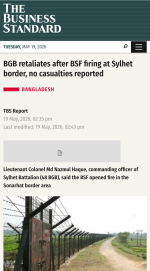
Such brotherly nation. Shooting and trying to trigger a conflict for absolutely no reason.

Now get your popcorn ready and watch certain "Bangladeshis" coming to defend BSF shooting with some sort of mental gymnastic. 🍿 🍿 🍿
 

Users who are viewing this thread

Pakistan Defence Latest

Latest Posts

Back
Top