Bangladesh - India News / Discussions

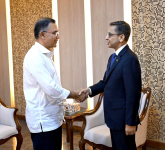
Bangladeshi prime minister recently met previous Indian high commissioner Pranay Verma for a farewell call.
To view this content we will need your consent to set third party cookies.
For more detailed information, see our cookies page.


1780207356062.png

@Vikramaditya1 @vasanthm @AjayGhatak @SoulSpokesman @BananaRepublic @MNZGamerX @Prince_

The Jamaati trolls you see on here posting nonsense and propaganda and anti-India hatred are not representative of Bangladeshi people and definitely not of our government. We definitely do have issues with some things New Delhi does but that can only be resolved through dialogue and negotiations. Jamaatis however would ideally like in the absence of a suicidal Bangladesh-India war a "cold war" which features a relationship characterised with nothing but hatred, hostility, insults, threats etc. They may also try to do 'soft-takfeer' (declaring someone a non-Muslim like ISIS in the middle east did a lot of) of Bangladeshi nationalists who are not India-haters and do not want either a full on Bangladesh-India war or a "cold war" (non-military but purely hatred) between the two, by insulting us and calling us Hindus or Hindutva bootlickers etc. They will use such tactics to silence Bangladeshi nationalists on this forum and so that the only narrative that you will hear is that "all Bangladeshis hate India" (Jamaati propaganda) and thus secure the agenda of their foreign masters to destroy Bangladesh-India relations.

Doing 'soft-takfeer' is extremely dangerous and calling Muslims as Hindus or Hindutva bootlickers is spiritually very dangerous because in Islam we are taught that if someone takfeers another Muslim wrongly then that person goes outside the fold of Islam. @Waz bhai, can you please ensure Jamaati trolls on this sub-forum are not allowed to call Muslim posters 'Kafirs' or 'Hindus' and engage in ISIS-style behaviour? Look at this thread where one Jamaati troll is attacking Sufis: https://defencepk.com/forums/thread...hrines-are-growing-in-bangladesh.32216/page-2

Anyway as we can see the current nationalist government in Bangladesh is not interested in such nonsense. Please do not take Jamaat's hatred of India, Indians and Hindus as representative of Bangladeshis in general. If Jamaatis had their way there would be no Bangladesh as they tried to stop Bangladesh independence in 1971 but were defeated, in the same way they were defeated in elections last year.

Also recently India praised prime minister Tariq Zia's father's role in liberating Bangladesh.

To view this content we will need your consent to set third party cookies.
For more detailed information, see our cookies page.


@uksyl @BananaRepublic

Kola bhai/ UKsyl bro,

Well, thanks. The large masses of BD citizens are moderate people who like anyone else want the well-being of themselves and their families- we saw this reflected in the 2026 poll.

Regards
 
LMAO so now gobar chand brought his back up back up gobar kranti das.

ANd as usual the gobar krant das goes on a spree of lies like its bramon masters and is trying to teach the rest of us Islam.

Listen up gobar chand, please read real history not the one passed to you from your bramon masters.

I hope you can look up the name of the muslim league and history before you try to label people as jamatis. Then again you are no different from your matric pass neta aka khamba. I understand posterior kissing is your forte but please for the love of god please come up with some plausible allegations.

The muslim league was made up of the descendants of the nawabs who were the loyal to the empire. Many of them wanted to rectify the missdeads of their ancestors.

Please don't try to teach us ISLAM. While you openly side with the oppressors of muslims and side with the Hindutava.

Are you aware of what Islam says about nationalism? Are you aware that in ISLAM a munafek is worse than a kaffir? Or they didn't teach you that your patshala?

I hope the moderators take action against such two faced shills, who claim to be Bengali but bend over backwards every time to please their braman masters.

Only in a sub sect of Bangladesh, can Indians find people venerating and worshiping them like no where else on earth. No wonder India doesn't want to let go of Bangladesh. Otherwise who else on god's green earth will worship them, as the rest of the world is slowly getting rid of them.
 
This is from a nationalist account.

To view this content we will need your consent to set third party cookies.
For more detailed information, see our cookies page.


To view this content we will need your consent to set third party cookies.
For more detailed information, see our cookies page.


View attachment 197616


Why are you spreading disinformation again? Why don't you disclose the fact that post 71 the awami league and its gang of murkhojoddhas did what their bramon masters wanted them to do i.e. remove the then Pakistan government's objection to the gangs barage?

There after Zia came and tried to restore status quo but the shiv lingam worshipers in Bangladesh got rid of him. Which is why neither his wife nor his son ever initiated a proper investigation on zias death?

Ever since then the Zia family publicly showed their hatered for india to get votes but in secret was massaging their masters shiv lingam.

Which is why in the 90's Khaleda rejected the submarine cable, opened the doors to further corruption to beat ershad. People have memory you know. Right before the election it was well established that the dgfi worked in the background to bring BNP in power.

I am glad they did. As with every time BNP comes to power the wrath of Allah comes down to this nation. Now people will see the real face of BNP and once they get agitated we will see where khamba card baba will run away to.
 
To view this content we will need your consent to set third party cookies.
For more detailed information, see our cookies page.


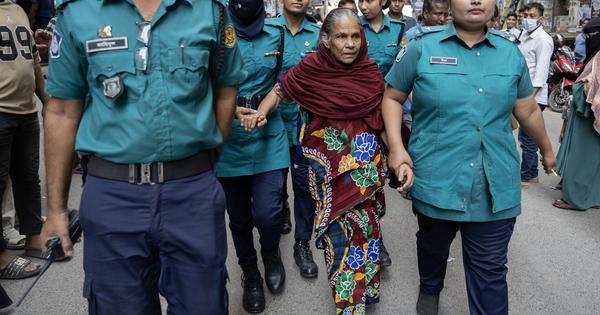
Modi's thugs got an Indian Assamese woman who doesn't even speak a word of Bangla and was sent into Bangladesh.


She is an Indian citizen and needs to return to her motherland, India, rather than being a part of the Gujarati-led ethnic cleansing of Muslims in India (led by two Gujaratis, Modi and Amit Shah).

1780765384044.png
 
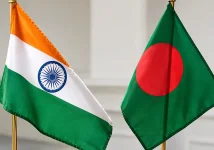
West Bengal’s Political Shift and the Future of India–Bangladesh Relations

Author : Sohini Bose
Expert Speak Raisina Debates

Published on Jun 06, 2026

Border securitisation may sharpen India-Bangladesh tensions, but renewed momentum on Teesta offers a pathway to restore trust and stability

1780743252_img-indo-bangla.webp

On 9 May 2026, a new government took charge in West Bengal following a sweeping electoral victory. Among the key promises in the new ruling party BJP’s manifesto to the Bengal populace, national security tops the list, echoing a long-standing concern of the BJP-led National Democratic Alliance government at the centre about alleged illegal infiltration from Bangladesh through the unfenced and less guarded portions of West Bengal’s border. The subsequent swift measures undertaken by the new West Bengal state government have fuelled anxiety among some hardliners in Bangladesh. West Bengal is, after all, more than just another Indian state for Bangladesh, sharing common resources, several family connections, and a history of partition. Hence, “any strain on one side quickly reverberates to the other.” In such political circumstances, it is important not only to analyse the impact of these developments on Bangladesh but also to identify areas where cooperation can be increased to help stabilise bilateral ties and enhance goodwill among people.

West Bengal is, after all, more than just another Indian state for Bangladesh, sharing common resources, several family connections, and a history of partition. Hence, “any strain on one side quickly reverberates to the other.”

Border Security and Strategic Geography​

The West Bengal state government has instructed the “illegal immigrants” to be arrested and handed over to the Border Security Force (BSF) for deportation. It has also approved the transfer of land to the BSF in the border districts to fence the remaining parts of the India-Bangladesh boundary, within 45 days of forming the government. Of West Bengal’s entire border with Bangladesh, nearly 1,600 km is already fenced, while the remaining 600 km remains open. In the first instalment, 27 km has been handed over to the BSF, of which 18 km is for fencing and 9 km for the construction of BSF outposts and necessary infrastructure. More land will be transferred, with all expenses paid by the centre and the BSF.

The state government has also approved the handover of 120 acres of the Siliguri Corridor in north Bengal to the centre for national security. The narrow strip of land connecting India’s Northeast with the rest of the country is known as the ‘Chicken’s Neck’ for its strategic vulnerability. In the past few years, New Delhi has become especially apprehensive of its sanctity due to several developments in Bangladesh. These include controversial statements by Muhammad Yunus, Chief Adviser of the former interim government of Bangladesh, about the territorial vulnerability of India’s Northeast, his reported exchange with China to develop an airbase at Lalmonirhat and the acceptance of Beijing’s offer to execute the Teesta River Comprehensive Management and Restoration Project. Both projects risked bringing China closer to the Indian border. The Teesta project is also being pursued by the current Bangladesh Nationalist Party (BNP) government in Dhaka, fuelling concerns in New Delhi about strategic sensitivities.

Ripples in Bangladesh​

While the Indian government deems the above measures necessary to strengthen national security and development, hardline groups in Bangladesh interpret them otherwise. The speed with which the new government has moved on border fencing, purported deportation, land transfers, and security-related decisions has sharpened these anxieties. Demolition drives targeting “illegal” properties in West Bengal have also fed into this narrative, allowing agitators to frame domestic law-and-order measures in cross-border terms.

As water is a state subject and bilateral decisions are a matter of central jurisdiction under the Indian Constitution, the Teesta issue became embroiled in a federal deadlock, making it impossible to settle.
For the Tarique Rahman administration, which came to power in February 2026 after nearly a year and a half of domestic unrest and political turmoil, the problem is twofold. Dhaka has long maintained that the alleged illegal migration into India is overstated and has hence refused to accept deportees without clear proof of their Bangladeshi citizenship. A surge in their number poses a structural challenge to the BNP government, straining border management systems. At the same time, provocative digital content can inflame public agitation in a country where anti-India sentiment has remained politically salient in recent months. This could undermine the BNP government’s legitimacy and its attempts to cultivate a functional relationship with New Delhi. This not only indicates the need for India and Bangladesh to strengthen their cooperation in managing deportations, but also to identify areas of cooperation that can function as confidence-building measures for people on both sides of the border. One such area is the dispute over the Teesta River.

River Diplomacy as a Political Corrective​

Among the 54 transboundary rivers shared by India and Bangladesh, the Teesta flows southwards, from the hills of Sikkim and northern West Bengal to the relatively low-lying Rangpur Division in Bangladesh. As the primary river flowing through northern Bangladesh, it supports the agricultural needs of over 10 million people, producing 14 percent of the nation’s crop production. However, Bangladeshi experts are of the view that Indian dams constructed upstream have depleted the discharge into their country, hindering the irrigation of over 100,000 hectares of land. Before the dams were built, nearly 6,710 cusecs (cubic feet per second) flowed into the country, which has currently been reduced to only 1,200-1,500 cusecs during the dry season, receiving 200-300 cusecs at times. This is far less than the national requirement of 5000 cusecs per day. Naturally, both countries have sought to arrive at a resolution.

In 1983, an ad hoc agreement was reached at the 25th Joint River Commission, by which Bangladesh would receive 36 percent of Teesta’s waters. But its terms were unfulfilled. Another agreement was reached in 2011, allocating 42.5 percent of the water to India and 37.5 percent to Bangladesh. However, the agreement could not be formalised due to objections from West Bengal’s previous regime, which argued that the state’s growing water needs and declining river flows made the proposed arrangement untenable. Hence, sharing more water with Bangladesh would affect the people in West Bengal. As water is a state subject and bilateral decisions are a matter of central jurisdiction under the Indian Constitution, the Teesta issue became embroiled in a federal deadlock, making it impossible to settle.

Refocusing attention on resolving the Teesta issue will not only help New Delhi mitigate anti-Indian sentiment in Bangladesh but also raise the Tarique Rahman government’s popular legitimacy.
Consequently, this has been one of the longest-standing issues of contention between Dhaka and New Delhi, spurring anti-Indian sentiments among sections in Bangladesh. It is therefore not surprising that China’s offer to build a multipurpose barrage and dredge and embank portions of the Teesta to form a single manageable channel was accepted over India’s similar offer by Dhaka’s interim administration and the subsequent BNP government. However, with the centre-state alignment now greater between New Delhi and West Bengal than ever before, there are likely to be fewer political hurdles in resolving the Teesta issue. If such a settlement leads to a mutually beneficial water-sharing agreement between India and Bangladesh, it will not only be a significant diplomatic victory for both governments but also help to restore public goodwill.

Refocusing attention on resolving the Teesta issue will not only help New Delhi mitigate anti-Indian sentiment in Bangladesh but also raise the Tarique Rahman government’s popular legitimacy. Hence, in this moment of diplomatic strain, India and Bangladesh must rethink political narratives that amplify suspicion and grievance and instead foreground shared interests, river diplomacy and people-centric gains, so that contentious issues are managed without allowing public sentiment to slide into hostility.

 
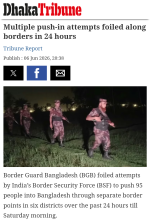
1000018468.pngOur Dinajpur Correspondent reports that BSF members attempted to push 11 individuals into Bangladesh through Mashalgaon border under Haripur upazila of Thakurgaon, which falls under the jurisdiction of Dinajpur Battalion (42 BGB), at approximately 3:30 am on Saturday.

According to BGB, the attempted push-in was detected and successfully prevented by BGB personnel deployed in the area. The group consisted of 11 people, including three men, four women, and four children.

Our Hili Correspondent reports that BGB thwarted early yesterday an alleged attempt by BSF to push five Indian nationals into Bangladesh through the Ghasuria border area in Hili. BGB personnel, aided by local residents, intervened and prevented the entry. BGB officials said border patrols and surveillance have been intensified, and no individuals were pushed into Bangladesh.

UNB adds: BGB members prevented push-in attempts through the bordering areas of Netrakona, Naogaon, Lalmonirhat, Panchagarh and Jhenaidah, said Shariful Islam, media officer of BGB headquarters.

According to the statement, BGB members from Maheshpur Battalion (BGB-58) in Jhenaidah foiled attempts of three individuals to enter Bangladesh from India through Jadabpur border.

BGB patrol members took position along the zero line and prevented their entry, forcing them to return to Indian territory.

In Naogaon, members of BGB-16 Battalion obstructed entry of 17 individuals into Bangladesh through Karamdanga border.

In Lalmonirhat, BGB members under Teesta Battalion (BGB-61) prevented illegal entry of 21 people into Bangladesh along Barkhata and Poyshottibari border areas in Hatibandha and Patgram upazilas.

Besides, BGB members under the Lalmonirhat Battalion (15 BGB) stopped an attempt to push seven individuals into Bangladesh through Dighaltari border. The same battalion also thwarted another attempt involving four people at Durgapur border.

Indian authorities reportedly brought 10 individuals to an area outside Barobari Pradhanpara border area in Panchagarh under Nilphamari Battalion (56 BGB).

A flag meeting was subsequently held between BGB and the Border Security Force (BSF) at the company commander level.

During the meeting, BSF claimed that the individuals were Bangladeshi nationals but failed to provide supporting evidence, according to the BGB statement. The matter remains under close observation.

Meanwhile, 16 to 17 individuals who had earlier been gathered at a government primary school in Assam's Mahadev Police Station area opposite the Kochugora border under Netrakona Battalion (31 BGB) were relocated to an area adjacent to BSF’s Chikni camp opposite Lengura border due to BGB’s firm position.

 
Such brotherly love. Sending more people to our country. Where are our Sylheti Hindutva Bharat defenders of PDF? Such great news for our brotherly relationship. Come join in to celebrate and defend Bharat mata. Curse all the forces trying to create enemity between the two countries!

Bangladesh should take in every single individual India pushes in. How dare BGB push back and not listen to Bharat's command? Bharat said they are Bangladeshi nationals and we must believe it. Why is BGB asking for proof? How dare they?

We should take in all Indian Muslims into Bangladesh. Because that is what the new Hindutva Bharat wants.
 

Users who are viewing this thread

Back
Top