US and India agree on safe passage, death penalty suspension for Sheikh Hasina
Diplomatic efforts reportedly focus on sentence suspension, security guarantees and political reconciliation ahead of her possible return
by Enayet Kabir
August 12, 2026
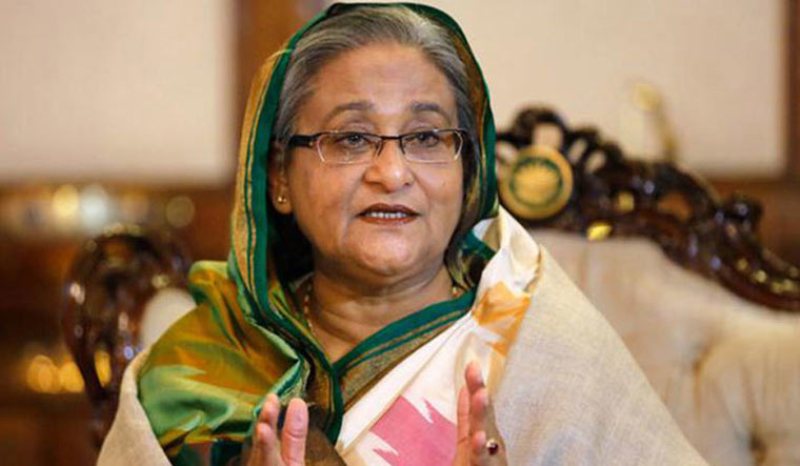
View attachment 210908
The United States and India have reportedly reached a diplomatic understanding on creating an opportunity for Bangladesh’s former Prime Minister
Sheikh Hasina to return to the country by ensuring her security and securing a suspension of her
death sentence and other sentences for at least one year, according to diplomatic sources cited in Bangladesh.
Over the past two weeks, US and Indian officials have reportedly conveyed the decision to senior members of the Bangladesh government, including Prime Minister Tarique Rahman, and sought Dhaka’s cooperation.
According to the report, a possible framework for Hasina’s return was discussed during meetings between Indian National Security Adviser Ajit Doval and US Special Envoy for South and Central Asia Sergio Gor on August 10 and 11, as well as through other diplomatic contacts.
The reported objective has been to find a formula under which Hasina’s “dignity” and “security” would be maintained while facilitating her return to Bangladesh. However, the issue of lifting the government order banning the political activities of the Awami League has reportedly not yet been resolved.
The report says the United States has once again begun viewing regional security issues “through India’s eyes.” It further claims that diplomatic mediation by Washington and New Delhi has brought the ruling Bangladesh Nationalist Party (BNP) and the banned Awami League into a process of reconciliation.
According to the report, India and the United States have identified the presence of “undemocratic” forces in Bangladesh as a potential threat to their broader regional security strategy. The assessment has reportedly contributed to intensified diplomatic engagement involving Washington, New Delhi and Dhaka.
The report also links the recent diplomatic activity to what it describes as a military agreement among Turkey, Pakistan and Saudi Arabia, referred to as the “Mecca Agreement.”
It claims that the agreement, modelled on NATO’s collective-defence principle, provides that an attack on any one of the three countries would be treated as an attack on all three.
The report says the agreement prompted increased consultations between Indian and US diplomats because New Delhi views the arrangement as a potential security threat. These claims, however, have not been independently established in the report.
Against this backdrop, Research and Analysis Wing (R&AW) chief Parag Jain reportedly made a brief visit to Bangladesh on August 9-10 with three other officials at the invitation of Bangladesh’s Directorate General of Forces Intelligence (DGFI).
The delegation reportedly comprised Jain, Ashwin Mukund Kotnis, an Indian Police Service officer whose father, M V Kotnis, had previously held a senior position in the same intelligence establishment; Rahul Negi; and Saibal Ray Chowdhury.
According to the report, after arriving in Dhaka, the Indian officials held separate meetings with Bangladesh Home Minister Salahuddin Ahmed and the Prime Minister’s Defence Adviser, Brigadier General (retd) Dr A K M Shamsul Islam. Shaibal Ray Chowdhury reportedly met Prime Minister Tarique Rahman.
Jain’s movements have attracted particular attention because he reportedly visited China before travelling to Bangladesh. His Dhaka visit is being viewed in the context of an emerging diplomatic equation surrounding Hasina’s security and future status.
India is reportedly treating the question of Hasina’s return and security as a matter connected to its own national-security interests. The report further claims that New Delhi has maintained close consultations on the issue with Russia and several European countries.
An Indian diplomatic source is quoted as saying that China has supported an Indian initiative concerning “Sheikh Hasina’s return and security.” The extent and nature of any such Chinese support, however, have not been publicly established.
Hasina’s Return and Legal Proceedings
The report also points to growing international controversy surrounding the legal proceedings against Hasina. Her trial and the resulting sentences have attracted criticism and scrutiny internationally, according to the source.
A press conference held in New Delhi on August 5 received extensive coverage in the international media. During the event, Hasina reiterated her expectation of returning to Bangladesh by December.
Her remarks subsequently brought the question of her return and personal security to the forefront of diplomatic discussions.
The reported diplomatic initiative therefore appears to involve several interconnected issues: the legal status of Hasina, the possibility of suspending her sentences, guarantees concerning her personal security, the conditions under which she could return, and the political status of the Awami League.
For India, the issue carries both political and security implications. New Delhi must balance its relationship with Bangladesh’s current government with its longstanding security concerns surrounding Hasina and the Awami League. For Washington, the question is increasingly being viewed through the broader prism of regional stability and its strategic coordination with India.
For Dhaka, any arrangement would involve difficult questions about the judicial process, domestic political reconciliation, law and order, and the government’s commitment to enforcing court decisions.
There is no public confirmation from the US, Indian or Bangladeshi governments of an agreement to suspend Hasina’s sentence or of a settled arrangement for her return. Nor has there been independent official confirmation of all the diplomatic and intelligence discussions described in the report.
Nevertheless, the reported sequence of high-level contacts—including the Doval-Gor meetings, the visit of the Indian R&AW chief to Dhaka and continuing diplomatic engagement between India, the United States and Bangladesh—suggests that Hasina’s future is emerging as an increasingly important issue in the region’s diplomatic and security calculations.
The United States and India have reportedly reached a diplomatic understanding on creating an opportunity for Bangladesh’s former Prime Minister

nenews.in




 Pakistan Deploys Chinese SH-15 155mm howitzers Near India Border Against a Backdrop of Regional Tensions. (21 Viewers)
 Bangladesh Lists 2 Riders For PM Rahman's India Visit. One Is Hasina Return (4 Viewers)


 Joint Defense Agreement: Turkey, Saudi Arabia, and Pakistan, news & updates (52 Viewers)

