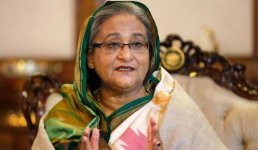
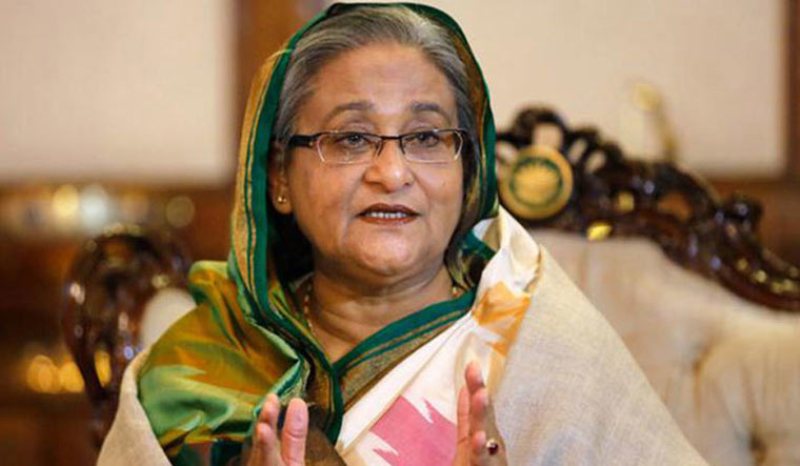
Bangladesh Lists 2 Riders For PM Rahman's India Visit. One Is Hasina Return

LeonBlack08

INT'L MOD
Joined
Dec 9, 2008
Messages
7,111
Reaction score
11,082
Reputation
4,219.2
Country of Origin
Country of Residence
According to a statement from the Bangladeshi foreign ministry, officials from both countries have been in contact for several weeks about the possibility of a bilateral visit by Tarique Rahman to New Delhi.

Bangladesh said on Sunday that its Prime Minister Tarique Rahman's proposed visit to India is unlikely to go ahead unless New Delhi moves ahead with the extradition of former prime minister Sheikh Hasina and other fugitives wanted by Dhaka.

According to a statement from the Bangladeshi foreign ministry, officials from both countries have been in contact for several weeks about the possibility of a bilateral visit by Rahman to New Delhi.

Bangladesh foreign ministry spokesperson AKM Shahidul Karim said that the discussions had been affected by a public interaction involving Hasina in New Delhi on August 5.

"We are of the view that a propitious environment needs to be created for the visit," Karim said.

"To this end, we have requested the Indian authorities to expeditiously act on our request to extradite Sheikh Hasina and other fugitive criminals, and to hand over to Bangladesh the accused killers of Shaheed Sharif Osman Hadi in compliance with our bilateral extradition treaty. We are awaiting their response."

Two people, accused of killing political activist Osman Hadi, were arrested by the special task force (STF) of the West Bengal police from the border town of Bongaon in North 24 Parganas district in March.

We reiterate that we will continue to pursue our 'Bangladesh First' policy to promote friendly bilateral relations with other countries, including our neighbours, on the basis of sovereign equality, national dignity, non-interference in each other's internal affairs and mutual benefit," the statement continued.

Bangladesh said the process surrounding Rahman's possible visit had been "vitiated" by Hasina's open press interaction in New Delhi, despite her conviction by Bangladesh's International Crimes Tribunal for crimes against humanity. The Centre made it clear that the press conference involving Hasina and Bangladeshi officials had nothing to do with the Indian government.

India has previously said that its extradition request from Bangladesh concerning Hasina remains "under examination".

Hasina was removed from power in August 2024 after a student-led uprising that grew into an anti-government movement. After her government fell, she fled to India, where she has remained.
 

Bangladesh says PM Tarique Rahman will not visit India until Hasina extradited

AFP
August 16, 2026

Bangladesh said on Sunday that Prime Minister Tarique Rahman would not visit India until New Delhi extradited Sheikh Hasina, the Bangladeshi former premier who fled during a 2024 uprising.

The countries have had a strained relationship since deadly anti-government protests brought down Hasina’s government and prompted her to escape to neighbouring India, where she remains.

She faces the death penalty in Bangladesh after being convicted of crimes against humanity, and Dhaka has repeatedly requested her extradition.

Speaking to reporters on Sunday, foreign ministry official A.K.M. Shahidul Karim played down media speculation about a possible trip by Rahman to India next week.

“We are of the view that a propitious environment needs to be created for the visit,” Karim told reporters.

“To this end, we have urged the Indian authorities to expedite their efforts to extradite Sheikh Hasina and other fugitives.” India has said Bangladesh’s extradition request is “under examination”.

Rahman took office in February and has since visited Malaysia and China, departing from the tradition of Bangladeshi leaders heading to India for their first overseas trip.

India’s High Commissioner to Bangladesh, Dinesh Trivedi, met Rahman last week, fuelling speculation over a possible breakthrough.

Officials from Bangladesh and India have been in contact in recent weeks about the possibility of a visit by Rahman, Karim said.
 
Looks like India will just stall until Hasina herself returns voluntarily, but does the BNP government really want her back or is it just posturing? Won't she be a bigger political headache in Bangladesh rather than out of sight in India and will they really carry out the death sentence from the case that is the basis of the extradition request ?

 
Looks like India will just stall until Hasina herself returns voluntarily, but does the BNP government really want her back or is it just posturing? Won't she be a bigger political headache in Bangladesh rather than out of sight in India and will they really carry out the death sentence from the case that is the basis of the extradition request ?

It's not going to be happened.

Haseena not going anywhere, might bangaladeshi PM will not come and indian cricket team also not going to Bangladesh for cricket series..

India never care about balai lamda case and china useless concerns, leave this matter..
 
It's not going to be happened.

Haseena not going anywhere, might bangaladeshi PM will not come and indian cricket team also not going to Bangladesh for cricket series..

India never care about balai lamda case and china useless concerns, leave this matter..
What is "balai lamda" ? Please use ChatGPT or some other LLM to proofread your post. It is impossible to understand what you are trying to say.
 
is "balai lamda" ? Please use ChatGPT or some other LLM to proofread your post. It is impossible to understand what you are trying to say.
Don't have too much time... It's just a typo error. Dalai Lama... Read about it.
It's not just India. Historically, many countries have given political asylum or protection to leaders from third countries. It's quite common. Just think like an ordinary Indian guy.

I only use chatgpt while sending official email to high profile members, otherwise I am happy with my rough English.

Anyway - such conditions if Bangladeshi PM will bring between india and Bangladesh relationship, it will not going to work
 
Don't have too much time... It's just a typo error. Dalai Lama... Read about it.
It's not just India. Historically, many countries have given political asylum or protection to leaders from third countries. It's quite common. Just think like an ordinary Indian guy.

I only use chatgpt while sending official email to high profile members, otherwise I am happy with my rough English.

Anyway - such conditions if Bangladeshi PM will bring between india and Bangladesh relationship, it will not going to work
The Dalai Lama has not been convicted of crimes against humanity and sentenced to death by any court.
 
The Dalai Lama has not been convicted of crimes against humanity and sentenced to death by any court.

Sir ji, I can give a lot of examples where a leader was given asylum by another country and lived there. There is nothing new about it. Political relationships between countries are different... It can be a major point for discussion between the two countries but you can't stick with it.

Even I know of countries that have given asylum to people like Dawood Ibrahim, who was accused of carrying out bomb blasts that killed people. A political leader and a criminal or terrorist cannot be compared in the same way. I’m only giving this as an example—there is otherwise no comparison between giving asylum to a political leader and giving asylum to a criminal or terrorist.
 
The Dalai Lama has not been convicted of crimes against humanity and sentenced to death by any court.

They are comparing apples and oranges. Both issues are not comparable.

One is a convicted criminal (Hasina), the other (Dalai Lama) is a threat to Chinese political establishment. DL has a legitimate case for political asylum. Hasina is simply a criminal hiding under Modi's protection.
 
The Dalai Lama has not been convicted of crimes against humanity and sentenced to death by any court.
Says who? Dalai Lama is the leader of a terrorist group and a dangerous seperatist. That's what a Chinese person would say. If he lands in China he will be promptly arrested for the charges maybe sentensed to death because these crimes carry death penalty in China. So we should respect Chinese laws and deport him there?

Now I'm not say SHW is Dalai Lama but she is a political refugee and she will not be forcefully removed from India. If she wishes she can leave for BD or any country for that matter.
 
@LeonBlack08 @MNZGamerX

Is this true that a senior RAW operative Parag Jain met Dr Shamsul Alam and some other senior security chiefs behind TZ's back?

Regards

I have been unbanned so am back ... I don't know about this meeting. Where did you get this information? Any links? Which Shamsul Alam is this?
 
Says who? Dalai Lama is the leader of a terrorist group and a dangerous seperatist. That's what a Chinese person would say. If he lands in China he will be promptly arrested for the charges maybe sentensed to death because these crimes carry death penalty in China. So we should respect Chinese laws and deport him there?

Now I'm not say SHW is Dalai Lama but she is a political refugee and she will not be forcefully removed from India. If she wishes she can leave for BD or any country for that matter.
People don't understand that other countries don't always trust politically sensitive decisions made by another country's government or courts.

For example, Pakistan's former Prime Minister Zulfikar Ali Bhutto was executed on 4 April 1979 after a court sentenced him to death. However, the case has remained highly controversial, with many believing that political influence played a role in the proceedings. In March 2024, Pakistan's Supreme Court also observed that Bhutto's trial and appeal did not meet the requirements of a fair trial and due process.

Usually, when a person has clearly committed a crime and there is credible, internationally accepted evidence and a fair judicial process, two countries can cooperate to extradite or hand over the accused
 
US and India agree on safe passage, death penalty suspension for Sheikh Hasina

Diplomatic efforts reportedly focus on sentence suspension, security guarantees and political reconciliation ahead of her possible return

by Enayet Kabir
August 12, 2026

hasina1.jpg

The United States and India have reportedly reached a diplomatic understanding on creating an opportunity for Bangladesh’s former Prime Minister Sheikh Hasina to return to the country by ensuring her security and securing a suspension of her death sentence and other sentences for at least one year, according to diplomatic sources cited in Bangladesh.

Over the past two weeks, US and Indian officials have reportedly conveyed the decision to senior members of the Bangladesh government, including Prime Minister Tarique Rahman, and sought Dhaka’s cooperation.

According to the report, a possible framework for Hasina’s return was discussed during meetings between Indian National Security Adviser Ajit Doval and US Special Envoy for South and Central Asia Sergio Gor on August 10 and 11, as well as through other diplomatic contacts.

The reported objective has been to find a formula under which Hasina’s “dignity” and “security” would be maintained while facilitating her return to Bangladesh. However, the issue of lifting the government order banning the political activities of the Awami League has reportedly not yet been resolved.

The report says the United States has once again begun viewing regional security issues “through India’s eyes.” It further claims that diplomatic mediation by Washington and New Delhi has brought the ruling Bangladesh Nationalist Party (BNP) and the banned Awami League into a process of reconciliation.

According to the report, India and the United States have identified the presence of “undemocratic” forces in Bangladesh as a potential threat to their broader regional security strategy. The assessment has reportedly contributed to intensified diplomatic engagement involving Washington, New Delhi and Dhaka.

The report also links the recent diplomatic activity to what it describes as a military agreement among Turkey, Pakistan and Saudi Arabia, referred to as the “Mecca Agreement.”

It claims that the agreement, modelled on NATO’s collective-defence principle, provides that an attack on any one of the three countries would be treated as an attack on all three.

The report says the agreement prompted increased consultations between Indian and US diplomats because New Delhi views the arrangement as a potential security threat. These claims, however, have not been independently established in the report.

Against this backdrop, Research and Analysis Wing (R&AW) chief Parag Jain reportedly made a brief visit to Bangladesh on August 9-10 with three other officials at the invitation of Bangladesh’s Directorate General of Forces Intelligence (DGFI).

The delegation reportedly comprised Jain, Ashwin Mukund Kotnis, an Indian Police Service officer whose father, M V Kotnis, had previously held a senior position in the same intelligence establishment; Rahul Negi; and Saibal Ray Chowdhury.

According to the report, after arriving in Dhaka, the Indian officials held separate meetings with Bangladesh Home Minister Salahuddin Ahmed and the Prime Minister’s Defence Adviser, Brigadier General (retd) Dr A K M Shamsul Islam. Shaibal Ray Chowdhury reportedly met Prime Minister Tarique Rahman.

Jain’s movements have attracted particular attention because he reportedly visited China before travelling to Bangladesh. His Dhaka visit is being viewed in the context of an emerging diplomatic equation surrounding Hasina’s security and future status.

India is reportedly treating the question of Hasina’s return and security as a matter connected to its own national-security interests. The report further claims that New Delhi has maintained close consultations on the issue with Russia and several European countries.

An Indian diplomatic source is quoted as saying that China has supported an Indian initiative concerning “Sheikh Hasina’s return and security.” The extent and nature of any such Chinese support, however, have not been publicly established.

Hasina’s Return and Legal Proceedings

The report also points to growing international controversy surrounding the legal proceedings against Hasina. Her trial and the resulting sentences have attracted criticism and scrutiny internationally, according to the source.

A press conference held in New Delhi on August 5 received extensive coverage in the international media. During the event, Hasina reiterated her expectation of returning to Bangladesh by December.

Her remarks subsequently brought the question of her return and personal security to the forefront of diplomatic discussions.

The reported diplomatic initiative therefore appears to involve several interconnected issues: the legal status of Hasina, the possibility of suspending her sentences, guarantees concerning her personal security, the conditions under which she could return, and the political status of the Awami League.

For India, the issue carries both political and security implications. New Delhi must balance its relationship with Bangladesh’s current government with its longstanding security concerns surrounding Hasina and the Awami League. For Washington, the question is increasingly being viewed through the broader prism of regional stability and its strategic coordination with India.

For Dhaka, any arrangement would involve difficult questions about the judicial process, domestic political reconciliation, law and order, and the government’s commitment to enforcing court decisions.

There is no public confirmation from the US, Indian or Bangladeshi governments of an agreement to suspend Hasina’s sentence or of a settled arrangement for her return. Nor has there been independent official confirmation of all the diplomatic and intelligence discussions described in the report.

Nevertheless, the reported sequence of high-level contacts—including the Doval-Gor meetings, the visit of the Indian R&AW chief to Dhaka and continuing diplomatic engagement between India, the United States and Bangladesh—suggests that Hasina’s future is emerging as an increasingly important issue in the region’s diplomatic and security calculations.


Users who are viewing this thread

Pakistan Defence Latest

Country Watch Latest

Back
Top