LeonBlack08
INT'L MOD


What is the Teesta Master Plan? Bangladesh PM Tarique Rahman vows to implement project after China visit
Bangladesh Prime Minister Tarique Rahman committed to the Teesta Barrage Master Plan, emphasizing its national significance for water security and agriculture. He seeks China's support for this project aimed at enhancing livelihoods in northern Bangladesh and improving river management.
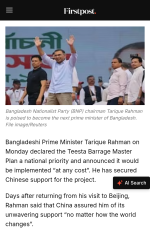
Bangladesh Prime Minister Tarique Rahman on Sunday pledged to materialise the Teesta Barrage Master Plan 'at any cost,' as per Bangladeshi news outlet The Daily Star, and has described the project as a national priority which will ensure water security for the nation and also support its agricultural output, thus helping improve livelihoods in the northern parts of the country.
"I have visited areas where there is water everywhere during the monsoon, yet farmers just a short distance away cannot irrigate their land because of water shortages," the publication quoted Rahman as saying.
The statement also comes in the wake of China showing support to Dhaka on the management of the Teesta. The two sides, during the meeting, reached a consensus on on expanding cooperation in areas such as the Teesta Master Plan, river management, flood-risk mitigation, river dredging, erosion control, irrigation and inland navigation, BSS quoted PMO spokesperson Amin as saying.
In his meeting with the Chinese water resources minister, Rahman highlighted Bangladesh's ongoing river excavation programme aimed at reducing flood risks, protecting the environment, and ensuring the proper management of water resources and sought China's technical assistance, the BSS reported.
On Wednesday, Rahman told an investors meeting at China's Dalian city that Bangladesh has finalised an action plan, which includes excavation of 20,000 km of rivers and canals over the next five years and improving water management in the Padma and Teesta rivers, as per a PTI report.
Last month, the Rahman government formally sought China's involvement and support for the Teesta River restoration project when Foreign Minister Khalilur Rahman visited Beijing.
What is the Teesta Master Plan?
The Teesta river flows from the eastern Himalayas through Sikkim and West Bengal before entering Bangladesh, where it is a key source of irrigation and livelihoods for millions of people.
For a number of years now, China has shown interest in developing the Teesta River Comprehensive Management and Restoration Project, which is located near the sensitive Siliguri Corridor of India which connects the mainland with the northeastern states.
In 2024, India offered Bangladesh technical and conservation assistance for the Teesta basin, reflecting New Delhi's efforts to deepen cooperation with Dhaka on transboundary river management.
Main objectives
The primary objectives of the plan are to improve flood control in the region, reduce riverbank erosion which forces communities to displace from their homes, increase dry-season water availability for Bangladesh, improve irrigation, restore navigability and promote economic development in the northern regions of the country.
Major proposed works
As per a survey report tabled in the Bangladesh parliament, the proposed master plan includes around 110 lm of riverbank protection work, dredging and river training.
It has also proposed flood embankments with 224 km roads along with the rehabilitation as well as construction of groynes and other structures.
Proposal has also been made to construct a new barrage to store water during the dry season.
Bangladesh Prime Minister Tarique Rahman committed to the Teesta Barrage Master Plan, emphasizing its national significance for water security and agriculture. He seeks China's support for this project aimed at enhancing livelihoods in northern Bangladesh and improving river management.
Bangladesh Prime Minister Tarique Rahman on Sunday pledged to materialise the Teesta Barrage Master Plan 'at any cost,' as per Bangladeshi news outlet The Daily Star, and has described the project as a national priority which will ensure water security for the nation and also support its agricultural output, thus helping improve livelihoods in the northern parts of the country.
"I have visited areas where there is water everywhere during the monsoon, yet farmers just a short distance away cannot irrigate their land because of water shortages," the publication quoted Rahman as saying.
The statement also comes in the wake of China showing support to Dhaka on the management of the Teesta. The two sides, during the meeting, reached a consensus on on expanding cooperation in areas such as the Teesta Master Plan, river management, flood-risk mitigation, river dredging, erosion control, irrigation and inland navigation, BSS quoted PMO spokesperson Amin as saying.
In his meeting with the Chinese water resources minister, Rahman highlighted Bangladesh's ongoing river excavation programme aimed at reducing flood risks, protecting the environment, and ensuring the proper management of water resources and sought China's technical assistance, the BSS reported.
On Wednesday, Rahman told an investors meeting at China's Dalian city that Bangladesh has finalised an action plan, which includes excavation of 20,000 km of rivers and canals over the next five years and improving water management in the Padma and Teesta rivers, as per a PTI report.
Last month, the Rahman government formally sought China's involvement and support for the Teesta River restoration project when Foreign Minister Khalilur Rahman visited Beijing.
What is the Teesta Master Plan?
The Teesta river flows from the eastern Himalayas through Sikkim and West Bengal before entering Bangladesh, where it is a key source of irrigation and livelihoods for millions of people.
For a number of years now, China has shown interest in developing the Teesta River Comprehensive Management and Restoration Project, which is located near the sensitive Siliguri Corridor of India which connects the mainland with the northeastern states.
In 2024, India offered Bangladesh technical and conservation assistance for the Teesta basin, reflecting New Delhi's efforts to deepen cooperation with Dhaka on transboundary river management.
Main objectives
The primary objectives of the plan are to improve flood control in the region, reduce riverbank erosion which forces communities to displace from their homes, increase dry-season water availability for Bangladesh, improve irrigation, restore navigability and promote economic development in the northern regions of the country.
Major proposed works
As per a survey report tabled in the Bangladesh parliament, the proposed master plan includes around 110 lm of riverbank protection work, dredging and river training.
It has also proposed flood embankments with 224 km roads along with the rehabilitation as well as construction of groynes and other structures.
Proposal has also been made to construct a new barrage to store water during the dry season.