Boeing Is Hiring 20 Times More Engineers From India As US Aims To Cut Dependence On China: Media

Wouldn't you agree the real delta that is yet to happen is when Pakistan industrialization picks off?

Right now a lot of big tech has offshore companies in India and it has already been saturated and the economical benefits have been realized for decades. I doubt there is any other radical shift anticipated because it's already been done.

Meanwhile Pakistan and Bangladesh is sitting on a lot of potential. If Pakistan can control its internal security that industrial economy is going through the moon.

It was widely discussed in MBA institutions of western countries till 2003, that we would reach a 'saturation' by 2020, the maximum.
And Yes, We don't find anything more than that since 2022, at least.
Further, We are on continuous and definite decline since 2022.....
🇮🇳
 

How Indian-origin engineers took over America’s tech scene, and the colleges that got them there​

Indian-origin engineers have significantly reshaped the US technology sector, transitioning from students to leaders in major companies like Microsoft, Google, and IBM. Their strong educational foundations in India, combined with opportunities in America, have fueled innovation and global impact. These leaders exemplify a successful migration story, blending their roots with American ingenuity to redefine technological possibilities.

Their success is more than personal triumph; it reflects a broader story of how migration, education, and ambition converge to drive the knowledge economy. :)
Engineers leading Microsoft, Google, IBM, and pioneering start-ups did not simply adapt to the competitive American landscape, they redefined it. 👍
Their journeys show how strong foundations in science and mathematics, combined with opportunities in the US, have produced leaders capable of transforming an era of rapid technological change.
🇮🇳

Read more at:
https://economictimes.indiatimes.co...ofinterest&utm_medium=text&utm_campaign=cppst

 
So, what's going on with the Indians taking American jobs? How do Americans view this?
 
So, what's going on with the Indians taking American jobs? How do Americans view this?
There are a couple of other related threads in progress discussing this topic. Based on my own analysis, and, as an engineer (recently retired):
  1. there is indeed a shortage of engineers in general in the US
  2. some of the disciplines have a larger shortage than others
  3. some of the disciplines have a higher demand than others
  4. US schools need to be providing more focus on STEM
  5. in order to remain competitive, the US is left with little choice but to recruit qualified engineers from outside the US to make up the shortfall as well as job growth
Yet, at the same time, there is a shortage of trained tradespeople. An article I posted in one of the other threads; Ford CEO Jim Farley was quoted that he is currently unable to fill as many as 5000 mechanic positions. 5000 mechanics. And this is but one example.
 
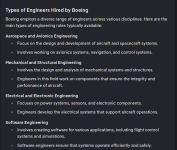
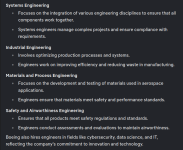
Want to add one more comment to this before hitting the rack for the night (it is 2308 local time where I'm at). Need to dive a little deeper into the disciplines Boeing is hiring. Took the quick way out with an AI search:

1763273375374.png
1763273411906.png

Tomorrow, I will re-post the link with the table for the projected demand by field for the above.
 
@AZ_HighCountry

AZ Saar

Yet, at the same time, there is a shortage of trained tradespeople.

Same problem in India. Too few carpenters, plumbers, electricians. This is also one of the factors that is hugely constraining industrial growth.

Only the Chinese seem to have gotten it right.

Regards
 

Boeing Is Hiring 20 Times More Engineers From India As US Aims To Cut Dependence On China: Media​


In a notable transformation indicative of wider geopolitical trends, Boeing is expanding its engineering recruitment significantly in India rather than in China. This adjustment arises as the United States aims to lessen its dependence on Chinese expertise in light of escalating geopolitical apprehensions.

Boeing is hiring nearly 20 times more engineers in India than in China, according to a report on August 1 by the Hong Kong-based South China Morning Post (SCMP).

As of July 31, the Boeing Careers website showed only five job openings in China, three of which were in engineering. In contrast, India had 83 job openings, with 58 dedicated to engineering positions. This disparity has remained consistent for at least a couple of weeks.

Boeing’s current employment statistics further highlight this trend. The aerospace giant has around 2,200 employees in China, compared to more than 6,000 in India. This is despite the fact that India’s total commercial aviation fleet is only about one-sixth the size of China’s.

The shift is particularly striking given Boeing’s historical connection to Chinese talent. Wong Tsu, Boeing’s first aeronautical engineer, was born in Beijing.

Hired in 1916 after graduating from the Massachusetts Institute of Technology (MIT), Wong played a pivotal role in designing Boeing’s first financially successful aircraft, the Model C naval training seaplane. That achievement set the stage for Boeing to develop its first dedicated passenger planes a decade later.

Tom Crouch, curator emeritus at the Smithsonian’s National Air and Space Museum and author of several aviation history books, noted Wong’s significant impact on Boeing’s early success.

“The Model C was not only Boeing’s first production order, it was the first Boeing aircraft to be produced in large numbers and sold,” Crouch said. “Wong Tsu put the company on the map.”

Despite his key contributions, Wong spent only ten months at Boeing, leaving for China shortly before the Model C’s Navy test flights. In Seattle, Wong’s contributions are commemorated at the Museum of Flight, where a permanent exhibit honors his work.


In China, he founded the country’s first airplane factory in Fuzhou in 1917 and later headed the Aviation Research Academy in 1945, earning recognition as one of the founding fathers of Chinese aviation.

Boeing Shifts Focus From China To India

Boeing’s relationship with the Chinese aviation market began in the early 1970s, sparked by a historic visit from then-US President Richard Nixon. This engagement led to the establishment of multiple joint ventures in China, including engineering, maintenance, and research centers, as well as a 737 completion and delivery center.

Over the years, parts and assemblies for over 10,000 Boeing planes worldwide have been produced in China, with notable collaborations such as the 737 Completion and Delivery Centre in Zhoushan, Zhejiang province.


However, the landscape has dramatically shifted for Boeing following two catastrophic crashes involving its 737 Max aircraft—one in Indonesia in 2018 and another in Ethiopia in 2019.

These incidents, which resulted in the grounding of the 737 Max fleet and severely damaged Boeing’s reputation, have been compounded by further safety concerns, including instances of wheels falling off planes and a mid-air panel blowout on a 737 Max aircraft.

Despite Boeing recently resuming deliveries of the 737 Max to China after addressing safety issues, the company’s relationship with China remains fraught.

777x-hero_1280x720.jpg


File Image


This resumption comes after intermittent deliveries since 2019, during which time US-China tensions have escalated over various issues, including technology and national security.

Compounding Boeing’s challenges, China has developed its passenger jet, the C919, through the Commercial Aircraft Corporation of China (Comac), aiming to capture market share from both Boeing and Airbus.

China is poised to become the world’s largest aviation market over the next two decades, with an estimated requirement of 8,830 aircraft deliveries by 2043, as per Boeing’s 2024.

Adding to Boeing’s woes, China has increasingly favored Airbus over Boeing for its new fleet acquisitions, pushing Boeing to seek growth opportunities elsewhere.


This shift has driven Boeing to strategically pivot towards India, a country with a burgeoning pool of engineering talent and a rapidly growing aviation market.

India, now the world’s third-largest domestic airline market, trailing only the US and China, is set to require 2,835 aircraft deliveries by 2043.

Boeing’s increased focus on India is part of a broader strategy to reduce dependence on China while tapping into India’s engineering capabilities. This aligns with India’s ambitions to position itself as an alternative to China for technology and manufacturing.

In January, Boeing inaugurated its largest facility outside the US in Bengaluru, investing approximately $200 million in the Boeing India Engineering and Technology Centre (BIETC).

Following this, in February, Boeing announced plans to establish a new logistics center in India to better serve its regional customers. Boeing’s forecasts suggest that Indian airlines will need over 2,200 new aircraft in the coming two decades, bolstered by India’s swift recovery from the pandemic.

India’s domestic air traffic is projected to have the highest growth rate globally for the next two decades. From 2019 to 2042, the average annual revenue passenger kilometers for India’s domestic routes is expected to increase by 7.4%.

This growth rate exceeds the 6% forecasted for emerging Asian economies and the 5.3% predicted for China’s domestic routes.

Air India, Boeing’s oldest customer in the region, is expected to order hundreds of new narrow body and widebody jets as it expands its operations. This growing partnership with Indian aviation firms is a testament to Boeing’s strategic shift towards India
can't wait for the f-47 or NGAD to crash because of software issues
 
we were discussing, Indians are Creamy Layer of US-west. the industries of US-west are highly dependent on Skilled Indian work force. .....

American common citizens paying less than 1/3 a third Tax than Indians is also state 'grading', between the people, as compared to locals of US :coffee:

US-west can't run their industries without Indian immigrants, its a information....


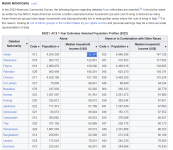
1763298910534.png


.
=> as in above Table, we find the population of Indians more than Chinese also, at 4.5million+ and 4.2million respectively 👍
🇮🇳
 
36% of scientists at NASA are Indians: Govt survey

11 Mar 2008 — As many as 12% scientists and 38% doctors in the US are Indians, and in NASA, 36% or almost 4 out of 10 scientists are Indians.
🇮🇳

 
@Corax

Because your thieving country stole USD45 trillion of our money in 1757-1947. Return that to us and we will see. Bihar will look like Britain and Britain will look like Bihar.

Regards
 
@Corax

Because your thieving country stole USD45 trillion of our money in 1757-1947. Return that to us and we will see. Bihar will look like Britain and Britain will look like Bihar.

Regards

Indian Americans: The New Model Minority​

Indian Americans are in fact a new "model minority." This term dates back to the 1960s, when East Asians--Americans of Chinese, Japanese and Korean descent--were noted for their advanced educations and high earnings. :coffee:

When statistical adjustments are used to convert the backward digit span results to full-scale IQ scores, Indian Americans place at about 112 on a bell-shaped IQ distribution, with white Americans at 100. 112 is the 79th percentile of the white distribution. For more context, consider that Ashkenazi Jews are a famously intelligent ethnic group, and their mean IQ is somewhere around 110. 👍
🇮🇳


@Corax

Because your thieving country stole USD45 trillion of our money in 1757-1947. Return that to us and we will see. Bihar will look like Britain and Britain will look like Bihar.

Regards
Why do you need it back? I thought you were a 'superpower' with trillions worth of GDP and so many amazing engineers, doctors and scientists?
 
36% of scientists at NASA are Indians: Govt survey

11 Mar 2008 — As many as 12% scientists and 38% doctors in the US are Indians, and in NASA, 36% or almost 4 out of 10 scientists are Indians.
🇮🇳

A simple check online.

AI Overview

The claim that 36% of scientists at NASA are Indian nationals is false and widely considered a persistent internet hoax
.
 

Users who are viewing this thread

Pakistan Defence Latest

Country Watch Latest

Latest Posts

Back
Top