(CDF / COAS)'s Desk

You are just a keyboard warrior "Malcolm". Just like your fake jeet scammer name, you only bark behind a keyboard. When push comes to shove, you hide like a coward like your Indian air force grounded their planes during war.

Banned, so maybe we should call him Malcolm.....X.....

:)
 
To view this content we will need your consent to set third party cookies.
For more detailed information, see our cookies page.


The US, being currently the only real super power, has many alliances, with NATO, with Israel, with India, Australia, UK, etc.

However, FM Munir was seated in the first row. With these few top most relationships. They say a picture is worth a thousand words. That's the case here. The first two rows are always designed for VIP's or the most strategic relations you want to honor and show respect for.

Many here have given me grief lately, every time I wrote about the US-Pakistan relationship that's strategic in nature and will grow our economy to new heights. This picture serves my posts.
 
Be interesting to know where Kurilla goes next, maybe Army Chief of Staff?

Actually seems like he has retired
 
Now more honest and sane version of Munir's second us visit, FT is behind paywall so posting in full

Please use the sharing tools found via the share button at the top or side of articles. Copying articles to share with others is a breach ofFT.com T&Cs and Copyright Policy. Email [email protected] to buy additional rights. Subscribers may share up to 10 or 20 articles per month using the gift article service. More information can be found here.
https://www.ft.com/content/990b41df-a22a-4075-826b-f5601be85d8a

How Pakistan wooed Trump — and rattled India


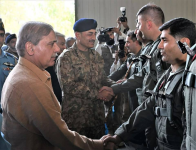
Crypto, minerals and flattery paved Islamabad’s improbable rise in White House favour© FT montage/Getty Images/Pakistan ArmyHow Pakistan wooed Trump — and rattled India on x (opens in a new window)How Pakistan wooed Trump — and rattled India on facebook (opens in a new window)How Pakistan wooed Trump — and rattled India on linkedin (opens in a new window)ShareSavecurrent progress 0%Humza Jilani in Islamabad, John Reed in New Delhi and James Politi in WashingtonPublished9 HOURS AGO117Print this pagePakistan’s chief of army staff Asim Munir smiled for the camera this weekend, arm in arm with a top American general — his second warm welcome this summer into the heart of the US establishment.Munir travelled to Florida for the retirement of General Michael Kurilla, the commander of US military forces in the Mideast, who has previously praised the Pakistan strongman for a “phenomenal partnership” in the fight against terrorism. To General Dan Caine, America’s top military officer, Munir passed a plaque and an invitation to visit Pakistan.Even more remarkably, in June Munir had a two-hour private lunch in Washington with Donald Trump, just a month after Pakistan and arch-rival India fought their bloodiest military confrontation for decades.It was an astonishing reception for a man who, despite wielding the country’s most powerful office, is not a head of government — and even more so for an official representing Pakistan. Relations with Washington were assumed to be heading for the rocks after the re-election of Trump, who once accused the nuclear-armed country of 240mn people of offering the US “nothing but lies and deceit”.Instead, the Trump administration’s ties with Islamabad appear to be blossoming, while India — which was left seething by Munir’s White House welcome — has faced scorn despite Narendra Modi’s previous friendly bond with Trump.“What’s happening in US-Pakistan relations is a surprise. I would describe the relationship now as one that’s enjoying an unexpected resurgence, even a renaissance,” says Michael Kugelman, a non-resident senior fellow at the Asia Pacific Foundation. “Pakistan has very successfully understood how to engage with such an unconventional president.”PLAY | 00:22Show video descriptionDonald Trump claimed credit for brokering a ceasefire between Pakistan and India in May © ReutersIndia and Pakistan’s contrasting diplomatic fortunes have the potential to upend geopolitics in volatile south Asia and are already feeding into trade, where the US gave Islamabad a relatively light 19 per cent tariff while hitting New Delhi with a punitive 50 per cent.Trump also promised a deal to develop what he called Pakistan’s “massive Oil Reserves”, while Pakistan is offering other investment opportunities to the US, hoping to revive its bailout-dependent economy.The newfound US admiration for Pakistan is partly the fruit of a charm offensive concocted by Pakistan’s senior generals, leveraging counterterrorism co-operation, outreach to business people close to Trump and deals covering energy, critical minerals and cryptocurrencies — all accompanied by a cascade of flattery for the White House.Leaders in Islamabad believed they needed to urgently get into the good graces of the erratic president and some of his allies who had been deeply critical of Pakistan over its alleged support for the Taliban during Nato’s war in Afghanistan.Project 2025, a pre-election blueprint that has inspired many early Trump administration moves, lambasted Pakistan’s military-dominated regime as an “intensely anti-American and corrupt” client of China. Members of Trump’s inner circle also targeted increasingly autocratic Pakistan’s treatment of jailed former prime minister Imran Khan. A bipartisan group in congress began to draft legislation to impose sanctions on Munir over Khan’s imprisonment.“We had no idea what to expect with him, but the general consensus was that it was likely going to be rough,” said one senior Pakistani diplomat.Pakistan’s turnaround was helped early on by what the US saw as an important arrest. In March Asim Malik, the head of Pakistan’s Inter-Services Intelligence spy agency, delivered a high-value Isis-K operative who the US said was behind a 2021 bombing in Kabul that killed more than 180 people, including 13 US soldiers. His capture earned Pakistan Trump’s praise in his March State of the Union address, when the US president also lambasted India over high tariffs.Crucially, too, Pakistan deployed a form of crypto diplomacy to make its way into Trump’s inner circle.Project 2025, a pre-election blueprint that has inspired many early Trump administration moves, lambasted Pakistan’s military-dominated regime as an ‘intensely anti-American and corrupt’ client of China © Aamir Qureshi/AFP/ Getty ImagesWorld Liberty Financial, a Trump-backed cryptocurrency venture, signed a letter of intent with Pakistan’s crypto council in April, when its co-founders visited Pakistan. Zach Witkoff, the son of US special envoy Steve Witkoff, said during the trip that Pakistan had “trillions of dollars” of mineral wealth ripe for tokenisation.Since then, Bilal bin Saqib, Pakistan’s minister for crypto and blockchain, has emerged as a shadow diplomat, taking part in trade talks with Washington and pitching Pakistan’s crypto potential to figures close to Trump’s family and advisers.Pakistani officials also point to their conduct during the May conflict with India as having bolstered their credibility with Trump. In their telling, Pakistan displayed a combination of strength and restraint, shooting down a handful of Indian jets but refraining from massive escalation, while the US and Gulf states worked the phones to secure a ceasefire.Islamabad also gave credit to Trump for brokering the truce with New Delhi — to the point of nominating the US president for the Nobel Peace Prize. Trading his khakis for a suit and tie this weekend, Munir again heaped praise on the US president when speaking to a group of Pakistani-Americans in Tampa.Munir said Trump’s “strategic leadership” had prevented “many wars in the world”, according to a Pakistani official.“Trump needs success stories to proclaim and Pakistan is happy to give them to him,” says Husain Haqqani, a former Pakistan ambassador to the US now at the Hudson Institute, a think-tank in Washington.India Business BriefingThe Indian professional’s must-read on business and policy in the world’s fastest-growing big economy. Sign up for the newsletter hereBy contrast, Modi has taken a more flinty approach. The day before the lunch with Munir in June, the Indian leader had a testy phone call with the US president about his role in the truce. Modi then publicly contradicted Trump by saying the agreement with Pakistan did not come about because of American intervention, but was at Pakistan’s initiative and took place through existing channels of communication between the two countries’ armed forces.“Prime Minister Modi firmly stated that India does not and will never accept mediation,” India said in a summary of the call.Munir’s visit to see the president, which came as the US prepared military strikes on Iran, also helped Pakistan’s military chief tout another facet of their relationship: military and intelligence co-operation.Munir essentially offered Pakistan as a trusted back channel between the US and its adversaries Iran and China, a strategy that harks back to the Pakistan of the 1970s that facilitated Richard Nixon’s opening of US relations with Communist China.While Pakistan rebuked Washington for the strikes against Iran, the country continued to try to cast itself as a mediator between the US and its foes. In late July, Munir flew to Beijing, where he toured the headquarters of the People’s Liberation Army and promised Chinese foreign minister Wang Yi that he would protect Chinese workers in Pakistan from insurgent attacks.And in between warm encounters with US Centcom commander Kurilla, who received military honours from Pakistan’s government in late July, Munir has also welcomed Iranian President Masoud Pezeshkian to Islamabad.Pakistan’s army chief Field Marshal Syed Asim Munir, right, meets outgoing US commander General Michael Kurilla during a ceremony in Tampa, on Sunday © Pakistan Army“Pakistan is a rare country that is friends with China, Iran, the Gulf states, to a lesser extent Russia, and now, again, the US,” said Marvin Weinbaum, a senior fellow at the Middle East Institute in Washington. “The US sees Munir as someone who can play a useful strategic role, and the Pakistanis keep their lines open to everyone but know to pull back when one relationship is clashing with another.”For India, the burgeoning relationship between Trump and its arch-rival has caused deep irritation, aggravated by its own failure to fend steep tariffs on its far bigger economy. Trump first levied a 25 per cent tariff on India, then doubled it to 50 per cent because of Russian oil purchases. “It will take some time to get over the lack of trust here,” said one person briefed on the events.Indian officials are also irked at seeing military-ruled Pakistan rewarded after luring Washington with business deals. “It’s very easy to deal with dysfunctional systems,” the person said — a reference to the ease with which Pakistan turned what looked like a weak position at the start of Trump’s term into a win.Current and former Pakistani officials and analysts warn that Trump could still turn on Islamabad if it fails to deliver. Most of Pakistan’s natural resource riches are either unproven or lie in volatile provinces beset by insurgencies that led to 2,000 deaths last year. Pakistan’s economy relies on a $7bn IMF bailout and debt rollovers from China and Gulf allies.RecommendedPakistan's politicsPakistan pitches Nobel, crypto and rare earths to woo Donald TrumpIf Trump decides to patch things up with India again, he may lash out against Pakistan to please Modi, they say. Two diplomats said Trump is hopeful, for instance, that Islamabad will recognise Israel — a tall order for Islamabad given the strength of public opposition to such a move.“Trump is playing the Pakistan card to try and gain more advantage with India, annoy the Indians, and see if this will make them talk to him and accept his term,” says Haqqani. “It’s a transactional improvement”.“Unelected leaders and military officials are willing to overpromise to appeal to what they think is Trump’s narcissism,” adds Hussain Nadim, a former policy adviser in Pakistan who is now a Washington-based critic of Munir’s rule. “Trump and his advisers may eventually run out of patience when they see that Pakistan is not delivering.”Shahid Khaqan Abbasi, a former prime minister for the ruling Pakistan Muslim League-Nawaz party from 2017 to 2018 who left to start his own party, agrees that Pakistan should “be wary of the volatility of the Trump administration”.“Modi was once the good guy, now he’s being beaten up. Zelenskyy got a public berating,” he said. “Pakistan needs to protect both its interests and its dignity.”

 
To view this content we will need your consent to set third party cookies.
For more detailed information, see our cookies page.
 

ThePrint Exclusive: Asim Munir’s India nuke threat from US ballroom—‘will take half the world down’​


Speaking at black-tie dinner in Tampa, Pakistan army chief Asim Munir, ThePrint has learnt, also said, ‘we will wait for India to build a dam, and when it does so, we will destroy it with ten missiles’.​

Praveen Swami
10 August, 2025 02:37 pm IST


Copy of the invite to the black-tie dinner hosted for Pakistan army chief, Field Marshal Asim Munir, in Florida | By special arrangement


'Indus river is not the Indians’ family property,' Munir told attendees.Munir was in Florida to attend retirement function for Gen Kurilla, outgoing CENTCOM commander.Pakistan army chief also took the opportunity to make the case for military involvement in Pakistani politics.

Tampa: Field Marshal Asim Munir, Pakistan’s military chief, threatened to plunge the region into nuclear war should his country face an existential threat in a future war with India, saying “we are a nuclear nation, if we think we are going down, we’ll take half the world down with us.” The extraordinary remarks—the first nuclear threats known to have ever been delivered from the soil of the United States against a third country—were made at a black-tie dinner hosted for Munir by businessman Adnan Asad, who serves as honorary consul for his homeland in Tampa.

The Field Marshal followed up his nuclear threat, sources present at the dinner told ThePrint, with comments on the Indus Waters Treaty, saying India’s decision to place it in abeyance could put 250 million at risk of starvation. “We will wait for India to build a dam, and when it does so, phir 10 missile sey faarigh kar dengey [we will destroy it with 10 missiles].”
https://vdo.ai/contact?utm_medium=video&utm_term=theprint.in&utm_source=vdoai_logo
“The Indus river is not the Indians’ family property. Humein missilon ki kami nahin hai, al-Hamdulillah [we have no shortage of missiles, Praise be to God],” Munir concluded.
Guests invited to the function were not allowed to carry cellphones or other digital device, and no text of the speech was circulated. ThePrint reconstructed the contents of the speech from the memory of several participants who were present.

Field Marshal Munir was in Florida to attend a retirement function for General Michael Kurilla, the outgoing commander of the United States Central Command (CENTCOM). A representative of the defence forces of Israel—a country with which Pakistan does not have diplomatic relations—was also present at the function.

Earlier, Munir had controversially been invited to meet with US President Donald Trump. This interaction caused disquiet among pro-democracy forces in Pakistan since no invitation has yet been extended to its Prime Minister or President.


Salad, soup and bombs

An estimated 120 Florida-based members of the Pakistani diaspora were served a western-style dinner at the Grand Hyatt Hotel in Florida’s Tampa, beginning with Caesar salad, and followed by tomato bisque, a choice of chicken and salmon braised with herbs—all clearly marked to indicate the food was Halal.

The function began with a recitation of As-Saf verse 4 from the Quran, which asserts that “Allah loves those who fight in his cause in a row as though they are a [single] structure joined firmly.” Pakistan named its operations during the Four-Day war of May Bunyaanum Marsoos, after the verse. Following the Quranic recitation, Pakistan’s national anthem was played, the sources said.

Field Marshal Munir mocked India’s refusal to provide specific details of its losses during the Four-Day war. “The Indians should accept their losses,” Munir said, adding, “Sportsman spirit is a virtue.” He also said that he had offered for an inventory of Pakistan’s losses to be made public, as long as India also conducted a similar exercise.

The Pakistan army chief devoted a substantial part of his prepared speech, read from notes, to the war and its fallout.“Ek tweet karwaya tha with Surah Fil and a picture of [the industrialist] Mukesh Ambani to show them what we will do the next time,” he said. The verse Surah Fil describes how Allah dispatched birds to drop stones on an enemy’s battle elephants, reducing them “to chewed-up straw”.

“We’ll start from India’s East, where they have located their most valuable resources, and then move westwards,” Field Marshal Munir said.

Field Marshal Munir, a religious conservative who is the first chief of the Pakistan army to have a seminary education, has frequently used theological points to support his arguments. However, he also resorted to simpler metaphors for the benefit of his diaspora audience.

“I am going to use a crude analogy to explain the situation,” Field Marshal Munir went on. “India is shining Mercedes coming on a highway like Ferrari [sic], but we are a dump truck full of gravel. If the truck hits the car, who is going to be the loser?”

Field Marshal Munir took the opportunity to make the case for military involvement in Pakistani politics and strategic decision-making, directing many of his comments personally to former Ports and Shipping Minister Babar Khan Ghauri, who served under Prime Minister Yusuf Raza Geelani. “They say war is too serious to be left to the Generals, but politics is also too serious to be left to the politicians.”

The Field Marshal urged the diaspora to do more to support Pakistan. “Kisi ki maa kaali ho sakti hai, aur kisi ki dharti-maa kaali ho sakti hai, par maa maa hoti hai [someone’s mother might be dark-skinned, and the earth of someone’s motherland might be dark, but a mother is a mother],” he said, in a passage inflected with Hindi-film tropes.


Allah, he went on, would bless Pakistan with his bounty, because it is one of only two states founded on the basis of the Kalimah, the Islamic profession of faith. The first, Munir argued, was the city-state of Medina founded by the Prophet Muhammad. He—incorrectly—asserted that Medina was renamed Tayyiba, or blessed.

The second such state, the Field Marshal said, was Pakistan, and God would reward it with energy and natural resources, just as the earth under Medina had been. He described finds of rare earth metals, minerals and hydrocarbons that are purported to have recently been made in Pakistan.

Field Marshal Munir noted India’s recent diplomatic tensions with the United States and joked that Pakistan should begin offering masterclasses on balancing rival powers. “The real reason for our success is that we are not misers,” he said. “If someone does good work, we praise and appreciate them. That is why we nominated President Donald Trump for the Nobel Prize.”

(Edited by Amrtansh Arora)

user-matching
Why you Indians are so cowardly making hue and cry about what the Pak army chief said. As Hindutva terrorist Modi claimed (that not even a single drop of water would be allowed to go to Pakistan) just go ahead build a dam on any of Pakistani rivers and then see if Pakistanis come true to their promise or not.
 
Indians:
“We will destroy you”
“We will murder your children”
“Qatal ki raat”
“Brahmos is ready”

Pakistan
“We will burn you from east to west”

Indians “Oh my god - who says such horrible things! Teacher do you see what they said?!l” “oh the humanity!”


On a serious note this quid pro quo hypocrisy with India can never be matched by Pakistan
 
Dumb thing to say that Pakistan will strike when dam/s are already build. What's the plan, flood your own downstream country? You strike as soon as the first project team arrive on site.
 
Dumb thing to say that Pakistan will strike when dam/s are already build. What's the plan, flood your own downstream country? You strike as soon as the first project team arrive on site.
Figure of speech but the situation is already beyond project team on site. However, destroying the dam doesn’t necessarily mean you have flooding in pk. Plenty of other ways to stop project work without needing it fully built.
 
.
Not really!

The USA is unlikely to abandon Pakistan, as we all know. From the perspectives of Iran and Afghanistan, Pakistan holds significant value. The USA tends to leverage its relationship with Pakistan when it suits its interests.

Currently, the situation seems to reflect a short-term conflict reminiscent of a cold war between Trump and the Indian government. Trump appears to be retaliating against India for not aligning with his expectations and positions, which is creating challenges in their relationship.

At this moment, India is not in a position to influence the situation significantly. A brief rekindling of ties between Pakistan and the USA is always a possibility.

As we know USA, they will find oil or gas in Pakistan or not, but definitely Pakistan will ending by buying oil from USA with happily.
1754949462979.png
 

Users who are viewing this thread

Pakistan Defence Latest

Country Watch Latest

Back
Top