China Auto Thread


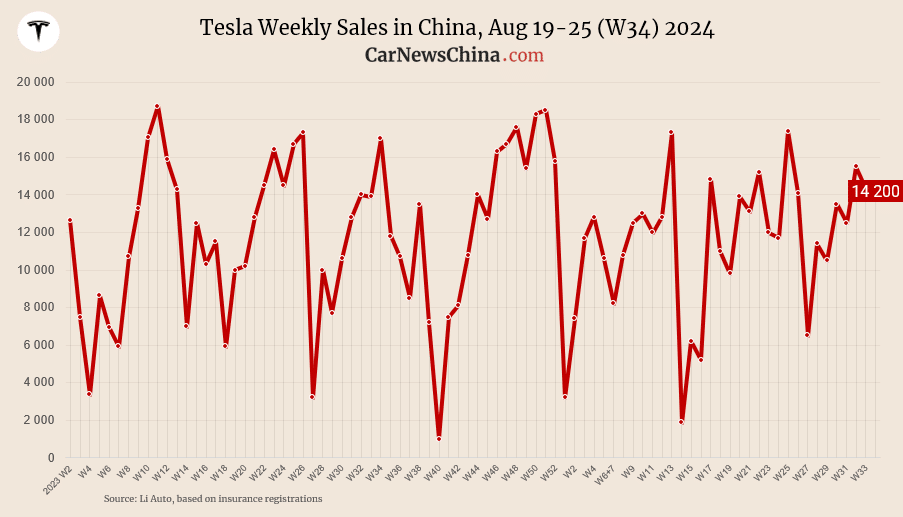
China EV registrations in W34: Xiaomi 2,100, Nio 4,600, Tesla 14,200, BYD 87,800​


Reading Time: 5 minutes

Jiri Opletal

August 27, 2024


0


News like this to your inbox or phone?​


Weekly summary to your inbox
I want this

Never miss and important news
Get Instant notification once the news is published.
Follow Us

In the third week of August, week 34 of the year, the market was firmly up, with Zeekr and Xiaomi being the exceptions. Nio’s insurance registrations were up 40%, and BYD was up 10% compared with the week before. Tesla was mainly flat, and Xioami was 20% down.


Week 34 of 2024 (W34) 2024 is between August 19 – 25. The week W34 2023, used for year-on-year comparison, was between August 21 – 27.

The weekly sales are published by Li Auto, and despite Li’s not explicitly saying it, they are based on insurance registration data. The numbers are rounded and present new energy vehicles (NEV) sales, the Chinese term for BEVs, PHEVs, and EREVs (range extenders). To be completely precise, it also includes hydrogen vehicles (FCEVs), but their sales are almost non-existent in China.


NEV penetration exceeds 50% again​

The EV market in China continues to grow in W34, with the weekly penetration rate exceeding 51% once again. In W34, total vehicle sales reached 467,000 units, representing a slight year-over-year decrease of 0.43% but a significant week-over-week increase of 13.08%. ICE vehicle sales totaled 226,000 units, a year-over-year decline of 24.41%, though a 14.72% increase was noted from the previous week. Meanwhile, NEV sales surged to 241,000 units, marking a 45.18% increase from the same period last year and an 11.57% rise from the previous week. The NEV penetration rate for the week stood at 51.61%, a significant jump of 16.21%compared to last year.

Year-to-date, the Chinese automotive market has seen total sales of 13.053 million units, reflecting a year-over-year growth of 3.22%. ICE vehicle sales, however, have declined to 7.343 million units, down 14.02% from last year. On the other hand, NEV sales have continued to climb, reaching 5.71 million units, a notable 39.09% year-over-year increase. The year-to-date NEV penetration rate has risen to 43.74%, up by 11.28 percentage points compared to the same period in 2023.

Brand registrations​

BYD secured the top position, registering 87,800 vehicles, its weekly ATH record. It is up 11.85% from 78,500 the week before and up 69.83% from 51,700 units in the same week last year.


So far, between August 5 and 25, BYD has sold 242,100 vehicles in China.


GM’s Chinese joint venture SGMW sold 15,000 EVs under the Wuling brand, up 18.11% from 12,700 units the week before and 92.31% from 7,800 units the week before.

Tesla secured the third position, registering 14,200 vehicles, down 0,7% from 14,100 units the week before but down 16.47% from 17,000 units last year. In the first three weeks of August, between August 5 – 25, Tesla sold 44,000 vehicles in China.

Li Auto saw a steady increase, delivering 11,600 vehicles, an 8.41% rise from 10,700 units the week before. Compared to the same period last year, when 7,700 vehicles were delivered, sales grew by 50.65%.

In the first three weeks of the month, between August 5 – 25, Li Auto’s sales stand at 33,400 units.


Aito experienced a sharp rise, registering 9,000 vehicles sold, a 60.71% increase from the previous week’s 5,600 units. Year-over-year, sales skyrocketed by an impressive 1025%, compared to just 800 units in the same period last year.

In the first three weeks of the month, between August 5 – 25, Aito has sold 18,500 vehicles.

GAC Aion recorded sales of 7,900 vehicles, reflecting a 14.49% increase from 6,900 units the week prior. However, on a yearly basis, sales declined by 36.29%, down from 12,400 units.

In the first three weeks of the month, between August 5 – 25, GAC Aion has delivered 14,800 vehicles so far this month.

Leapmotor achieved sales of 6,200 vehicles, a 16.98% growth from the 5,300 units sold the previous week. Year-over-year, this represents a 100% increase from 3,100 units last year.

In the first three weeks of the month, between August 5 – 25, Leapmotor reached 16,900 units.

Changan managed to sell 5,500 vehicles, slightly up by 5.77% compared to 5,200 units in the previous week. In the first three weeks of the month, between August 5 – 25, Changan has delivered 14,800 vehicles.

Nio saw a notable jump, with 4,600 vehicles sold, representing a 39.39% increase from the 3,300 units sold the previous week. However, compared to last year’s 5,000 units, sales are down by 8%. In the first three weeks of the month, between August 5 – 25, Nio sold 11,200 units in China


Volkswagen recorded sales of 4,600 vehicles, a 21.05% increase from the 3,800 units sold the week prior. Compared to last year’s 4,900 units, this marks a slight decline of 6.12%.

Deepal reported 3,800 vehicles sold, reflecting a 22.58% growth from the 3,100 units sold the previous week. On a yearly basis, sales grew by 31.03%, up from 2,900 units last year.

In the first three weeks of the month, between August 5 – 25, Deepal has reached 9,600 units.

Zeekr delivered 3,000 vehicles, down 14.29% from the 3,500 units sold the previous week and a slight 3.23% decrease from 3,100 units last year.

In the first three weeks of the month, between August 5 – 25, Zeekr has sold 9,900 vehicles.

Xpeng saw an increase, registering 2,800 vehicles, up 21.74% from the 2,300 units sold last week. However, compared to the previous year’s 3,300 units, this represents a 15.15% decline.

Xiaomi experienced a drop in sales, delivering 2,100 vehicles, down 19.23% from the 2,600 units sold the previous week. In the first three weeks of the month, between August 5 – 25, Xiaomi registered 8,200 units in China.


Denza reported sales of 1,800 vehicles, a 5.88% increase from the 1,700 units sold last week. However, this represents a decline of 21.74% compared to 2,300 units last year. In the first three weeks of the month, between August 5 – 25, Denza has sold 5,300 vehicles.
 

BYD MPV to launch at Chengdu Auto Show – more likely to be called Zhou than Tang Max​


Reading Time: 3 minutes

Mark Andrews

August 26, 2024


0


News like this to your inbox or phone?​


Weekly summary to your inbox
I want this

Never miss and important news
Get Instant notification once the news is published.
Follow Us

The new BYD MPV will be officially released on August 30 at the Chengdu Auto Show. This car has previously been spotted in various spy shots, and there has been considerable speculation as to whether it will be called the Tang Max or Zhou. The mystery will be solved at 2:30 in Hall 9.


The unveiling announcement came from Lu Tian, GM of BYD’s Dynasty sales division, in a tweet on Weibo. As part of the message, it makes a statement saying something along the lines of “the curtain of the new dynasty will be opened.” This suggests that the new car has a new dynasty name. Tang has already been applied to a range of BYD SUVs, so the name Tang Max now seems highly unlikely. Unless BYD has chosen another dynasty name to give the new MPV, then Zhou seems almost certain.

As part of the tweet, Lu also included some spy shots of the new car. These, however, are still quite heavily camouflaged, which is obviously designed to keep us guessing right up until the event. We can at least though make out the silhouette, and we know that the car will be more than 5 meters, and it’s likely that the wheelbase alone will be three meters. From the shots we can see that the new car will have an imposing grill, this is somewhat of a trademark feature for the Dynasty series.


An interior spy shot from a different source shows the three rows of seats from the rear. The new BYD has a seven-seat layout arranged as 2 + 2 + 3. Up front, the car has three screens with a digital LCD instrument panel, a center infotainment screen, along with a dedicated passenger’s entertainment screen. In the second row, the two seats have independent armrests and seem to be electrically adjustable. Passengers sitting here also benefit from airplane-style tray tables, which come from the backs of the front seats. It looks as if there may be some controls on the back of the center console and possibly even a compartment for use by rear passengers. Between the two second-row seats is a small passage for entry to the third row. Each passenger in the third row appears to have an adjustable headrest.

The new MPV is expected to use BYD’s DM 5.0 technology. This has debuted with only two engines a 1.5 naturally aspirated engine and a 1.5 turbo. Most likely, the 1.5T engine will find its way into the new MPV as this engine has been the heart of the PHEV system in larger vehicles such as the forthcoming Han DM-i. The BYD472ZQB engine has a maximum power of 115 kW and, in the case of the Han, is matched with a 200 kW peak power TZ210XYD electric motor. Earlier reports suggested the Zhou would have an all-electric range of 200 km which is far greater than any other cars fitted with the DM 5.0 technology.

Prices are expected to be in the 250,000 – 350,000 yuan (34,450 – 48,200 USD) range. More information should become clear at the Chengdu Auto Show, although it is unclear whether that event will be just an unveiling or a full launch.


Source: Fast Technology
 

Jetour Shanhai L6 plug-in hybrid SUV entered market at 17,400 USD​


Reading Time: 4 minutes

Dong Yi Chen

August 26, 2024


0


News like this to your inbox or phone?​


Weekly summary to your inbox
I want this

Never miss and important news
Get Instant notification once the news is published.
Follow Us

On August 25, Jetour officially launched its Shanhai L6 plug-in hybrid SUV, offering a total of three trims for consumers to choose from, with a price range of 123,900 – 144,900 yuan (17,400 – 20,300 USD). The three trims are Pro, Max, and Ultra. Shanhai is a new energy vehicle series under Jetour.


The Jetour Shanhai L6 is positioned as a compact SUV, measuring 4630/1910/1684 (1690) mm, with a 2720 mm wheelbase. Six exterior paints are available, including Moonlight White, Interstellar Black, Phantom Gray, Vanilla Blue, Star Mist Silver, and an optional Bibo Green.

Power comes from Chery’s Kunpeng super hybrid C-DM system, which consists of Chery’s fifth-generation ACTECO 1.5TGDI hybrid engine and an electric motor, mated to a 1DHT. The engine outputs a maximum power of 115 kW (154 hp) and a peak torque of 220 Nm while the electric motor outputs 150 kW (201 hp) and 310 Nm. The 19.43 kWh ternary lithium battery pack offers a CLTC pure electric cruising range of 125 km (or 91 km WLTC). The official comprehensive range is 1,400 km and the comprehensive fuel consumption per 100 km is 1.25 L.


In the front, the Jetour Shanhai L6 adopts a closed grille with numerous lines to emphasize layered and angled design, as well as a trapezoidal grille at the bottom. Other design elements include traditional door handles, hidden exhaust outlets, and through-type taillights.

The interior is available in two colors: Dynamic Gray and Racing Blue. As the entry-level version, the Pro trim comes standard with an on-board storage unit on the center console that supports both heating and cooling, electric adjustment/heating of external side mirrors, a 9.2-inch instrument panel, a 12.8-inch central control screen, leather seats, manual 6-way adjustment of the driver seat, manual 4-way adjustment of the co-pilot seat, remote control, voice recognition, a 6-speaker audio system, and the Huawei HiCar system, to name a few.

On top of the Pro configurations, the Max is equipped with a panoramic sunroof, electric folding capability for the external side mirrors, rain-sensing windshield wipers, an electric tailgate, electric 6-way adjustment of the driver seat, a 9.2-inch TFT LCD instrument panel, a 15.6-inch central control screen, 50 W mobile phone wireless charging, an 8-speaker audio system, mono-color ambient lights, and advanced driving assistance functionalities including adaptive cruise control, traffic jam assist, forward collision warning, and traffic sign recognition.


Additionally, the Ultra trim has added AI-powered intelligent interactive taillights, roof luggage racks, a heated steering wheel, electric lumbar support/heating/ventilation for the driver seat, electric 4-way adjustment of the co-pilot seat, rear center armrest with cup holder, a 9-speaker Sony audio system, 64-color ambient lights, face recognition, driver fatigue monitoring, blind spot monitoring, door opening warning, lane change assist, a driving recorder, and a front parking radar, to also name a few.

Furthermore, there are 32 storage areas throughout the vehicle.

In July, Jetour sold 41,106 vehicles, a year-on-year increase of 91.1%; bringing its cumulative sales from January to July to 264,661 vehicles, a year-on-year increase of 97.7%.

Source: Jetour, AutoHome
 

Incredible New BYDs! (Seal 06 GT, Xia MPV, And More!)​


To view this content we will need your consent to set third party cookies.
For more detailed information, see our cookies page.
 

Chery Fulwin E05 is a new electric sedan for China​


Reading Time: 3 minutes

Dong Yi Chen

August 31, 2024


1


News like this to your inbox or phone?​


Weekly summary to your inbox
I want this

Never miss and important news
Get Instant notification once the news is published.
Follow Us
At the 2024 Chengdu Auto Show, Chery unveiled its Fulwin E05 under the Fulwin (or Fengyun in Chinese) series. The new car is expected to be priced at around 150,000 yuan (21,100 USD) and will be offered in both EV and EVER variants.


In the front, the closed grille paired with the slender sharp headlights on both sides and raised ribs on the hood are highly recognizable. A roof-mounted lidar is also present. The Chery Fulwin E05 will come standard with advanced driving assistance capabilities such as memory parking and high-speed navigation.

From the side, the car body adopts a fastback shape. Other notable design elements include frameless doors, hidden door handles, and interesting rim shapes.


The vehicle that appeared at the Chengdu Auto Show was equipped with 245/45 R20 Pirelli tires. Additionally, it is reported that the wheelbase of the Chery Fulwin E05 will reach 2900 mm and the length will reach 4800 mm.

At the rear, the taillights adopt a through-type design, with the “FULWIN” logo added between the light groups. At the same time, the panoramic sunroof is integrated with the front and rear windows.

Inside, the cockpit is minimalistic and layered; a large area is wrapped in soft materials. There is a rectangular instrument panel behind the flat-bottom steering wheel, a suspended central control screen, and hidden air-conditioning outlets. In addition, the ambient lighting decoration effect on the dashboard, center console, door trims, and carpet are eye-catching.


Furthermore, the interior is expected to come with an in-vehicle refrigerator and an “AI emotional smart cabin” with four modes, which is likely along the line of sleep mode or relaxing mode as an example.

At this time, the specific power and interior parameters have not been officially announced, we’ll watch closely for more details.

Last year, Chery restarted the Fulwin series, and in less than a year, it launched four new cars, namely Fulwin A8, T6, T9, and T10, and plans to launch a total of 11 models in two years. The Fulwin T11 is also expected to launch at this year’s Chengdu Auto Show.

Source: Chery Fulwin Weibo, DongCheDi
 

Ora canceled White Car and Black Cat small EVs due to losses, despite strong sales​


Reading Time: 2 minutes

Mark Andrews

September 2, 2024


0


News like this to your inbox or phone?​


Weekly summary to your inbox
I want this

Never miss and important news
Get Instant notification once the news is published.
Follow Us

For most producers, selling 20,000 cars of a model a month would be seen as a success, but in the case of Ora an EV brand from Great Wall Motor, such sales meant a loss. This was the explanation Dong Yudong, CEO of Ora, gave for the discontinuation of the Black Cat and White Cat small electric hatchbacks over the last couple of years.


In an interview, Dong explained the decision and outlined the economics. Although the Ora brand has had monthly sales in the region of 20,000 for the Black Cat and White Cat models, according to Dong, the brand lost 10,000 yuan (1,400 USD) with each sale. He says that the monthly loss was more than 200 million yuan (28 million USD) which was unsustainable for the brand.

The cost of what in China is known as the three electric systems, which consist of the battery, motor, and electric control unit, accounts for most of the vehicle’s cost. In the case of the Black Cat and White Cat models, this can be as much as 90% of the cost, while the battery alone can account for 40 to 60%.


From such sales figures, it would appear that the two models were successful, but their culling is an indication of the ferocity of the market competition. It also shows that with the decrease in subsidies, it is very difficult for companies to make a profit, particularly on small EVs. It is also perhaps further vindication for the charge from the EU and the US, among others, that China does not sell EVs for their true cost. It is also not the first such admission from a Chinese insider, we previously reported that Song Zhiping, president of the China Association of Listed Companies state that the only new energy vehicle companies that made a profit were BYD and Li Auto.

The Ora Black Cat, originally known as the Ora R1, was produced between 2019 and 2022. It is diminutive, measuring 3495, 1660, and 1560 mm (l/w/h) and having a wheelbase of just 2375 mm. The White Cat is only slightly bigger, measuring 3621, 1660, and 1520 (l/w/h) and having a wheelbase of 2490 mm. The car was produced from 2020, and according to our information, sales ceased possibly as far back as 2022.

Editor’s note:​

It is strange that Dong only recently made these comments in an interview, seeing as the production of both the Black Cat and the White Cat ended a few years ago. At the same time, he made some counterintuitive comments, Claiming that in the next five years, sales of EVs with a length of more than 4.6 meters would decline and those of A0 size cars would increase in the next three to five years. What this means, given that he now believes such cars are competitive, is not clear.


Source: Fast Technology
 

Geely Geome Xingyuan revealed in official images as BYD Dolphin rival​


Reading Time: 3 minutes

Denis Bobylev

September 2, 2024


3
Geely geome xingyuan official imge exterior beige black interior black whiteGeely revealed official images of the Geome Xingyuan

News like this to your inbox or phone?​


Weekly summary to your inbox
I want this

Never miss and important news
Get Instant notification once the news is published.
Follow Us

Geely revealed official photos of the Geome Xingyuan funky electric hatchback. It is the latest addition to the brand’s Geome line. The 4.1-meter electric car with up to 114 hp and a 410 km range will enter China this year to rival the BYD Dolphin.


Geome was previously known as Geometry. It was initially an independent brand under the Geely Group. However, disappointing sales volume resulted in turning the Geometry brand into the Geome series under the Geely brand. Nowadays, its model line comprises six cars: Panda Mini, Panda Knight, G6, M6, E, and A. Soon, the Xingyuan hatchback will become the latest addition to the Geome line.

Geely Geome Xingyuan official images​

Geely released official images of the Geome Xingyuan EV on September 2. It follows the new design language first adopted by the Geome model. It has a roundish styling with a sleek body, raindrop-shaped headlights, flush door handles, and a blackened roof. The rear end of the Xingyuan has the “Geome” inscription, a spoiler, and oval taillights.


Other features of the Geome Xingyuan exterior styling are flush door handles and fuzzy four-spoke rims. It has plastic trim all over the lower part of the body. Its overall styling looks like a mix of Wuling Bingo (see specs) and Smart #1 (see specs). So, the Xingyuan looks ordinary for its class. However, its design is still eye-catching with black-beige body shade.

Inside, the Geome Xingyuan makes a loud statement it is a city car. It has an illuminated city view pattern on the center console and door cards. Another feature of the Xingyuan is a two-spoke D-shaped steering wheel, a small LCD instrument cluster, and a sizeable suspended main screen. Its center tunnel has two wireless charging pads, a small gear shifter, two cup holders, and a small storage compartment.

Geely officially shared that Xingyuan adopts the Flyme Auto OS from the Meizu phone maker. Its controlling stake was acquired by Geely in 2022. The main features of the Flyme Auto OS are a high integration with Meizu phones, wide customization options, games support, and a built-in AI assistant.


Geely Geome Xingyuan specs​

The Geely Geome Xingyuan applied for the sales license on July 10 in China. Its dimensions are 4135/1805/1570 mm with a wheelbase of 2650 mm. It is 10 mm longer and 35 mm wider than the BYD Dolphin (see specs). However, the BYD’s EV has a 50-mm longer wheelbase. The curb weight of the car lies in the 1215 – 1285 kg range.

The Geome Xingyuan has an 11-in-1 electric drive. The entry-level trim of the Xingyuan EV adopts the TZ160XS001 electric motor from GLB Power for 58 kW (78 hp). Its top speed reaches 125 km/h. The more powerful variant has the TZ160XS002 from the same manufacturer for 85 kW (114 hp). The top speed of this hatchback is 135 km/h.

The Geely Geome Xingyuan has two LFP batteries made by CATL on board. Among them, the first pack offers a capacity of 30.12 kWh, suitable for 310 km of CLTC range. The second variant is a 40.16 kWh battery for 410 km. The Geely Xingyuan will enter the market this year with a starting price of around 80,000 yuan (11,250 USD).

Source: Geely
 

Kaiyi unveiled the X7 iHD, e-Qute 02, and X3 Pro EV for overseas markets​


Reading Time: 3 minutes

Dong Yi Chen

September 2, 2024


0


News like this to your inbox or phone?​


Weekly summary to your inbox
I want this

Never miss and important news
Get Instant notification once the news is published.
Follow Us

On September 1, Kaiyi unveiled three models for the overseas market, namely, the X7 iHD (Chinese market name: Kunlun iHD International Edition), e-Qute 02 (Chinese market name: Shiyue International Edition), and X3 Pro EV (Xuanjie Pro EV International Edition), at the 2024 World Power Battery Conference held in Sichuan, China. The three models will be sold to markets such as Central Asia, Eastern Europe, Asia Pacific, the Middle East, Africa, and Central and South America in the future.


Kaiyi’s overseas market strategy​

Kaiyi’s 2+4+3+4 strategy focus on 2 core markets, expands into 4 major regions, penetrate into 3 regions, and deplpy in 4 large regional markets.

2 core markets: establish a foothold in Central Asia and Eastern Europe.


4: expand into Asia Pacific, Middle East, Africa, and Central and South America with existing gasoline-powered vehicles.

3: penetrate the right-hand drive markets in Southeast Asia, Australia and New Zealand, and Europe with new energy vehicles.

4: further expand the quality and quantity of sales channels in the Central and South American regions in Mexico, Brazil, and Argentina; in the Asian market, focus on Thailand and Pakistan.


X7 iHD​

The Kaiyi Kunlun X7 iHD is a plug-in hybrid mid-size SUV with a length, width, and height of 4738/1968/1708 mm respectively, and a wheelbase of 2820 mm. The exterior and interior designs of the car are the same as that of the Kaiyi Kunlun iHD. Both the 5-seat and 7-seat layouts are available.

The interior is equipped with a 12.3-inch full LCD instrument panel, a 14.6-inch central control screen, a D-shaped steering wheel, and decorated with ambient lighting.

Power comes from Kaiyi’s plug-in hybrid system consisting of a 1.5T engine and dual electric motors, mated to a DHT, with a comprehensive torque of 523 Nm, power of 252 kW (338 hp), and a 0 – 100 km/h acceleration time of 7.7 seconds. Its 22.48 kWh CATL lithium iron phosphate battery pack provides a CLTC pure electric range of 150 km and a CLTC comprehensive range of 1200 km. For reference, the current domestic version on sale is powered by BYD FinDreams’ plug-in hybrid system.

e-Qute 02​

Different from the domestic version on sale, the e-Qute 2 has cancelled the rear doors.

The interior adopts a right-hand drive layout. For reference, the Kaiyi Shiyue entry-level trim is powered by a front electric motor, with a maximum power of 35 kW (47 hp) and a peak torque of 87 Nm, paired with Gotion High-Tech’s lithium iron phosphate battery pack, providing a CLTC range of 201 km, and does not support fast charging. The high-end trim is equipped with a 40 kW (54 hp)/110 Nm electric motor, paired with CATL’s lithium iron phosphate batteries, offering a CLTC range of 301 km, and supports fast charging.

X3 Pro EV​

The Kaiyi X3 Pro EV is a pure electric compact SUV.

The interior also adopts a right-hand drive layout.

For reference, the Kaiyi Xuanjie Pro EV is powered by a permanent magnet synchronous motor with a maximum power of 120 kW (161 hp) and a peak torque of 280 Nm, paired with a 53.6 kWh CATL lithium iron phosphate battery pack. The NEDC cruising range is 401 km and the DC fast charging time from 30% to 80% is 30 minutes.

Source: AutoHome, Sohu
 

Users who are viewing this thread

Latest Posts

Back
Top