
Navigation
Install the app
How to install the app on iOS
Follow along with the video below to see how to install our site as a web app on your home screen.
Note: This feature may not be available in some browsers.
More options
Style variation
You are using an out of date browser. It may not display this or other websites correctly.
You should upgrade or use an alternative browser.
You should upgrade or use an alternative browser.
China Auto Thread
- Thread starter StraightEdge
- Start date
More options
Who Replied?
冖_冖
Registered Member

China targets 40% penetration for new-energy heavy trucks by 2030
China has mapped out a plan to promote new-energy heavy-duty trucks, aiming for a fleet exceeding 1.6 million vehicles by 2030.
 cnevpost.com
China targets 40% penetration for new-energy heavy trucks by 2030
Jun 13, 2026, 4:31 PM GMT+8The Chinese government has unveiled an ambitious plan to scale up new-energy heavy-duty trucks, aiming to accelerate the low-carbon transition in the transportation sector.
- China has mapped out a plan to promote new-energy heavy-duty trucks, aiming for a fleet exceeding 1.6 million vehicles by 2030.
- Authorities aim for these vehicles to carry 18% of highway freight volumes by 2030.
The plan sets a target of achieving a 40% market penetration rate by 2030, according to a joint statement released Saturday by 11 government bodies including the Ministry of Transport.
By then, China's fleet of new-energy heavy trucks is expected to exceed 1.6 million, accounting for about 20% of the total heavy-duty truck fleet.
The official target is for new-energy heavy trucks to carry 18% of highway freight volumes by 2030.
New-energy heavy trucks refer to heavy-duty freight vehicles with a gross weight of 12 tons or more that use new power systems.
To achieve this goal, the government will roll out massive supporting infrastructure, planning to build 30,000 kilometers of zero-carbon freight corridors along key sections of the national expressway network.
Authorities will support and guide the deployment of about 3,000 heavy-truck charging and battery-swapping stations. New and upgraded highway service areas will be required to build such facilities or reserve space for them.
The implementation plan also sets specific targets for certain regions and scenarios. In key air pollution control areas such as the Beijing-Tianjin-Hebei region and the Fenwei Plain, the electrification rate for fixed short-haul routes will exceed 80%.
To accelerate the adoption of the new technology, the Chinese government outlined several substantial support measures.
Authorities will step up fiscal and financial backing, coordinating funds to support vehicle purchases and the construction of charging infrastructure. Local governments are encouraged to provide funding through special-purpose bonds and green credit.
Policymakers are also actively promoting business model innovation and the improvement of the regulatory system. The plan encourages the development of new business models such as vehicle-battery separation and battery leasing.
The application scenarios for new-energy heavy trucks will also be expanded to heavy-duty transport sectors including logistics, mining areas, and ports.
In addition, authorities require the establishment of a full-lifecycle traceability system for batteries within swapping stations to strengthen safety management.
The setting of the long-term goal comes as the electrification trend in China's heavy-truck industry is viewed as unstoppable.
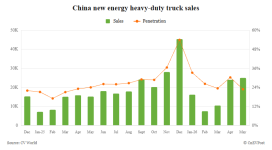
China's full-year sales of new-energy heavy trucks in 2025 stood at 231,100 units, surging 182% year-on-year, with the penetration rate reaching about 29%, according to a January report by CnEVPost.
Last December, the single-month penetration rate hit a record high of 53.89%, largely due to front-loaded demand before the expiration of subsidies.
The fundamental reason consumers are willing to pay for new-energy heavy trucks lies in their significant economic advantages.
Compared with traditional fuel vehicles, new-energy heavy trucks can save about 1.2 million yuan ($177,110) in costs over a 10-year operating cycle, Caijing reported in January, citing Xia Nan, sales director of commercial vehicles at CATL (HKEX: 3750).
CATL is one of the active promoters of electrification in the heavy-truck sector. It launched standardized battery swap packs for heavy trucks in May 2025, stating at the time that the industry was expected to achieve a 50% electrification rate in the following three years.
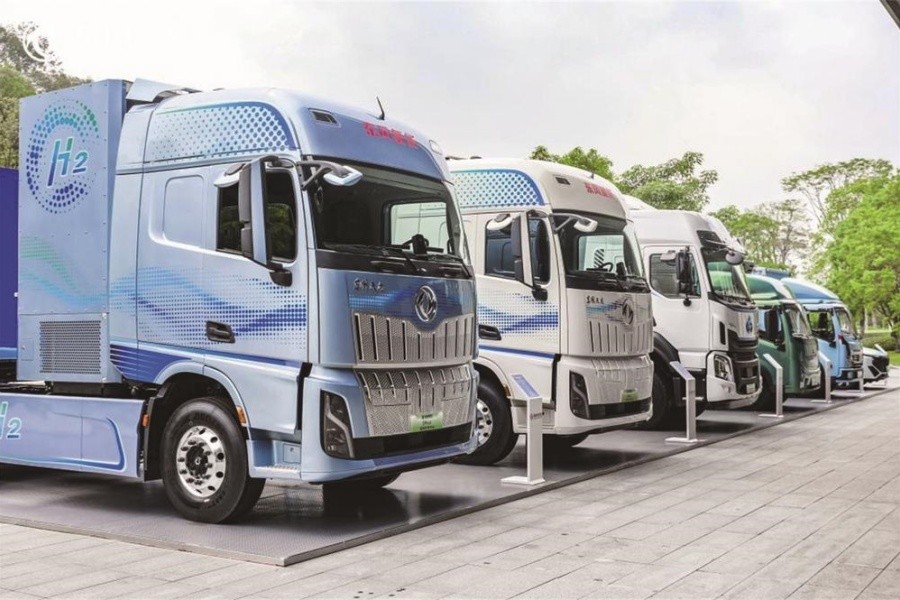
Dongfeng unveils hydrogen truck with 400 kW fuel cell - electrive.com
Dongfeng has unveiled its new 400 kW 'Hydrogen Core' fuel cell system for 49-tonne trucks. At the same time, the manufacturer introduced a new vehicle
 www.electrive.com
Dongfeng unveils hydrogen truck with 400 kW fuel cell
Dongfeng has unveiled its new 400 kW 'Hydrogen Core' fuel cell system for 49-tonne trucks. At the same time, the manufacturer introduced a new vehicle platform designed to support the system and enable ranges of up to 1,700 kilometres.
Image: Dongfeng
27.05.2026 - 13:36
Dongfeng recently hosted the ‘Hydrogen Propulsion for Dongfeng – Pioneering the Future’ event in Wuhan, where the company unveiled a new fuel cell system for commercial vehicles. According to the manufacturer, the system delivers 400 kW of power, offers a service life of more than 30,000 hours and supports cold starts at temperatures down to -40 °C. With the new system, Dongfeng now offers three hydrogen fuel cell platforms with outputs of 70 kW, 150 kW and 400 kW.
Dongfeng describes its new fuel cell solution as China’s first hydrogen fuel cell platform developed with metal bipolar plates, which has passed the 10,000-hour endurance test under the country’s new national standards. This follows China’s introduction of stricter regulations to ensure vehicle quality.
As another innovation, the manufacturer introduced the new T1 commercial vehicle platform and highlighted its compatibility with the 400 kW fuel cell system. It remains unclear whether the platform can also accommodate other powertrains and potentially serve as a multi-purpose architecture. However, Dongfeng is positioning the T1 platform primarily for hydrogen applications, stating that it ‘provides a solid foundation for the large-scale, commercial operation of hydrogen-powered commercial vehicles.’
According to the company, the T1 platform focuses on four key areas: low energy consumption, lightweight construction, fast refuelling and high safety standards. Dongfeng backed these claims with specific figures: “Following practical tests in mountainous and flatland regions, Dongfeng’s hydrogen vehicles achieved a hydrogen consumption of just 7 kg per 100 kilometres. The 49-tonne hydrogen-powered tractor unit weighs only 8.8 tonnes. With a refuelling time of just 15 minutes, the vehicles achieve a range of up to 1,700 kilometres.”
The platform also features an intelligent, decentralised energy system and a battery system.
However, the range figure is likely based on China’s CLTC test cycle, which includes more stop-and-go traffic and lower average speeds than the WLTP cycle used in Europe. As a result, CLTC values tend to be significantly more optimistic and less representative of real-world driving conditions. The quoted 1,700-kilometre range should therefore be regarded as a theoretical figure. According to Dongfeng, its hydrogen-powered trucks and passenger cars already operating on the road have collectively covered more than one million kilometres in real-world use.

Hamartia Antidote
Elite Member

'Light years ahead of the rest of the world': China shows off the future of EV batteries at the Beijing Auto Show — as CATL and BYD race to cut charging times down to just five minutes

Geely questions ultra-fast charging safety in implicit dig at BYD
Geely's official account warned against battery cell temperatures exceeding 65°C during charging, a statement widely seen as an implicit jab at BYD.
cnevpost.com
Geely questions ultra-fast charging safety in implicit dig at BYD
Geely Auto (HKEX: 0175) is mounting an unnamed technical challenge against rival BYD (HKEX: 1211), taking direct aim at potential safety risks of excessive battery temperatures caused by the latter's heavily promoted flash charging technology.
Geely published a post on its official WeChat account on Tuesday with a blunt headline that translated as — "Temperature above 65°C? Not recommended!"
The article cited China's current national standard GB/T44500-2024, noting that the reference threshold for the maximum charging temperature of lithium iron phosphate (LFP) power batteries should not exceed 65°C.
Geely did not name any competitor in the article. But this is widely seen as an implicit jab at BYD, which is aggressively promoting its second-generation Blade Battery and 1,500-kilowatt flash-charging technology.
Geely's core argument is built on physics. The company cited Joule's law, saying that battery heat generation rises exponentially as current increases. The faster the charging speed, the faster the cell temperature climbs.
As megawatt-level fast charging becomes increasingly common, battery thermal management faces higher technical requirements, Geely said.
The company said its Shendun Golden Battery, tested by the China Automotive Technology & Research Center, recorded a peak temperature of just 64°C throughout the full megawatt-level charging process.
Geely also emphasized that its battery passed the full GB38031-2025 certification last May, a standard dubbed the "strictest battery safety order in history."
"Charging fast is not enough; what matters more is ensuring safety!" Geely wrote in the post.
The trigger for the controversy can be traced back to last month. On May 6, a Chinese battery industry blogger livestreamed a test of BYD's flash-charging model, the Fang Cheng Bao Tai 3.
The test showed that under an ambient temperature of 25°C, the model charged from 9% to 97% in 9 minutes and 9 seconds. But temperatures at multiple test points exceeded 74°C, peaking at 76.42°C.
The blogger noted that battery charging temperatures are generally around 60°C, and exceeding 70°C is basically not permitted. He warned that excessively high temperatures could cause electrolyte gassing and trigger the risk of SEI film decomposition.
BYD initially issued a brief response. Li Yunfei, general manager of its branding and public relations division, said on social media platform Weibo on May 7 that everyone is welcome to visit the Flaming Mountains in Turpan, Xinjiang during the hottest months of July and August, and try out flash charging while there.
But the controversy did not subside. Other battery makers also joined the discussion. An executive at Gotion High-tech (SZSE: 002074) said at an industry conference on May 17 that ultra-fast charging does indeed affect battery life.
The executive said the safe operating temperature for LFP batteries is 60°C. Lithium hexafluorophosphate begins to slowly decompose at 60°C and accelerates its decomposition at 70°C. Lithium hexafluorophosphate accounts for more than 60% of electrolyte costs and is the key material for lithium-ion conduction.
Facing persistent questioning, BYD eventually hit back directly. Sun Huajun, chief technology officer of the company's battery business group, refuted the claim that flash charging damages batteries during an interview with Chinese media on May 19.
"You can't simply say flash charging damages batteries," Sun said. He pointed out that from 1C and 2C to 4C and 5C, every increase in charging rate prompted questions about battery damage, but technology has advanced each time.
Sun said the symmetrical structure of BYD's Blade Battery allows current to flow out from both ends, with both the top and bottom surfaces dissipating heat simultaneously, resulting in relatively lower thermal resistance. BYD also optimized the dimensions of the second-generation Blade Battery to accommodate flash charging.
On the question of whether 70°C is the battery's limit, Sun said no. He noted that just a few years ago, the industry still believed the high-temperature ceiling for LFP batteries was 60°C.
"We should not be bound by static numbers," Sun said. He stressed that the core lies in understanding the mechanism by which temperature affects battery life, and then continually pushing boundaries through innovation.
The backdrop to this debate is the intense market rivalry between Geely and BYD. According to data from the China Passenger Car Association (CPCA), Geely topped the automaker retail sales ranking for the first five months of 2026 with 848,116 units, though down 17.7% year-on-year. BYD followed with 766,401 units, down 39.1% year-on-year.
In the new energy vehicle (NEV) segment, BYD remained in first place, while Geely ranked second with 470,396 units.
BYD has stopped producing pure fuel-powered vehicles since March 2022, focusing on NEV models, including battery electric vehicle (BEV) and plug-in hybrid electric vehicle (PHEV) models. Geely still maintains a lineup of fuel-powered cars.
冖_冖
Registered Member

China's sodium-ion push reaches heavy trucks with FAW Jiefang trial
FAW Jiefang and Hina Battery completed nearly 7 months of road tests on a sodium-ion battery heavy truck, with cumulative mileage surpassing 15,000 km.
cnevpost.com
China's sodium-ion push reaches heavy trucks with FAW Jiefang trial
FAW Jiefang and Hina Battery completed nearly 7 months of road tests on a sodium-ion battery heavy truck, with cumulative mileage surpassing 15,000 km.
cnevpost.com
China's sodium-ion push reaches heavy trucks with FAW Jiefang trial
Jun 18, 2026, 3:38 PM GMT+8
FAW Jiefang, the truck-making unit of FAW Group, has completed full-condition systematic testing of a sodium battery heavy truck, marking a key breakthrough for the new battery technology in the heavy-duty commercial vehicle sector.
- FAW Jiefang and Hina Battery completed nearly 7 months of road tests on a sodium-ion battery heavy truck, with cumulative mileage surpassing 15,000 km.
- The Jiefang J6P tractor, fitted with a 339-kWh sodium battery, retained more than 90% of usable capacity at -40°C.
FAW Jiefang conducted the tests in cooperation with Chinese sodium-ion battery maker Hina Battery, work that could offer an alternative to lithium batteries in solving industry challenges such as cold-weather degradation and slow charging for new-energy heavy trucks.
The test model was the Jiefang J6P battery-electric tractor, fitted with a high-capacity 339-kWh sodium-ion battery, according to a statement from FAW Jiefang on Thursday.
The testing ran for nearly 7 months, with cumulative road-test mileage surpassing 15,000 kilometers and closely tracking real-world user operating scenarios, FAW Jiefang said.
The tests covered bench trials, vehicle reliability trials, power performance trials and extreme high- and low-temperature environmental assessments.
FAW Jiefang said the tests fully validated the operating-condition adaptability, running quality and overall safety of the vehicle equipped with sodium batteries.

In an extreme cold environment of -40°C, the battery can still retain more than 90% of usable capacity, suiting freight needs in the cold regions of northeast and northwest China.
The truck needs only 20 to 25 minutes to fully charge, and the battery has a cycle life of more than 8,000 cycles under fast-charging conditions, far exceeding conventional industry standards, FAW Jiefang said.
The truck maker also said the chemical system of sodium-ion battery materials is milder and offers outstanding thermal stability, matching the high-frequency, heavy-load operating needs of commercial vehicles.
The progress places FAW Jiefang within the broader race to commercialize sodium batteries in China, as the industry seeks alternatives to lithium that balance cost and performance.
Hina Battery general manager Li Shujun has previously predicted that sodium battery prices could catch up with lithium batteries in 2027 or 2028.
He said sodium battery costs are falling rapidly while lithium prices are rising, and the price ranges of the two will converge.
Industry giants are also accelerating their plans. CATL (HKEX: 3750) plans to invest 5 billion yuan ($735 million) to build 40 GWh of new sodium-ion battery capacity in Fujian, according to a regulatory filing last month.
In late April, CATL secured a 60 GWh sodium battery order for energy storage, setting an industry record.
BYD (HKEX: 1211) has said it has developed a sodium battery with a cycle life of up to 10,000 cycles, while BAIC Group has unveiled sodium battery samples with energy density exceeding 170 Wh/kg.
FAW Jiefang said that going forward it will continue to deepen its work in new-energy technology, refine its new-energy heavy truck product lineup and support the green, low-carbon transition of the logistics industry.
ety
Trusted Member

Chinese automakers achieve significant breakthrough in internal combustion engine technology, weakening Japan's advantage.
Written by:Guancha.cnpublishing:2026-06-19 21:00 renew:2026-06-19 21:00

Chinese automakers, which have established a leading advantage in the field of pure electric vehicles, are now also making significant progress in the field of internal combustion engine technology.
According to a Nikkei Asia report on June 18, Chinese automakers are rapidly catching up with Japanese automakers' long-standing advantage in engine technology, thanks to several major technological breakthroughs in fuel economy. Companies such as Chery, Geely, and Changan have successively launched ultra-high thermal efficiency hybrid engines, relying on technologies such as artificial intelligence (AI) and high-pressure fuel injection to overcome fuel economy bottlenecks.

Chery's hybrid engine, the "Kunpeng Tianqing," has achieved a thermal efficiency of 48.57%. (Yiche)
The report noted that at an auto show in Shenzhen earlier this month, the engine of Chery Automobile's new SUV model, the Tiggo 9, became the focus of attention. In April of this year, Chery announced that its hybrid engine under development, the "Kunpeng Tianqing," had achieved a thermal efficiency of 48.57%. According to Hong Gaoming, Vice President of Chery Automobile Co., Ltd., this figure ranks first globally.
Thermal efficiency refers to the proportion of heat generated by fuel combustion that is converted into power; the higher the value, the better the fuel economy. Chery states that the thermal efficiency of commercially available gasoline engines is generally between 38% and 45%.
"Kunpeng Tianqing" will be applied to plug-in hybrid and range-extended electric vehicles, which are equipped with a small engine for additional power generation.

A new energy vehicle production line at the Shijiazhuang branch of Chery New Energy Automobile Co., Ltd. (Xinhua)
Last year, new energy vehicles accounted for 48% of new car sales in China. Chery ranked third in the domestic passenger car market in terms of wholesale volume. Although many Chinese automakers focus on new energy models, 70% of Chery's sales still come from gasoline-powered vehicles.
Chery sold 2.8 million vehicles last year, of which 1.34 million were exported, surpassing BYD and Geely to become China's largest automobile exporter.
Geely Automobile has developed an engine with a thermal efficiency of 48.41% and has used artificial intelligence to improve the fuel efficiency of its i-HEV hybrid system. At a press conference in April this year, Geely Automobile Group CEO Gan Jiayue stated bluntly: "We will completely overturn the traditional hybrid technology of Japanese automakers."
Geely's goal this year is to increase overseas sales by 80%, reaching 750,000 vehicles. Last year, internal combustion engine models accounted for more than half of its exported vehicles.

An automated welding line is photographed at the welding plant of Geely Automobile's Baoji manufacturing base in Shaanxi Province. (Xinhua)
In May of this year, Changan Automobile launched a model equipped with a new hybrid engine and a 500-bar fuel injection system. Changan stated that this is the world's first mass-produced vehicle with an engine of this pressure level. Higher injection pressure improves thermal efficiency and provides stronger power during acceleration.
Market research firm GlobalData predicts that by 2038, the global market share of electric vehicles will rise to 49%, an increase of 33 percentage points from 2025; the share of pure gasoline vehicles will decrease by 36 percentage points to 25%; the proportion of conventional hybrid vehicles will remain at around 15%, while plug-in hybrid vehicles will increase to 8%.
Nikkei Asia points out that Japanese automakers have long held a leading position globally in engine technology, while Chinese automakers have primarily bridged the gap by developing electric vehicle technology. According to industry intelligence firm MarkLines, Chinese companies held a 59% share of the global electric vehicle market last year, while Japanese automakers accounted for only 3%; however, in non-electric vehicle sectors, Japanese companies held a 30% share, higher than China's 20%.
However, Chinese automakers are now steadily improving their internal combustion engine technology. GF Securities, a Chinese brokerage firm, believes that with higher fuel efficiency and more intelligent products, Chinese companies will reshape the global hybrid vehicle market landscape.

中國車企內燃機技術取得重磅突破 日本優勢被削弱
在純電動汽車領域確立領先優勢的中國車企,如今也在內燃機技術領域取得顯著進展。據《日經亞洲》6月18日報道,憑藉燃油經濟性領域多項重磅技術突破
 www-hk01-com.translate.goog
Beijingwalker
VIP Member
EV Cars Dominate EU May Sales - Chinese Car Sales Explode For Month
ON 6/24/2026Demand for battery-electric vehicles across Europe (including UK and EFTA) keeps building, and in May they bumped petrol-powered cars down to third among powertrain types, trailing only traditional hybrids. Chinese brands added to the shake-up, logging 121,030 European sales in May, nearly double their May 2025 total and good for a 10.7 percent share for the first time.
When factoring in the UK, EFTA countries Iceland, Liechtenstein, Norway, and Switzerland, as well as the European Union, total new car registrations rose 3.6 percent to 1.15 million units in May. In the EU alone, they were up 3.2 percent to 955,013 compared to May last year.
EV Cars Dominate EU May Sales - Chinese Car Sales Explode For Month - AutoSpies Auto News
EV Cars Dominate EU May Sales - Chinese Car Sales Explode For Month
Beijingwalker
VIP Member
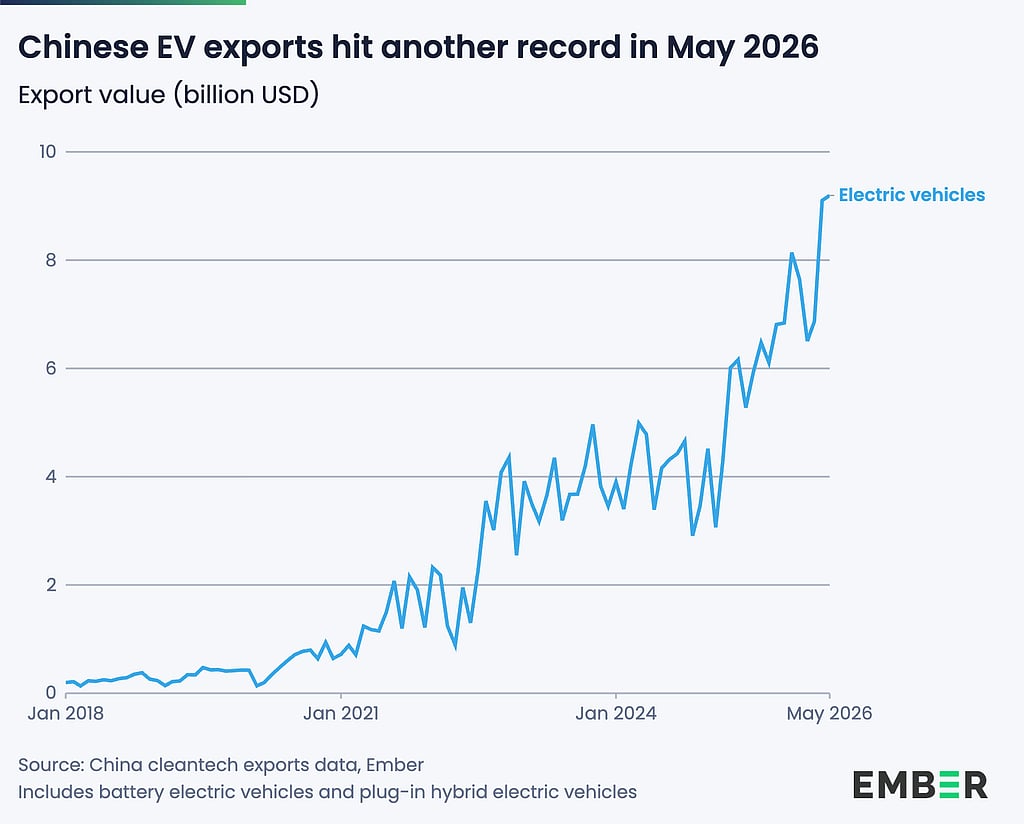
China’s EV exports hit record $9.2 billion in May as ASEAN demand surges amid energy security concerns
The latest record highlights China’s growing dominance in global EV manufacturing and exports24 Jun 2026
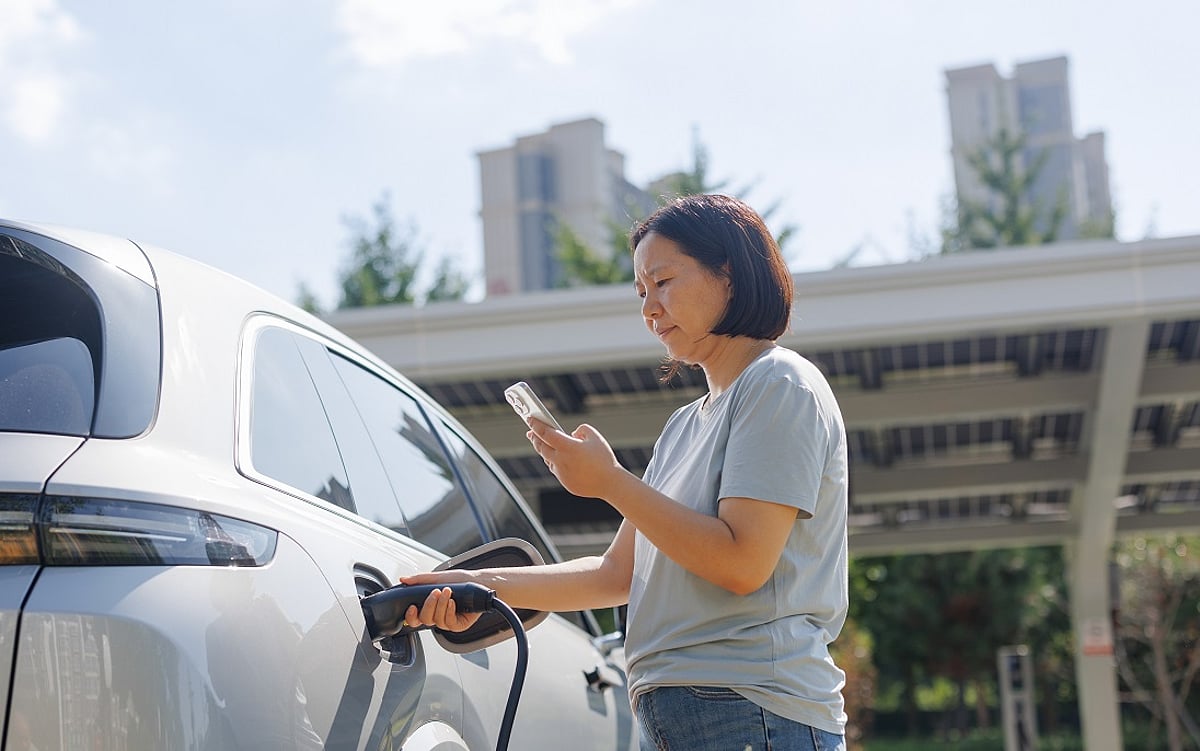
China’s EV exports hit record $9.2 billion in May as ASEAN demand surges amid energy security concerns
China’s electric vehicle (EV) exports reached a record $9.2 billion in May 2026, rising 49 per cent year on year, as demand from the Association of Southeast As
Beijingwalker
VIP Member
Chinese automakers achieve significant breakthrough in internal combustion engine technology, weakening Japan's advantage.
Written by:Guancha.cn
publishing:2026-06-19 21:00 renew:2026-06-19 21:00
Chinese automakers, which have established a leading advantage in the field of pure electric vehicles, are now also making significant progress in the field of internal combustion engine technology.
According to a Nikkei Asia report on June 18, Chinese automakers are rapidly catching up with Japanese automakers' long-standing advantage in engine technology, thanks to several major technological breakthroughs in fuel economy. Companies such as Chery, Geely, and Changan have successively launched ultra-high thermal efficiency hybrid engines, relying on technologies such as artificial intelligence (AI) and high-pressure fuel injection to overcome fuel economy bottlenecks.
Chery's hybrid engine, the "Kunpeng Tianqing," has achieved a thermal efficiency of 48.57%. (Yiche)
The report noted that at an auto show in Shenzhen earlier this month, the engine of Chery Automobile's new SUV model, the Tiggo 9, became the focus of attention. In April of this year, Chery announced that its hybrid engine under development, the "Kunpeng Tianqing," had achieved a thermal efficiency of 48.57%. According to Hong Gaoming, Vice President of Chery Automobile Co., Ltd., this figure ranks first globally.
Thermal efficiency refers to the proportion of heat generated by fuel combustion that is converted into power; the higher the value, the better the fuel economy. Chery states that the thermal efficiency of commercially available gasoline engines is generally between 38% and 45%.
"Kunpeng Tianqing" will be applied to plug-in hybrid and range-extended electric vehicles, which are equipped with a small engine for additional power generation.
A new energy vehicle production line at the Shijiazhuang branch of Chery New Energy Automobile Co., Ltd. (Xinhua)
Last year, new energy vehicles accounted for 48% of new car sales in China. Chery ranked third in the domestic passenger car market in terms of wholesale volume. Although many Chinese automakers focus on new energy models, 70% of Chery's sales still come from gasoline-powered vehicles.
Chery sold 2.8 million vehicles last year, of which 1.34 million were exported, surpassing BYD and Geely to become China's largest automobile exporter.
Geely Automobile has developed an engine with a thermal efficiency of 48.41% and has used artificial intelligence to improve the fuel efficiency of its i-HEV hybrid system. At a press conference in April this year, Geely Automobile Group CEO Gan Jiayue stated bluntly: "We will completely overturn the traditional hybrid technology of Japanese automakers."
Geely's goal this year is to increase overseas sales by 80%, reaching 750,000 vehicles. Last year, internal combustion engine models accounted for more than half of its exported vehicles.
An automated welding line is photographed at the welding plant of Geely Automobile's Baoji manufacturing base in Shaanxi Province. (Xinhua)
In May of this year, Changan Automobile launched a model equipped with a new hybrid engine and a 500-bar fuel injection system. Changan stated that this is the world's first mass-produced vehicle with an engine of this pressure level. Higher injection pressure improves thermal efficiency and provides stronger power during acceleration.
Market research firm GlobalData predicts that by 2038, the global market share of electric vehicles will rise to 49%, an increase of 33 percentage points from 2025; the share of pure gasoline vehicles will decrease by 36 percentage points to 25%; the proportion of conventional hybrid vehicles will remain at around 15%, while plug-in hybrid vehicles will increase to 8%.
Nikkei Asia points out that Japanese automakers have long held a leading position globally in engine technology, while Chinese automakers have primarily bridged the gap by developing electric vehicle technology. According to industry intelligence firm MarkLines, Chinese companies held a 59% share of the global electric vehicle market last year, while Japanese automakers accounted for only 3%; however, in non-electric vehicle sectors, Japanese companies held a 30% share, higher than China's 20%.
However, Chinese automakers are now steadily improving their internal combustion engine technology. GF Securities, a Chinese brokerage firm, believes that with higher fuel efficiency and more intelligent products, Chinese companies will reshape the global hybrid vehicle market landscape.
中國車企內燃機技術取得重磅突破 日本優勢被削弱
在純電動汽車領域確立領先優勢的中國車企,如今也在內燃機技術領域取得顯著進展。據《日經亞洲》6月18日報道,憑藉燃油經濟性領域多項重磅技術突破
Not just EVs – Chinese Automakers Surpass Japan in Traditional Powertrains, Says Nikkei
Jun 26, 2026 3:51 AM CEST
Geely Emgrand with i-HEV technology. Credit: Geely
https://db.carnewschina.com/get-full-access
Japanese media have publicly acknowledged that Chinese automakers are rapidly closing – and in some cases surpassing – Japan’s long-held advantage in internal-combustion engine technology, particularly in hybrid powertrains.
In an article titled “Chinese Automakers Rapidly Catching Up with Japanese Rivals in Engine Technology, Power-Conversion Efficiency and AI Utilisation,” Nikkei Chinese highlighted breakthroughs by Chery, Geely and Changan that combine record thermal efficiency with intelligent control systems.
- Chery unveiled its “Kunpeng Tianqing” hybrid system on the new Tiggo 9 at the Shenzhen Auto Show. The engine achieves a thermal efficiency of 48.57 per cent – the highest figure publicly claimed by any automaker.
- Geely‘s “i-HEV” powertrain, fitted to the Xingyue L (Monjaro), reaches 48.41 per cent efficiency through a 15.5:1 compression ratio, Miller-cycle valve timing and AI-driven energy management that adjusts in real time to altitude, humidity and temperature.
- Changan introduced the “Bluecore Super Engine” featuring the world’s first mass-produced 500-bar high-pressure direct-injection system, delivering finer fuel atomization and sharper throttle response.
Intelligence on ICE
Beyond hardware, Chinese engineers are embedding artificial intelligence and sensor fusion into engine control units. Geely’s system, for example, continuously optimises combustion and energy flow, allowing the powertrain to adapt instantly to changing road and weather conditions. Chery plans to deploy the same engine family across plug-in hybrids and range-extender electric vehicles, targeting markets where charging infrastructure remains limited.
Dual-track approach
While Chinese brands accelerate global electric-vehicle sales, they are simultaneously refining gasoline and hybrid technology to serve the more than 70 million annual buyers who still choose combustion-powered cars. In 2025, Chery sold 2.8 million vehicles, 70 per cent of them gasoline-powered, and exported 1.34 million units – more than any other Chinese automaker.
As reported by Nikkei, Japanese firms still lead in non-electric segments with a 30 per cent share versus China’s 20 per cent, yet analysts at GF Securities argue that China’s combination of ultra-efficient engines and vehicle intelligence is poised to reshape the hybrid market through 2038, when GlobalData forecasts hybrids will still account for 15 per cent of global sales.
Not just EVs: Chinese automakers surpass Japan in traditional powertrains, says Nikkei
Even in internal-combustion engine technology, Chinese carmakers have surpassed Japanese rivals, Japanese media reports.
 carnewschina.com
Beijingwalker
VIP Member
Chinese cars are not just EVs, they leads in all fronts now.Not just EVs – Chinese Automakers Surpass Japan in Traditional Powertrains, Says Nikkei
Jun 26, 2026 3:51 AM CEST
Geely Emgrand with i-HEV technology. Credit: Geely
https://db.carnewschina.com/get-full-access
Japanese media have publicly acknowledged that Chinese automakers are rapidly closing – and in some cases surpassing – Japan’s long-held advantage in internal-combustion engine technology, particularly in hybrid powertrains.
In an article titled “Chinese Automakers Rapidly Catching Up with Japanese Rivals in Engine Technology, Power-Conversion Efficiency and AI Utilisation,” Nikkei Chinese highlighted breakthroughs by Chery, Geely and Changan that combine record thermal efficiency with intelligent control systems.
These figures exceed the 38–45 per cent range typical of current gasoline engines and even surpass many modern hybrids previously regarded as class-leading.
- Chery unveiled its “Kunpeng Tianqing” hybrid system on the new Tiggo 9 at the Shenzhen Auto Show. The engine achieves a thermal efficiency of 48.57 per cent – the highest figure publicly claimed by any automaker.
- Geely‘s “i-HEV” powertrain, fitted to the Xingyue L (Monjaro), reaches 48.41 per cent efficiency through a 15.5:1 compression ratio, Miller-cycle valve timing and AI-driven energy management that adjusts in real time to altitude, humidity and temperature.
- Changan introduced the “Bluecore Super Engine” featuring the world’s first mass-produced 500-bar high-pressure direct-injection system, delivering finer fuel atomization and sharper throttle response.
Intelligence on ICE
Beyond hardware, Chinese engineers are embedding artificial intelligence and sensor fusion into engine control units. Geely’s system, for example, continuously optimises combustion and energy flow, allowing the powertrain to adapt instantly to changing road and weather conditions. Chery plans to deploy the same engine family across plug-in hybrids and range-extender electric vehicles, targeting markets where charging infrastructure remains limited.
Dual-track approach
While Chinese brands accelerate global electric-vehicle sales, they are simultaneously refining gasoline and hybrid technology to serve the more than 70 million annual buyers who still choose combustion-powered cars. In 2025, Chery sold 2.8 million vehicles, 70 per cent of them gasoline-powered, and exported 1.34 million units – more than any other Chinese automaker.
As reported by Nikkei, Japanese firms still lead in non-electric segments with a 30 per cent share versus China’s 20 per cent, yet analysts at GF Securities argue that China’s combination of ultra-efficient engines and vehicle intelligence is poised to reshape the hybrid market through 2038, when GlobalData forecasts hybrids will still account for 15 per cent of global sales.
Not just EVs: Chinese automakers surpass Japan in traditional powertrains, says Nikkei
Even in internal-combustion engine technology, Chinese carmakers have surpassed Japanese rivals, Japanese media reports.
ety
Trusted Member
Chinese firms currently have 20% of world share of non-electric vehicles. That's a significant share.Chinese cars are not just EVs, they leads in all fronts now.
Beijingwalker
VIP Member
China exports record 448,000 passenger EVs, worth US$9.2 billion, in May 2026
June 26, 2026
China exported a record 448,000 electric passenger vehicles in May 2026, driving export values of US$9.2 billion, another record figure and up 49% year-on-year.

June 26, 2026
China exported a record 448,000 electric passenger vehicles in May 2026, driving export values of US$9.2 billion, another record figure and up 49% year-on-year.
China exports record 448,000 passenger EVs in May 2026
China exported a record 448,000 electric passenger vehicles in May 2026, according to figures from thinktank Ember.
www.evinfrastructurenews.com
Beijingwalker
VIP Member
BYD Poised to Overtake Tesla in Global EV Sales Race
2026/07/01 22:24Chinese electric vehicle manufacturer BYD is emerging as a major contender in the global EV market, with new delivery figures suggesting it may surpass Tesla in total electric vehicle sales for the second quarter of the year.
According to reported data, BYD delivered approximately 557,090 fully electric vehicles during the quarter, placing the company ahead of analyst consensus estimates for Tesla, which stand at around 406,024 deliveries for the same period.
If confirmed, this would position BYD as the world’s top electric vehicle seller for the quarter, marking a significant milestone in the ongoing competition between the two automotive giants.
The surge in BYD’s performance has been supported by strong international demand, particularly in overseas markets where the company has expanded aggressively over the past year.

Exports played a key role in the company’s growth trajectory, with shipments rising 94.7% year-over-year in June alone to reach 175,349 vehicles.
This sharp increase in overseas deliveries highlights BYD’s growing global footprint and its ability to compete in markets traditionally dominated by established Western automakers.
The company’s expansion strategy has focused on offering a broad range of electric vehicles across multiple price segments, making its products accessible to a wider consumer base.
BYD has also benefited from strong domestic demand in China, which remains the world’s largest electric vehicle market and a key driver of global EV adoption.
In contrast, Tesla continues to maintain a strong presence in premium electric vehicle segments, particularly in North America and Europe, where brand recognition and technological leadership remain significant competitive advantages.
Despite the difference in delivery volumes, Tesla continues to command a substantially higher market valuation.
The company’s market capitalization currently stands at approximately $1.49 trillion, compared to BYD’s valuation of around $108 billion.
This valuation gap reflects investor expectations regarding long-term growth, profitability, technology leadership, and future expansion into areas such as autonomous driving and energy storage.
Tesla’s higher valuation also reflects its positioning as more than just an automaker, with significant investments in artificial intelligence, robotics, and energy infrastructure contributing to its broader market narrative.
BYD, meanwhile, has been increasingly recognized for its vertically integrated manufacturing model, which allows the company to produce key components such as batteries in-house, potentially reducing costs and improving supply chain efficiency.
Industry analysts note that the competition between BYD and Tesla represents a broader shift in the global automotive landscape, where Chinese manufacturers are rapidly gaining market share in the electric vehicle sector.
The growth of BYD also underscores China’s expanding influence in clean energy manufacturing and electric mobility technologies.
As governments worldwide push for stricter emissions standards and increased adoption of electric vehicles, competition among manufacturers is expected to intensify further in the coming years.
Both BYD and Tesla are expected to play central roles in shaping the future of the global EV market, though their strategies differ significantly in terms of pricing, market focus, and technological development.
Tesla continues to emphasize software-driven innovation, autonomous driving capabilities, and premium vehicle performance, while BYD focuses on scale, affordability, and rapid global expansion.
The latest delivery figures have sparked widespread discussion across financial markets and automotive industry circles, including commentary on social media platforms such as X, where analysts debated the implications of BYD’s rapid growth. The development was also referenced by the X account Coin Bureau, contributing to broader attention on the competitive dynamics between the two companies.
While quarterly delivery leadership may shift between manufacturers, long-term competition is expected to depend on factors such as technological innovation, global expansion strategies, regulatory environments, and consumer demand trends.
For now, BYD’s strong performance signals a potential turning point in the global electric vehicle race, as Chinese manufacturers continue to challenge established leaders in the industry.
Beijingwalker
VIP Member


BYD Accelerates Global EV Expansion as Chinese Automakers Capture Dominant Market Share | EVTech.News
Driven by aggressive expansion in emerging markets and deep cost advantages, BYD and other Chinese EV brands are rapidly surging in global market share, reshapi
Beijingwalker
VIP Member
China Auto Exports Expected to Near 10 Million in 2026 Amid Overseas Push
By Yu CongPublished: Jul. 2, 2026 3:32 a.m. GMT+8

A roll-on/roll-off vessel loads vehicles for export at a berth in Lianyungang, Jiangsu province, on July 1, 2026. Photo: VCG
China’s auto exports are expected to approach 10 million vehicles in 2026, up from 7.1 million in 2025, according to an annual global automotive market outlook released June 30 by consulting firm AlixPartners.
The projected surge highlights a strategic shift among Chinese automakers, which are accelerating overseas expansion as growth in the domestic market slows. Their ambitions increasingly go beyond exports, with companies seeking to build local manufacturing capacity and deeper regional footprints.

China Auto Exports Expected to Near 10 Million in 2026 Amid Overseas Push
Chinese automakers are accelerating overseas expansion as domestic growth slows, with Europe becoming a key battleground for exports and localized production
Beijingwalker
VIP Member
Chinese automakers overtake Japanese rivals in Europe despite EV tariffs
Renewed purchase subsidies offers boon to BYD, while Nissan looks to other markets
BYD's overseas first-half passenger vehicle sales jumped 70% from a year earlier. (Photo by Shinya Sawai)
KOSUKE TOSHI and SHIZUKA TANABE
July 2, 2026 16:54 JST
- Chinese automakers surpassed the sales of Japanese brands in Europe's passenger car market for the first time in May, driven partly by BYD's strong overseas performance in the first half of 2026.
According to data from the European Automobile Manufacturers' Association (ACEA), combined sales of five Chinese automakers—BYD, SAIC, Geely, Chery, and Leapmotor—reached 138,410 units that month, a 65% year-on-year increase. In contrast, combined sales of six Japanese automakers—Toyota, Nissan, Suzuki, Mazda, Honda, and Mitsubishi—totaled 130,424 units, down 3% year-on-year, making Chinese brands’ sales 6% higher than those of Japanese brands.

Chinese automakers overtake Japanese rivals in Europe despite EV tariffs
Renewed purchase subsidies offers boon to BYD, while Nissan looks to other markets
 asia.nikkei.com
Users who are viewing this thread
Total: 5 (members: 0, guests: 5)
Pakistan Defence Latest
-
 Federal cabinet gives nod to imposition of emergency in KP; summary sent to president (69 Viewers)
- Latest: Meengla
-

-
-

-
Country Watch Latest


Latest Posts
-
"Roses Are Red, Violets Are Blue, & Polar Vortex Is Coming For You" (5 Viewers)
- Latest: Davey Crockett
-
Federal cabinet gives nod to imposition of emergency in KP; summary sent to president (69 Viewers)
- Latest: Meengla
-
Makkah Defence Alliance: Turkey, Saudi Arabia, and Pakistan, news & updates (59 Viewers)
- Latest: mythbuster
-
-
 New Indian movie supports and agitates Tibetan separatism and terrorism (18 Viewers)
- Latest: Master Chief