China's Auto Exports Are on Track to Top $100 Billion
July 21 , 2026 22:47 BJT
Gasgoo Munich- In 2021, China's auto exports totaled $345 billion. Five years later, in just the first half of 2026, that figure has hit $918 billion, nearing the $100 billion threshold.
Rising from $345 billion to $918 billion in just six months, China's auto industry has traversed a path that took many nations decades—in only five years.
Automobiles Rewrite China's Export DNA
Data from the General Administration of Customs shows China's total merchandise trade exports reached $2,125.8 billion in the first six months of 2026, a 17% year-on-year increase. Within that, complete vehicle exports surged 54% to $918 billion, with June alone seeing a 70% jump to $182 billion.
Image Source: Huaban.com
In terms of volume, the achievements remain striking. According to the China Association of Automobile Manufacturers (CAAM), auto exports hit 5.096 million units in the first half, up 65.3%—marking the first time semi-annual exports have breached the 5 million mark. June alone saw 1.037 million units shipped, a 75.1% surge and the first single-month exceedance of 1 million units.
Overall exports grew 17%, while auto exports jumped 54%. That near-threefold "scissors gap" signals a profound shift in China's export engine. Cui Dongshu, secretary-general of the CPCA, summed it up: "Auto exports have performed exceptionally well in recent years, surging from $345 billion in 2021 to $117.4 billion in 2024, creating an explosive growth trajectory." The full year of 2025 reached $142.4 billion. With the first half of 2026 already at $918 billion, breaking the $150 billion mark for the full year is virtually certain.
Image Source: Huaban.com
It is not just automobiles rewriting the export landscape. Customs data shows lithium battery exports climbed 43% to $487 billion in the first half, while solar cell exports rose 24% to $329 billion. Together, the "New Three" exports increased 51.6% to $118.35 billion. Among them, electric vehicles posted the fastest growth, with cumulative exports reaching $52.1 billion—a 75.1% increase. Leveraging a first-mover advantage in new energy and intelligent innovation, Chinese autos have not only scaled up export volumes but have also become a key force driving global R&D and design innovation through deep integration with artificial intelligence.
From garments and home appliances to automobiles, lithium batteries, and solar cells, China's "starting lineup" for exports is being redefined. And automobiles are undoubtedly the absolute core of this new roster.
Who Is Driving This“Surge”?
The rising numbers in both volume and value are just the first layer of the story. The real question is: where is this growth momentum coming from?
The answer lies in the explosion of new energy vehicles (NEVs).
CAAM data reveals NEV exports reached 2.355 million units in the first half, up 1.2 times year-on-year, accounting for over 46% of total auto exports. In June alone, NEV exports hit 523,000 units, a 1.6-fold increase. Chen Shihua, deputy secretary-general of CAAM, stated at a monthly briefing that auto exports in the first half "exceeded expectations, forming a stable support."
Specifically, passenger vehicle exports reached $14.5 billion in June, an 84% year-on-year surge and a 658% jump compared to June 2021. NEVs are the "main driving force" pulling this rapid expansion. With 2.355 million units exported in the first half—up 1.2 times and claiming over 46% of the total—the sector is dominant. China's NEV supply chain, from mineral processing and battery manufacturing to vehicle integration, has formed the world's most complete and cost-competitive closed loop. If past exports relied on value for money, today they compete on technological superiority.
Many industry observers judge that Chinese autos are crossing a critical threshold from "scale expansion" to "value export," shifting from a focus on affordability to leveraging technological gaps. The supply chains for NEV core systems—battery, motor, and electronic control—and intelligent features now offer stronger product competitiveness overseas
The diverging landscape of export markets further confirms this trend. From January to May 2026, Brazil surpassed Russia to become China's largest export market, shipping 372,000 passenger vehicles—a 178.7% year-on-year increase. Russia followed closely with 351,000 units, up 139.8%.
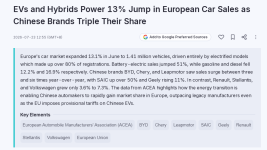
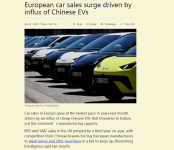
Together, the two nations account for over 40% of China's top ten passenger vehicle export destinations. Markets like the UK, Belgium, Italy, and Australia also maintained rapid growth. An analysis by Gasgoo Auto Research Institute notes that the European market is "blooming across the board; counting Russia, Europe's share of China's passenger vehicle exports has now exceeded half."
On the new energy front, Brazil topped the list of top five destinations for Chinese NEV passenger exports from January to May with 283,000 units, followed by Belgium and the UK. Exports to Italy and Germany exploded by 365.3% and 211.2% respectively—Chinese NEVs have successfully penetrated the heartland of traditional automotive powers.
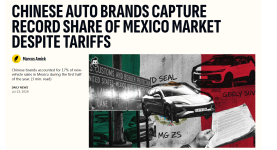
Meanwhile, the global map of Chinese auto exports is being reshaped. The Latin American market is polarized: Brazil saw a sales surge driven by a rush to buy ahead of expected tariff hikes in July, while Mexico saw exports plunge 40% due to earlier tariff increases and tightening North American trade policies. Middle Eastern markets like the UAE also entered an adjustment period, falling 32.6%. This divergence suggests to some extent that Chinese auto exports have moved from a "swarm" style of extensive expansion into a new stage of refined operation.
Image Source: Chery Auto
Changes at the corporate level are equally noteworthy. CPCA data shows that among the top ten exporters in the first half, Chery Auto led with 931,500 units, up 70.9%, followed closely by BYD with 769,300 units, a 73.6% increase. Together, the two account for nearly 40% of the top ten's total. Geely Auto exported 472,500 units, up 158.3%; SAIC Passenger Vehicle shipped 404,200; Great Wall Motor 256,000; and Tesla China 229,000.
Even more telling is the export ratio. Chery's exports account for 74.3% of its total sales—meaning over 70% of its cars are sold overseas. BYD's overseas sales share exceeds 40%, while Great Wall Motor's export ratio has reached 50%. In the first half, auto exports accounted for 37% of domestic sales, up from just 19% a year earlier. "Going global" has shifted from an elective for a few companies to a required course for the entire industry; overseas markets are moving from being "icing on the cake" to constituting "half the sky."
Undercurrents and the Path Forward Amidst the Boom
The high-growth figures are undoubtedly inspiring, but the unavoidable structural contradictions hidden beneath the data also deserve attention.
The most prominent issue is the "ice and fire" disparity between complete vehicles and parts. While complete vehicle exports jumped 54% to $918 billion in the first half, parts exports grew a mere 7% to $51.3 billion. The "scissors gap" is obvious.
Chen Jingjing, secretary-general of the Automobile Branch of the China Chamber of Commerce for Import and Export of Machinery and Electronic Products, noted in an interview that auto parts export destinations "are mostly traditional automotive powers, represented by the US and EU, where restrictive measures against Chinese exports are continuously landing." This stands in stark contrast to complete vehicle exports, which "basically don't go to the US."
Chen further warned that Chinese auto exports "have bid farewell to the purely trade-driven stage and must shift towards localized, systematic deep cultivation." She pointed out a common weakness among domestic companies: "emphasizing sales while neglecting after-sales service." Short-term volume surges only overdraw the brand, she argued; after-sales service, spare parts, customer repurchases, and local reputation are the core lifelines for long-term overseas growth. Cui Dongshu was more direct, stating, "We must follow the development of independent automakers."
The high growth of vehicle exports is certainly welcome, but if parts lag behind for too long, the "autonomy and controllability" of China's auto export sector risks becoming hollow.
Additionally, the continuous escalation of trade barriers presents another real pressure. Since October 2024, the EU has imposed definitive anti-subsidy duties on Chinese pure electric vehicles for five years, adding extra tariffs ranging from 7.8% to 35.3% on top of the 10% base duty. BYD, Geely, and SAIC were hit with additional rates of 17%, 18.8%, and 35.3% respectively. In June 2026, the European Commission plans to extend these anti-subsidy duties to plug-in hybrid vehicles. Xinhua Finance reported that the new rules could reference pure electric standards, pushing the maximum combined tariff above 45%.
Non-tariff barriers are also escalating. The EU plans to introduce a "Supply Chain Diversification Instrument" and the "Public Procurement Act" in September 2026, proposing that companies in sensitive sectors establish diversified supply channels in key areas and cap procurement from a single supplier at 30% to 40%.
Meanwhile, Brazil has uniformly raised import tariffs on electric vehicles to 35% starting July 1. Thailand has implemented a "production capacity wagering" mechanism, requiring automakers to exchange export volumes for localization production quotas. Tariff and non-tariff barriers are converging to tighten the screws.
Facing the increasingly high "walls," Chinese automakers are answering not by detouring, but by digging in—moving from "trade exports" to "industrial exports."
For example, a domestic NEV maker's factory in Brazil serves as a typical sample. The plant celebrated the rollout of its 100,000th NEV in July. The first phase plans an annual capacity of 150,000 to 200,000 units, with a long-term goal of expanding to over 500,000 units. It also plans to raise the localization procurement rate to 50% by early 2027.
Image Source: Chery Auto
In Europe, Chery's layout is equally significant. In June 2026, the factory jointly operated by Chery and Spain's Ebro Automotive Group in the Barcelona Free Trade Zone activated its new M1 production line. Spanning 696 meters with 97 workstations, the line has a production cycle of approximately 75 minutes per vehicle. Rafael Ruiz, president of Ebro, stated that choosing a Chinese firm as a technology partner aims to "introduce new technologies and industrial experience in the automotive sector to Spain, transforming them into local industrial capacity and employment opportunities."
From product exports to the full-chain localization of capacity, brand, and supply chain, this shift is becoming the necessary path for Chinese autos to move from the "first half" to the "second half" of their global journey—a trend the industry summarizes as "ecosystem exports." Driven by advantages in new energy and intelligent technology, the form of Chinese auto exports is evolving: automakers are the first to deploy overseas capacity, followed closely by supply chain companies, while overseas warehouses for parts and after-sales service networks are being simultaneously perfected.
Product export is only the first step; the comprehensive localization of capacity, brand, and supply chain is the key to determining whether Chinese automobiles can truly gain a foothold overseas.
Based on the export volume of 5.096 million units in the first half, breaking the 10 million mark for the full year is almost a foregone conclusion. International professional institutions predict that China's auto exports will grow 41% year-on-year in 2026 to reach 10 million units, making it the first country in the world to export 10 million vehicles—about 2.5 times Japan's export volume.
Conclusion
Looking back at 2021, China's auto exports were less than $350 billion—a mere footnote in the global trade map. Five years later, in just half a year, they are approaching the $100 billion magnitude at $918 billion. Behind this lies the systematic eruption of decades of accumulation in Chinese manufacturing and a historic window for reshuffling the global industrial landscape.
Yet beneath the halo of numbers, structural concerns are clearly visible. The "disconnect" between parts and vehicles, the full convergence of trade barriers, and the real test of localization capabilities—each is a threshold that cannot be bypassed. The road from "trade exports" to "industrial exports," and from "scale expansion" to "value deepening," has just been paved, but it is far from flat.
$918 billion is both a report card and an admission ticket. For Chinese autos to truly move from "big" to "strong," the decisive chapter is yet to come.


 www.shawlocal.com


 voi.id

 carnewschina.com

 GAC Aion S. Credit: Xcar
 electrek.co


 www.nst.com.my

 www.chosun.com

 www.autoweek.com