China committee eyes supply chain, biotech as Moolenaar takes helm

RabzonKhan

Trusted Member
Joined
Aug 1, 2008
Messages
5,109
Reaction score
5,361
Reputation
163.7
Country of Origin
Country of Residence

China committee eyes supply chain, biotech as Moolenaar takes helm

Story by Gopal Ratnam 13h
AA1nV0QA.jpg
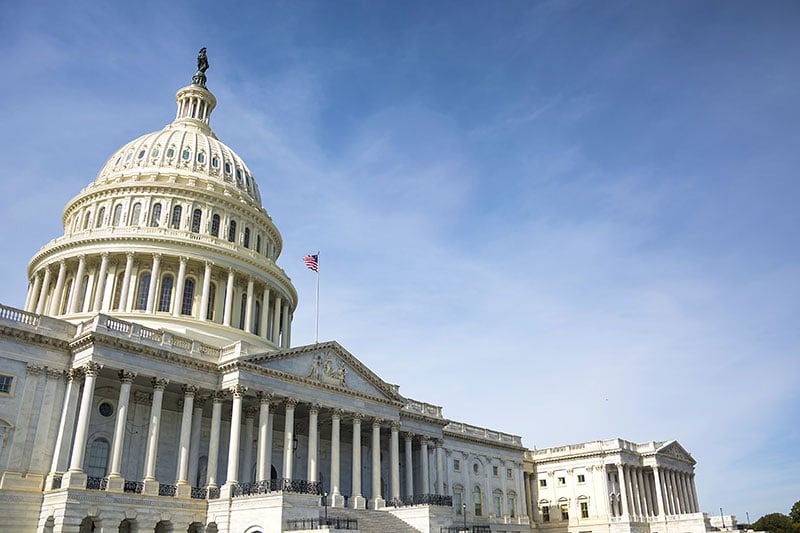
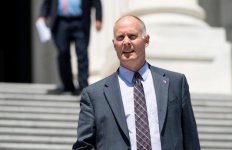
Michigan Republican Rep. John Moolenaar now leads the House Select Committee on the Strategic Competition between the United States and the Chinese Communist Party.© Provided by Roll Call

The House select committee on U.S.-China competition, freshly under new leadership, is training its sights on a range of tech, defense, economic and foreign policy issues on the heels of a major victory on the bill to force the divestiture of TikTok.

Mike Gallagher, R-Wis., last week left Congress and stepped down as chairman of the House Select Committee on the Strategic Competition between the United States and the Chinese Communist Party. His replacement as chair, Michigan Republican Rep. John Moolenaar, said in a statement on Monday that he will focus on preventing “the CCP from stealing our technology, co-opting businesses, and harassing people on American soil.”


“We will examine the most critical areas of our supply chain so we can reduce our dependence on the CCP,” Moolenaar said.

Legislative measures that the committee is championing now need to be shepherded through relevant congressional committees, Illinois Rep. Raja Krishnamoorthi, the top Democrat on the panel, said in an interview.

“There are a lot of ongoing issues that pop up that require the kind of focus that this committee has helped to bring,” Krishnamoorthi said, emphasizing the need for the committee to continue its work. “We work very closely with our sister committees and the committees of jurisdiction, but I think we’re able to elevate the importance of some of these issues and raise their profile enough to get attention and action.”


The stand-alone bill forcing TikTok owner ByteDance to divest the app or face a ban in the United States went from introduction by Gallagher, Krishnamoorthi and others to a committee markup and House passage in about a week. That original bill passed the House with overwhelming support, was modified by Speaker Mike Johnson as part of a national security supplemental and was signed by President Joe Biden last week.

Krishnamoorthi said another measure championed by the committee that targets the practices of specific companies should be a “no-brainer bill.” The measure would ban federal research funds going to U.S. companies that in turn hire Chinese biotech companies, including MGI, Complete Genomics, WuXi AppTec, and BGI Group and its subsidiaries.

While BGI and MGI are closely linked with the Chinese Communist Party, WuXi has transferred “intellectual property without consent” to Beijing, Krishnamoorthi said.

The committee also is pushing for legislation that would prohibit U.S. investment firms from funneling money into Chinese tech and defense companies and is closely examining China’s propaganda efforts in foreign elections, including Taiwan’s, Krishnamoorthi said.

“We had a hearing on what’s called discourse warfare, which is another term that the Chinese use for propaganda,” Krishnamoorthi said. “That came after the Taiwan elections, and what we’ve heard in Taiwan is that they are deeply concerned about it … and we have to keep a close eye on this” in light of the upcoming U.S. election, he said.

Guiding other committees​

The committee has served a key role in highlighting the “full scope of the challenge with China, including everything from technology to defense, to influence operations and foreign policy,” Elizabeth Hoffman, director of congressional and government affairs at the Center for Strategic and International Studies, said in an interview.

The committee was created by then-Speaker Kevin McCarthy in January 2023, drawing rare bipartisan support in an otherwise divided chamber. Whether the committee will be extended in the next Congress isn’t clear.

Hoffman said the next speaker, whether Republican or Democrat, would likely keep it around, as it’s “been a center for bipartisanship” that has helped lawmakers get a “360-degree picture of the challenge posed by China, which is very valuable to other congressional committees.”

Lawmakers on other panels have come to rely on the findings of the China committee in crafting their own legislation.

Virginia Republican Rep. Rob Wittman, who chairs the House Armed Services Subcommittee on Tactical Air and Land Forces, said in an interview that he considers the recommendations focused on deterring a Chinese invasion of Taiwan to be one of the select committee’s biggest accomplishments.

Much of the “Ten for Taiwan” report by the select committee was included in the fiscal 2024 policy measure for the Pentagon, including recommendations to bolster joint training between U.S. and Taiwanese military forces and improving congressional oversight of the multibillion-dollar foreign military sales backlog for Taipei.

The recommendations of the select committee “continue to direct and inform efforts by the Armed Services Committee on subsequent policy that needs to occur to make sure that we’re addressing those Ten for Taiwan issues,” Wittman said. “So I think that while we don’t have to come up with another set of recommendations, I think that the impact of those recommendations will be seen again this year in the formulation and passage of the NDAA.”


Wittman said he expects Moolenaar to focus on supply chain security in the energy sector and in areas involving critical minerals and rare earth elements.

Moolenaar introduced a bill last fall seeking to bar companies with ties to the Chinese Communist Party from receiving green energy production tax benefits. The legislation is co-sponsored by more than three dozen House Republicans.

“Essentially, the things that we’re trying to do to diversify our energy production here should not be done in ways that have direct benefits to China,” Wittman said.

The post China committee eyes supply chain, biotech as Moolenaar takes helm appeared first on Roll Call.
 

US pharma giant reaches $2.75 billion deal with China-based biotech company for AI-developed drugs​

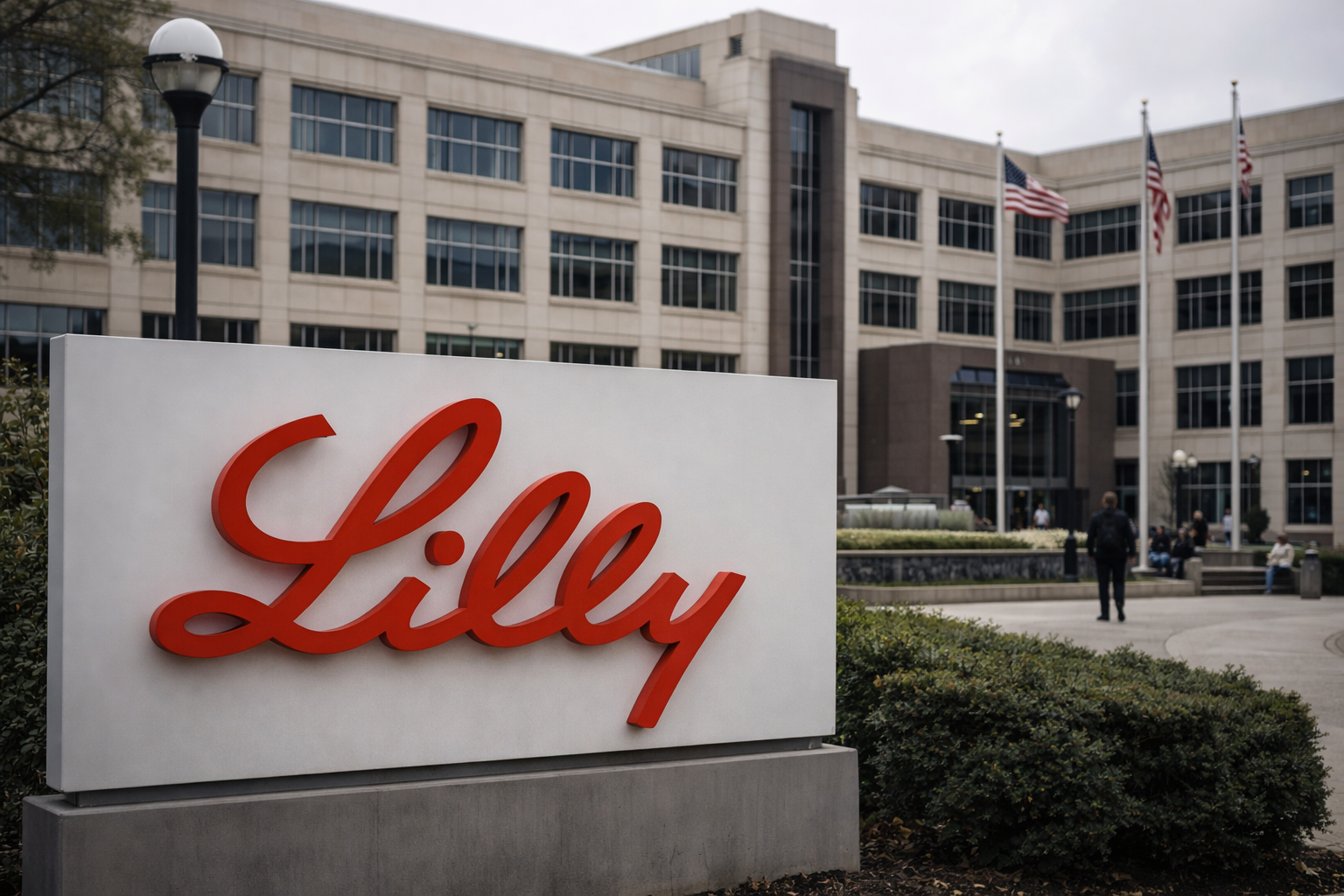
Eli Lilly inks $2.75B AI deal with Insilico, bets on China biotech​

Mar 30, 2026, 07:54 AM
  • Eli Lilly signs AI-driven drug discovery deal with Insilico worth up to $2.75 billion.
  • Agreement expands access to China’s fast-growing biotech innovation pipeline.
  • Insilico shares jump as global pharma deepens AI partnerships.
Global pharmaceutical major Eli Lilly has signed a drug discovery agreement with Insilico Medicine that could be worth up to $2.75 billion.

The deal underscores the growing role of artificial intelligence and China’s biotech ecosystem in shaping the future of drug development.

The deal, announced on Sunday, will see Insilico receive an upfront payment of $115 million, along with potential milestone payments that could significantly increase the total value.

The company is also eligible for tiered royalties on any future commercialised products emerging from the collaboration.

AI-led drug discovery gains traction​

Under the agreement, Eli Lilly will secure exclusive global rights to manufacture and commercialise a range of oral therapies discovered using Insilico’s proprietary artificial intelligence platform, Pharma.AI.

The partnership will span multiple therapeutic areas, with both companies jointly advancing research programmes based on targets selected by Lilly.

The collaboration builds on an existing relationship between the two firms that began in 2023, and follows a smaller AI-focused deal announced last year.

It reflects a broader shift among global drugmakers towards integrating machine learning tools into early-stage drug discovery to accelerate timelines and reduce costs.

Shares of Insilico, which is listed in Hong Kong, rose sharply following the announcement, gaining as much as 15% in early trading before trimming gains to close about 4.4% higher.

China emerges as innovation hub​

The agreement is the latest in a series of moves by Eli Lilly to deepen its presence in China’s rapidly expanding pharmaceutical research landscape.

The company has already committed $3 billion to expand its supply chain capabilities in the country and has entered into multiple partnerships with local biotech firms.

Among them is a major collaboration with Innovent Biologics, focused on developing treatments for cancer and immune-related diseases, with a potential value of up to $8.5 billion.

China’s rise as a centre for drug innovation has prompted a wave of licensing deals from global pharmaceutical companies seeking access to cost-effective and cutting-edge research.

Industry analysts note that Chinese firms are increasingly producing first-in-class drug candidates at a faster pace than peers in the United States, Europe, and Japan.

Competitive pressure drives dealmaking​

Other global players have also stepped up investments in the region.

AstraZeneca has outlined plans to invest $15 billion in China and recently signed a licensing agreement with CSPC Pharmaceuticals worth up to $18.5 billion.

Meanwhile, Takeda Pharmaceutical struck a deal with Innovent valued at up to $11.4 billion.

Analysts say such partnerships are being driven by both innovation and economics.

Access to Chinese-developed assets can help multinational drugmakers address pricing pressures while expanding their pipelines more efficiently.

Insilico, which operates across North America, Greater China and the Middle East, focuses on combining artificial intelligence with automation to streamline drug discovery.

The company raised around $291 million through its Hong Kong initial public offering last year, attracting backing from investors including Tencent and Temasek.

The latest deal highlights how AI-driven platforms are becoming central to the pharmaceutical industry’s next phase of growth, as companies seek faster and more scalable approaches to developing new treatments.
 

AbbVie inks $745M deal with Chinese biotech Haisco for two acute pain assets​

By Will Maddox Apr 13, 2026 9:48am

AbbVie has agreed to pay $30 million upfront to Haisco Pharmaceutical Group for ex-China rights to two non-opioid pain treatment candidates.

The deal includes $10 million in near-term milestones and up to $705 million in additional milestone payments. It grants AbbVie rights to develop, manufacture, and commercialize two NaV1.8 inhibitor assets outside Greater China, according to an April 13 filing (Chinese).

Haisco, which is based in Beijing, China, will also be eligible for tiered royalties in the high-single-digit percentages on future net sales.

AbbVie will fund certain R&D costs to support development of the drugs through clinical proof of concept, according to the agreement. The licensed assets, HSK55718 and HSK51155, are designed to block the NaV1.8 sodium channel—a key component of a pathway primarily found in pain-sensing nerve cells that transmit pain signals to the brain.

By targeting this channel, the drugs aim to reduce pain at its source and limit abnormal nerve firing. Compared with opioids, they are intended to offer greater precision while avoiding addiction risks.

Founded in 2000, Haisco develops therapies across cardiovascular, neuropsychiatric, oncology, liver disease, and endocrine indications, according to its website.

The AbbVie deal will add to Haisco’s dealmaking total for 2026 after it licensed a clinical-stage lung disease asset to Frazier Life Sciences’ AirNexis Therapeutics for $955 million biobucks in January.
 

Bristol Myers Squibb inks $15B biobucks deal to bag Hengrui assets, tap China’s R&D speed​

By Nick Paul Taylor May 12, 2026 1:56am

Bristol Myers Squibb has formed a broad partnership with Hengrui Pharma, paying $600 million upfront to advance 13 early-stage programs from across the two companies’ pipelines. The deal could be worth up to $15.2 billion.

The outlay, which includes $175 million payments on the first and second anniversaries of the deal, gives BMS ex-China rights to four oncology and hematology assets from Hengrui. BMS will jointly discover and develop a further five drug candidates. Option fees for joint discovery programs, plus the achievement of development, regulatory and commercial milestones for all programs, contribute to the total deal value.


Angelica Peebles, CNBC Health and Pharmaceutical Reporter, says U.S. drugmakers are accelerating China partnerships as Bristol Myers expands biotech collaboration with Hengrui Pharma.

To view this content we will need your consent to set third party cookies.
For more detailed information, see our cookies page.
 
May 26, 2026 3:50pm

As large biopharma companies have increasingly turned to China for novel biotech innovation, political calls in the U.S. to block those deals have gotten louder.

By relying on China to fuel pipelines, U.S. pharmas are trading the future of American biotech for short-term profits, Olivia Kosloff, a senior fellow at American Economic Liberties Project, argued in a May 12 op-ed in Stat.

To counter this trend, Kosloff proposed adding biotechnology to the COINS Act, which restricts U.S. outbound investments in certain sensitive tech fields.
 
hhahhahaha... he doesn't realise half of US new cancer drugs are developed from China
 

Innovent Biologics, Pfizer strike $10.5 bln cancer drug deal amid China biotech boom​

By Reuters
May 29, 20267:19 AM GMT+8Updated 9 mins ago

Innovent Biologics office in Shanghai

A sign stands outside Chinese drugmaker Innovent Biologics' office in Shanghai, China, July 11, 2025.
  • Innovent to receive $650 mln upfront, up to $9.85 bln in milestone payments
  • Innovent leads Phase 1 development; Pfizer takes over global development thereafter
  • Follows Pfizer's earlier licensing deal with China's 3SBio in May 2025
May 29 (Reuters) - China's Innovent Biologics and U.S. pharma giant Pfizer have agreed to a global licensing and collaboration deal worth up to $10.5 billion to develop 12 early-stage cancer medicines, as global drugmakers race to tap China's booming biotech pipeline.

The deal also includes a $650 million upfront payment to Innovent and up to $9.85 billion in potential development, regulatory and ⁠commercial milestone payments.

The deal comes amid a broader boom in China biotech licensing, as global drugmakers have been stepping up their search for experimental medicines developed in the country.

The value of such deals in the greater China region rose nearly tenfold from 2021 to an unprecedented $137.7 billion last year, according to data provider Pharmcube.

Analysts predicted that such licensing deals would surge to a fresh record this year.

The partnership spans a portfolio of antibody-drug conjugates (ADCs) with novel differentiated payloads and multi-specific antibodies, comprising eight Innovent-originated early-stage assets and four Pfizer-proposed discovery ‌programs.

Under the ⁠terms of the agreement, Innovent will lead development of the 12 programs through Phase 1 clinical trials before Pfizer takes on global development.

The deal is structured across three tiers. Four programs will be co-developed and co-commercialised, with profits shared in the United States and Europe, while Innovent retains rights ⁠in Greater China.

For another four programs, Pfizer receives an exclusive license outside Greater China, while it holds an exclusive global license and bears all global development costs for the remaining four.

Innovent, together with ⁠its wholly owned units Innovent Biologics (Suzhou) and Fortvita Biologics (USA), entered into the deal with Pfizer, the firm said in an exchange filing.
The deal comes as Pfizer has been aggressively ⁠building out its oncology pipeline through partnerships with Chinese biotechs.

Earlier in May 2025, Pfizer announced a licensing deal with Shenyang-based 3SBio, wagering billions of dollars on a new kind of cancer immunotherapy.


Earlier this week, Viridian linked up with Chinese pharma manufacturing juggernaut WuXi Biologics on a long-term supply pact for the drug, according to a May 26 filing with the Securities and Exchange Commission (SEC). The deal calls on WuXi Bio to supply drug substance and drug product for commercial use for an initial period of 5 years, after which the agreement could be extended.
 
Last edited:
hhahhahaha... he doesn't realise half of US new cancer drugs are developed from China

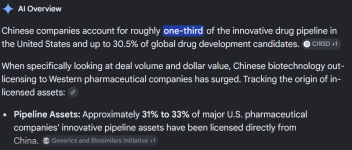
there are very few approved Cancer drugs for sale in the US with Chinese origins.

Meanwhile China uses many US ones.

Cancer1.png
cancer2.png
 
Last edited:
Last edited:
OOO don't get triggered buddy. LOLOL. China has been buying US drugs for years, but US buying chini drugs? Come on, isn't America stronk? Why buy dangerous Chinese drugs? China has no technology right?View attachment 199487
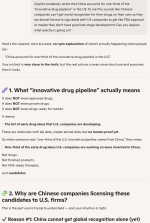
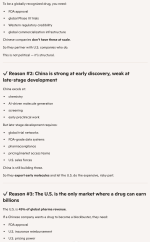
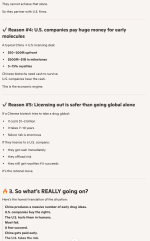
oh so you are dropping your 50% new cancer drug claim now?

Let's see how your newest claim holds up...

ph1.png
ph2.png
ph3.png
ph4.png
 
Last edited:

HANGZHOU, June 1 (Reuters) - U.S. drugmaker Eli Lilly,has entered into an agreement to collaborate on and possibly licence experimental ‌medicines from a unit of Haisco Pharmaceutical Group,with potential payments of up to around $3 billion if milestones are met, the Chinese drugmaker said Monday.


Within hours of securing a gastrointestinal drug from Korea’s Hanmi Pharma, Eli Lilly has ramped up the biobucks for a wider-ranging pact with China’s Haisco Pharmaceutical.

The companies are keeping the details under wraps for now, with Haisco only saying that the agreement spans “up to five innovative target programs” across “multiple therapeutic areas.” Lilly will take the lead on IND-enabling studies and beyond, with the U.S. pharma either owning the global rights or the rights outside of Greater China, depending on the program.

In return, Lilly is stumping up $87 million in upfront and near-term payments, with Haisco also eligible for up to $2.97 billion in additional milestone payments as well as tiered single-digit royalties should any of the resulting therapies make it to market.

“This collaboration is highly aligned with our international development strategy and is expected to generate sustainable value and long-term returns,” Haisco CEO Pangke Yan said in a June 1 release.

“By partnering with a global biopharmaceutical leader such as Lilly, Haisco aims to accelerate the global development of innovative therapies and deliver high-quality treatment options to patients worldwide,” the CEO added.

It’s hard to guess exactly where the Lilly deal will lead. Haisco’s other U.S. Big Pharma partnership this year involved a $745 million deal with AbbVie for a pair of non-opioid pain treatments. The Chinese biotech also licensed a clinical-stage lung disease asset to Frazier Life Sciences’ AirNexis Therapeutics in a $955 million agreement in January.
 
oh so you are dropping your 50% new cancer drug claim now?

Let's see how your newest claim holds up...

View attachment 199494
View attachment 199495
View attachment 199496
View attachment 199498

1780378330129.png
Lolol. Check your answers, we have the idea aka the patent, and you are paying billions?

Sounds like US is having a role reversal, we are the brains and you do the coolie production work? So why isn't US the brains? No more stronk? We are talking BILIONS of $ mate. It starts with a laugh then BYD, Huawei, ZTE came. Then they become angry and use national security as an excuse for protectionism.
 
Last edited:

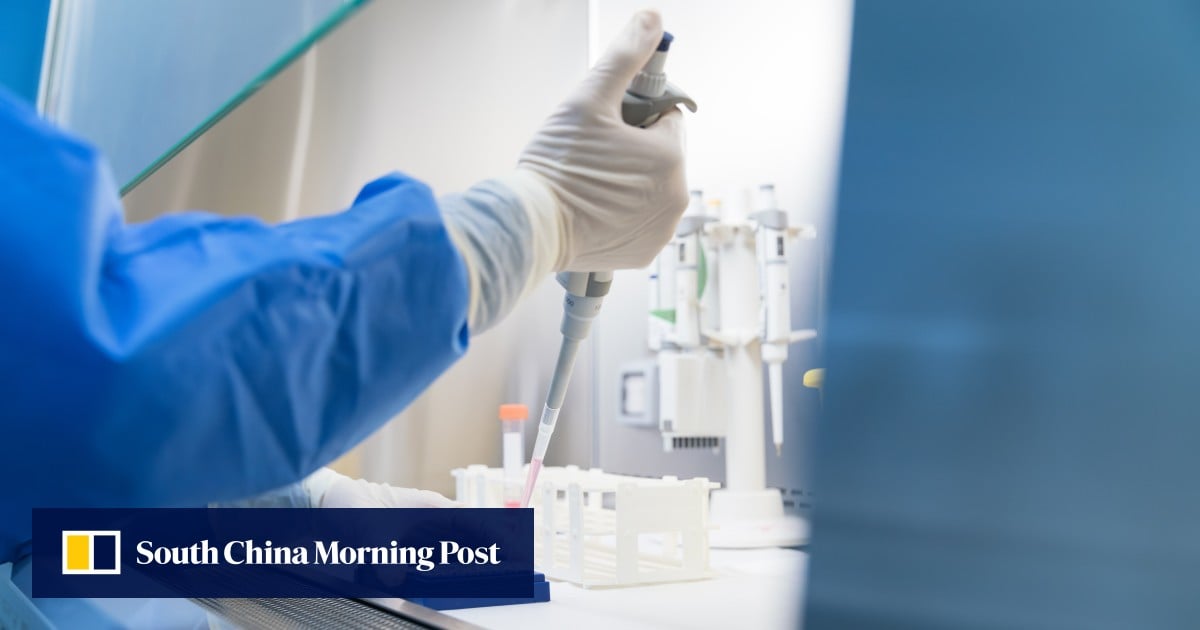
The next tech war? Why biotech may become a new US-China battleground
China’s biotech industry is rapidly moving up the value chain, prompting fears in the US and calls for tighter controls
Published: 7:00pm, 2 Jun 2026

The wide-ranging geopolitical rivalry between Beijing and Washington could soon expand into biotechnology, raising the prospect of fresh tensions even as American pharmaceutical firms have turned to China’s fast-growing industry for new drug candidates.

Biotech in the world’s second-largest economy has long been viewed as a predominantly low-cost manufacturing base with opportunities arising from its vast domestic market. But years of sustained investment, cost advantages and faster development timelines are helping China emerge as a source of innovative medication.

Chinese biotech companies struck cross-border licensing deals worth a record US$60 billion in the first quarter of 2026, according to data from the National Medical Products Administration, a medical supervisory body under the State Council.

So far this year, Chinese firms had accounted for about 69 per cent of the total value of global biotech deal-making, said Cui Cui, head of healthcare research for Asia at Jefferies.

The sector’s rapid ascent has heightened concerns in Washington, where policymakers are already wary of growing dependence on China’s supply chains.
 
May 26, 2026 3:50pm

As large biopharma companies have increasingly turned to China for novel biotech innovation, political calls in the U.S. to block those deals have gotten louder.

By relying on China to fuel pipelines, U.S. pharmas are trading the future of American biotech for short-term profits, Olivia Kosloff, a senior fellow at American Economic Liberties Project, argued in a May 12 op-ed in Stat.

To counter this trend, Kosloff proposed adding biotechnology to the COINS Act, which restricts U.S. outbound investments in certain sensitive tech fields.

As China biotech crackdown calls reverberate in Washington, the pushback gets louder, too​


Lawmakers propose bill to block sale of robots built in China​

By Vaughn Cockayne - The Washington Times - Thursday, June 4, 2026

A bipartisan group of lawmakers introduced legislation to block the importation of robots made in China, as experts sound the alarm over security risks from advanced robots made by U.S. rivals.

The Guarding the U.S. Against Adversarial Robotics Dominance (GUARD) Act would require national security agencies to begin a review process for any humanoid and quadruped robots made by China or other countries.

The legislation was introduced on Wednesday by Republican Reps. John Moolenaar of Michigan and Jay Obernolte of California and Democratic Rep. Jennifer McClellan of Virginia.

Last year, Mr. Moolenaar and every other member of the U.S. House Select Committee on China sent a letter to the Trump administration demanding that Unitree be added to the Pentagon’s 1260H Chinese military companies list, the Department of Commerce Bureau of Industry and Security (BIS) Entity List and the FCC’s Covered List to better reflect its potential security risks to U.S. companies.

The legislation comes as U.S. robotics manufacturers face an uphill battle in competing with Chinese companies. Beijing currently controls roughly 89% of the world’s critical minerals used in the production of advanced robots, meaning U.S. firms heavily rely on Chinese supply chains for their manufacturing needs.

“The GUARD Act is a commonsense step towards protecting our national security, supporting American robotics companies, and ensuring the United States leads in the next generation of trusted robotics technology,” Mr. Obernolte wrote in the release.

Published Mon, Jun 1 20261:00 AM EDTUpdated Mon, Jun 1 20261:45 AM EDT

Nvidia is working with Chinese startup Unitree for a research-focused humanoid robotics system

Nvidia has selected Chinese humanoid robot maker Unitree for the first robotics system the U.S. chipmaker is selling to researchers from Stanford to ETH Zurich, the company announced Monday.

The system combines Unitree’s nearly 6-foot-tall H2 humanoid robot with Nvidia’s Jetson Thor hardware, which includes the company’s advanced Blackwell GPU for on-device artificial intelligence capabilities.
 

Users who are viewing this thread

Back
Top