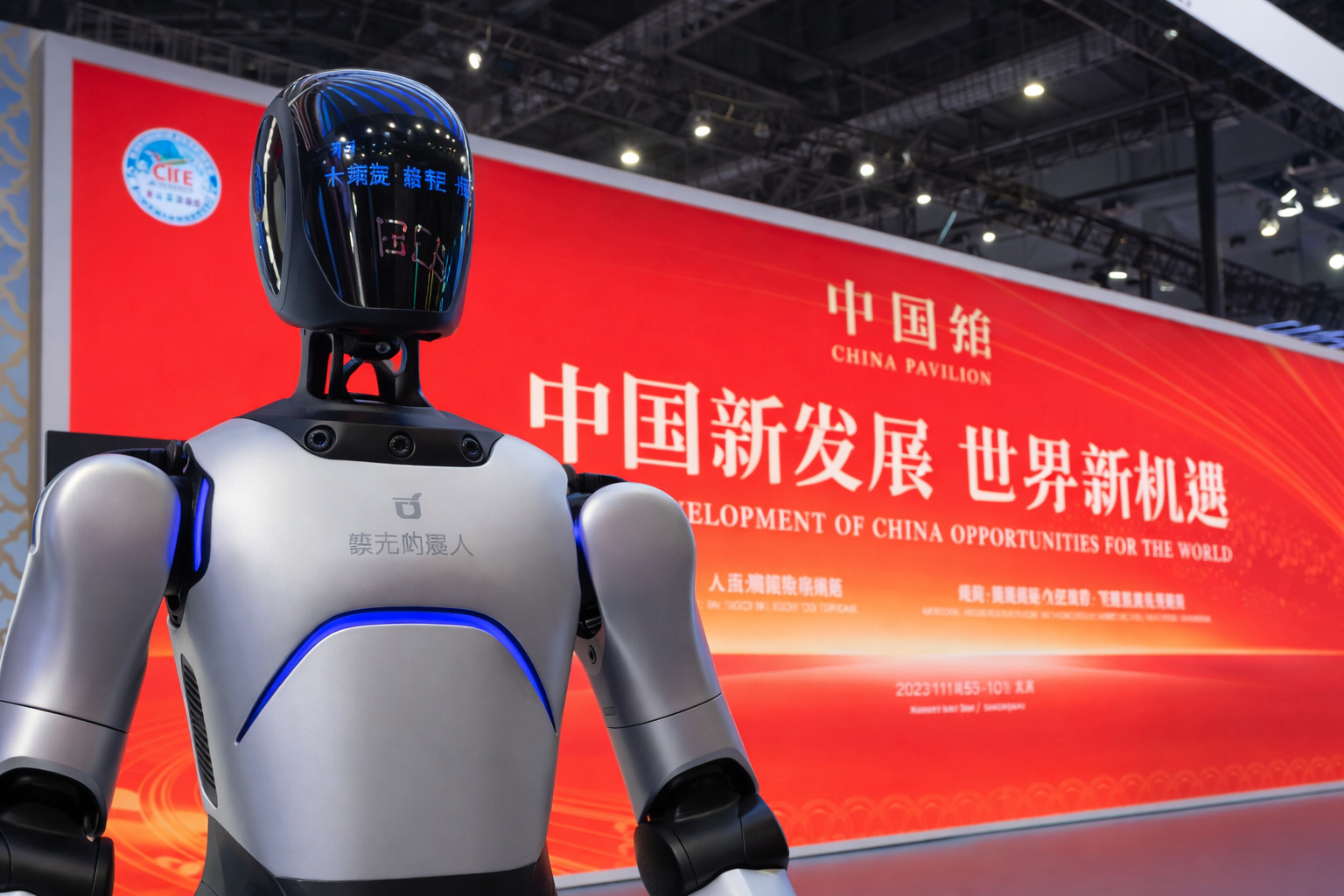
China already manufactures 90% of the world's humanoid robots and surpasses Tesla with ultra-fast logistics that allow it to test, break, and remake in days.
Jefferson Augusto
Published21/02/2026 às 17:42
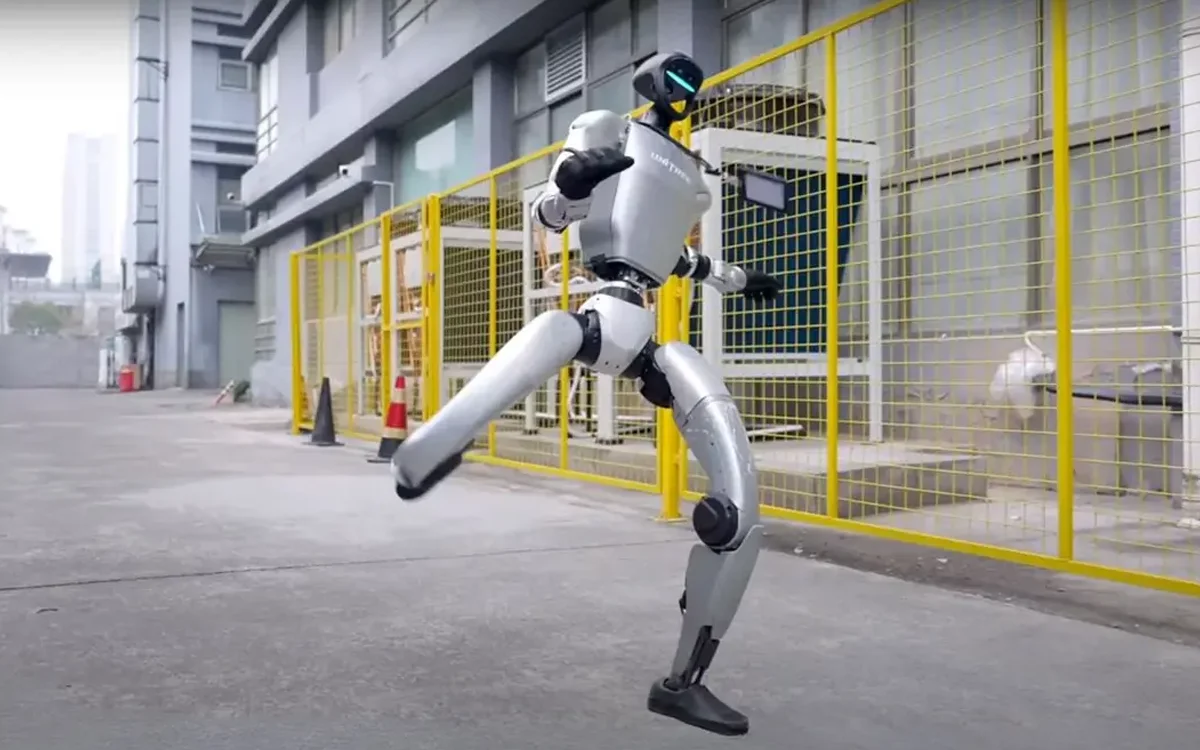
Chinese humanoid robots performing during a Chinese New Year event.
With 13 units sold in 2025 and prices starting at US$13.500, Chinese manufacturers are accelerating development cycles thanks to production chains that deliver parts in days, not weeks.
China already dominates approximately
90% of the global humanoid robot marketHowever, contrary to what many imagine, this leadership cannot be explained solely by state subsidies or technological copying. In practice,
The Chinese advantage lies in something more tangible and less ideological: an
ultra-dense industrial infrastructurecapable of transforming weeks of waiting into just a few days of execution.
The information was released by the portal “Xataka”, which analyzed the most recent figures in the sector and highlighted the strategic role of logistics in the global robotics race.
During the Chinese New Year, for example,
16 humanoid robots from Unitree They danced in front of almost
one billion viewersThe video went viral. Consequently, it reignited the debate: was it...
China Winning solely due to state support? Or is there something deeper behind this progress?
90% of the global market and prices that accelerate innovation.
The numbers are impressive. Em
2025China sent approximately
13 humanoid robots, according to data from the consulting firm
Om Day, published by
BloombergWith this, it consolidated its position as the leading global supplier.
Companies like
Unitree, UBTech and AgiBot They lead in volume. Meanwhile, the
Tesla, with your project
Optimus, implemented internally approximately
800 units during the same period. The difference in scale is significant.
Besides the production, the price is also noteworthy. The model
G1 from Unitree costs around
US$ 13.500. The
Tesla's Optimus must overcome
U.S. $ one thousand 20.
This difference is not merely commercial. On the contrary, it directly influences the pace of development.
With a fixed budget, a Chinese company can test more units, make more mistakes, and correct flaws more frequently. Therefore, every dollar invested generates more learning cycles. And, in humanoid robotics, learning quickly means evolving faster.
The real trump card: ultra-dense industrial hubs
Although the Chinese government has set clear goals for the robotics sector, the structural advantage goes beyond industrial policy. The core of this transformation lies in the manufacturing hubs of...
Pearl River Delta and
Yangtze Delta.
These regions are among the most densely populated on the planet in terms of manufacturing. Motors, actuators, sensors, custom circuit boards, and bespoke components are literally located within a few blocks of each other.
The role of the State and the challenge for the West.
It is true that the Chinese government has invested heavily in robotics. However, attributing success solely to industrial policy ignores structural factors. The United States remains the world's largest venture capital hub, with decades of experience funding high-risk startups.
If the dispute were solely about who has more money, the scenario might be different. However, physical infrastructure isn't built with financial capital alone. It requires integrated supply chains, logistical coordination, and years of consistent investment.
Furthermore, Chinese state capital is not entirely free from pressure. It is often classified as a public asset, which imposes additional liabilities on founders in case of failure. Consequently, some of the resources may be directed to projects considered politically safe, and not necessarily to the most disruptive ones.
Still, the decisive factor remains: the ability to "break and rebuild" quickly.
In the coming years, the world will see more viral videos of Chinese robots performing tasks with increasing fluidity. However, this is not just marketing. It's an environment where prototyping, failing, and improving happen at an accelerated pace.
In hardware engineering, this capability explains almost everything. And, for now, China has built the world's most efficient environment to do just that.
China produces 90% of humanoid robots and leads the market with ultra-fast logistics, surpassing Tesla and the United States by a wide margin.

en.clickpetroleoegas.com.br



 Unitree Robotics
 supercarblondie.com


 www.devdiscourse.com

 www.bolnews.com



 futurism.com