China hits back at Canada with fresh agriculture tariffs

China begins charging port fees for US ships, exempts China-built ones​

By Reuters
October 14, 20258:00 AM GMT+8

Containers at a port in Tianjin

A gantry crane lifts a container at a port in Tianjin, China February 8, 2025. REUTERS/Florence Lo/File Photo

BEIJING, Oct 14 (Reuters) - China has officially started collecting special port fees from U.S.-owned, operated, built, or flagged vessels on Tuesday but said Chinese-built ships would be exempted from the levies, according to state broadcaster CCTV.

The details published by CCTV clarify the specific provisions on exemptions, including for ships built by China, empty ships entering Chinese shipyards for repair, and other ships that are deemed exempted from payment.

China's transport ministry announced last week that it would slap the new port fees as a countermeasure to U.S. port fees on China-linked ships starting the same day.

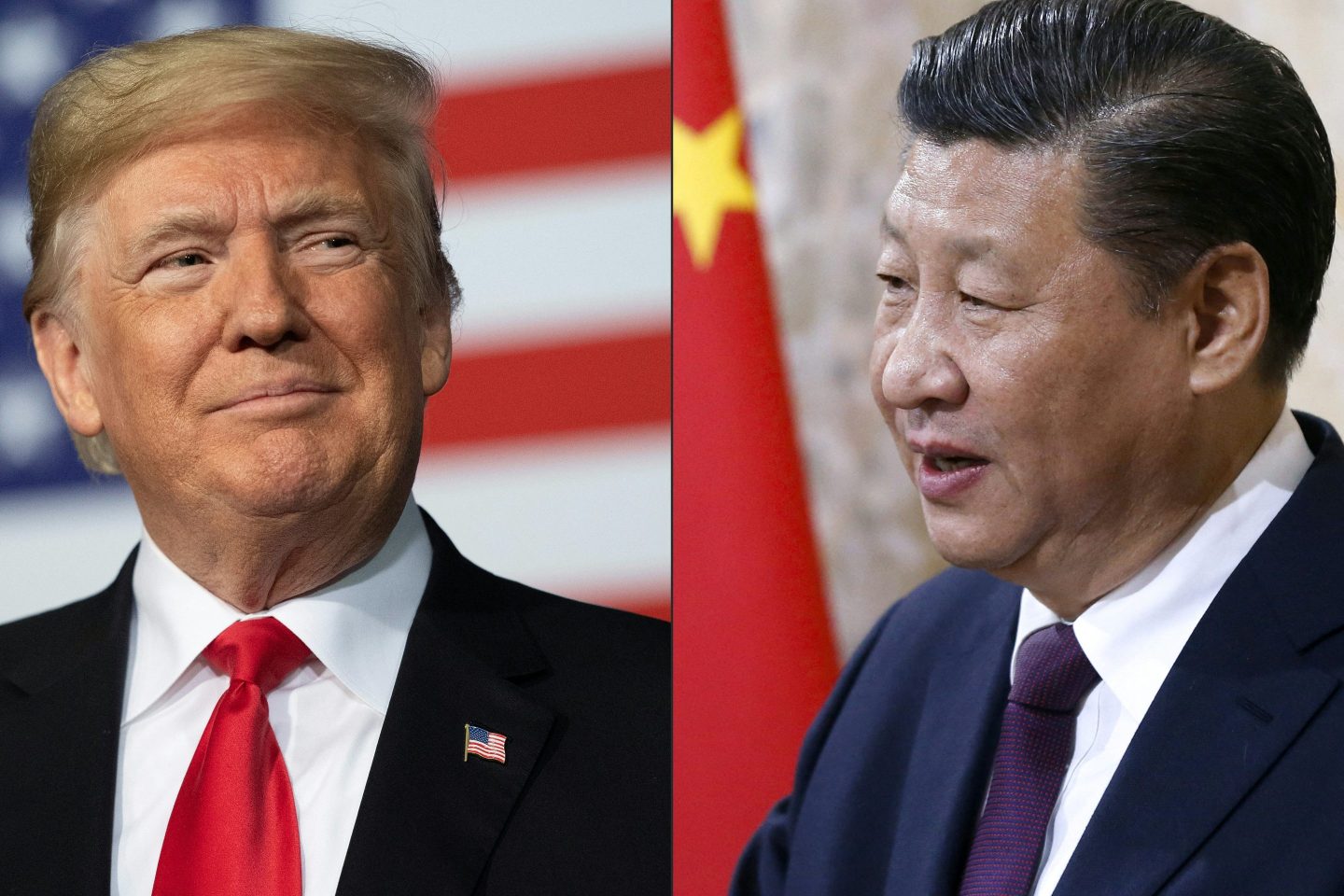
Following the announcement, U.S. President Donald Trump said he was raising tariffs on Chinese imports to 100% from November 1 and imposing export controls on critical software in reprisal for China expanding its export limits on rare earth minerals.

The special port fees will be collected at the first port of entry on a single voyage or for the first five voyages within the year, CCTV said, adding that the annual billing cycle will begin on April 17.


Trump's meeting with Xi appears back on as tone with China softens after tariff threat​

October 14, 20258
WASHINGTON ‒ Treasury Secretary Scott Bessent said he expects President Donald Trump and Chinese President Xi Jinping to still meet in October after Trump threatened to skip their meeting and impose massive tariffs on Beijing in retaliation to new Chinese export controls.

Bessent said Oct. 13 that the Trump administration and China had "substantial communication" over the weekend after Trump threatened to impose a new 100% tariff on imports from China that would take effect Nov. 1.

"He will be meeting with Party Chair Xi in Korea. I believe that meeting will still be on," Bessent said in an interview on Fox Business. "The idea is to give them time to meet and work this out."

Bessent said Trump now believes China's new export controls on rare earth minerals ‒ which triggered Trump's tariff threat ‒ might have come from a "lower-level official," not Xi.

"The Chinese system is quite brittle, so this may not have come from Xi Jinping himself," Bessent said. "This may have come from a Chinese hard-liner. They have hard-liners on their side too who are always trying to undermine the relationship."

Trump, in a post on Truth Social Oct. 12, suggested the situation with China will work out. "Don’t worry about China, it will all be fine! Highly respected President Xi just had a bad moment. He doesn’t want Depression for his country, and neither do I. The U.S.A. wants to help China, not hurt it!!!" the president wrote.

Speaking later to reporters aboard Air Force One on his way to Israel, Trump said: "I think we'll get along just fine. I have a great relationship with China."

The stock market, which tumbled after Trump's tariffs threats, soared on Oct. 13 as Trump and his administration softened the tone with China.

Still, Bessent called it "highly inappropriate" for China to announce the expanded export controls on the same day Trump announced a long-awaited peace deal between Hamas and Israel to end the fighting in Gaza.

"Trying to get leverage before a meeting with Donald Trump is a bad idea, and (Trump) turned the tables," Bessent said. "It was a miscalculation, but we are communicating now. I am confident that we can move forward."

Bessent said Trump administration officials plan to speak with Beijing officials this week, and Bessent plans to speak with his Chinese counterpart, before Trump meets Xi. He said Trump could choose not to move forward with the tariffs.

"The 100% tariff does not have to happen," Bessent said. "The relationship, despite this announcement last week, is good. Lines of communication have reopened, so we'll see where it goes."


Trump bet China would face ‘tremendous difficulties’ without U.S. consumers—Beijing just focused on the rest of the world instead​

BY ELEANOR PRINGLE
October 13, 2025 at 6:48 AM EDT

GettyImages-1212971297-e1760349746190.jpg

  • President Trump’s tariff offensive against China appears to be backfiring as Beijing sidesteps U.S. consumers and boosts exports elsewhere. Chinese shipments to the U.S. plunged 27% in September, but overall exports rose 8.3%—their highest total this year—driven by strong demand from Europe and other markets. The World Bank now expects China’s economy to grow 4.8% in 2025, while it downgraded U.S. growth to 1.4%. Despite Trump’s renewed threat of 100% tariffs, analysts at UBS and Deutsche Bank say both sides appear open to compromise, with markets betting negotiations will resume soon.
At the beginning of his tariff standoff with Beijing, President Trump was confident in his strong hand. China’s economy was reliant on U.S. consumers, he said, and so it would have to make some compromises or risk losing them.

“China has been hit much harder than the USA, not even close,” Trump wrote on Truth Social, the social media site he owns, in April. Later that month, he admitted that while American shoppers may have to cut back on Chinese-produced consumption, the White House’s tariff plan meant the Chinese government was “having tremendous difficulty because their factories are not doing business.”

Six months later and it seems Beijing has simply circumnavigated the U.S. by focusing on increasing its exports to the rest of the world. The diversification has been so successful that China’s export market is actually tracking significant growth despite the trade war.

According to data released by the General Administration of Customs, China’s shipments to the U.S. fell 27% in September, the sixth month of double-digit declines to its once most valuable customer. Meanwhile it charted strong growth to areas like the European Union (currently operating under a 15% tariff rate from the White House), leading to export growth to non-U.S. countries of 14.8%.

The shift away from the U.S. means exports are actually up 8.3% in September compared with a year ago, raking in $328.6 billion—its highest total for 2025 so far.

China’s economy is faring better than expectations outlined back in April, when President Trump first made his tariff plans known. Earlier in the year the World Bank speculated China’s economy would grow 4% in 2025, but last week revised this up to 4.8%. Likewise, it upped its expectations for 2026 from 4% to 4.2%.

Conversely, in June the World Bank cut its expectations for U.S. growth by 0.9 percentage points to 1.4% for 2025.

This backdrop means Trump’s threat last week to impose 100% tariffs on China may not have the potency it once did. Having been relatively successful in sidestepping Trump’s tariffs so far, Beijing responded forcefully to the Oval Office’s threat, blasting it as a “double standard.”

A spokesman for the Ministry of Commerce said: “Frequently threatening high tariffs is not the right approach to engaging with China. China’s position on a tariff war is consistent: We do not want one, but we are not afraid of one.”

Room for compromise​

Having issued the warning—and with both sides still operating under a pause on reciprocal tariffs until Nov. 10—President Trump did then seek to strike a more reasoned tone, and sent futures climbing as a result.

“I think we’re going to be fine with China,” Trump told reporters on board Air Force One yesterday afternoon. “I have a great relationship with President Xi; he’s a very tough man, a very smart man; he’s a great leader for their country, and I have a great relationship with him.

“I think we’ll get it set. I know what happened, I really understand what happened, and I’m not even saying he’s wrong. But then we met him with something much tougher than what he did to us.”

The back-and-forth may simply boil down to showmanship, wrote Deutsche Bank’s Jim Reid in a note to clients this morning: “There’s still plenty of time for negotiations, and I suspect the market will begin to price in a reasonable probability of a deal once the initial shock fades.

“For what it’s worth, Polymarket has the probabilities of the two Presidents meeting by Oct. 31st at 62% this morning, down from a peak of 88% last week but up from around 35% at the lows on Friday night. So there is a belief emerging that this is mostly negotiating tactics on both sides.”

UBS’s Paul Donovan also noted the Oval Office’s appetite for negotiation, telling clients this morning: “Both Trump and U.S. Vice President Vance have made conciliatory noises, which suggests that there may be some kind of retreat from the original threat.

“While the U.S. is obviously not able to publish data at the moment, the trend recently has the two countries’ data showing China selling U.S. more than the U.S. was buying from China,” he added. “That anomaly hints very strongly at rerouting by China to enable U.S. importers to avoid some of the tariffs.”


How China’s threats to clamp down on rare earth exports could wreak havoc on US tech giants, military contractors​

By Thomas Barrabi
Published Oct. 13, 2025, 4:26 p.m. ET

China’s pledge to choke off shipments of rare earth elements could wreak havoc on tech giants like Apple and Tesla as well as big US military contractors – and experts called it a major bargaining chip as Beijing haggles with President Trump over tariffs.

US companies and investors alike are scrambling to assess the impact of Beijing’s announcement that foreign entities must obtain special licenses beginning Dec. 1 to export products containing more than 0.1% of rare earth metals and magnets originating in China.

Stocks rallied on Monday after Trump said relations with China will be “fine” despite the latest dustup. The rebound occurred after Trump’s announcement of a 100% retaliatory tariff on Chinese goods starting Nov. 1 triggered the largest single-day selloff in six months last Friday.

Shares of US-based rare earth mining companies USA Rare Earth, Critical Metals and MP Materials all surged 20% or more on Monday.

China will have “significant discretion to delay, deny, or condition exports” involving advanced technology, according to Gracelin Baskaran, director of the Critical Minerals Security Program at CSIS. The critical minerals are needed to build iPhones, electric cars, drone motors, F-35 fighter jets and Tomahawk missiles.

“The move both strengthens Beijing’s leverage in upcoming talks while also undercutting US efforts to bolster its industrial base,” Baskaran said in a blog post.

It’s unclear how China plans to enforce the rules as US firms scramble to understand how to obtain export licenses and comply with their extreme requirements. Experts have warned for months that those supply chain hiccups will lead to higher prices for Americans buying tech gadgets.

Any license applications for products with military uses are likely to be rejected, China’s Commerce Ministry said. Licenses related to artificial intelligence products and chip production will be reviewed on a case-by-case basis.

Mark A. Smith, the CEO of Nebraska-based rare earths mining firm NioCorp, said he doubts Beijing will give up its strategic leverage even if trade talks go well.

F-35
Rare earths are needed to building F-35 fighter jets.AFP via Getty Images
“I don’t see China negotiating away the dual use export control regime they have put into place for heavy rare earths,” Smith told The Post. “They will say nice things about this not being a ban on rare earth exports, and they will sound accommodating.

“But the People’s Liberation Army will almost certainly ensure that export licenses that could possibly allow [rare earths] to make their way into defense technologies won’t see the light of day,” Smith said.

China, which controls about 70% of global rare earth mining and about 90% of processing capabilities, has steadily cut off access in recent years amid rising tensions with the West.

In April, China snarled worldwide shipments and left Western companies scrambling after it abruptly announced a separate set of licensing requirements on rare earth magnets.

An employee uses Apple's new iPhone 17 smartphone, which is demonstrated in a store during preparations for the series' launch of sales in Moscow, Russia, September 20, 2025.
An employee uses Apple’s new iPhone 17 smartphone, which is demonstrated in a store during preparations for the series’ launch of sales in Moscow, Russia, September 20, 2025.REUTERS
Meanwhile, the US has imposed restrictions on sales of advanced computer chips, such as those sold by Nvidia, due to national security concerns.

As The Post reported, many experts fear that China could implement a total embargo if diplomatic tensions take a more serious turn – such as in the event of an invasion of Taiwan.

Aside from its shipment restrictions, China said it would limit exports of technologies related to mining, smelting, recycling and magnet-making – making it more difficult for the US and other countries to ramp up domestic production.

The rules were announced just weeks before Trump and Chinese President Xi Jinping are set to meet on the sidelines of the Asia-Pacific Economic Cooperation forum in South Korea. Trump has threatened to cancel that meeting.

“China’s latest round of export-rule tightening underscores what manufacturers have long known: The US must increase and fortify its domestic critical minerals supply,” said Michael Davin, director of energy and resources policy at the National Association of Manufacturers.

 
U.S. Vulnerability Exposed as China Dominates 91% of Rare Earth Market

U.S. Security Held Hostage by Chinese Rare Earth Monopoly​

With 91% of global refined rare earths from China, U.S. defense and tech sectors face critical supply risks

By Choi Eun-kyung,
Cho Jae-hyun
Published 2025.10.14. 00:53Updated 2025.10.14. 10:52

As China announced additional "rare earth export control" measures on the 9th, U.S. President Donald Trump immediately condemned Beijing and warned of retaliatory tariffs as high as 100%. However, he reversed his stance just two days later. This shift underscores rare earths as a critical vulnerability for the United States, analysts say.

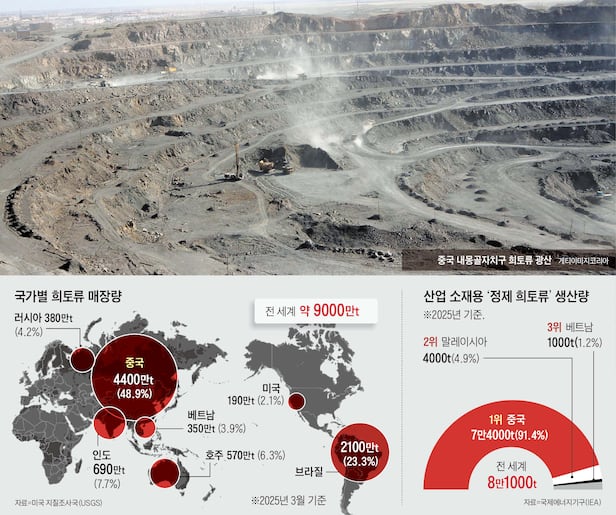
China’s dominant position in global rare earth reserves and production is no secret. During Trump’s first term, Beijing warned of weaponizing rare earths. Yet the U.S. failed to prepare adequately, leaving its core industries—advanced weaponry, electric vehicles, and semiconductor production—with few stable supply options.

4PM5R74QSZGC5HXMGSG3KZZDXA.jpg


**◇Advanced Industries and Security Held Hostage by the U.S.**

According to the U.S. Geological Survey, U.S. rare earth production in 2024 reached approximately 45,000 tons, the world’s second-largest output, but lagged far behind China’s 270,000 tons. Most of this is still sent to China for processing due to a lack of refining and processing facilities.

In 2019–2020, 100% of rare earth compounds and metals consumed by the U.S. were imported, with Chinese imports accounting for roughly 70%. For seven heavy rare earth elements—samarium, dysprosium, gadolinium, terbium, and yttrium—subject to Chinese export permits, 80–90% originate from China.

Rare earth restrictions target advanced industries and security. The U.S. Department of Defense estimated in April that F-35 fighter jets and Arleigh Burke-class Aegis destroyers (DDG-51) require 400 kg and 2,400 kg of rare earths, respectively. Aviation engines and electric motors need magnets made from samarium, which withstand high temperatures while generating strong magnetic forces. Radar systems and guided missiles face similar dependencies. According to the New York Times (NYT), the U.S. previously imported samarium from China and manufactured military-grade rare earth magnets domestically or with allies. However, Beijing’s tightened export controls on military-use rare earths have made this approach untenable. Effectively, U.S. security and industrial capabilities are held hostage by Chinese rare earths.

After the first U.S.-China trade war in 2018–2019, the Pentagon-led effort to secure rare earth supply chains made little progress. The only operational U.S. rare earth mine is California’s Mountain Pass, which closed in 2002 due to environmental concerns and reopened in 2018. To counter Chinese weaponization, the U.S. government acquired a 15% stake in Mountain Pass’s operator in July and agreed to purchase its output at twice the market price. Yet the mine’s target annual production of 1,000 tons of rare earth permanent magnets remains less than 1% of China’s output.

**◇China Dominates Rare Earth Mining Industry**

Rare earths are globally abundant, with China holding about 49% of reserves. The issue lies in processing: separating and refining mixed ores into high-purity products requires toxic chemicals, heavy metals, and radioactive materials. This explains why Western nations have outsourced rare earth extraction to China.

Since the 1990s, Beijing has pursued a strategy to develop rare earths as "China’s oil," now controlling the global supply chain for rare earths and critical minerals. Lee Won-ik, a deputy research fellow at the Science and Technology Policy Institute, noted that while China has over 30 universities training rare earth professionals, the U.S. and Europe have virtually none.

Japan, which faced a Chinese rare earth export ban during the 2010 Senkaku Islands (Diaoyu Islands) dispute, launched a national campaign to reduce dependence. It developed new technologies to minimize rare earth use, alternative materials, and recycling methods to recover rare earths from discarded electronics. Investments in overseas mines, such as in Australia, and stockpiling followed. These efforts reduced Japan’s reliance on Chinese rare earths from over 90% in 2010 to around 60% today. Lee Won-ik added that countering China requires long-term supply chain diversification, demand reduction, and recycling technologies—areas where the U.S. has lagged.

**☞Rare Earth Elements**

Rare earth elements (REEs) include 17 elements: the 15 lanthanides from lanthanum (La, atomic number 57) to lutetium (Lu, 71), plus scandium (Sc) and yttrium (Y). Dubbed the "vitamin of advanced industries," they are used in electric vehicle motors, secondary batteries, semiconductors, wind power turbines, and missile systems. China accounts for 91% of global refined rare earth production.


Wall Street thinks Trump will be forced to make a deal for China’s rare earth minerals​

BY JIM EDWARDS
October 13, 2025 at 6:01 AM EDT

  • Wall Street is bullish on U.S. stocks this morning, with S&P 500 futures strongly up, premarket. Traders seem to think that Trump will eventually be forced to make a trade deal with China that keeps rare earth materials and AI chips flowing between the two.
S&P 500 futures are strongly up this morning after the index fell by 2.71% on Friday, when investors reacted with dismay to President Trump’s threat to impose a new set of 100% tariffs on China. The reversal in favor of optimism this morning suggests investors now think Trump will eventually chicken out and Washington and Beijing will come to a deal.

Trump may not have a choice: China holds an unexpectedly strong hand in the trade war.

Trump’s tariff threat came after China announced it would impose export controls to the U.S. on rare earth minerals. China controls up to 90% of the rare earth market, and the minerals are needed by the West for everything from high-powered magnets to defense equipment to semiconductor computer chips.

Trump had previously placed export restrictions to China on Nvidia’s best-quality AI chips. In retaliation, China ordered companies to stop ordering Nvidia chips and began customs inspections to ensure they were not entering the country.

A rare earth ban would make life extremely difficult for U.S. tech companies if Trump can’t negotiate an alternative, according to Dean Ball, a former senior advisor in the White House Office of Science and Technology Policy. “We should not miss the fundamental point on rare earths: China has crafted a policy that gives it the power to forbid any country on Earth from participating in the modern economy,” he wrote on X over the weekend.

With the two nations apparently at an impasse, and China potentially holding the upper hand, investors bailed out of U.S. stocks on Friday. By Sunday, Trump apparently felt he needed to soothe everyone’s nerves with a post on Truth Social: “Don’t worry about China, it will all be fine! Highly respected President Xi just had a bad moment. He doesn’t want Depression for his country, and neither do I. The U.S.A. wants to help China, not hurt it!!!”

There is good reason to believe that Trump and Xi will eventually work things out. U.S. tariffs on China (currently suspended) don’t actually come into effect until Nov. 10, and Trump and Xi will likely both be at the Asia-Pacific Economic Cooperation summit that starts on Oct. 31. China would like to renew access to Nvidia’s products, and Trump loves to make a deal, especially if he can do so face-to-face.

 
As the Sino-US game escalates, Trump wants to increase his leverage! US experts warn: China still has three trump cards


"Rare earths aren't China's only trump card. American experts have pointed out that China still holds three key trump cards: pharmaceuticals, biotechnology, and chemicals. CNN data shows that 80% of amoxicillin's raw materials come from China, and 90% of ibuprofen's supply comes from China. If China were to halt supply, American hospitals and pharmaceutical companies would be left floundering. This isn't an exaggeration; whoever controls pharmaceutical raw materials can dictate the other's lifeline."

"Trump often claims that the US has more leverage, but in reality, many of its "cards" are replaceable. For example, without Boeing, aircrafts can be bought from Airbus, and the world has other options when it comes to software controls. But China's rare earth and pharmaceutical raw materials are truly unique. American media even say that China could shut down the US economy at any time, and the US would be powerless to do anything about it."


Trump and cronies want more trade and tech wars with China ?
 
Last edited:

Trump Downplays China Dispute - Rare Earths May Force Quick Concessions​

Oct. 13, 2025 9:02 AM E

Summary

  • Investors need to keep a close eye on markets as trade tensions between China and the United States escalate. That said, I don't believe investors need to exit the market.
  • Escalating U.S.-China trade tensions over rare earths and tariffs have rattled markets, but a quick de-escalation remains possible given political and economic pressures.
  • China's dominance in heavy rare earths creates a global supply chokehold, making diversification challenging and raising risks for U.S. defense and tech sectors.
  • Investors should stay vigilant amid volatility; select stocks may present buying opportunities if tensions ease, but prolonged conflict could deepen economic headwinds.
 

China's Silence Is Scarier Than Tariffs—5 Ways It Could Hit Trump Hard​

October 13, 2025 8:04 AM

In the latest escalation of U.S.–China trade tensions, President Donald Trump has gone loud. A 100% additional tariff on all Chinese exports. New export controls targeting critical software. A flurry of posts on Truth Social promising strength and stability. But while Washington roars, Beijing whispers. And that whisper—China's strategic silence—is more unnerving than any retaliatory headline.

Because when China doesn't respond with matching firepower, it's not backing down. It's calculating. And that calculation could reshape global markets, supply chains, and geopolitical alliances in ways far more disruptive than a tariff tit-for-tat.

While Trump's tone on China appeared to soften over the weekend, hinting at optimism and downplaying the risks, risks surrounding Washington's trade relations with Beijing remain very much alive.

Here are five ways China might strike back—quietly, precisely, and painfully.

1. Rare Earth Chokehold 2.0​

China already tightened exports of rare earths—the minerals essential to EVs, semiconductors, and defense systems. But the next move could be far more surgical: targeted bans on refined materials like gallium and germanium, or export licenses that mysteriously never get approved.

That wouldn’t be just a supply chain hiccup—it would be a strategic stranglehold. In such a scenario, U.S. manufacturers could face multi-quarter delays, price spikes, and forced redesigns. For Trump, it would undermine the "Made in America" narrative and hit swing-state industries where it hurts.

2. Regulatory Slowdowns For U.S. Firms

China doesn't need tariffs to retaliate. It can simply slow things down. Approvals for U.S. companies operating in China—Apple, Tesla, Starbucks—could take longer. Audits could become more frequent. Local partnerships could face new scrutiny.


Such moves are hard to headline, but corrosive over time. They tend to weaken corporate confidence, stall growth, and rattle markets. And they can do it without a single press release.

3. Yuan Management As A Pressure Valve

Rather than devalue the yuan outright, China could subtly adjust its midpoint rate, creating currency volatility that disrupts trade flows and investor sentiment. That would force the Federal Reserve into a corner—tighten to defend the dollar, or loosen to support growth?

Either way, it complicates Trump's economic messaging. Inflation control becomes harder. Market stability becomes elusive. And the narrative of "strong leadership" starts to wobble.

4. Quiet Divestment From U.S. Treasuries

China holds over $800 billion in U.S. debt. It doesn't need to dump it overnight. It can simply stop reinvesting, let maturities expire, and gradually reduce exposure.

The result? Yields rise. Borrowing costs increase. Deficit pressure mounts. And Trump's fiscal optics—already strained—start to crack. It's a slow bleed, not a headline-grabbing blow. But it's no less lethal.

5. Soft Power Realignment

China could accelerate trade deals with BRICS, ASEAN, and the EU, positioning itself as the "stable alternative" to U.S. unpredictability. It's not just economic—it's diplomatic. And it reshapes the global trade architecture.

For Trump, it's a loss of leverage. For the U.S., it's a step toward isolation. And for China, it's a quiet win on the world stage.

The Bottom Line

China's silence isn't passive—it's psychological warfare. By refusing to retaliate loudly, Beijing keeps Washington guessing, Wall Street nervous, and global allies watching. The real retaliation may not come with tariffs—it may come with precision strikes across supply chains, markets, and alliances.

And that silence? It's not weakness. It's strategy. And it's scarier than any tariff.


China denies link between its new rare-earth curbs and Pakistan's gift to Trump​

Oct 14, 2025, 08:05 IST

BEIJING: China on Monday said that its move to clamp strict restrictions on exports of rare-earth minerals and their technologies blaming foreign firms for their misuse has no link to Pakistani leaders presenting the precious metals to US President Donald Trump.

Beijing's ironclad friendship with Pakistan remained intact despite Islamabad developing close ties with Washington, Chinese Foreign Ministry spokesperson Lin Jian said."China's recent announcement on export control measures concerning rare-earths and related items has nothing to do with Pakistan," Lin told a media briefing here answering a question from state-run Global Times.

"The reports you mentioned are either unaware of the facts, or are based on speculation, or are intended to sow discord. They are groundless," Lin said.China, which virtually holds a monopoly over the rare-earth materials, last week announced further export controls for mining and processing the minerals alleging unnamed foreign firms of using its supplies for military purposes.

This is the second set of restrictions.Beijing's move angered Trump who threatened 100 per cent tariffs against Chinese goods.China accounts for about 70 per cent of the world's rare-earths mining but at the same time controls about 90 per cent of their processing which makes it virtually the sole supplier of the precious metals used in a host of modern equipment, including automobile, electronics, wind energy and defence.

China's rare-earth metals are much in demand as the US, the European Union and India are its top importers.A photo showing Pakistan army chief Field Marshal Asim Munir along with Prime Minister Shehbaz Sharif presenting a box which reports said were samples of rare-earth materials trigger speculation that the new measures announced by China blaming foreign firms misusing China's exports of raw-materials was attributed to Pakistan.Pakistan also reported to have sent first shipment of these metals to the US.

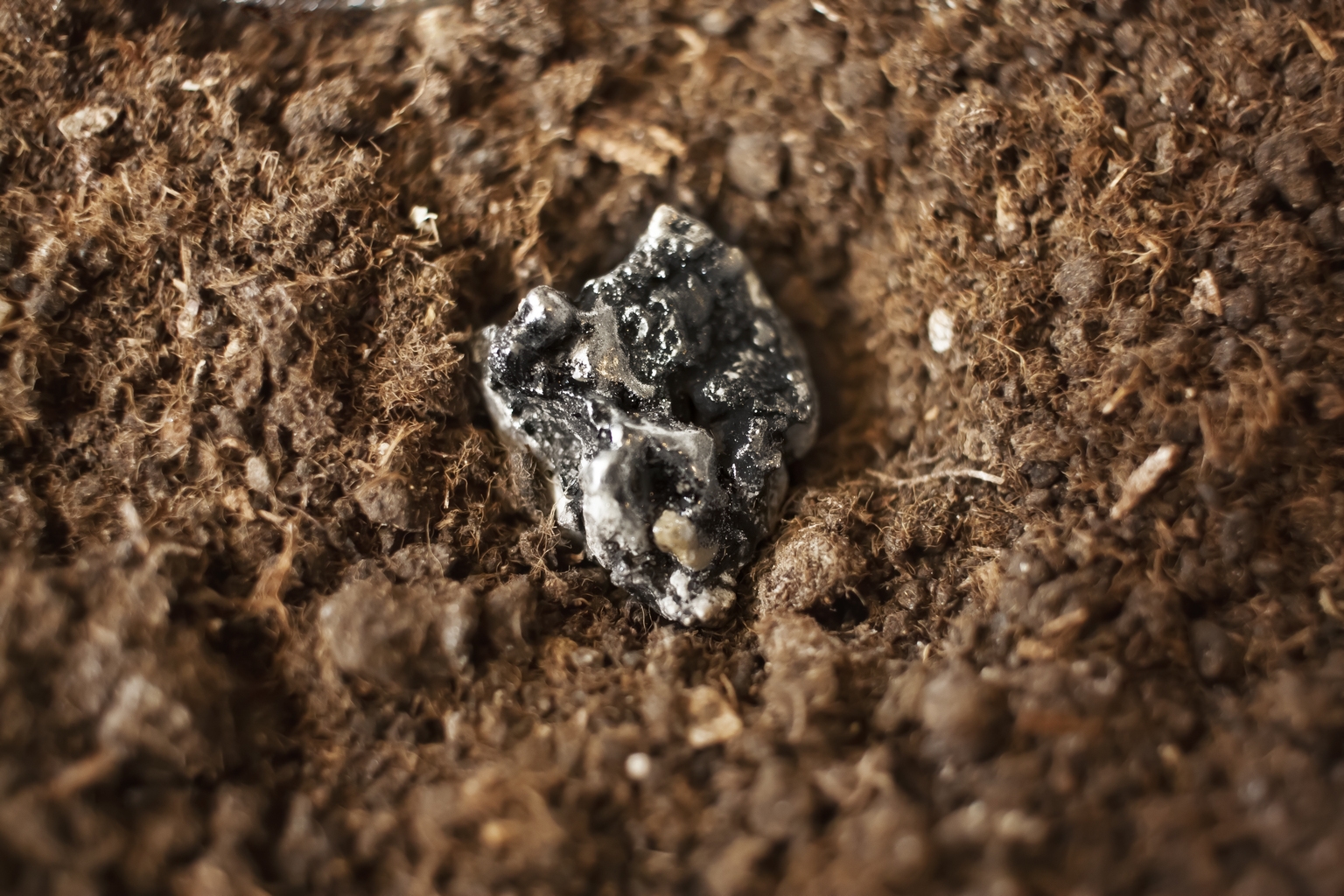
He said the box of raw stones presented to Trump by Gen Munir were not rare-earths but gem ores."From what I've learned, the two countries have been in communication on Pakistan-US mining cooperation. Pakistan stressed that its business with the US will never harm China's interests or its cooperation with China," Lin said."The samples that the Pakistani leaders showed and gave to the US leader are gem ores purchased by staff in Pakistan.

The reported stories that you mentioned are either misinformed or invented, or even designed to drive a wedge between China and Pakistan. They are just baseless," he said.Lin said China and Pakistan are all-weather strategic cooperative partners."Our iron-clad friendship has stood the test of time.

The two countries have maintained high-level strategic mutual trust and close communication on major issues concerning each other's common interests," he said.Lin said China's recently released export control measures are a legitimate action by the Chinese government to refine its export control system in accordance with laws and regulations.It aims to better defend world peace and regional stability and to fulfil non-proliferation and other international obligations, he said.
 
If Pakistan uses Chinese technology and equipment to process the critical minerals it implies a tacit approval and control by China. It's like controlling their supplies by other means....
 
Godi media were on a leash to spread these bullshits and later picked up by traffic hunger Chinese social media big V accounts which forced the MOF clarified
 
Godi media were on a leash to spread these bullshits and later picked up by traffic hunger Chinese social media big V accounts which forced the MOF clarified
This is also a good thing. Although the Pakistan and the Chinese upper-level government have communicated, the inevitable public opinion will affect the decision of one side. From this, we can see that China has reiterated the red line area. The purpose is to let external friends know that they should not be influenced by public opinion.
Don't do anything against friendship. The brotherhood that has been built over the decades has not come easily.
 
okya, then I'll change it to a way that a Vietnamese can understand.

For example, the various dynasties of China.

The reason for fall of the Qin and Sui dynasties was the exhaustion of soldiers and the frequent launching of wars.

The reason for the fall of the Han and Jin dynies was the monopoly of power by political families and the social hierarchy.

The reason for the fall of the Tang Dynasty was the military-industrial complex and eunuchs gaining power.

The reason for the fall of the Song and Ming dynasties was the deterioration of factional politics, which tore apart society.

The reason for the fall of Qing Dynasty was the refusal to trade with foreigners and the spread of drugs.

Ah, now there is a country that has stepped on all the landmines in our history What do you think Chinese who are familiar with history will think of this country?
You can’t compare the collapse of Chinese dynasties to projected collapse of US imperialism. That’s a misjudgment. Different shoes. As for politics, Trump will go out of office in 3.5 years. There will be a change towards the left wing. US military complex, US companies will remain intact, untouched whoever in the White House. You compare that to Putin’s Russia and Kim’s North Korea. Those countries with one man rule.

The fall of Ming dynasty had much to do with the rise of the Mongol, so the Qing with rise of the West, with Japan imperialism. those Chinese emperors or the Eunuchs failed to see the tide coming. But anyway to be correct, any Chinese dynasty lasted hundreds of years. That’s a long time. A change in the top is not unusual. Viet Nam had many changes in the top, too thru history.
 
You can’t compare the collapse of Chinese dynasties to projected collapse of US imperialism. That’s a misjudgment. Different shoes. As for politics, Trump will go out of office in 3.5 years. There will be a change towards the left wing. US military complex, US companies will remain intact, untouched whoever in the White House. You compare that to Putin’s Russia and Kim’s North Korea. Those countries with one man rule.

The fall of Ming dynasty had much to do with the rise of the Mongol, so the Qing with rise of the West, with Japan imperialism. those Chinese emperors or the Eunuchs failed to see the tide coming. But anyway to be correct, any Chinese dynasty lasted hundreds of years. That’s a long time. A change in the top is not unusual. Viet Nam had many changes in the top, too thru history.

The reason for the fall of the Ming Dynasty was the vicious party strife. The reason for the fall of the Qing Dynasty was the closeddoor policy and the widespread drug problem. The external enemies of the Ming and Qing Dynasties were not the main cause, but only the inducement. Any empireishes due to internal problems, and foreign enemies only kick down the last straw of a broken house.
 

Users who are viewing this thread

Country Watch Latest

Latest Posts

Back
Top