China hits back at Canada with fresh agriculture tariffs

The US is backing their trade war hand with fake economic data or no data to show booming economy in the US. Meaning the US has no real cards. It has to say it has 4 aces until China believes it, folds, and US wins.

US does not want China to stockpile metals.

US is stockpiling metals,

Pentagon Looking to Buy $1 Billion in Critical Minerals, FT Says​

The increased purchases come as new export controls of rare earths and other key materials for defense and technology manufacturing were unveiled by China’s Ministry of Commerce last week.

Stockpile metals. Also China is rich in REM, stockpile metals that hurt the US. US elites place huge bets on metals to suppress the prices, if you cause a shortage, their entire system collapses. The price is not the concern, shortages are the concern, as in REM shortages. It is why Western banks and central banks have been buying since Trump got into the White House and before, to prepare a hoard for the trade war to sell into higher prices. I think it is obvious which metals are inversely related to the solvency of the dollar.
 
I am simply astonished at the braindeadness of the global public. Trump starts a trade war on China with 100% tariffs and duped public believe Chinese responses to that make the US the victim. This means China has to stand up for themselves. It means China has to stand up to this bullying or face worse bullying.
 
Authors : Harsh V. Pant | Kalpit A Mankikar

Originally Published Mint
Published on Oct 16, 2025

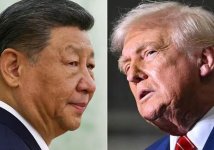
1760614304_img-china-us.jpg

Beijing is tightening its clamps on components that are integral to technology supply chains. Lithium batteries and related material, artificial diamonds that have industrial uses and rare earths like holmium, erbium, thulium, europium and ytterbium have been put on China’s export-control list.

This development comes on the heels of samarium, gadolinium, terbium, dysprosium, lutetium, scandium and yttrium being added to that list this year.

To comprehend the extent of the curbs and China’s supply stranglehold, take dysprosium, which is used in semiconductors. China refines 99% of this rare earth; a facility near Shanghai under its ministry of land resources accounts for the entire world’s production. In what constitutes Beijing’s extra-territorialization of domestic laws, entities making products that require such Chinese inputs will need a licence before their output is sold to a third country.

For instance, Beijing is seeking commitments from New Delhi that the rare earth magnets supplied by it will be used solely to fulfil domestic needs.

China had introduced export curbs in December 2020 with its Export Control Law. This law prohibits the export of advanced technology and materials deemed strategic to specific companies, and allows the Chinese government to act against nations that violate its national security or “interests." John Moolenaar, chairperson of the US Select Committee on China, has likened Beijing’s latest rare-earth curbs to an “economic declaration of war."

In a related development, Canadian firm TechInsights and others have been added to China’s list of ‘unreliable entities’ that seeks to penalize “entities that hurt the commercial interests of Chinese companies." Such companies could face trade restrictions, an investment ban in China and a bar on the entry of their employees to the country.

TechInsights, a provider of data related to advanced technology and intellectual property, has been banned from dealing with organizations or individuals in China. It allegedly unearthed Chinese tech major Huawei’s dependence on foreign semiconductors and revealed the identities of its hidden suppliers.

Since 2019, Washington has placed Huawei on a blacklist that prohibits chip-makers that do business with the US from working directly with it. Huawei has been spearheading Beijing’s drive to develop domestic alternatives to foreign chips and its action against TechInsights shows that it will seek retribution against firms that get in the way of its tech self-reliance mission.

Beijing has justified these expanding export-control measures by stating that many of these items have military applications and it is merely protecting its national security and interests. It has also signalled that it looks forward to using bilateral negotiations and other exchange mechanisms to discuss its rules.

Beijing announced its policy revision just days ahead of a meeting between US President Donald Trump and Chinese President Xi Jinping scheduled at the end of October. Its export-supply aggression reveals an intention of using important industrial and technological inputs as leverage. Sure enough, Trump responded with a threat to levy an extra 100% tariff on Chinese imports over and above the 30% already in place.

While the Chinese onslaught escalates Beijing-Washington tensions, it also highlights the unpredictability in the dynamics between Xi and Trump. Earlier this year, Trump had threatened to slap an unprecedented 145% import levy on Chinese goods. In turn, Xi had responded with a 125% retaliatory tariff. Several rounds of talks led to a truce and many extensions to it, with US tariffs on Chinese products settling at 30% and Chinese levies on American goods at 10%.

In September’s round of talks in Madrid, both sides seemed to make progress, arriving at a “basic framework" over control of social-media app TikTok, although the pricklier issue of tariffs was pushed down the road for the next round of talks.

The Trump administration gave TikTok another lease of life to operate in the US, with Bytedance—the company that owns this popular video-sharing app—getting time until 16 December to transfer control to an American entity.

The Trump administration had earlier cited national security considerations in seeking ByteDance’s divestment, yet kept dawdling over the deadline. A key factor behind Trump’s leniency towards TikTok was that his popularity among its users had grown. This could also have led Beijing to drop its reservations against the divestment and use it instead as a strategic lever.

Earlier, the resolve of America’s tech-export curbs against China seemed to be weakening after Trump took a policy U-turn to allow the sale of Nvidia’s AI chips.

Former US president Richard Nixon wrote in his autobiography that Communist leaders believed in Vladimir Lenin’s principle: Probe with bayonets, and if you encounter mush, proceed; if you encounter steel, withdraw.

In his pursuit of a trade deal, Trump seems to be reversing his China policy bit by bit. Xi is better prepared with a retaliatory arsenal for this trade war 2.0. He has not only revealed a capacity to throw his adversary off balance, but appears to be encountering mush.
 
If high end semiconductors cover 20% high tech industries, rare earth materials cover 90%.
 
When we reason with the United States, he's playing you a hooligan. When we're playing a hooligan with America, he's talking to you about the law. Normal people can no longer understand Trump's ever-changing policies. My friend once asked me who do you think this American stock god is, and my answer was Buffett. He can accurately predict the next step. My friend pointed out my mistake. Buffett needs to at least look at the financial statements and the trend of the K-line chart. And Trump directly drew the K-line in the blank space, his drawing is the only stock market trend, he is the stock god.
My friend's very humorous expression reminds me of a mental patient drawing time on his wrist and asking if it's right, you better not argue with a mental patient.
 
Last edited:
Trump first hit China with a stick, and China immediately hit Trump back with a stick.

Trump was stunned, suspecting that there was something wrong with the stick.

So Trump hit the EU, Japan, South Korea, and India with the stick, confirming that there was nothing wrong with the stick.

Then Trump hit China with the stick again This time, China hit Trump twice with the stick, and then hit the EU, Japan, South Korea, and India as well.

Trump cried, complaining on X that China bullied the whole world.
 
IMO any effects of these control measures would be temporary. US, Britain, France, Germany, Australia, Japan and other such countries that are US aligned still hold enough manpower, economic might, industry, and all the things required to eventually develop an alternative together.
It's similar to when US/West tried to cut off Huawei...and it was a temporary setback. The same is happening with US/West cutting off China from the latest chips...it's a temporary setback and China will eventually find a way to go it alone.

The same would happen in this case as well...US/West will have to find a way to mine, process, and purify rare earth metals.

IMO keeping ur adversary dependent on u...is what weakens them. When u cut them off and force them to be self reliant and innovate on their own..that's when u make them stronger...
...in the long term.
Beijingwalker
 
Last edited:
IMO any effects of these control measures would be temporary. US, Britain, France, Germany, Australia, Japan and other such countries that are US aligned still hold enough manpower, economic might, industry, and all the things required to eventually develop an alternative together.
It's similar to when US/West tried to cut off Huawei...and it was a temporary setback. The same is happening with US/West cutting off China from the latest chips...it's a temporary setback and China will eventually find a way to go it alone.

The same would happen in this case as well...US/West will have to find a way to mine, process, and purify rare earth metals.

IMO keeping ur adversary dependent on u...is what weakens them. When u cut them off and force them to be self reliant and innovate on their own..that's when u make them stronger...
...in the long term.
Beijingwalker
Matter of fact, China imposed rare earth sanction to Japan in 2012 for island dispute. Of course this sanction didn't last long. But it's an alarm for, not just Japan, also US. They realized their dependency on Chinese materials is dangerous. From that time, we always heard news about how US tried to get rare earth materials from other countries like Australia, Mongolia. Japanese and othe western countries did try their best to find rare earth purification measures. But more than 10 years have passed. Seems there is no big breakthrough.

On the other hand, China was very optimistic to the business relationship with US before 2018. The tough measures US imposed to China are out of Chinese expectation. China decided to establish its own semiconductor ecosystem from 2018. And till today China almost acchieved its goal.
 
Authors : Harsh V. Pant | Kalpit A Mankikar

Originally Published Mint
Published on Oct 16, 2025

View attachment 154426

Beijing is tightening its clamps on components that are integral to technology supply chains. Lithium batteries and related material, artificial diamonds that have industrial uses and rare earths like holmium, erbium, thulium, europium and ytterbium have been put on China’s export-control list.

This development comes on the heels of samarium, gadolinium, terbium, dysprosium, lutetium, scandium and yttrium being added to that list this year.

To comprehend the extent of the curbs and China’s supply stranglehold, take dysprosium, which is used in semiconductors. China refines 99% of this rare earth; a facility near Shanghai under its ministry of land resources accounts for the entire world’s production. In what constitutes Beijing’s extra-territorialization of domestic laws, entities making products that require such Chinese inputs will need a licence before their output is sold to a third country.

For instance, Beijing is seeking commitments from New Delhi that the rare earth magnets supplied by it will be used solely to fulfil domestic needs.

China had introduced export curbs in December 2020 with its Export Control Law. This law prohibits the export of advanced technology and materials deemed strategic to specific companies, and allows the Chinese government to act against nations that violate its national security or “interests." John Moolenaar, chairperson of the US Select Committee on China, has likened Beijing’s latest rare-earth curbs to an “economic declaration of war."

In a related development, Canadian firm TechInsights and others have been added to China’s list of ‘unreliable entities’ that seeks to penalize “entities that hurt the commercial interests of Chinese companies." Such companies could face trade restrictions, an investment ban in China and a bar on the entry of their employees to the country.

TechInsights, a provider of data related to advanced technology and intellectual property, has been banned from dealing with organizations or individuals in China. It allegedly unearthed Chinese tech major Huawei’s dependence on foreign semiconductors and revealed the identities of its hidden suppliers.

Since 2019, Washington has placed Huawei on a blacklist that prohibits chip-makers that do business with the US from working directly with it. Huawei has been spearheading Beijing’s drive to develop domestic alternatives to foreign chips and its action against TechInsights shows that it will seek retribution against firms that get in the way of its tech self-reliance mission.

Beijing has justified these expanding export-control measures by stating that many of these items have military applications and it is merely protecting its national security and interests. It has also signalled that it looks forward to using bilateral negotiations and other exchange mechanisms to discuss its rules.

Beijing announced its policy revision just days ahead of a meeting between US President Donald Trump and Chinese President Xi Jinping scheduled at the end of October. Its export-supply aggression reveals an intention of using important industrial and technological inputs as leverage. Sure enough, Trump responded with a threat to levy an extra 100% tariff on Chinese imports over and above the 30% already in place.

While the Chinese onslaught escalates Beijing-Washington tensions, it also highlights the unpredictability in the dynamics between Xi and Trump. Earlier this year, Trump had threatened to slap an unprecedented 145% import levy on Chinese goods. In turn, Xi had responded with a 125% retaliatory tariff. Several rounds of talks led to a truce and many extensions to it, with US tariffs on Chinese products settling at 30% and Chinese levies on American goods at 10%.

In September’s round of talks in Madrid, both sides seemed to make progress, arriving at a “basic framework" over control of social-media app TikTok, although the pricklier issue of tariffs was pushed down the road for the next round of talks.

The Trump administration gave TikTok another lease of life to operate in the US, with Bytedance—the company that owns this popular video-sharing app—getting time until 16 December to transfer control to an American entity.

The Trump administration had earlier cited national security considerations in seeking ByteDance’s divestment, yet kept dawdling over the deadline. A key factor behind Trump’s leniency towards TikTok was that his popularity among its users had grown. This could also have led Beijing to drop its reservations against the divestment and use it instead as a strategic lever.

Earlier, the resolve of America’s tech-export curbs against China seemed to be weakening after Trump took a policy U-turn to allow the sale of Nvidia’s AI chips.

Former US president Richard Nixon wrote in his autobiography that Communist leaders believed in Vladimir Lenin’s principle: Probe with bayonets, and if you encounter mush, proceed; if you encounter steel, withdraw.

In his pursuit of a trade deal, Trump seems to be reversing his China policy bit by bit. Xi is better prepared with a retaliatory arsenal for this trade war 2.0. He has not only revealed a capacity to throw his adversary off balance, but appears to be encountering mush.
Indian perspective
 
Matter of fact, China imposed rare earth sanction to Japan in 2012 for island dispute. Of course this sanction didn't last long. But it's an alarm for, not just Japan, also US. They realized their dependency on Chinese materials is dangerous. From that time, we always heard news about how US tried to get rare earth materials from other countries like Australia, Mongolia. Japanese and other western countries did try their best to find rare earth purification measures. But more than 10 years have passed. Seems there is no big breakthrough.

On the other hand, China was very optimistic to the business relationship with US before 2018. The tough measures US imposed to China are out of Chinese expectation. China decided to establish its own semiconductor ecosystem from 2018. And till today China almost achieved its goal.
Before China largely took over and basically cornered the market on rare earths...it was the US(and USSR during cold war) that were mainly producing rare earths. As for mining it...that's not the hard part...they are found across many countries not just China. The complexity is in refining and processing them. This is where US lost the lead..just like most of its industrial sector.

It was this neglect and letting industry fly out of US due to higher costs(as opposed to cheaper costs back in 70s and 80s in China) that US is no longer at the forefront of many things where China is leading now. However that doesn't mean US/West are incapable. It would just require pouring in a lot of money, time, and research.

As I said...it would only make US/West more independent...just like how shutting out China from the cutting edge chips is making China more self reliant and independent.
..the more independent u r..the less power ur adversary holds over u.
 
Before China largely took over and basically cornered the market on rare earths...it was the US(and USSR during cold war) that were mainly producing rare earths. As for mining it...that's not the hard part...they are found across many countries not just China. The complexity is in refining and processing them. This is where US lost the lead..just like most of its industrial sector.

It was this neglect and letting industry fly out of US due to higher costs(as opposed to cheaper costs back in 70s and 80s in China) that US is no longer at the forefront of many things where China is leading now. However that doesn't mean US/West are incapable. It would just require pouring in a lot of money, time, and research.

As I said...it would only make US/West more independent...just like how shutting out China from the cutting edge chips is making China more self reliant and independent.
..the more independent u r..the less power ur adversary holds over u.
Refining rare earth materials in 70s and 80s is completely different than today. 40 years ago 99.9% purity can meet all demands. Today China can make it 99.9999%. Which is needed for cutting edge products.
 
Refining rare earth materials in 70s and 80s is completely different than today. 40 years ago 99.9% purity can meet all demands. Today China can make it 99.9999%. Which is needed for cutting edge products.
Of course it is...it would be stupid to think that everything stood still since the last 40-50 years. If it had stood still then it would be no problem for the US and West to pick it up from there...
...that's precisely why they are struggling bcuz they let their industry fizzle out and fell behind in R&S(bcuz they were relying on imports).

U r missing the point...that's not what I'm saying. What I'm saying is they CAN do it..it would just take time, money, resources, etc. Any setbacks due to China's controls would be temporary..in the long run it would make them more independent of China.
 
To view this content we will need your consent to set third party cookies.
For more detailed information, see our cookies page.
 

China has found Trump's pain point - rare earths​

9 hours ago


Osmond Chia Business reporter
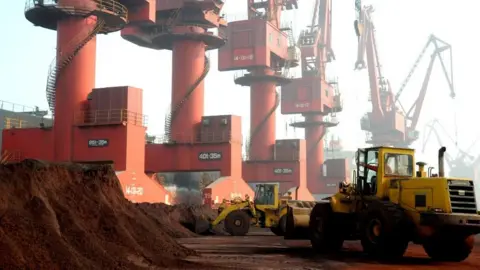
Reuters Two yellow trucks move heaps of soil containing rare earth elements at a port in China. At least five red cranes in the background tower above the trucks.
Reuters
Last week, China's Ministry of Commerce published a document that went by the name of "announcement No. 62 of 2025".

But this wasn't just any bureaucratic missive. It has rocked the fragile tariffs truce with the US.

The announcement detailed sweeping new curbs on its rare earth exports, in a move that tightens Beijing's grip on the global supply of the critical minerals - and reminded Donald Trump just how much leverage China holds in the trade war.

China has a near-monopoly in the processing of rare earths - crucial for the production of everything from smartphones to fighter jets.

Under the new rules, foreign companies now need the Chinese government's approval to export products that contain even a tiny amount of rare earths and must declare their intended use.

In response, US President Donald Trump threatened to impose an additional 100% tariff on Chinese goods and put export controls on key software.

"This is China versus the world. They have pointed a bazooka at the supply chains and the industrial base of the entire free world, and we're not going to have it," said US Treasury Secretary Scott Bessent.

On Thursday, China said the US had "deliberately provoked unnecessary misunderstanding and panic" over the rare earths restrictions.

"Provided the export licence applications are compliant and intended for civilian use, they will be approved," a commerce ministry spokesperson added.

This week, the world's two biggest economies also imposed new port fees on each other's ships.

The flare-up in the trade war brings to an end months of relative calm after top US and Chinese officials brokered a truce in May.

Later this month, Trump and China's President Xi Jinping are expected to meet and experts have told the BBC the rare earths restrictions will give China the upper hand.

China's new controls are bound to "shock the system" as they target vulnerabilities in American supply chains, said international business lecturer Naoise McDonagh from Australia's Edith Cowan University.

"The timing has really upset the kind of timeline for negotiations that the Americans wanted," he added.
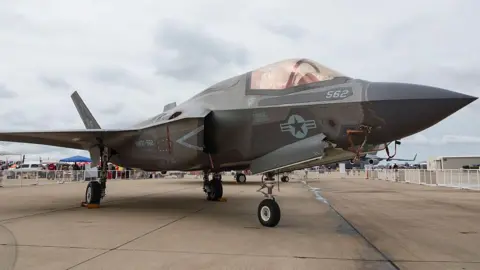
Getty Images A close-up shot of the US Marine Corps F-35 fighter jet displayed at America's Air Show at Marine Corps Air Station Miramar in San Diego, California.
Getty Images
Rare earth minerals are crucial for the production of fighter jets like the F-35
Rare earth minerals are essential for the production of a whole range of technology such as solar panels, electric cars and military equipment.

For example, a single F-35 fighter jet is estimated to need more than 400kg (881.8lb) of rare earths for its stealth coatings, motors, radars and other components.

China's rare earth exports also account for around 70% of the world's supply of metals used for magnets in electric vehicle motors, said Natasha Jha Bhaskar from advisory firm the Newland Global Group.

Beijing has worked hard to gain its dominance of the global rare earth processing capacity, said critical minerals researcher Marina Zhang from the University of Technology Sydney.

The country has nurtured a vast talent pool in the field, while its research and development network is years ahead of its competitors, she added.

While the US and other countries are investing heavily to develop alternatives to China for supplies of rare earths, they are still some way from achieving that goal.

With its own large deposits of rare earths, Australia has been tipped as a potential challenger to China. But its production infrastructure is still underdeveloped, making processing relatively expensive, Ms Zhang said.

"Even if the US and all its allies make processing rare earths a national project, I would say that it will take at least five years to catch up with China."

Why the US needs China's rare earths​


Inside Australia's billion-dollar bid to take on China's rare earth dominance​


How Europe is vying for rare earth independence from China​


The new restrictions expand measures Beijing announced in April that caused a global supply crunch, before a series of deals with Europe and the US eased the shortages.

The latest official figures from China show that exports of the critical minerals were down in September by more than 30% compared to a year ago.

But analysts say China's economy is unlikely to be hurt by the drop in exports.

Rare earths make up a very small part of China's $18.7tn a year economy, said Prof Sophia Kalantzakos from New York University.

Some estimates put the value of the exports at less than 0.1% of China's annual gross domestic product (GDP).

While rare earths' economic value to China may be tiny their strategic value "is huge", she said, as they give Beijing more leverage in talks with the US.

Despite accusing China of "betrayal", Bessent has left the door open to negotiations.

"I believe China is open to discussion and I am optimistic this can be de-escalated," he said.

During a meeting with the US private equity group Blackstone's chief executive Stephen Schwarzman on Thursday, China's Foreign Minister Wang Yi also highlighted the need for talks.

"The two sides should engage in effective communication, properly resolve differences and promote stable, healthy and sustainable development of China-US relations," Wang said, according to the ministry's website.

What China has done recently is "getting its ducks in a row" ahead of those trade talks with the US, said Prof Kalantzakos.

In curbing rare earth exports, Beijing has found its "best immediate lever" to pressure Washington for a favourable deal, Ms Bhaskar said.
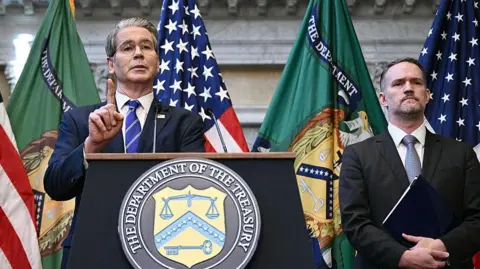
Getty Images Treasury Secretary Scott Bessent and Trade Representative Jamieson Greer take questions from reporters in Washington DC. The pair are speaking behind a lectern with a prominent US Department of the Treasury plaque displayed.
Getty Images
Top US officials Scott Bessent and Jamieson Greer blasted China as "unreliable"
Jiao Yang from Singapore Management University believes that although Beijing holds the cards in the short-run, Washington does have some strategic options at its disposal.

The US could offer to lower tariffs, which is likely to be attractive to Beijing as the trade war has hit its manufacturers hard, said Prof Jiao said.

China's economy is reliant on the income from the goods it makes and exports. The latest official figures show its exports to the US were down by 27% compared to a year ago.

Washington can also threaten to hit China with more trade restrictions to hamper efforts to develop its technology sector, said Prof McDonagh.

For example, the White House has already targeted China's need for high-end semiconductors by blocking its purchases of Nvidia's most advanced chips.

But experts say that is likely to have only limited effects.

Measures targeting Beijing's tech industry may slow China but won't "stop it dead in the water," said Prof McDonagh.

China has shown with its recent economic strategy that it is willing to take some pain to achieve its long-term goals, he added.

"China can carry on even if it costs a lot more under US export controls.

"But if China cuts off these rare earth supplies, that can actually stop everyone's industry. That's the big difference."
 

Users who are viewing this thread

Back
Top