retaxis
Trusted Member


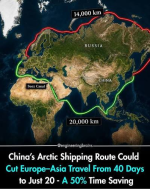
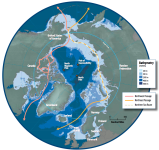
Looks like China and Russia are preparing the northern arctic route to bypass Suez and malacca strait in the next few years. Its already operational but support networks and emergency stations needs to be built along the arctic route as well. China and Russia just measuring sea ice and seeing how many ice breakers and support the region needs in the near future. I am sure China will dole out most of the money for this but many countries will use this route in the future to reduce travel time and fuel costs.
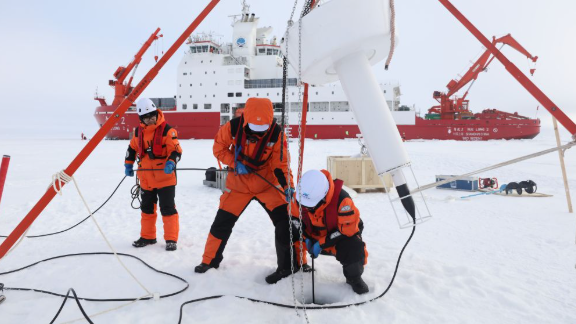
China and Russia conduct first joint Arctic sea ice observation during China's 16th Arctic expedition. /CMG
China's icebreaker Xuelong 2, currently carrying out the country's 16th Arctic expedition, is sailing through the Arctic Ocean, where Chinese researchers and two Russian researchers from the Arctic and Antarctic Research Institute have conducted joint sea ice observations.
This marks the first field observation cooperation between China and Russia in the area of sea ice monitoring.
Lin Long, head of the sea ice team aboard the Xuelong 2, said that before entering the Arctic ice zone, Chinese and Russian researchers discussed their respective standards and methods for sea ice observation. They found that the two sides' main observation areas largely overlapped while also exchanging views on some differences.
The decline of Arctic sea ice has been one of the most significant changes in the Earth's system over the past nearly 50 years and is considered an indicator of climate change.
The joint observations are being conducted manually from the vessel during navigation. Researchers are recording sea ice concentration, type, size and thickness, as well as snow thickness.
Compared with satellite remote sensing, ship-based observations offer higher spatial resolution, are less affected by clouds and fog, cover the entire navigation route and allow for more detailed measurements of ice thickness. The data can therefore complement satellite observations.
Lin said the two sides conducted detailed visual observations of ice conditions along the vessel's route around the clock, recording irregular changes in sea ice and ice thickness, and expanded observations to include basic atmospheric conditions, vessel-related parameters and large animals.
"Compared with previous Chinese Arctic expeditions, this joint observation is more practical," Lin said, adding that it not only improves understanding of changes in Arctic sea ice but also takes into account its potential support for ship design and navigability assessments in ice-covered waters.
Both sides said the joint observations provided important data on Arctic summer sea ice, contributing to assessments of changes in Arctic sea ice and the ocean, as well as a better understanding of climate change.
The cooperation also enabled the two sides to exchange expertise and experience in sea ice observation, laying a foundation for further international cooperation.
China and Russia conduct first joint Arctic sea ice observation during China's 16th Arctic expedition. /CMG
China's icebreaker Xuelong 2, currently carrying out the country's 16th Arctic expedition, is sailing through the Arctic Ocean, where Chinese researchers and two Russian researchers from the Arctic and Antarctic Research Institute have conducted joint sea ice observations.
This marks the first field observation cooperation between China and Russia in the area of sea ice monitoring.
Lin Long, head of the sea ice team aboard the Xuelong 2, said that before entering the Arctic ice zone, Chinese and Russian researchers discussed their respective standards and methods for sea ice observation. They found that the two sides' main observation areas largely overlapped while also exchanging views on some differences.
The decline of Arctic sea ice has been one of the most significant changes in the Earth's system over the past nearly 50 years and is considered an indicator of climate change.
The joint observations are being conducted manually from the vessel during navigation. Researchers are recording sea ice concentration, type, size and thickness, as well as snow thickness.
Compared with satellite remote sensing, ship-based observations offer higher spatial resolution, are less affected by clouds and fog, cover the entire navigation route and allow for more detailed measurements of ice thickness. The data can therefore complement satellite observations.
Lin said the two sides conducted detailed visual observations of ice conditions along the vessel's route around the clock, recording irregular changes in sea ice and ice thickness, and expanded observations to include basic atmospheric conditions, vessel-related parameters and large animals.
"Compared with previous Chinese Arctic expeditions, this joint observation is more practical," Lin said, adding that it not only improves understanding of changes in Arctic sea ice but also takes into account its potential support for ship design and navigability assessments in ice-covered waters.
Both sides said the joint observations provided important data on Arctic summer sea ice, contributing to assessments of changes in Arctic sea ice and the ocean, as well as a better understanding of climate change.
The cooperation also enabled the two sides to exchange expertise and experience in sea ice observation, laying a foundation for further international cooperation.