China Science And Technology News

Why it's imperative for China to beat the USA to the moon:

The average Westerner is a roofer with a mortgage to pay. They don't care how far ahead Chinese EVs are. They definitely don't care how much a monopoly China has on rare Earths. They do not care that China is the leader of 5G and clean energy tech.

What will catch this type of ordinary Westerner's attention is who been to the moon first. This the kind of ppl the US president will rally for emotional support when they gone rabbid mad and want a war with China.

China's strategy had always been to win without actually going to war. How can such a strategy be realized if even the average American thinks the US has a small chance of winning?

No, make the average Joe come to realize the West is only second best. And the only way to drive this message home to the Western commoners is "who been to the moon first?". Shatter their delusion at the very core of their beliefs about their own country's superiority, and then "winning without fighting" becomes a meme not a mere wish nor belief...
 
I suppose you have some data to back up that statement. Or may be not. :D
Are you currently residing in China? Most people in China are usually no fun to interact with on English speaking websites. They usually cannot understand sarcasm. They definitely don't understand metaphors and always demand proof. When I say something like where is the HSR train in China that breaks the speed of sound in another thread? Do people from China literally read that as where is the train travelling at 1200km/hr? This is impossible as even an airline does not travel that fast! Do I really need to prove the average Joe in the West is a roofer with a mortgage or mean it literally? What is really meant you figure it out, it's too embarassing for me to say it literally...
 
Are you currently residing in China? Most people in China are usually no fun to interact with on English speaking websites. They usually cannot understand sarcasm. They definitely don't understand metaphors and always demand proof. When I say something like where is the HSR train in China that breaks the speed of sound in another thread? Do people from China literally read that as where is the train travelling at 1200km/hr? This is impossible as even an airline does not travel that fast! Do I really need to prove the average Joe in the West is a roofer with a mortgage or mean it literally? What is really meant you figure it out, it's too embarassing for me to say it literally...

So you are just bullshitting. Just as I figured. Thank you for making it clear. :D

Like saying the average Chinese is a ... ... You see, two can play at that game.
 
So you are just bullshitting. Just as I figured. Thank you for making it clear. :D

Like saying the average Chinese is a ... ... You see, two can play at that game.
Thems fighting words. Since you start it... Are you dense enough to not understand the average Joe is a roofer with a mortgage is a metaphor for Joe average with some kind of (often very huge) debt to repay. Are you really that low IQ? Is it that hard for me to prove most Americans are in debt (let alone in HUGE debt)? :D

People always make a fool of themselves when they start fights they had zero chance of winning...

P.S: I never have time to waste on dumb keyboard warriors as you. Ignored :P
 
Last edited:
Thems fighting words. Since you start it... Are you dense enough to not understand the average Joe is a roofer with a mortgage is a metaphor for Joe average with some kind of debt to repay. Are you really that low IQ? Is it that hard for me to prove most Americans are in debt? :D

People always make a fool of themselves when they start fights they had zero chance of winning...

P.S: I never have time to waste on dumb keyboard warriors as you. Ignored :P
Btw, I apologize if any authentic Chinese posters feel offended. I'm not used to posting on my phone. It's uncomfortably small for me to check each poster's country flag. And I think PDF removed those flags below their avatars some while ago...
 
By @junshiguancha1
“China is going where no one has gone before. Tianwen-2 has reached its first target — a 45m asteroid spinning once every 5 minutes” | #Tianwen2 will then sample the asteroid, deliver sample to Earth, patrolling a comet-belt (7B km)
To view this content we will need your consent to set third party cookies.
For more detailed information, see our cookies page.


1780837788948.png
To view this content we will need your consent to set third party cookies.
For more detailed information, see our cookies page.
 

According to an X post by The Kobeissi Letter on Sunday, China's chip exports surged 100% year-over-year to a record $31 billion in April. This has tripled over the past two years.

Overseas sales of laptops, tablets, and their components spiked 47% from the year-ago month.

To view this content we will need your consent to set third party cookies.
For more detailed information, see our cookies page.
 
1780805626281
 

AI model routing: How Chinese models are taking over AI usage​

To view this content we will need your consent to set third party cookies.
For more detailed information, see our cookies page.
 
To view this content we will need your consent to set third party cookies.
For more detailed information, see our cookies page.


The way (and speed) the world is losing drinkable water sources. Soon desalination will be a major source of drinking water not only for local use but also for export to those landlocked countries that face water shortage and have no sea/oceans.
 
I wonder if there is a way to use AI to decrease the population of smokers in China. It seems everywhere you go in China you are inhaling second hand smoke.
 

China's Xiaomi MiMo Is Now 15X Faster Than ChatGPT and Claude​

Xiaomi's MiMo-V2.5-Pro-UltraSpeed blows past the speed threshold custom silicon companies spent years building toward—on regular GPUs.​

https://decrypt.co/author/jose
By Jose Antonio Lanz
Jun 9, 2026

Artificial intelligence. Image: Decrypt/Shutterstock

Artificial intelligence. Image: Decrypt/Shutterstock

In brief​

  • Xiaomi and inference partner TileRT have broken 1,000 tokens per second on a 1-trillion-parameter model, a first at that scale, using a standard 8-GPU commodity node—not custom chips.
  • The speed comes from FP4 quantization on the model's expert layers and DFlash speculative decoding, which proposes a full block of tokens in one pass instead of one at a time.
  • A limited API trial opens June 9 through June 23, priced at 3× standard MiMo rates for roughly 10× the generation speed.

Most people know Xiaomi as the Chinese phone brand. The one that makes cheap electric scooters and air purifiers. Not exactly the company you'd expect to break a major AI inference speed record on a Monday morning.

And yet. Xiaomi just released MiMo-V2.5-Pro-UltraSpeed, a serving mode for its trillion-parameter flagship that hits over 1,000 tokens per second—peaking near 1,200 in demos.

Parameters are the internal numerical weights that define how a model thinks—the more you have, the more complex the patterns it can recognize. Tokens are the chunks of text the model reads and writes, roughly three-quarters of a word each on average.


Xiaomi did it on a single 8-GPU commodity node. Standard hardware, no custom chips. That changes the calculus for who can actually deploy this kind of speed in production.

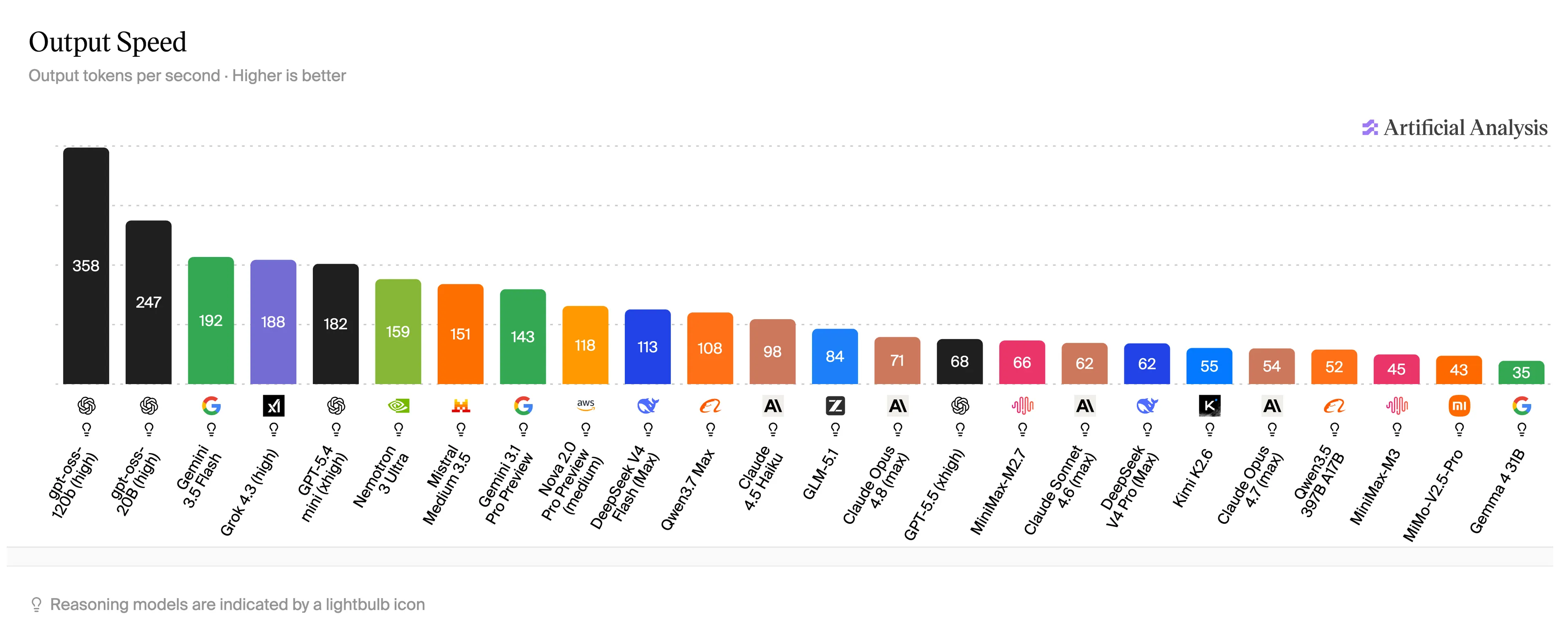
To put that number in human terms: per Artificial Analysis, GPT-5.5—what most ChatGPT users are actually talking to—sits at 68. Claude Opus 4.6 lands around 71 with the lower end model, Haiku, touching 98 tokens per second. Gemini Flash hits 192 tokens per second. MiMo-V2.5-Pro-UltraSpeed does 1,000, on a model that matches Opus on coding benchmarks.

Output-Speed-8-Jun-26.png@webp


Cerebras and Groq built entire businesses around this problem. Cerebras designed a wafer-scale chip the size of a dinner plate, packing 44GB of on-chip memory to eliminate the bandwidth bottleneck that slows down GPU inference. It hit 969 tokens per second on Meta's Llama 3.1 405B—impressive, but that's a 405-billion-parameter model, less than half the size of MiMo-V2.5-Pro. Groq's custom Language Processing Unit architecture tops out around 300–750 tokens per second depending on model.

Neither runs on hardware you can rent from AWS tonight.

Xiaomi did it on commodity GPUs through software alone—a combination of model-level tricks and a purpose-built inference engine called TileRT.

What's actually going on under the hood​

Two techniques carry the speed. The first technique is called FP4 Quantization: instead of running the model at full 8-bit or 16-bit numerical precision, Xiaomi shrinks the expert layers—which make up most of the 1 trillion parameters—down to 4-bit. Memory footprint drops, bandwidth pressure drops, speed goes up. The catch is usually a small quality degradation. Xiaomi's fix is surgical: only the expert layers get compressed, everything else stays at full precision. With this approach, quality loss is described as near-zero.

The second is DFlash speculative decoding. Normal speculative decoding has a small draft model guess the next few tokens, then the big model verifies them in parallel. DFlash skips the sequential drafting entirely—it fills a whole block of masked positions in a single forward pass. In coding tasks, the big model accepts an average of 6.3 out of 8 proposed tokens per verification round. That's six tokens confirmed in one step instead of one.

TileRT ties it together. It keeps the entire compute pipeline continuously resident inside the GPU—no per-operator launch overhead, no execution gaps.

Xiaomi calls this approach "extreme model-system codesign," and the phrase is accurate: Neither technique alone gets to 1,000 tokens per second, but the synergy among all approaches does.

MiMo-V2.5-Pro is a frontier-level model. We covered the V2.5 Pro launch in April—it matches Claude Opus on most coding benchmarks and runs at roughly $0.43 input / $0.87 output per million tokens. Opus costs $5 input / $25 output per million tokens.

UltraSpeed accelerates that exact MiMo V2.5 Pro model, not a stripped-down version.

Fast enough inference changes how you can use a model. You can run dozens of reasoning paths in parallel instead of waiting on one answer. Fraud detection, trading signal generation, real-time agent loops—all of these have hard latency constraints that 60 tokens per second can't meet. At 1,000 tokens per second, they can.

Xiaomi is pricing the speed at 3 times the standard MiMo-V2.5-Pro rate for roughly 10 times the output. The API trial runs June 9–23, application-based, with priority given to enterprise and professional developers. The FP4-DFlash checkpoint is already open-sourced on Hugging Face for community testing.

 
I wonder if there is a way to use AI to decrease the population of smokers in China. It seems everywhere you go in China you are inhaling second hand smoke.
The British forced opium smoking in China that devastated the country. The Spanish empire in FIlipin brought tobacco smoking to China that are no good for Chinese health either. These Europeans were just wicked, all they did were to bring bad things to China. Smoking is a real big problem in China and the Chinese gov ought to severely curtail it.
 

China extends lead in Nature Index global research rankings

10 June 2026
shutterstock_2628290393-800x534.jpeg
Shutterstock.com/AustralianCamera

China has strengthened its position as the world’s leading contributor to high-quality research, while the wider East Asia region continues to outpace Europe and North America in output growth, according to the latest Nature Index Research Leaders tables.

The 2026 Research Leaders rankings, based on full-year 2025 data, also mark the most significant methodological update to the Nature Index since its launch in 2014. The database has broadened its disciplinary coverage by adding applied science and social science titles, while introducing a new article-level classification system designed to provide a more accurate picture of global research activity.

The Nature Index now includes 17 applied-science journals, one conference and 15 social-science journals. The additions were selected following a global survey of more than 4,000 researchers on where they would choose to publish their most significant work.

The index has also replaced its journal-based classification approach with an article-level subject classification system, allowing individual papers to be assigned to specific disciplines rather than inheriting a journal’s primary subject area. To maintain comparability, articles from the newly added journals have been incorporated retrospectively for 2024 and 2025, while the revised classification methodology has been applied across the entire database.

“With expanded disciplinary coverage and a recalibrated methodology, the Nature Index now provides a more comprehensive and precise view of high-quality research output,” said Simon Baker, Chief Editor, Nature Index. “In terms of the results, we are continuing to see extremely strong performance from China, while there is also evidence that the wider East Asia region is growing output at a faster rate than Europe and North America.”

China remained the world’s leading contributing country, recording a 22.4 per cent increase in research output between 2024 and 2025. It was the only country in the global top ten to achieve double-digit growth. Japan, South Korea and India also featured in the global top 10, with both Japan and South Korea posting growth of almost 10 per cent.

The United States and Germany remained among the top five countries across all seven subject areas. The US led globally in health sciences and social sciences, while the UK ranked among the top five in every subject area except chemistry.

At the institutional level, the Chinese Academy of Sciences retained its position as the world’s leading research institution overall and across most subject areas, excluding health sciences and social sciences. Nine of the world’s top 10 institutions are now based in China, up from eight in the previous rankings, with Zhejiang University rising to second place globally.

Harvard University climbed to third overall and led the rankings in both health sciences and social sciences. US institutions dominated the social sciences rankings, accounting for nine of the top 10 positions.

In biological sciences, Harvard ranked second, while Germany’s Max Planck Society placed third. European institutions also performed strongly in physical sciences, with four organisations in the global top 10, including the Max Planck Society in second place and Italy’s National Institute for Nuclear Physics in fourth. The Helmholtz Association ranked fourth globally in Earth and environmental sciences.


Users who are viewing this thread

Country Watch Latest

Back
Top