China Science And Technology News

Despite High Spending, Japan Trails Global Leaders in Top-Cited Science Papers​

Science Aug 28, 2026

China at Number One​

A report issued in 2026 by Japan’s National Institute of Science and Technology Policy shows that Japan was again ranked thirteenth for its average number of papers in the top 10% most cited globally in the field of natural science between 2022 and 2024, with 3,163 (adjusted to reflect partial credit for joint authorship). For the top 1% most frequently cited papers, Japan ranked twelfth with an annual average of 271. Japan’s average annual number of papers published overall was 66,214, placing it fifth worldwide.

China ranked first for papers in the top 10%, with 84,392 papers, followed by the United States with 29,911 and Britain with 7,696. China was also number one by a wide margin for the overall number of papers and those in the top 1% ranking for citations.
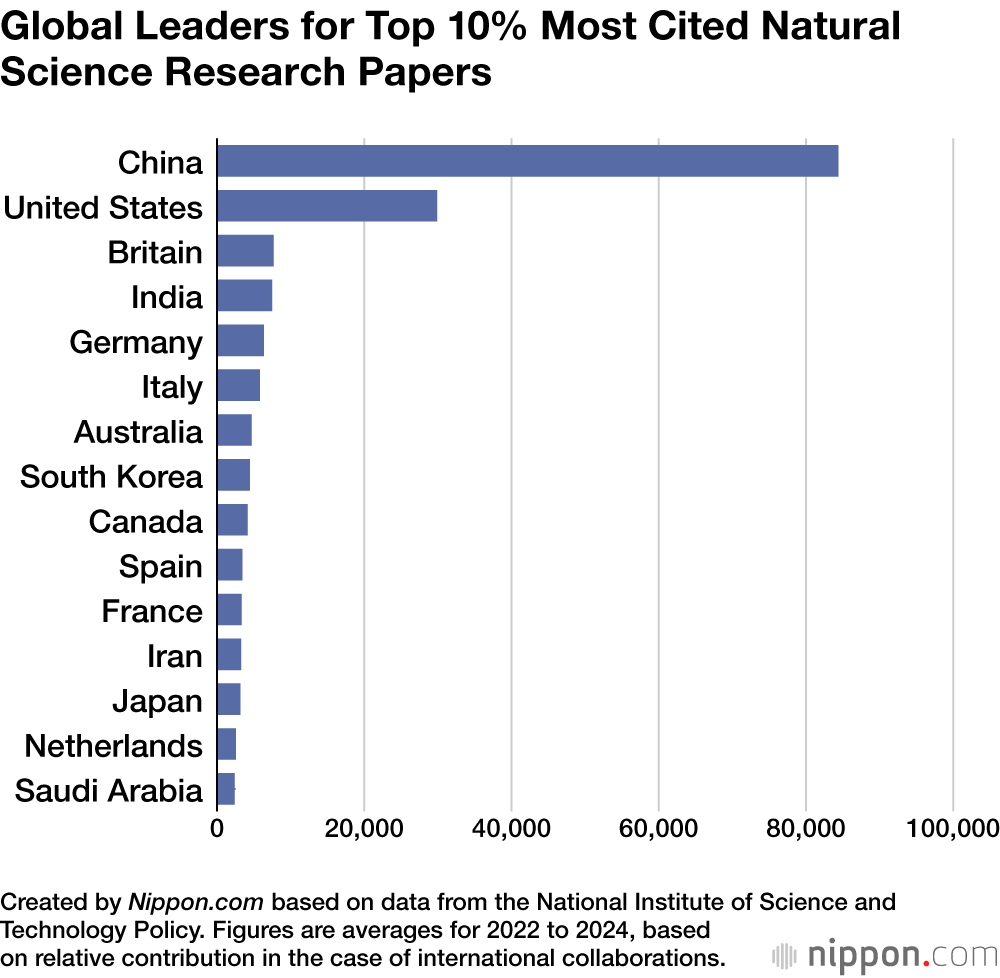
Global Leaders for Top 10% Most Cited Natural Science Research Papers

Out of the Top 10 in 2019​

The breakdown by academic field for the top 10% most cited papers shows that Japan has a higher share of papers for physics and clinical medicine than other areas. The United States has higher shares in clinical medicine, basic life sciences, and physics, while China is strong in the fields of materials science, chemistry, and engineering.

The graph below shows the changes in the global ranking for the top 10% most cited papers. Japan was in the top four in the early 2000s, but since then has fallen in the ranking, overtaken by countries like China, France, and South Korea. In 2019, it fell out of the top 10 into twelfth place, and has never returned.
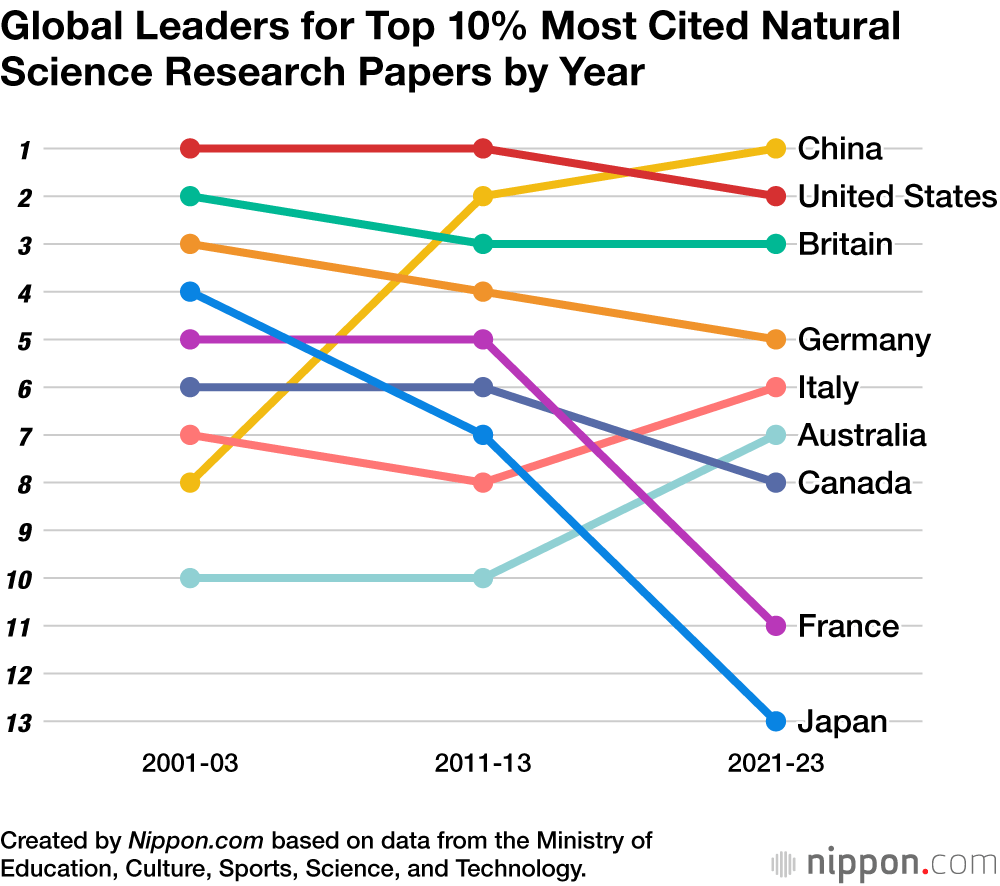
Global Leaders for Top 10% Most Cited Natural Science Research Papers by Year

A look at other indicators shows that Japan ranks third globally behind the United States and China for its R&D expenditures and number of researchers, which totaled ¥22.1 trillion and 703,000, respectively. Japan ranks first worldwide in the number of “patent families,” groups of patents for a single invention filed across two or more countries or regions, at 64,000.

Government spending on R&D spiked from ¥2.7 trillion in 2020 to ¥3.7 trillion in 2024. Although R&D expenditures have also been rising in the corporate and university sectors since the early 2020s, this has yet to translate into a higher position in the global ranking for most cited research papers.

Japan had 190,000 female researchers in 2025, making up 19.0% of the overall total. Of these, 39,000 had doctorates.

 
China announced further progress in its push for a crewed moon landing by 2030, with its lunar spacesuit and a bed rest experiment for long-term space stays both advancing, the country's astronaut center said on Saturday:

- The development of China's moon-landing spacesuit Wangyu - meaning "gazing into the cosmos" - is progressing smoothly, with dozens of key technologies now in place. The lunar spacesuit is designed to be lightweight, miniaturized, highly efficient and safe.

- The country is also advancing astronaut health research, with the "Dixing-3" bed rest experiment completed. The experiment launched in May aimed to address physiological protection challenges for long-term space stays and crewed lunar landing missions. Results showed that the experiment effectively protects the human bone, muscle and cardiovascular systems, and it will provide technical support for long-term space stays and crewed lunar landing missions.
 

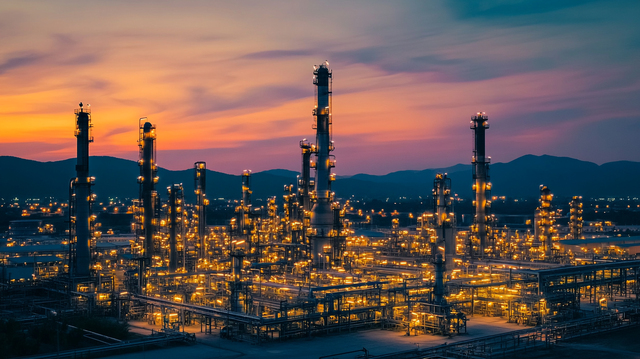
Chinese Scientists Develop Oil Refining Method to Cut Energy Use by Ninety-One Percent​

September 19, 2026

Chinese researchers developed a new oil refining technique that could reduce energy consumption during crude oil separation by around 91% compared with conventional distillation. The researchers from the Dalian Institute of Chemical Physics say the technology could, if scaled for industrial use, lower production costs and emissions while enabling more precise separation of crude oil components and improving the value of refinery products.

Molecular Refining Targets Energy-Intensive Separation

Crude oil must first be separated into different components before refineries can convert them into fuels, plastics and other products. Traditionally, refineries use distillation, which repeatedly heats crude oil so that different components vaporise and condense according to their boiling points. However, this process requires significant energy and offers limited precision. The approach, described as “molecular refining,” instead separates crude oil components at the molecular level. It uses chemical membranes to selectively sort different molecules and direct them towards suitable production streams.

Membranes Act as Molecular Sieves

The researchers developed metal-organic framework (MOF) membranes with precisely designed pores and surface properties. These membranes act as molecular sieves and separate compounds based on their size and chemical characteristics. The process, known as cascade membrane separation, uses two stages. First, the membrane separates molecules according to size. The researchers targeted straight-chain and single-branched alkanes used to produce ethylene from other components in the mixture. Next, the remaining molecules undergo a more selective separation. A second membrane uses surface chemistry to distinguish aromatic compounds from multi-branched alkanes and cycloalkanes. Aromatics serve as important intermediates for producing plastics, resins and fibres, while the other compounds can be used in petrol production.

Researchers Test 15-Component Naphtha Mixture

To improve the membranes’ performance, the research team used a tannic acid micro-etching method to continuously adjust their pore size and surface chemistry. The researchers then tested the two membranes in sequence using a simulated light naphtha mixture containing 15 components. In laboratory tests, the membrane system separated the mixture into three groups of high-value products, achieving a recovery rate of 85–90%.

Process Could Reduce Refining Energy Consumption

The biggest potential advantage comes from eliminating the repeated heating, vaporisation and condensation required by conventional distillation. According to the study, the membrane-based process consumed approximately 91% less energy than traditional distillation under the tested conditions. Consequently, the technology could potentially reduce energy requirements, operating costs and emissions if researchers successfully scale it for industrial applications.

Potential for More Efficient Petrochemical Refining

The researchers published their findings in National Science Review, describing the graded molecular sorting approach as a potential platform for petrochemical refining. However, the reported results come from laboratory testing, and further development and scale-up would be required to determine how the technology performs under industrial refinery conditions. As reported by scmp.com, if successfully commercialised, the approach could offer refineries a more energy-efficient way to separate crude oil components while improving the recovery and utilisation of higher-value petrochemical feedstocks.
 

Users who are viewing this thread

Back
Top