
Beijingwalker
VIP Member

China’s 4 commercial jets unboxed: from the rebranded C909 to a futuristic C939
More details about China’s home-grown passenger planes emerge at Zhuhai air show, with new sales and lofty aviation ambitions on display
Frank Chenin Zhuhai, Guangdong provinceandRalph Jenningsin Hong Kong
Published: 8:00am, 13 Nov 2024Updated: 9:49am, 13 Nov 2024
The state-owned Commercial Aircraft Corporation of China (Comac) has signed a framework agreement at a major air show to sell its first C929, a widebody jet aeroplane akin to the Airbus 350 or Boeing 787.
An eventual delivery – the plane is still being developed – to flagship carrier Air China would put Comac’s third type of civilian jet into the air.
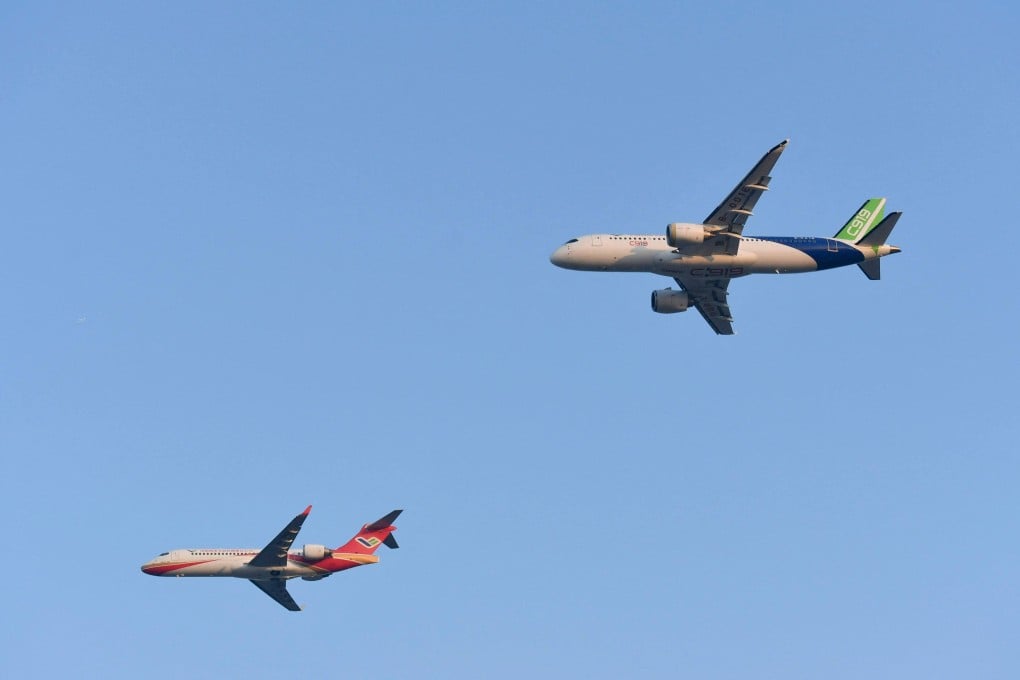
Meanwhile, Comac has formally rebranded its ARJ21 small plane as the C909 – bringing its designation in line with the planemaker’s naming convention for its passenger jets. And looking to the future, a fourth and even larger aircraft type is still being designed.
Comac aims to advance China’s goal of technological self-sufficiency while selling its aircraft overseas. The Shanghai-based manufacturer intends to eventually compete mainly with Airbus and Boeing, because their planes have similar specifications.
In light of updates from the 15th China International Aviation and Aerospace Exhibition, also known as the Zhuhai air show, here is a rundown of each of China’s home-grown aircraft type:
1. C909 small aircraft (formerly the ARJ21)
The C909 covers a series of turbofan aircraft with 78 to 97 seats for relatively short flights of 2,225 to 3,700km (1,382-2,299 miles) – far enough to service popular domestic routes in China.Development started in 2002, and the aircraft took flight six years later. Regional carrier Chengdu Airlines began operating the aircraft, China’s first one made for civilian use, in 2015, and TransNusa Airlines of Indonesia has bought the planes since 2022. More than 150 have been sold altogether, with more than 17 million passengers transported, according to state media.
The manufacturer has released only one C909 variant, meaning its specs have remained unchanged since its initial release. Its name change was discussed at the Zhuhai air show on Tuesday.
The C909 compares in size to the defunct Boeing 717, the retired McDonnell Douglas MD-80 and -90 line of planes, and the Embraer E190-E2 model.
McDonnell Douglas manufactured in Shanghai before merging with Boeing in 1997, and Comac has used MD-90 tooling for the C909’s assembly. General Electric supplies the Chinese plane’s twin CF34 engines, and Ukrainian planemaker Antonov designed the wings.
The still-flying Embraer planes can carry 106 passengers and fly as far as 5,278km per trip.
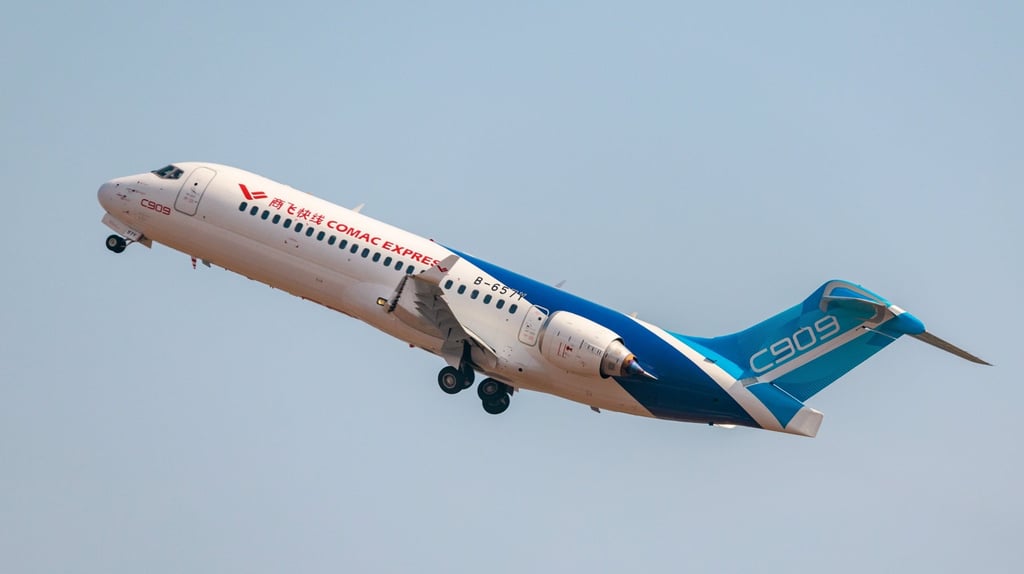
A C909 passenger airplane performs during the flight demonstration part at an air show in Zhuhai. Photo: EPA-EFE
2. C919 narrowbody aircraft
C919 narrowbody planes can fit 158 to 192 seats and fly from 4,075 to 5,555km. After 15 years of research, the plane debuted in May 2023 as part of the China Eastern Airlines fleet. Comac has received at least 300 firm orders this year from major Chinese airlines.Flagship Chinese carrier Air China’s C919 aircraft have made at least 174 flights over 389 hours, with more than 23,800 passengers transported, the official Xinhua reported at the start of the Zhuhai air show.
Overseas, Brazilian cargo and charter airline Total Linhas Aereas may be looking to place the first C919 order outside Asia.
Many key parts of the C919 are made by American or European suppliers.
Its engine, for example, is produced by CFM International, a joint venture between GE Aerospace of the US and France’s Safran Aircraft Engines.
A pledge of stable supplies and improved localised support from US-based GE Aerospace, a major stakeholder in the C919’s engine provider, gives the aircraft model a boost.
The C919 compares most closely to the Airbus 320 and Boeing 737 lines of aircraft.
Planes in the A320 series can seat 140 to 180 passengers and can fly 6,300km in one journey. Boeing 737s hold 138 to 230 seats and fly 5,954 to 7,084km.
3. C929 widebody aircraft
Comac is working on a twin-aisle plane, the C929, for 280 to 290 passengers. It could be able to fly as far as 12,000km in one trip. The flight distance from Beijing to New York is about 11,000km.Air China signed an agreement on Tuesday to order the planes once complete. Airlines could take deliveries of this model as soon as 2027, but because of global supply-chain delays, it is more likely to emerge en masse by 2029, said Eric Lin, head of Greater China research with UBS in Hong Kong.
Comac has completed an agreement for the construction of metals, composites and components for the C929 aircraft in a deal with Hunan Aerospace Huanyu Communication Technology valued at no more than US$175 million, according to a stock market filing.
The C929 would compare closest to the Airbus A350 and Boeing 787 aircraft families in terms of maximum flight distances. A350 models can take 300 to 350 passengers on flights up to 15,000km. Boeing 787 models can fly 13,600 to 14,600km and carry 242 to 290 passengers.
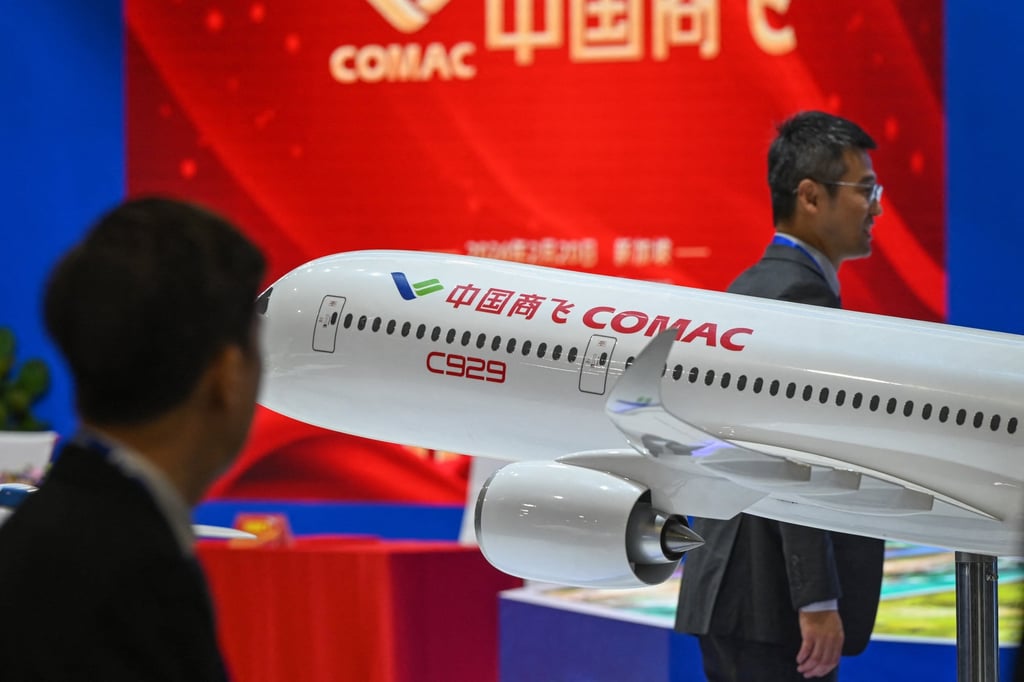
A miniature model of China’s C929 aeroplane is displayed at the Singapore Airshow on February 20. Photo: AFP
4. C939 jumbo aircraft
China has worked out preliminary designs for this giant plane that is expected to fly in the more distant future.The C939 is intended to be a widebody, twinjet airliner similar to the Boeing 777, said Mayur Patel, the Asia head for industry data platform OAG Aviation. The C939 would have the capacity for 400 seats and a range of 13,000km, he said.
A Boeing 777 can seat 301 to 368 passengers and fly 9,700 to 15,840km. The current longest flight in the world is from Singapore to New York, at a distance of 15,348km (9,537 miles).
It is too early to know where Comac would source parts, but China is working separately on its first turbofan commercial aircraft engine, the CJ-1000.
Planes of this size face headwinds from environmental concerns about engine exhaust and a market focus on aircraft made for shorter flights. Boeing’s final 747 was completed in 2022 after 50 years in production.
Comac may take years before developing a testable prototype, a source familiar with Comac’s work told the Post on condition of anonymity.
Deliveries of the C939 will not start for at least a decade and will occur only if Comac has “adequate resources” with mostly imported components, said Richard Aboulafia, managing director of the US-based aerospace consultancy AeroDynamic Advisory.


