China invests record $583 billion in science and tech as US administration seeks research cuts
Beijing plans to strengthen research in semiconductors, AI, quantum technology and other strategic fields.
Innovation
Oct 17, 2026 08:38 AM EST
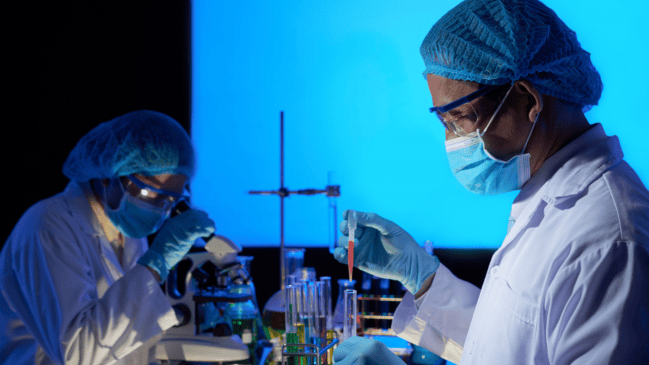
China’s R&D spending grows 10% annually over five years. (Representational image)
Magnific
China increased research and development spending by 8.2% in 2025, pushing total investment above $583 billion as Beijing expands support for basic science, universities and strategic technologies.
The latest figures from China’s National Bureau of Statistics highlight a growing contrast with the US, where the Trump administration has proposed steep cuts to federal research budgets, including reductions of 39% for the National Institutes of Health and 55% for the National Science Foundation in its proposed 2026 budget.
China’s spending remains second only to that of the US in absolute terms, but its sustained investment in scientific research and industrial development is strengthening its position in the competition over semiconductors, AI and other advanced technologies.
Increased funding for basic science and universities
China’s total R&D expenditure exceeded $583 billion in 2025, and according to state news agency Xinhua, spending grew at an average annual rate of 10% over the five years through 2025, making China one of the fastest-growing major research investors,
the South China Morning Post reported.
Basic research recorded the largest percentage increase among the three main categories, rising 13.3% year over year to roughly $40 billion. Despite that growth, basic research still accounted for just over 7% of total R&D spending. Research expenditure at higher education institutions rose 11%, to approximately $48 billion.
China’s overall research spending was 3.4 times Germany’s and 3.5 times Japan’s, according to the reported figures. Its R&D intensity, measured as expenditure relative to gross domestic product, reached 2.8% in 2025, surpassing the OECD average for the first time and placing the country 12th globally.
Businesses remained the main source of research investment, with enterprise spending exceeding around $420 billion for the first time, accounting for more than 77% of the national total. Investment was concentrated in major industrial and technology centers, including Guangdong,
Jiangsu, Zhejiang and Shandong provinces, as well as Beijing and Shanghai.
US research budgets face proposed cuts
China’s investment growth comes as the Trump administration seeks to reduce federal support for
scientific research. A Harvard Business School article cited in the report said the administration froze or terminated about $3 billion in National Institutes of Health grants in early 2025, affecting approximately 3,800 research projects.
Uncertainty over federal funding has already placed pressure on institutions that depend on government grants to support researchers, laboratories, and long-term projects. Furthermore, Interruptions to funding can affect not only individual projects, but also the training and retention of researchers needed to maintain a country’s technological capabilities.
Meanwhile, China’s government has signaled that it intends to direct further resources toward basic science and technologies considered important for economic competitiveness and national security.
Chinese science and technology minister Yin Hejun has identified stronger fundamental research as a prerequisite for major technological breakthroughs, with Beijing seeking to address bottlenecks in sectors such as
semiconductors, industrial machinery and high-end scientific instruments.
Beijing plans to strengthen research in semiconductors, AI, quantum technology and other strategic fields.

interestingengineering.com