
Beijingwalker
VIP Member

China’s rail gun milestone: guided projectile prototype passes real firing test
Breakthrough as a delicate silicon shell fitted with a guidance chip is shot from an electromagnetic rail gun, survives and records the ride

Stephen Chenin Beijing
Published: 4:00pm, 9 Jun 2026Updated: 4:03pm, 9 Jun 2026
Inside a metal shell being hurled from a standstill to a speed many times faster than sound, the pressure could be as high as an elephant standing on every square inch of a human body. To make matters worse, an invisible, violent magnetic storm is raging through its path.
This is the world inside an electromagnetic rail gun. For decades, this has been the nightmare that kept weapons engineers awake.
Their dream was to place a guidance chip inside a rail gun shell so it could steer itself to a faraway target. But how could the delicate silicon brain survive a force 20,000 times that of gravity combined with a magnetic pulse 140,000 times stronger than the Earth’s magnetic field inside a large, powerful rail gun?
A breakthrough, published in the Journal of North University of China (NUC) in May, has just told the world that the nightmare is now over.
In a real-life firing test, a Chinese smart projectile prototype not only survived this journey but also recorded the entire ride.
“The electromagnetic rail gun experiment verified that it can survive an extreme environment of an 8 ms pulse width, 20,000g-force overload, and a 7 T magnetic flux density,” wrote the team led by associate professor Ge Shuangchao with NUC.
Headquartered in Taiyuan, the university is one of China’s top defence research institutes.
“After the experiment, the deformation and damage of the protective shell were examined. The protective shell was found to be structurally intact, with no obvious deformation,” Ge’s team wrote.
The most powerful gun in the world is being tested in China
“The internal components of the multi‑stage buffer structure were undamaged, and the sensors and associated circuits produced normal electrical outputs,” they added.
In future warfare, a hypersonic rail gun round could strike a target hundreds of kilometres away at a cost that is just a fraction of conventional missiles. But if it is just a lump of metal flying that fast, the slightest error at launch would mean missing by miles.
The chip’s job is to talk to the shell’s tiny fins, correct its path through the atmosphere, and ensure it hits precisely what it is supposed to. If the brain dies in the first millisecond, the superweapon becomes a very expensive firework.
The scientists are facing a double-headed monster. First, the launch creates a mechanical shock wave through the projectile’s body. Second, the immense electrical current that fires the round generates a magnetic field so powerful it can induce rogue currents and fry unprotected circuits.
In the past, China, like others, had reported “hardened” electronics, but until this paper, the world had never seen open-source, measured data from a real rail gun test that proved a complete system could survive.
Ge and her colleagues designed a multilayered cocoon of protection, with each layer playing a specific role. From the outside in, it includes a jacket of copper, a layer of iron, a cushion of polyurethane, a shield of a special magnetic alloy known as mu-metal, and finally a blanket of polyurethane right next to the electronics.
The outer copper is the first line of defence against the electromagnetic storm, acting like a lightning rod. The iron provides a brute-force barrier with its high magnetic saturation.
But the real genius is the polyurethane that is not just for cushioning the physical blow but also a vital “impedance mismatch” layer.
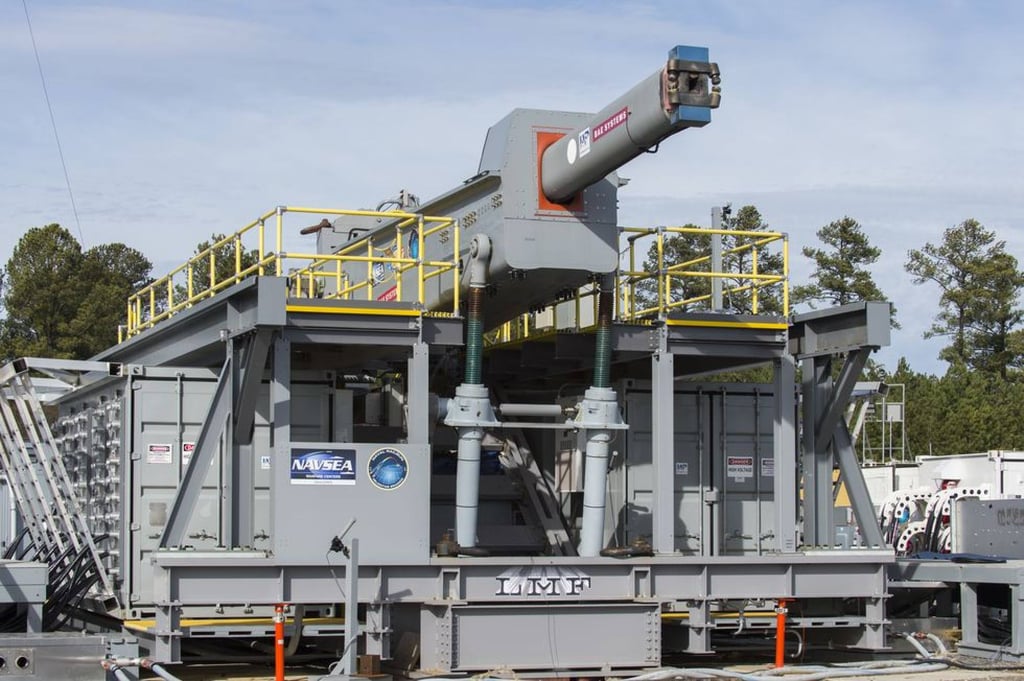
The 32-MJ version of the Office of Naval Research-funded Electromagnetic Railgun prototype. Source: US Navy
When the destructive stress wave travels through the hard metal and suddenly hits the soft, squishy polyurethane, a huge part of the wave’s energy gets reflected back. The inner mu-metal then catches the last remnants of the magnetic field, while the final polyurethane layer gently cradles the electronics.
The team used a powerful genetic algorithm (NSGA-II) that mimicked natural selection to test thousands of virtual combinations, finding the perfect balance in which each layer’s thickness was optimised to strangle both types of assault at the same time.
The result was a 71.4 per cent boost in overall shielding performance.
In the live rail gun test, two other prototype designs failed. But their optimised cocoon held firm.
The United States, after years of high-profile research, has shelved its naval rail gun project, unable to solve the technical barriers for a practical weapon.
Japan is also working on a rail gun, but its system is a small-calibre design. While useful for short-range defence, a small-calibre gun cannot pack the power source and the giant, sophisticated guidance systems needed for a long-range hypersonic strike.
This paper shows that China is turning the rail gun from a laboratory curiosity into a potential war-winner. An operational weapon that can hurl guided projectiles at hypersonic speeds over vast distances could threaten aircraft carriers, turn fixed installations into death traps and rewrite the rules of naval and air defence.
The NUC hosts the State Key Laboratory of Extreme Environment Optoelectronic Dynamic Measurement Technology and Instrument. The National Defence Science and Technology Innovation Institute also took part in the study.


