China’s rise in biotech to potentially lower healthcare costs globally, life science investor says

Beijingwalker

VIP Member
Joined
Nov 4, 2011
Messages
92,914
Reaction score
113,429
Reputation
2,116.3
Country of Origin
Country of Residence

China’s rise in biotech to potentially lower healthcare costs, life science investor says​

Innovative drugs coming out of China’s biotech firms have become increasingly popular licensing targets for MNCs​


Of the top 10 global drug deals by transaction volume in the first half, seven involved licensing from Chinese firms. Photo: Shutterstock Images

Xinmei Shen
Published: 8:00am, 22 Aug 2025

China’s rise in biotech innovation offers the world a potentially cheaper alternative to costly healthcare products from Western suppliers, but geopolitical tensions remain a major challenge for the country’s globalisation efforts, according to a local investor in the sector.

“We can lower the cost of healthcare and benefit more people through technological innovation and efficiency improvement,” Da Liu, managing director of CR-CP Life Science Fund, said in an interview with the Post earlier this week. “China’s recent achievements in biotech show that it’s possible.”

The CR-CP Life Science Fund was launched in 2019 by the state-run China Resources Group and Thai conglomerate Charoen Pokphand Group, with US$170 million under management. Companies the fund has backed include Legend Biotech, which went public in New York in 2020, and Singapore-based Mirxes, which listed its shares in Hong Kong in May this year.

Innovative drugs coming out of China’s biotech firms have become increasingly popular licensing targets among multinational corporations (MNCs) in recent years, leading to what some are calling a “DeepSeek moment” for the local industry.

Of the top 10 global drug deals by transaction volume in the first half, seven involved licensing from Chinese firms. Photo: Shutterstock Images

Xinmei Shen
Published: 8:00am, 22 Aug 2025

China’s rise in biotech innovation offers the world a potentially cheaper alternative to costly healthcare products from Western suppliers, but geopolitical tensions remain a major challenge for the country’s globalisation efforts, according to a local investor in the sector.

“We can lower the cost of healthcare and benefit more people through technological innovation and efficiency improvement,” Da Liu, managing director of CR-CP Life Science Fund, said in an interview with the Post earlier this week. “China’s recent achievements in biotech show that it’s possible.”

The CR-CP Life Science Fund was launched in 2019 by the state-run China Resources Group and Thai conglomerate Charoen Pokphand Group, with US$170 million under management. Companies the fund has backed include Legend Biotech, which went public in New York in 2020, and Singapore-based Mirxes, which listed its shares in Hong Kong in May this year.


Innovative drugs coming out of China’s biotech firms have become increasingly popular licensing targets among multinational corporations (MNCs) in recent years, leading to what some are calling a “DeepSeek moment” for the local industry.
 

China's pharmaceutical industry now 2nd-largest in world,accounting for about 30 percent of the global total of innovative drugs in research: official​


Xinhua | Updated: 2025-08-22 11:35

BEIJING - China's pharmaceutical industry is now the second largest in the world, accounting for about 30 percent of the global total of innovative drugs in research, said Yang Sheng, deputy head of the National Medical Products Administration, on Friday.

 
China's pharmaceutical industry now 2nd largest in the world: official
By Global Times
Published: Aug 22, 2025 12:18 PM

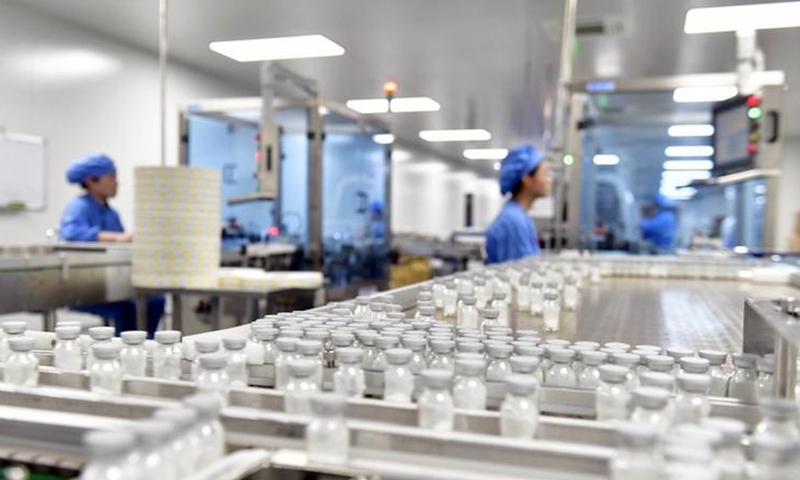
Staff members work at a pharmaceutical company in Dingtao District of Heze City, East China's Shandong Province, Oct 29, 2023. Photo: Xinhua

Staff members work at a pharmaceutical company in Dingtao District of Heze City, East China's Shandong Province, Oct 29, 2023. Photo: Xinhua

China's pharmaceutical industry currently ranks as the second largest in the world, with the number of innovative drugs in the pipeline accounting for approximately 30 percent of the global total, an official with the National Medical Products Administration (NMPA) told a press conference on Friday.

Since the beginning of the 14th Five-Year Plan period (2021-25), a total of 204 innovative drugs, 387 pediatric drugs, and 147 drugs for rare diseases have been approved for market, effectively meeting the medication needs of key population groups, Yang Sheng, deputy head of NMPA, told the press conference.

During the period, China has taken comprehensive measures to strengthen the safety baseline for drugs, support the high-quality development of the pharmaceutical industry across the entire chain, and ensure comprehensive coverage of the public's medication needs, according to Yang.

Chinese authorities approved 50 innovative drugs in the first seven months of 2025, surpassing the total of 48 approvals for all of last year.

Many of the innovative drugs approved for market launch are for serious conditions such as cancer, metabolic disorders and immune diseases.

Along with economic development and rising living standards, China is making fast progress in the field of innovative pharmaceuticals in recent years, and a number of multilateral drug companies have stepped up efforts to set up research and development (R&D) centers in the country.

In March, US pharmaceutical giant Pfizer opened a new R&D center at BioPark in the Beijing Economic-Technological Development Area. British pharmaceutical giant AstraZeneca signed an agreement in the same month to invest $2.5 billion in Beijing over the next five years, including the establishment of a global strategic R&D center in the city, according to Xinhua.

 
If China can make quality medical care affordable to the general population of the world, that will be an unprecedentedly great contribution to the humanity.
 

Charted: US Pharmaceutical Drug Imports from China

July 6, 2025
By Niccolo Conte
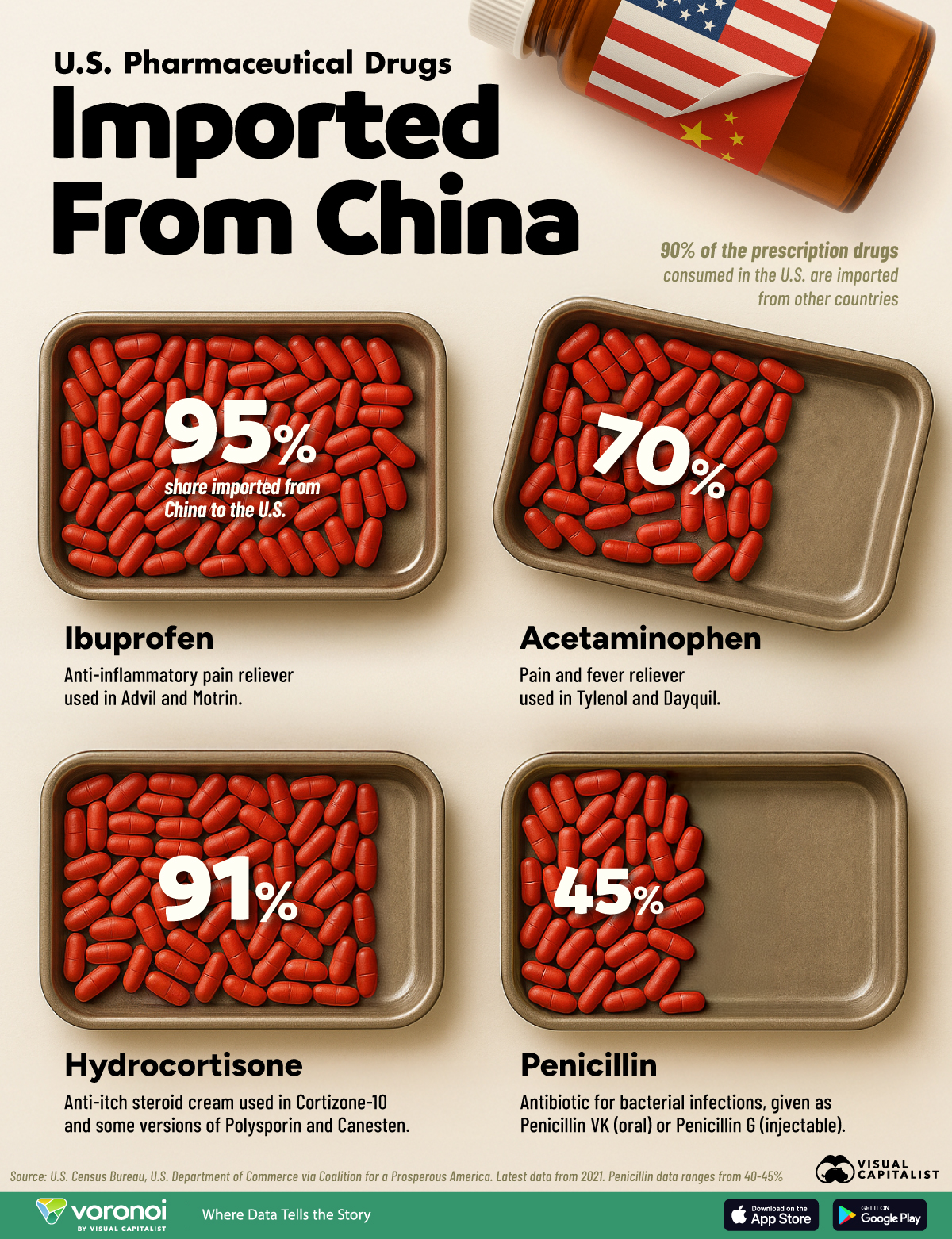
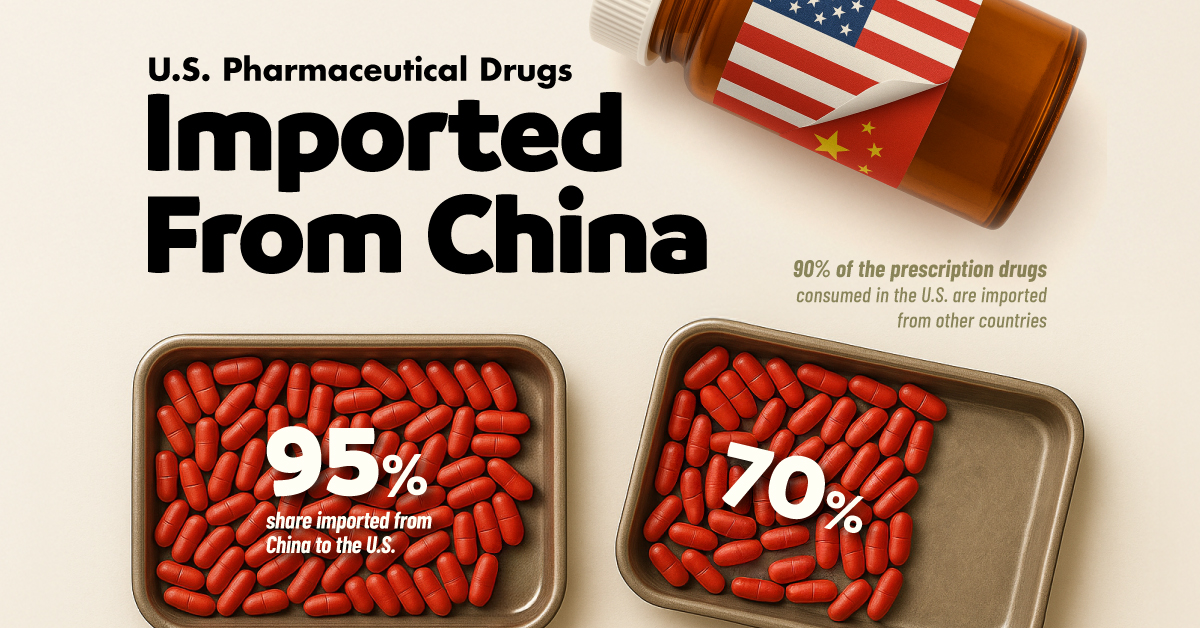
This infographic shows U.S. dependence on pharmaceutical drug imports from China for common medicines like ibuprofen and acetaminophen.
Charted: U.S. Pharmaceutical Drug Imports from China

  • China supplies 95% of U.S. ibuprofen imports and 70% of acetaminophen imports
  • Roughly 90% of medicines prescribed in the U.S. are imported from other countries
The U.S. heavily depends on overseas suppliers for many of its essential medicines, and China plays a pivotal role in that supply chain.

This graphic breaks down the share of U.S. pharmaceutical imports from China for four common drugs, based on the latest available 2021 data from the U.S. Census Bureau and Department of Commerce, accessed via the Coalition for a Prosperous America.

Over the last two decades, China has become a dominant supplier of active pharmaceutical ingredients (APIs) and finished drug products to the United States. In 2021, China was the leading supplier of U.S. pharmaceutical imports by weight, accounting for 23% of the total.

Here are some common pharmaceutical drugs for which the U.S. depends heavily on Chinese imports:

微信图片_20250713003346.png


China supplies 95% of U.S. imports of ibuprofen, which is used in over-the-counter drugs like Advil and Motrin. Similarly, 70% of U.S. acetaminophen (used in Tylenol and DayQuil) imports originate from China.

Furthermore, China accounts for 91% of U.S. hydrocortisone imports. Hydrocortisone is the medicinal preparation of the hormone cortisol, and is used to treat allergies and inflammation.

Penicillin, a widely-used antibiotic, is also primarily imported from Chinese manufacturers.
Today, 90% of prescription drugs consumed in the U.S. are imported from other countries, making it the world’s largest pharmaceutical importer.

Since 2001, pharmaceutical imports have surged more than sixfold, and pharmaceutical goods now rank one of the most-imported goods into the United States.

This trend has raised concerns about supply chain security, particularly considering global disruptions like COVID-19, when sudden spikes in demand lead to shortages.


Inside China’s Bio-Tech Mega Factory: Mass Production America Can’t Match!​

To view this content we will need your consent to set third party cookies.
For more detailed information, see our cookies page.
 

AstraZeneca to invest US$15bn in China manufacturing and R&D​

18th February 2026

astrazeneca-logo-shutterstock_1664089354.jpg

Tada Images / Shutterstock.com

PHARMACEUTICAL giant AstraZeneca has announced plans to invest US$15bn in China, deepening its presence in the country’s manufacturing and research ecosystem and citing China’s growing “scientific excellence”.

The investment, announced last week, will span the pharmaceutical value chain from drug discovery to commercial manufacturing. AstraZeneca said it will focus particularly on cell therapies and oncology, drawing on China’s advanced R&D and manufacturing capabilities to expand its biotech portfolio.

As part of the expansion, the company plans to grow its manufacturing footprint in Beijing, Wuxi, Taizhou and Qingdao. AstraZeneca said the programme is expected to support more than 20,000 jobs across the supply chain and accelerate access to new treatments for Chinese patients.

Chinese expertise​

China has been rapidly growing its pharmaceuticals sector in recent years, particularly in gene and cell therapies. More than 400 cell therapies are currently in clinical trials in the country, with notable strength in CAR T and stem cell development.

The country’s focus on manufacturing is part of its “Healthy China 2030” strategy, launched in 2016 to improve the nation’s health and strengthen social and economic development.

UK-Chine trade links​

AstraZeneca’s investment was announced during UK prime minister Keir Starmer’s visit to China, where he reaffirmed his country’s commitment to collaboration in pharmaceutical innovation.

AstraZeneca says it is also working with UK universities including the University of Cambridge, the University of Oxford and King’s College London to build research partnerships linked to its China expansion.

Pascal Soriot, CEO of AstraZeneca, said: “By expanding our capabilities in breakthrough treatments like cell therapy and radioconjugates, we will strengthen our contribution to China’s high-quality development and, most importantly, bring next-generation modalities to patients.”

The company recently forecast annual revenues of US$80bn by 2030 and the launch of more than 20 new medicines, underscoring the strategic importance of its China investment.

 
China Surpasses US in Drug Trials as Washington Responds
August 12, 2026 10:41 PM

3d-Rendering-Of-A-Red-Medical-Capsule-An.jpg

China has pulled ahead of the United States in clinical drug development and supply chain, two of six domains measured in a June Cure Innovation Index survey, even as Big Pharma signs billion-dollar deals for Chinese-developed medicines.

Washington Moves — But the Patient Clock Is Ticking

In a statement to Benzinga, Dr. Nathan Goodyear, an integrative medicine physician at Williams Cancer Institute who has spent time in China himself, said the scale of the shift is striking. “A decade ago, almost none of the new cancer drugs in the American pipeline came from China. Today, roughly a third of the new drugs Big Pharma licensed in came from Chinese labs." Goodyear said.

He said the security concern and the patient cost of restricting the licensing partnerships are both real. “Throttle these partnerships too abruptly and the near-term cost lands on the people with the least time to spare — cancer patients,” Goodyear said. “Fewer candidates in the pipeline, longer timelines, and less price competition on some of the most promising new drugs.”

The U.S. Department of Health and Human Services launched Operation TrailBlazer in late June. The agency warned in its roadmap of a “critical window, measured in years, not decades, to act decisively or risk ceding military, geopolitical, and economic advantages to China.”

Congress introduced the Biotech Investment National Security Act the same month to screen outbound biotech investment. The move builds on the Biosecure Act, signed into law in December 2025, which bars federal agencies from procuring biotechnology services from firms linked to foreign adversaries.

The concern has reached across party lines. Sen. Kirsten Gillibrand (D), speaking at a Senate Special Committee on Aging hearing on Jun. 17, said, “One of the things that should worry us most and should immediately spark Congressional action is China’s top-to-bottom efforts to dominate the next generation of biotechnology.”

The Deals Tell the Story

The scale of that shift is reflected in the deal flow.

Bristol Myers Squibb Inc. (NYSE:BMY) signed a $15.2 billion collaboration with China’s Jiangsu Hengrui Pharmaceuticals in May. The deal covers 13 early-stage programs in oncology, hematology and immunology. It ranks among the largest cross-border biotech deals ever signed.

Merck & Co. Inc. (NYSE:MRK) reached a $2 billion licensing agreement in March 2025 for HRS-5346, a cardiovascular drug developed entirely in China. Merck secured exclusive rights to the drug outside Greater China.

Pfizer Inc. (NYSE:PFE) Chief International Commercial Officer Alexandre de Germay said at an industry event, “Today, 40% of all clinical studies in oncology in the world are in China. The volume of innovation that is coming out of biotech in China is just amazing.”

A Cure Innovation Index survey of 117 senior U.S. industry and academic leaders found the U.S. retained its edge in technology transfer, capital and commercialization and talent. The two countries were rated equal in scientific discovery.

According to the same survey, 76% of experts say the U.S. leads but China is closing fast, 85% say the U.S. lead lasts 10 years or less, and 72% agree China is improving faster than the U.S.

The Science Is Closing the Gap

Shun
Lu, a medical professor at Shanghai Jiao Tong University, speaking at the Global Health Summit in Hong Kong, said China was the first country to complete research on a drug resistance problem affecting roughly 15% of lung cancer patients with an EGFR gene mutation. “The drug’s indication has currently only been approved in China and is about two years ahead of the U.S.,” Lu said.

In antibody-drug conjugates, among the most sought-after assets in oncology dealmaking today, Lu said China is “basically at the same level as the United States.”

The money is following the science. Last week, the Hong Kong Investment Corporation, which manages about $8 billion in assets and is wholly owned by the Hong Kong government, said it had built a diversified biotech and health care portfolio spanning both traditional Chinese and Western medicine.

The Domestic Counterpoint

Some American companies have taken a different path.

Regeneron Pharmaceuticals Inc. (NASDAQ:REGN) said in 2025 that “over 80% of our workforce and assets are in the U.S. and all of our Food and Drug Administration-approved medicines were invented in our New York laboratories.”

Amgen Inc. (NASDAQ:AMGN), which operates one of the largest domestic manufacturing footprints in the biotech industry, has been expanding U.S. production capacity.

Both companies have kept most of their discovery, development and manufacturing operations in the United States. Washington is now actively encouraging the broader industry to follow a similar model.

Unlike semiconductors, biotechnology is not a single bottleneck. The U.S. and China are competing across a multi-layered biomedical ecosystem, with each country holding advantages at different stages of the value chain.

For Goodyear, the answer lies not in how much the U.S. depends on China, but in building a system that can withstand disruption. “The real question isn’t ‘more dependence or less,'” he said. “It’s resilience. Resilience isn’t the same as immunity.”

He added, “We can’t ban our way out of this. The answer is targeted, not blunt.”

 
Last edited:
To view this content we will need your consent to set third party cookies.
For more detailed information, see our cookies page.
 

Users who are viewing this thread

Country Watch Latest

Latest Posts

Back
Top