China's solar push reshapes traditional ways of life on Tibet's high plateau

Beijingwalker

VIP Member
Joined
Nov 4, 2011
Messages
94,103
Reaction score
114,319
Reputation
1,912.7
Country of Origin
Country of Residence

China's solar push reshapes traditional ways of life on Tibet's high plateau​

By Andrew Silver
November 4, 202612:16 PM GMT+8

5JSDORDAPJPN3D5XAW7ZNEQJKI.jpg

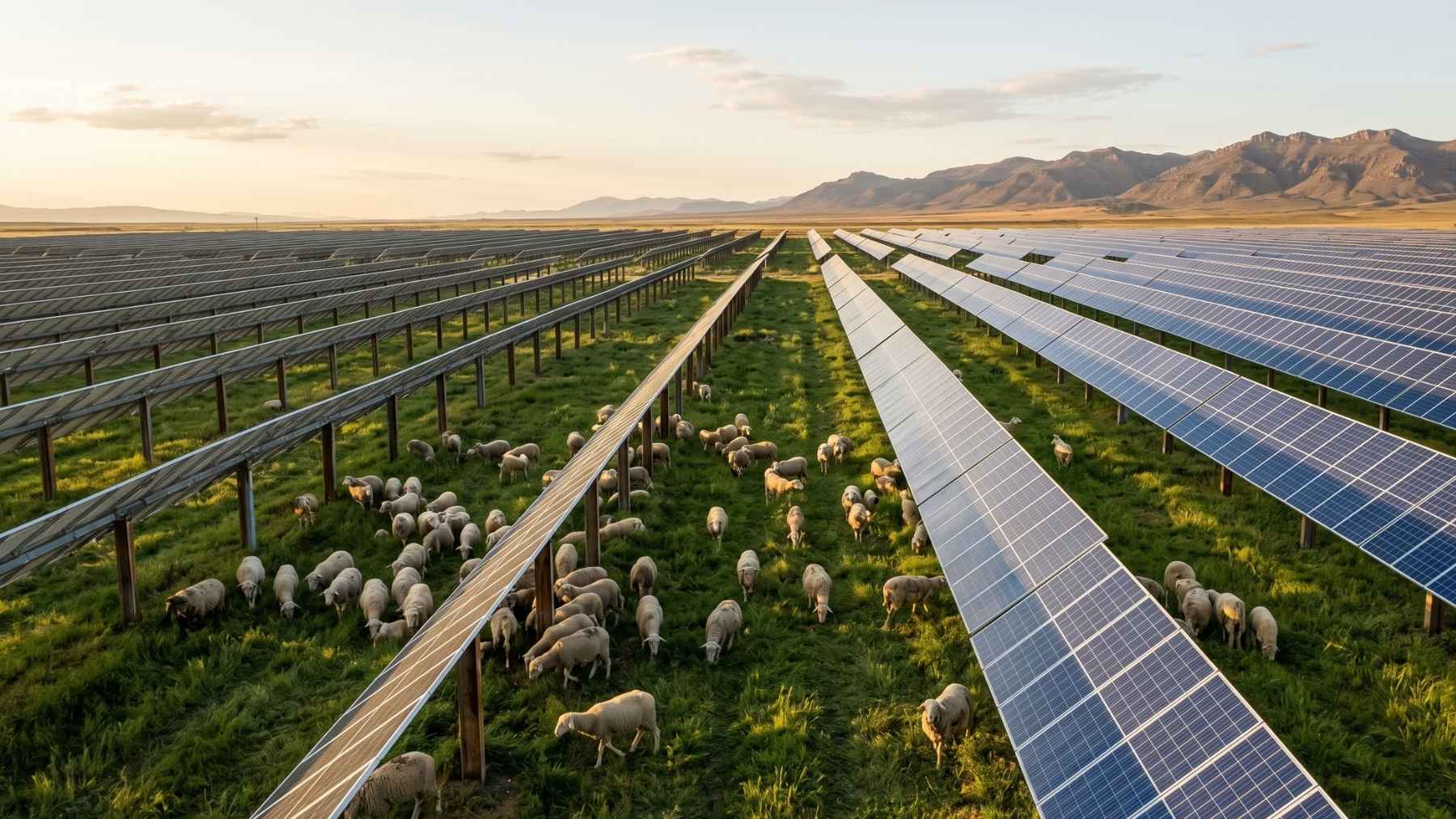
A flock of sheep moves among solar panels at Talatan Solar Park in Hainan Tibetan Autonomous Prefecture, Qinghai province, China, August 5, 2026. REUTERS/Go Nakamura Purchase Licensing Rights, opens new tab

  • Summary
  • Plateau is a focus for China's renewable energy ambitions
  • Shepherds say grazing in solar parks boosts incomes
  • Researchers say projects fragment grazing lands
  • They also accelerate changes in nomadic ways of life
GONGHE, China Nov 4 (Reuters) - Life has become unexpectedly easier and more lucrative for some shepherds on the world's highest plateau, after China began carpeting the area with solar panels in a drive to diversify its energy mix.

"It has made grazing much easier for us," said Li Yonglin, 25, one of those ‌allowed to freely graze their sheep in a fenced solar park in Gonghe, a county in the northwestern province of Qinghai.

"In the morning, we simply open the gate to the sheep pen and don't really need to look after them. They come back on their own in the evening, and we just pen them up."

Li estimated the new approach had boosted his earnings to 50,000 yuan to 60,000 yuan ($7,496.14 to $8,995.37) from 10,000 yuan to 20,000 yuan when he followed the old way.

By July this year, state media said, 6,330 households in five townships had benefited from 56 grazing sites in Hainan, a culturally Tibetan area that encompasses Gonghe, but did not disclose how many got grazing access.

HIGHER INCOMES BUT TRADITIONS ⁠AT RISK​

Such early signs suggest China's projects sprawling over hundreds of acres on the vast Qinghai-Tibet plateau are boosting incomes for some, though researchers and others warn they are also eroding traditional ways of life.

One study, opens new tab estimated the region, sometimes called "the roof of the world", where nomadic communities have grazed livestock for millennia, holds almost half of China's solar energy potential, making it a focal point for renewable energy efforts.

Solar overtook coal in July as the country's biggest source of installed power capacity, and authorities plan to expand wind and solar power generation by a further 53% in the next five years.

The complex Li visits, sprawling over 148,000 acres (60,000 hectares), uses grazing sheep to reduce mowing costs, said Cao Jun, a safety supervisor for a State Power Investment Corporation (SPIC) project in Hainan.

It leads to a "win-win situation", he told Reuters, with power generated by the plant sent nationwide to cities such as Beijing, the capital, and the commercial hub of Shanghai.

But the integration of livestock and solar infrastructure has not been universally welcomed.

Researchers say solar projects are transforming life on the plateau, where thousands of Tibetan nomads were resettled into rural townships in the early 2000s as the ‌government sought ⁠to reverse ecological degradation.

"You can find some places (to graze) around the solar panels, but these are not suitable for nomads and shepherds to hold their livelihood," said researcher Tsewang Dorji at the Tibet Policy Institute in India's hill town of Dharamsala.

Plateau dwellers get little say in the conversion of pastures to solar power projects, said one researcher studying environmental conservation and new energy infrastructure there.

PROJECTS FRAGMENT ONCE-OPEN GRAZING SPACE​

Such installations fragment once-open grazing lands, making herders' task of watching over livestock harder, added the researcher, who sought anonymity in order to protect collaborators.

Sheep from 16 households were allowed to graze in a solar park for part of ⁠the year, the government in Gonghe said in 2024.
A small number of nomads were "tokenistically employed to graze sheep" but goats and yaks were generally excluded, said Mandie McKeown, advocacy director at the environmental charity Foundation for Gaia, which is based in Britain.

Evidence shows "This isn't pastoralism as it’s traditionally been practised," McKeown told Reuters.

Wind rattling through solar farm posts and wires produced "persistent and unsettling" sounds that disturbed both people and animals, anthropology ⁠researcher Sanggay Tashi at the University of Colorado Boulder said in an article in June, citing people in Qinghai.

Online government records in 2017 showed one undated complaint that Gonghe's photovoltaic power stations had damaged grasslands, leaving sheep and cattle little grass to eat.

The records, which cited Hainan as the administrative region for the case without identifying the aggrieved person, said an investigation found no truth ⁠in the accusation, while adding that grazing was not permitted in the area.
Authorities in Qinghai did not respond to requests for comment.

Not everyone in Gonghe is complaining, though.
"Life has changed tremendously," said another shepherd, Wen Yujun, who now finds himself able to manage a herd of 700 to 800 largely on his own.
"I never could have imagined it before," added the 43-year-old, who estimated his annual income had risen eight-fold to about 80,000 yuan.
($1=6.6701 Chinese yuan renminbi)
 
The so called " disrupting Tibetan traditional life style" means Tibetans should stay poor forever and they have no right to be wealthy and live a comfortable and modern life which westerners have enjoyed for decades.
The funny thing is the all Tibetans living in Tibet are so excited about the project cause their income has increased 8 folds, they benefit massively from the project while all Tibetans living in India and the west hate it , cause they don't benefit this development at all.
So who should the Chinese government listen to?
 

China accounts for nearly half of clean industry investments, research shows​

By Reuters
November 4, 202611:32 AM GMT+8

View attachment 222036
Numerous solar panels cover the surface at the Dalad Banner Photovaltic Base in Kubuqi desert with Baotou city seen in the background during organized media tour, in Ordos, Inner Mongolia Autonomous Region, China, June 12, 2026.

SINGAPORE, Nov 4 (Reuters) - China secured $45 billion in investment in clean industries in 2026 and now accounts for 49% of all clean industrial plants currently operating or under construction, a ‌global investment tracker said on Wednesday.

The Reuters Power Up newsletter by columnist Ron Bousso provides everything you need to know about the global energy industry. Sign up here.

  • The Mission Possible Partnership was set up to promote decarbonisation projects in "hard to abate" industries worldwide, including lower-carbon cement and steel plants, clean methanol production, sustainable aviation fuel and aluminium smelting using greener energy sources
  • A ⁠record 36 commercial-scale industrial decarbonisation projects reached a final investment decision in the past 12 months, with 23 in China alone, according to MPP's Global Project Tracker
  • Sustainable aviation fuel, methanol and clean ammonia were the leading sectors over the period
  • It brings the total number of such projects financed or built worldwide to 189, including 93 in China, with another 838 announced or under development, ‌the ⁠tracker showed
  • "We have seen a record number of final investment decisions in the last 12 months, but we need to move from tens to hundreds of financed plants each year," said Faustine Delasalle, MPP's chief ⁠executive
  • Gaining access to low-cost renewable power is crucial for many of these low-carbon industrial plants to get off the ground, with the pipeline of announced ⁠projects requiring an estimated 3,500 terawatt-hours of electricity per year, 12% of current global power demand, MPP said
  • Clean industrial projects ⁠are competing for electricity supplies with the booming data centre sector, and grids are struggling to keep up with the soaring demand, it added


China built the world’s largest solar farm on a high-altitude Tibetan plateau desert that was 98% sand. Three years later it grew so much grass they had to bring in 20,000 sheep to eat it​

By: Luis Reyes

Published: Jun 6, at 8:30am ET
solar-farm-tibet.jpg

You’d expect a solar megaproject covering a chunk of high-altitude desert to be bad news for the people who graze sheep there. Fence off the land, install a few million panels, ship the locals somewhere else: that is the standard playbook for utility-scale anything. What’s happening at the Talatan complex in Qinghai, on the northeastern lip of the Tibetan Plateau, is the opposite. Three years after the panels went up at industrial scale, herders are running more sheep on more grass than they had before construction started.

The short version: panels block wind, cool the soil, and trap moisture. Grass grows. So much grass, in fact, that the solar operator now needs the sheep to keep it from shading the modules and turning into a winter fire risk. The herders get free pasture, the utility gets free landscaping, and a stretch of Gobi that used to be mostly sand is now a working grassland under glass, not unlike the way other clever renewable projects are repurposing land nobody else wanted.

Talatan sits in Gonghe County, Hainan Tibetan Autonomous Prefecture, and the scale is genuinely hard to picture. The complex is developed by Huanghe Hydropower, a subsidiary of the State Power Investment Corporation, and treated as a single facility it has been reported as the world’s largest solar plant by both footprint and output.

Installed capacity has climbed fast: Chinese government figures put it around 8,430 megawatts in mid-2024, and by 2026 the complex was reported at roughly 21 gigawatts generating more than 18,000 gigawatt-hours a year. Once construction wraps, the photovoltaic park is slated to cover about 609 square kilometers, close to the size of the city of Chicago, with more than 7 million panels and over 60 separate solar operators inside the same fence line.

One slice of that cluster, the roughly 64-square-kilometer Gonghe Photovoltaic Park, is the part scientists have studied most closely. That is the patch where the strange thing happened.

Before construction, the Talatan area was bad land. Chinese state media report that 98.5% of it was sand, with herders driving flocks long distances every year just to find enough grass to keep them alive. Then came the panels, and with them an accidental greenhouse effect at ground level. Less direct sun on the dirt means less evaporation. Maintenance crews wash the panels periodically, and that runoff drips into the soil. Wind speeds fall because the rows act as windbreaks.

The numbers the operator publishes are aggressive. Its own remote-sensing data, from a joint study with Xi’an University of Technology, claims wind speed dropped about 50%, soil evaporation fell roughly 30%, and vegetation cover hit 80% across three years. Those are utility-published figures, so squint at them. But a peer-reviewed assessment in Scientific Reports, run by researchers at Xi’an University of Technology and Qinghai University, scored conditions inside the Gonghe array clearly better than the surrounding desert on soil moisture, vegetation and microbial life, concluding the buildout had “a positive impact on the ecological environment.” The grass came back hard enough to start shading the modules.

That’s where the herders re-enter the story. Grass that grows over a meter tall under the panels cuts output and turns into a winter fire hazard. In places it shot up past a meter, tall enough to block the panels and drag down power efficiency, according to a staffer at the local industrial park. Rather than pay crews to cut it or spray herbicide near drinking water, the operator cut deals with neighboring villages: bring your sheep in, eat the grass, don’t pay us.

The engineering got rewritten around the animals. Technicians widened the gap between panel rows from three to five meters and lifted the mounting height from 50 centimeters to between 1.5 and 1.8 meters, so sheep can walk underneath without crouching. The first 2012 arrays were too low; newer ones aren’t.

The grazing arrangement now looks like this:

  • Free grazing runs June through October each year.
  • Roughly 66 square kilometers (about 100,000 mu) of company-owned pasture inside the fence is open to herders.
  • The prefecture has set up 32 photovoltaic eco-pastures and 56 centralized grazing sites.
  • 18 nearby villages run more than 20,000 sheep through the park each year.
  • Annual grass output runs around 110,000 tonnes, with one local official putting it at 118,000 tonnes, enough to feed 200,000 sheep.
The income side is where the policy theater meets the bank account. Yehdor, a 49-year-old herder profiled repeatedly in Chinese state coverage, told Xinhua his family now pulls in “nearly 100,000 yuan (about 14,000 U.S. dollars) a year from raising sheep,” with his flock growing from 200 head to more than 300. An earlier 2024 account pegged his jump at roughly 20,000 yuan before the park to 70,000 to 80,000 after. State figures put the agrivoltaic setup at over 10,000 yuan per mu, roughly $1,398 per 0.07 hectares, and credit it with lifting 173 nearby villages out of poverty. That is official Chinese government framing, so read it knowing the source, but the broad-stroke trend of more grass, more sheep, more cash shows up in the peer-reviewed work too.

There is also a branding twist. Locals now market the meat as “photovoltaic sheep” and sell mutton nationwide via e-commerce, which sounds invented but apparently isn’t. Each animal carries a QR-coded ear tag storing its age, vaccination history and owner, so a buyer can scan the code and trace the lamb chop back to a specific flock under a specific row of panels.

The Talatan numbers are spectacular. They are also a single site, in a specific microclimate, with a utility that has obvious reasons to publish flattering data. Other researchers have already flagged the catch. A separate study of photovoltaic sites across the wider Qinghai-Tibet Plateau found that about 56% of installations saw vegetation cover improve, while 44% actually lost cover compared with surrounding land. Soil moisture explained roughly 62% of the difference, and more than half of the apparent restoration traced back to the water used to wash the panels. Cut the cleaning budget, or push into drier zones, and the lush patches disappear. Lean on them too hard in a truly arid area and the extra plant growth starts pulling water out of an aquifer that can’t refill it.

For the US solar industry, the Talatan result still matters because the dual-use idea is finally getting a serious case study. The American Solar Grazing Association has been pitching the same model since 2018, mostly to skeptical utilities, and it is the kind of approach the broader US clean-energy build-out keeps circling as it runs into its own cost and land fights. Talatan is what the pitch looks like at gigawatt scale: panels generate the power the grid needs, the soil underneath gets a microclimate it didn’t have, and the farmers who would have been pushed off the land are the ones being paid to maintain it.

The Chinese version comes wrapped in caveats about water budgets, state messaging, and a utility that completely controls the story. But the basic finding, that a properly engineered solar farm can leave the local agricultural economy bigger than it found it, is now a data point instead of a hope.


Users who are viewing this thread

Back
Top