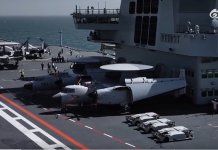
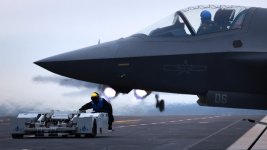
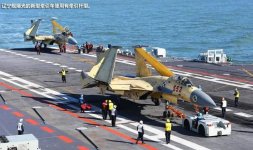
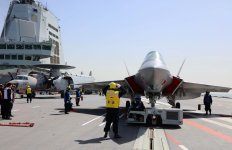
We know that both aircraft carriers and amphibious assault ships carry a large number of aircraft. To freely maneuver these aircraft within the confined deck space for tight arrangements to maximize sortie capacity and enable free transfers, relying solely on the aircraft's own power is absolutely not feasible. Not to mention other issues, the wake turbulence alone poses significant dangers. Therefore, a device to tow the aircraft is necessary, and thus the aircraft tractor came into being.
The aircraft tractor, in essence, is a simple concept. For countries without advanced capabilities, even ordinary trucks or tractors can be used as long as they can tow an aircraft. Yes, I'm looking at you, India—haha. However, for those capable of operating aircraft carriers and amphibious assault ships, the configurations must be high-end. The tractors used must meet numerous requirements, such as a low center of gravity, typically appearing as a flat rectangular shape, usually with a 4 to 6-wheel design. They must be structurally compact, small in size, have low failure rates, be highly maneuverable, operate at low speeds, possess strong towing capacity, offer precise and stable control, have a small turning radius, and be resistant to rain, snow, ice, high temperatures, high humidity, and corrosion. They must also simplify work procedures and reduce personnel requirements. As a result, they are quite expensive. It is said that a single tractor on the Liaoning aircraft carrier costs over ten million yuan.
Aircraft tractors can be categorized by power source into internal combustion engine types and electric tractors. Based on towing methods, they can be divided into bar-type and barless types. The earliest tractors used on the Liaoning were internal combustion engine bar-type tractors, which connected to the aircraft via a towbar. Later, barless tractors were introduced, eliminating the towbar that connected the aircraft and the tractor. Instead, these use their own clamping-lifting mechanism to connect to the aircraft's nose landing gear.
Electric barless tractors can be further divided into ride-on and walk-behind types, depending on the operator's relationship with the tractor. Ride-on types are used for towing medium/heavy aircraft, while walk-behind types are mostly used for towing light aircraft and have a smaller operational range. Based on the control method, they can also be categorized as contact or non-contact, meaning whether the control device is on the vehicle or operated via wired or wireless remote control.
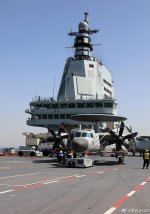
The tractors on the Fujian aircraft carrier are all products from Beijing Jinlun Kuntian. Most are ride-on barless tractors, with some bar-type tractors as well. On the Hainan ship, light remote-controlled electric aircraft tractors for towing helicopters have been deployed.
from: 蒋蒋烽火谈