New images suggest China’s fourth aircraft carrier could launch in 2027, analysts say
Shipyard activity at Dalian showing Type 004 underscores Beijing’s military ambitions by 2035, according to expert
Gabriel Dominguez
9:06pm, 29 Oct 2026
China’s fourth aircraft carrier, widely believed to be
the country’s first with a nuclear-powered system, could launch as early as next year, according to US researchers, as Beijing pursues a fleet capable of projecting naval and air power
far beyond its shores.
A launch in 2027 would coincide with the centenary of the People’s Liberation Army, with the anniversary falling on August 1. Beijing has previously used major military anniversaries to showcase developments in its armed forces.
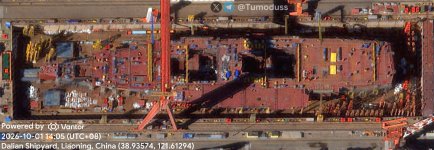
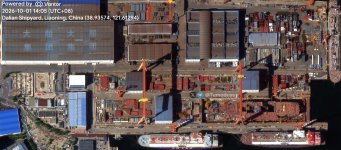
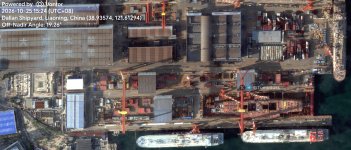
The Washington-based Centre for Strategic and International Studies (CSIS) said in an updated assessment on Tuesday that satellite imagery from this month showed the warship – commonly referred to as the Type 004 – at a construction stage comparable to that of China’s third carrier,
the Fujian, in May 2021, about a year before its June 2022 launch.
This suggests the Type 004 could enter the water next year. However, analysts cautioned that its larger size and potentially more complex propulsion system, as well as unforeseen issues, could put it on a different schedule from the Fujian. Beijing does not disclose construction timelines.
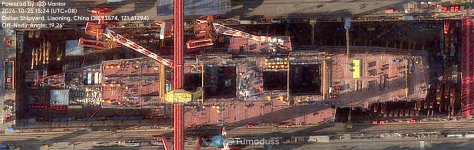
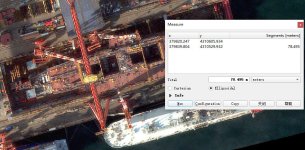
The latest photographs show the Type 004 in a dry dock at Dalian Shipyard in northeastern China without its flight deck or island superstructure.
Launching a carrier does not mean it is ready for operational service. The Fujian, for example, was only commissioned in November last year, more than three years after its launch.
Brian Hart, deputy director of the CSIS China Power Project and a co-author of the assessment, said that a late-2027 launch was plausible.
“If construction continues at this pace, and if it follows a similar construction timeline to the Fujian, I would not be surprised if the vessel launches by the end of 2027 or early 2028,” he said.
According to CSIS, the unfinished hull measures about 322 metres long and 46 metres wide (1,056 feet by 151 feet), although its final dimensions remain unclear.
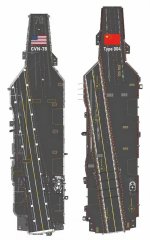
An imagery analyst who requested anonymity estimated the hull was closer to 327 metres long. He said the completed vessel could be up to 339 metres if its flight deck extended beyond the visible bow, which could make it comparable in length to the US Navy’s largest aircraft carriers.
Hart said the latest photographs also showed upper hull sections being installed, including structures to support a flight deck extending considerably farther than the lower hull.
The imagery analyst similarly expected the flight-deck modules and island superstructure to be installed before launch, while deck surfacing and the installation of arresting gear, sensors and weapons could be completed pierside afterwards.
Referring to the latest CSIS assessment, Jim Fanell, a retired US Navy captain and former US Pacific Fleet intelligence chief, said the “scope, scale and speed of the construction at Dalian” had left him “even more convinced” that the Chinese navy’s fourth carrier was most likely to be launched next year.
While China’s sequence of construction is not known, progress could also depend on when and how its expected nuclear propulsion system is installed.
Another retired US Navy captain, Bradley Martin, who is a senior policy researcher at the Rand Corporation, also considered a launch next year feasible.
“China does have experience with naval nuclear power, so I don’t think it’s a huge stretch to say that launch will occur in 2027,” he said.
Martin said that before launch it would be “advantageous” to install the propulsion plant and propeller shafts, complete the hull and superstructure and apply underwater coatings.
“Depending on whether integration of nuclear propulsion proves challenging, there could be a two [to] three-year lapse between launch and actual readiness to operate,” he said.
The imagery analyst raised questions about whether the reactors would be installed at Dalian or whether the unfinished hull might be moved elsewhere for that work.
The Type 004, which is also expected to feature an electromagnetic aircraft launch system, reflects Beijing’s longer-term ambitions for its carrier fleet.
According to a
2025 Pentagon report, the Chinese navy aims to build six more
aircraft carriers by 2035, potentially bringing its fleet to nine.
Analysts said such an expansion would require significantly accelerating production, including building multiple vessels simultaneously.
Fanell said the Type 004’s construction at Dalian showed China could build large carriers at two separate shipyards. But he questioned whether those facilities could deliver the projected fleet, suggesting six operational carriers by 2035 was more realistic.
Reaching nine might require a third construction site, he suggested, although there was no evidence of one.
Hart said it was “conceivable” China could build carriers simultaneously at Dalian and Jiangnan Shipyard, where the Fujian was built. He also pointed to a carrier-capable dry dock at the Yulin Naval Base on Hainan island, which he said could provide “additional capacity to maintain and refit existing carriers”, freeing other dry docks for new construction.
James R. Holmes, who holds the J.C. Wylie Chair of Maritime Strategy at the US Naval War College, considered a nine-carrier fleet “feasible” if China’s navy had settled on a design acceptable to its leadership.
“China certainly has the industrial capacity to start cranking these hulls out like sausages, much as it has Type 055 cruisers and other major surface combatants,” he said.
A larger fleet could also significantly expand Beijing’s military options, allowing it to sustain carrier operations in the Indian Ocean and western Pacific.
“A fleet that size would provide enough hulls to manage events in the western Pacific, China’s primary theatre of interest, while creating an expeditionary fleet for operations out of area,” Holmes said.
According to Martin, Chinese carriers might not match their US counterparts in the number of aircraft missions they could generate and would be vulnerable in heavily contested waters during a conflict with US forces.
He said their broader value was to provide Chinese decision-makers with “options in conflicts worldwide”, even if the vessels were not decisive in a direct confrontation with the US Navy.