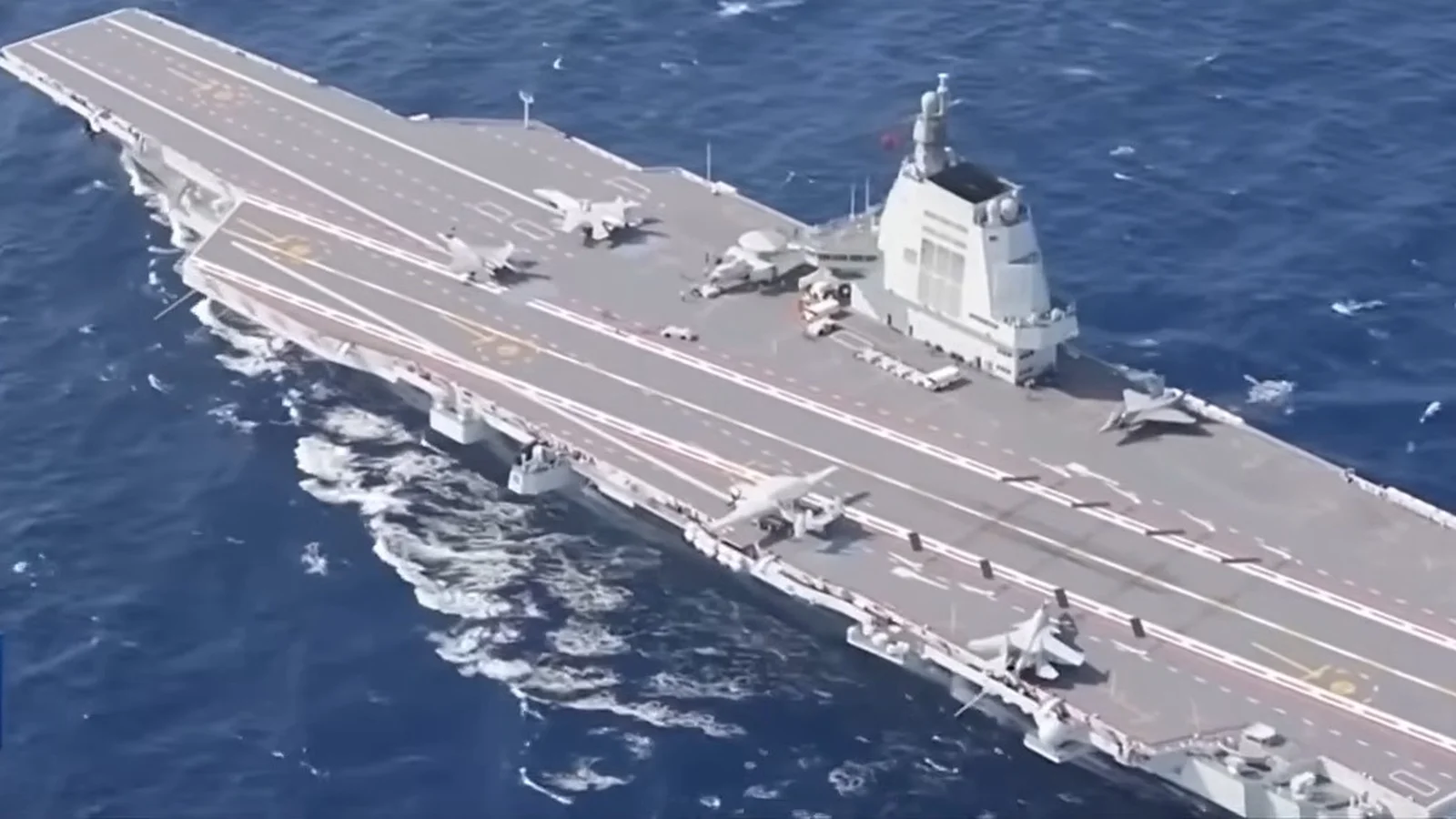
Chinese Aircraft Carriers - Liaoning, Shandong, Fujian and the future

Yes, but two different world strategies here right?

US has used carrier power to reienforce presence in Europe, Mid East and Pacific and project power. Someone correct me if I am am wrong here but China does not plan to do that, it (rightfully so) wants to protect it's interests in near abroad and maybe Indian Ocean. For that does it need to match USN carrier for carrier?

Realistically can USN field more then 6 of it's 11 aircraft carriers at any given time in the Pacific?
There is a classic Chinese saying: "Having a sword in your hand and not using it is not the same as having no sword in your hand to use."

China’s national defense capabilities are developed and prepared with the most extreme scenarios in mind. This includes—but is not limited to—contingencies involving the United States.

OK, I am not a mind reader, can you be less cryptic? Of course they prepare for sceanrios V the US
 
There is a classic Chinese saying: "Having a sword in your hand and not using it is not the same as having no sword in your hand to use."

China’s national defense capabilities are developed and prepared with the most extreme scenarios in mind. This includes—but is not limited to—contingencies involving the United States.


I would agree

China has Type 076 LHA although not a carrier more a amphibious assault ship I would add that if it can take the latest JL-15 or JL-XX + GJ-21 UCAVs it will be a great for addition to CV-16 + CV-17 for extra "critical mass"

003 is already operating J-35+ J15 + KJ-600 AWACS

and the 004 should see launch next year and maybe we see start of 005?

by 2030 in "theory" at least we have 5 flat decks from China that could be operating fighters

that will tilt the balance in the Pacific in favour of China

US advantage in under sea submarines will be smaller with the newer Chinese Type 09X SSN

USN main advantage comes from Carriers + SSN, take that way and what's else is left
 
OK, I am not a mind reader, can you be less cryptic? Of course they prepare for sceanrios V the US
I think my statement is quite straightforward...

Okay, to put it even more directly: China's national defense development and construction is being carried out according to the standard of "taking on all countries in the world single-handedly." ------ This refers to our direction of development and our goals; it does not mean that we currently possess such capabilities, and certainly does not imply that we intend to commit aggression against any other country.

We are simply taking precautions against such an eventuality. Should that day ever arrive, we hope to be able to handle the situation, rather than surrendering outright.
This is an extreme defensive strategy, rather than an offensive one.

Is my explanation clear enough now?

That is much more clear and slightly different from your previous answer, yes.
 
Yes, but two different world strategies here right?

US has used carrier power to reienforce presence in Europe, Mid East and Pacific and project power. Someone correct me if I am am wrong here but China does not plan to do that, it (rightfully so) wants to protect it's interests in near abroad and maybe Indian Ocean. For that does it need to match USN carrier for carrier?

Realistically can USN field more then 6 of it's 11 aircraft carriers at any given time in the Pacific?
Yeah, what irritates me is US is trying to limit the expansion or building of Chinese navy and warships. Who in the world give them the right to do so while they want to keep building US military as the world's only dominant superpower forever ? Whether China wants to build 12 carriers or just 6 or 8 is another matter for China to decide according to its national interests.
 
Yeah, what irritates me is US is trying to limit the expansion or building of Chinese navy and warships. Who in the world give them the right to do so while they want to keep building US military as the world's only dominant superpower forever ? Whether China wants to build 12 carriers or just 6 or 8 is another matter for China to decide according to its national interests.

Their arrogance is already becoming their downfall as we speak
 
Yes, but two different world strategies here right?

US has used carrier power to reienforce presence in Europe, Mid East and Pacific and project power. Someone correct me if I am am wrong here but China does not plan to do that, it (rightfully so) wants to protect it's interests in near abroad and maybe Indian Ocean. For that does it need to match USN carrier for carrier?

Realistically can USN field more then 6 of it's 11 aircraft carriers at any given time in the Pacific?
At the Ministry of National Defense press conference on November 14, 2025, Senior Colonel Jiang Bin, responding to the question about the Fujian aircraft carrier being permanently stationed at the Sanya naval port, stated:

"China is committed to the path of peaceful development and firmly pursues a national defense policy that is defensive in nature. The Chinese military has always been a steadfast force for world peace. ... As my comrades in the navy put it,
where China's national interests lie, our naval tracks will reach; the deep blue is the eternal direction for aircraft carriers."
 
Last edited:

China’s Fourth Carrier Type 004 Shows Possible Nuclear Signs: CSIS Flags Two 15×15-Meter Compartments​

Firuze Kılıç
17 Nov 2026 23:58

China’s fourth aircraft carrier, Type 004, is taking shape at Dalian Shipyard with ongoing hull and flight-deck construction. Based on satellite imagery taken on November 12 and reported by The Aviationist on November 16, Army Recognition’s analysis cites an October 27 assessment from the Washington-based Center for Strategic and International Studies (CSIS) identifying two roughly 15-by-15-meter compartments resembling shielded reactor spaces. CSIS rates nuclear propulsion as “likely” based on this finding, but reactor output, fuel type and electrical capacity remain unknown, and China’s Ministry of National Defense has made no official statement on the propulsion system.

More concrete data exists on the carrier’s launch systems: China’s Ministry of National Defense confirmed in September 2025 that Type 004’s predecessor, the Type 003 carrier Fujian, had completed launch-and-recovery tests using electromagnetic catapults with J-35, J-15T and KJ-600 aircraft. CSIS’s assessment says four catapults and a third aircraft elevator are “plausible” for Type 004, though neither has been confirmed. There is no official figure for aircraft capacity; secondary estimates range from 75 to 100, which the sources describe as speculative.

For comparison, the U.S. Ford-class carriers are better documented: congressional testimony states they run on two nuclear reactors driving four shafts, with an officially stated speed above 30 knots and electrical capacity about three times that of the Nimitz class. The U.S. Naval Sea Systems Command (NAVSEA) lists Ford-class capacity at 75 or more aircraft, with design targets of 160 sorties a day sustained over 30 days, rising to 270 a day during a four-day surge. USNI News reported in August 2026 that the U.S. Chief of Naval Operations said Ford had exceeded Nimitz-class sortie-generation performance.

The analysis stresses that direct comparisons remain limited. Type 004’s nuclear propulsion might eventually match Ford’s endurance and speed, but without confirmed power output, the claim cannot be tested. A similar gap applies to airborne early warning: China’s KJ-600 is compared with the U.S. E-2D Advanced Hawkeye, which carries AN/APY-9 radar and Cooperative Engagement Capability, but public data on KJ-600 performance is limited. No public evidence exists of a Chinese platform equivalent to the U.S. EA-18G Growler electronic-warfare aircraft.

The analysis also notes that nuclear propulsion alone does not guarantee sustained air power: aviation fuel, munitions, spare parts, and escort and replenishment ships are still required regardless of reactor type. On the U.S. side, F-35C launch-and-recovery testing began aboard USS John F. Kennedy in October 2026, though that does not mean an operational F-35C squadron is currently aboard Ford. According to the analysis, confirming Type 004’s real capability will require verified propulsion and deck-layout data, sea trials, and repeated operations with a full air wing.


China’s fourth aircraft carrier, bigger than others and nuclear-powered, nears completion​

By Military Times staff
Nov 23, 2026

China’s fourth aircraft carrier, a gigantic vessel known so far as just Type 004, will come out as early as next year bigger than its predecessors and with nuclear power that can launch planes faster than usual in case of any conflict, analysts say.

And it’s tipped to add pressure on countries, such as Japan and the United States, that already keep a high alert for the Chinese military.

GettyImages-2300475929.jpg
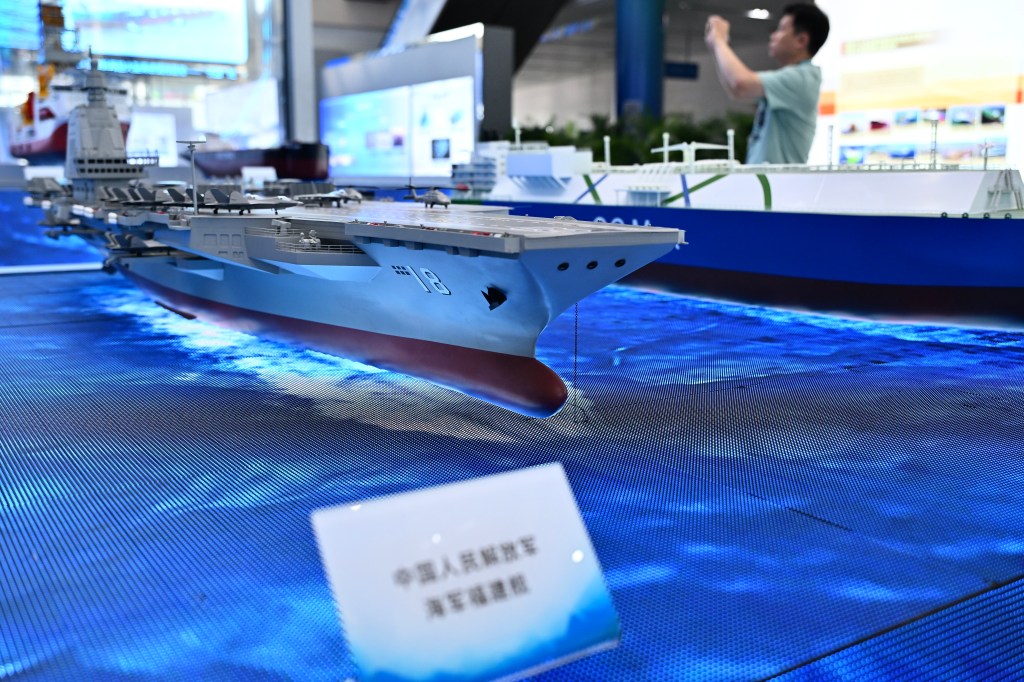
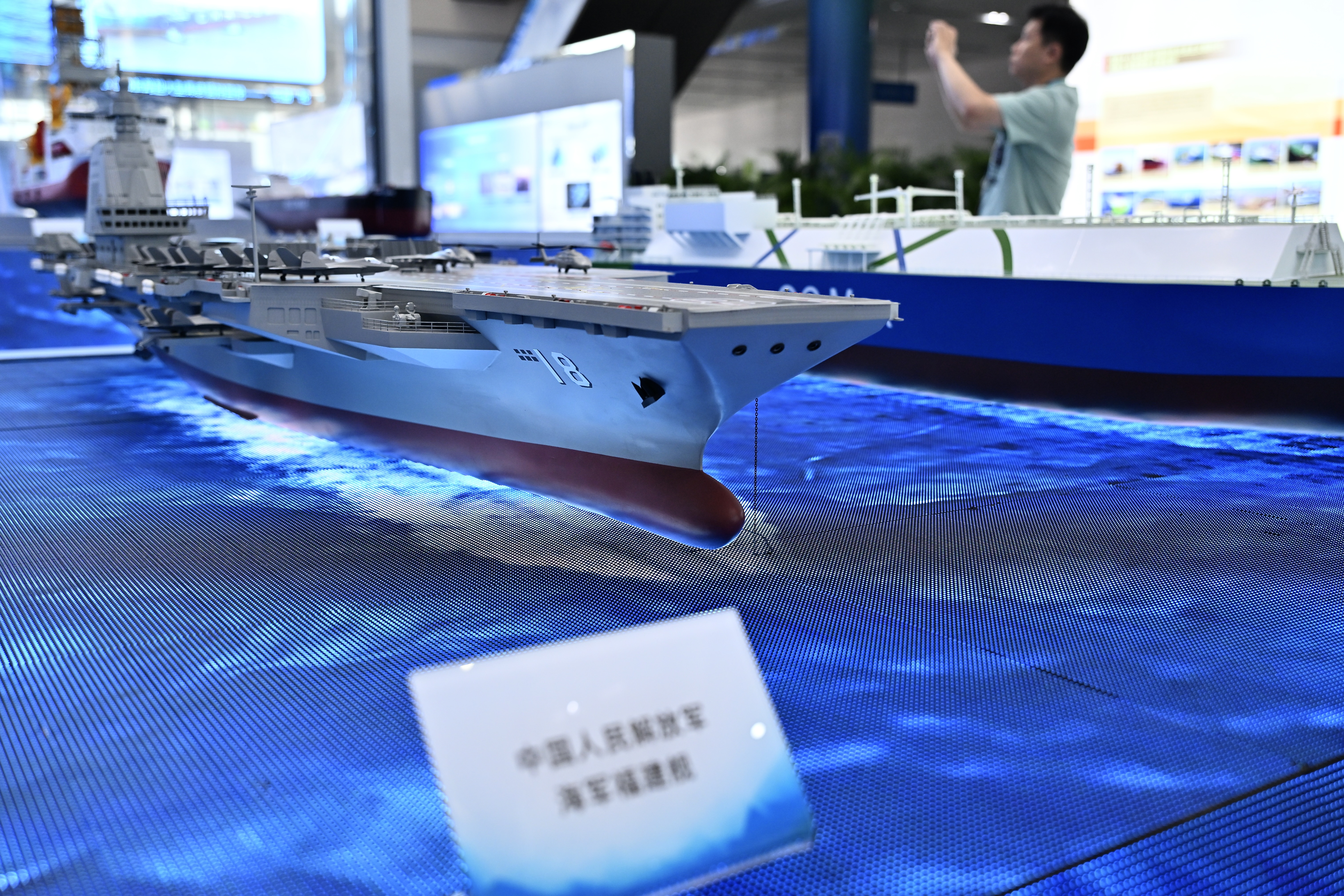
A model of the Chinese People’s Liberation Army Navy Fujian aircraft carrier is displayed at the 2026 World Maritime Equipment Conference on Oct. 16, 2026, in Fuzhou, Fujian Province of China. (Zhang Bin/China News Service/VCG via Getty Images)

The carrier being built now in the northern port city Dalian could accommodate 75 to 90 planes once deployed, the Asia program director at the think tank Defence Priorities has said.

As of October, the vessel’s hull measured about 322 meters in length from the unfinished bow to stern with a width of approximately 46 meters, according to the Center for Strategic and International Studies (CSIS), also a think tank.

CSIS called Type 004 “far larger than any other class of surface combatant” in China’s navy.

Aerial photos of the carrier show the “basic hull form” already built, auguring well for a 2027 launch, said Collin Koh, a senior fellow at Nanyang Technological University in Singapore. Deployment would take 5 to 10 years, he said.

The specs would make Type 004 “slightly larger” than China’s Fujian aircraft carrier, currently the biggest one in its fleet, Koh said.

Information available today about the Type 004 – likely to be renamed after a Chinese province like the existing three – classify the vessel as a “supercarrier” in terms of electronics, tonnage and aircraft carrying capacity, said Alexander Huang, chairman of the Council of Strategic and Wargaming Studies in Taipei.

Nuclear power on board would offer the aircraft more propulsion than China’s existing electromagnetic aircraft launch system, Koh said. He said that would eliminate the need for power generators on board the carrier while allowing faster takeoffs – without payload compromises – and quick combat turnarounds for refueling.

“It seems to signal a certain strategic objective,” Koh said of the nuclear capability. “It’s not just going to move along your coast. It seems to signal a certain global ambition.”

Nuclear power will give the carrier “essentially unlimited endurance” and allow for global deployment without the kind of tanker support a conventionally powered carrier needs, said David Silbey, a Cornell University professor specializing in military history and defense policy.

The fourth carrier may get posted to northern China because the other three are in the south, Huang said. In that scenario, he said, China could “use one of the four to always operate somewhere.”

Type 004 may be used for training and maintenance as well as operations, Huang added.

China’s fourth carrier gets it closer to rivaling the U.S. navy, analysts said.

It will compare in size to the Nimitz and Ford class U.S. carriers, which means it can carry as many as 100 aircraft, Silbey said. “That gives it much more striking power than previous carriers, which could only carry around 50,” he said.

The U.S. navy has 11 carriers, all nuclear powered.

Even if smaller than the U.S. fleet, a Chinese navy with nuclear-powered carriers can mount a challenge to the United States, Koh said.

The U.S. navy maintains bases in Guam, Hawaii and Japan plus treaty alliances with Japan and the Philippines. The U.S. and China have long seen each other as rival superpowers.

Experts have said China sent an especially large number of its naval deployments near Japan’s southernmost islands and nearby waters since a political rift that erupted in November 2025 over a remark by Japanese Prime Minister Sanae Takaichi.

The Philippines is embroiled in a maritime sovereignty dispute with China.

China plans to build more carriers over the next decade for a “blue water capability that they’ve never really had before,” Silbey said. “In the Pacific, it means that they can go after American assets that are out of range of their other assets.”


Users who are viewing this thread

Back
Top