Chinese Aircraft Carriers - Liaoning, Shandong, Fujian and the future

Fujian's information plate from its shipyard.

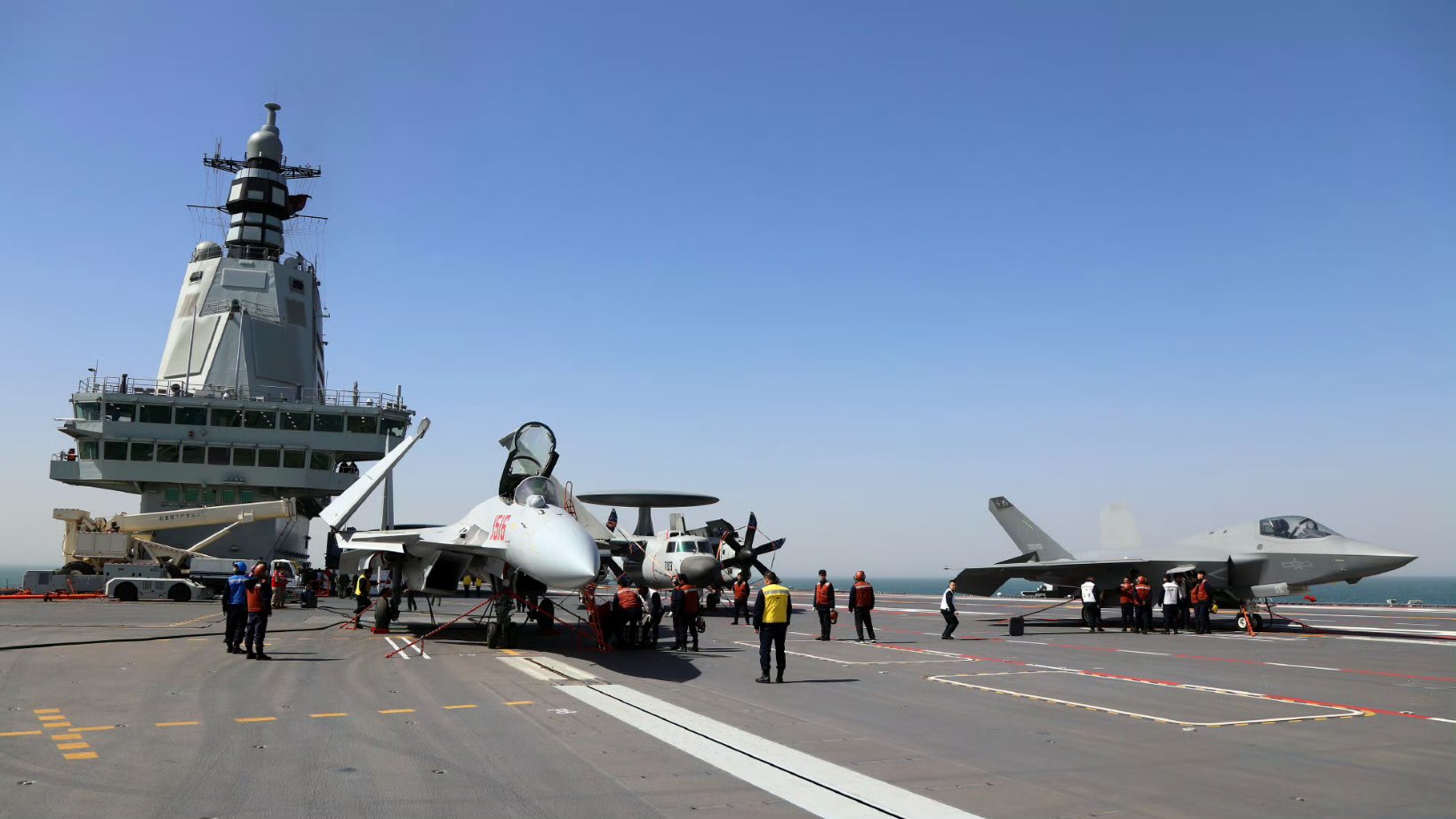
The ship actually has a 330 meters long flight deck, and 80 meters wide. The displacement is 85,000 tonnes, it is not likely the full load displacement.

Because China's EMALS is slightly longer than the US version, that's why the number has been reduced from 4 to 3 on a 330 meter long flight deck. The elevator is also 1 less than the Ford class carrier.

Compared to the 305 meters long Shandong, Fujian does indeed look like a 330 meters long supercarrier.

View attachment 153351

View attachment 153352
Interesting observation about the length of the EMCATs. Longer catapults mean the G forces and speeds will be lower than the 3-4 Gs on the US Cats and the 4-5 Gs on the even shorter French cats, meaning Chinese carrier aircraft will have less fatigue on the aircraft.

Perhaps lower launch speeds (or the same speed but over a longer distance) means less power is needed to launch the aircraft.

To view this content we will need your consent to set third party cookies.
For more detailed information, see our cookies page.
 
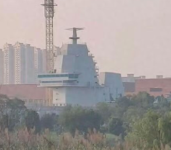
It's not funnel but testing site, there are stalite image from Dalian, photo taken by passenger airliner seen reactor wall, research papers all indicating it's definitely a CVN.

China's CVN can have exhaust port, and we don't need to copy the CVN-78 which is a failure along with its successors of the same class.
 
Will Type 004 use any Gas turbines? Is the facility at Wuhan testing two different configurations at the same time; island for the CVN and exhaust funnel for a modification of current carriers in service?

The Type 004/005 will indeed be powered by the CGT-40 gas turbines as a secondary power source to reinforce the EMALS/AAG and other electronic systems.

Its main source of power will also come from its advanced twin molten salt reactor.
 
Interesting observation about the length of the EMCATs. Longer catapults mean the G forces and speeds will be lower than the 3-4 Gs on the US Cats and the 4-5 Gs on the even shorter French cats, meaning Chinese carrier aircraft will have less fatigue on the aircraft.

Perhaps lower launch speeds (or the same speed but over a longer distance) means less power is needed to launch the aircraft.

To view this content we will need your consent to set third party cookies.
For more detailed information, see our cookies page.


However, 4 catapults are always more efficient than 3 catapults.

That's why the Type 004/005 will need to increase its flight deck length from 330 meters to 350 meters in order to host for 4 longer Chinese EMALS catapults and 3 elevators.
 
This will be the actual island structure, the exhaust port of Fujian has been detached from the main structure because it often blackened the mast with its smoke on Fujian.

View attachment 153386
lol ok what about the reactor wall seen in dalian shipyard, dude there is nothing called hybrid aircraft carrier...get over it.
 
lol ok what about the reactor wall seen in dalian shipyard, dude there is nothing called hybrid aircraft carrier...get over it.

Before the J-36, there was no aircraft with 3 engines.

There was hybrid carrier before, the Ulyanovsk was supposed to be a hybrid carrier with nuclear reactors + steam boilers.

However, China's hybrid supercarrier is nuclear reactors + gas turbines which is much more advanced than the Ulyanovsk.

Too many Chinese military fans are getting stuck with the Ford class wannabe mindset.

Come on, we are getting far ahead of the US with our marvelous J-36, and do you think that we still need to imitate their backward/dysfunctional Ford class?
 
Before the J-36, there was no aircraft with 3 engines.

There was hybrid carrier before, the Ulyanovsk was supposed to be a hybrid carrier with nuclear reactors + steam boilers.

However, China's hybrid supercarrier is nuclear reactors + gas turbines which is much more advanced than the Ulyanovsk.

Too many Chinese military fans are getting stuck with the Ford class wannabe mindset.

Come on, we are getting far ahead of the US with our marvelous J-36, and do you think that we still need to imitate their backward/dysfunctional Ford class?
It has nothing to do with Ford, anyway mark this post and let's come back in a few years, shall we?
 
ok, mark this post and let's come back in a few years.

Indeed, most Gerald Ford class fanboys in China will be deeply shocked that the next supercarrier in Dalian will be 120-130K tonnes, with twin nuclear reactor, but also got a weird exhaust port on the rear of the island structure.
 
Last edited:
G3AZ0FKW4AABOyK
 
lol ok what about the reactor wall seen in dalian shipyard, dude there is nothing called hybrid aircraft carrier...get over it.
USS Enterprise CVN-65 was a hybrid carrier. Perhaps China is going down the same path as both the US and Russia, especially if they want to have dedicated back conventional power for the catapults.

Does the Fujian have IEP?
 
USS Enterprise CVN-65 was a hybrid carrier. Perhaps China is going down the same path as both the US and Russia, especially if they want to have dedicated back conventional power for the catapults.

Does the Fujian have IEP?

IEP starts with Type 003 Fujian.

The US has also figured out that the EMALS needs to be backed by supplementary conventional power in order not to over-exhaust the reactors.

However, they can only use the diesel generator to back its EMALS, and CVN-79 and CVN-80 will install even more diesel generators compared to the CVN-78.

The best conventional power to back the EMALS should be the gas turbines.
 
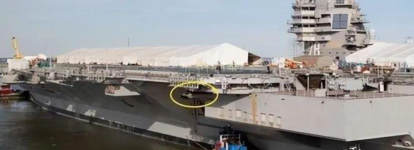
Here is the exhaust port of the diesel generators of the CVN-78.

Because the diesel generators only emit very little smoke compared to the gas turbines, that's why the exhaust of the CVN-78 can be placed beneath its flight deck, and also to keep its island structure small and neat.

The gas turbines can simply emit too much smoke, and it cannot be placed beneath the flight deck which would affect the flight operation of the aircrafts onboard, so it can only be placed on top of the island structure.


CVN-78.png
 
Last edited:
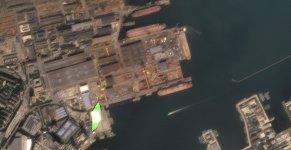
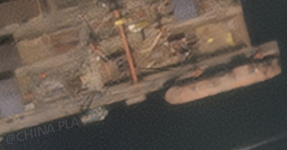
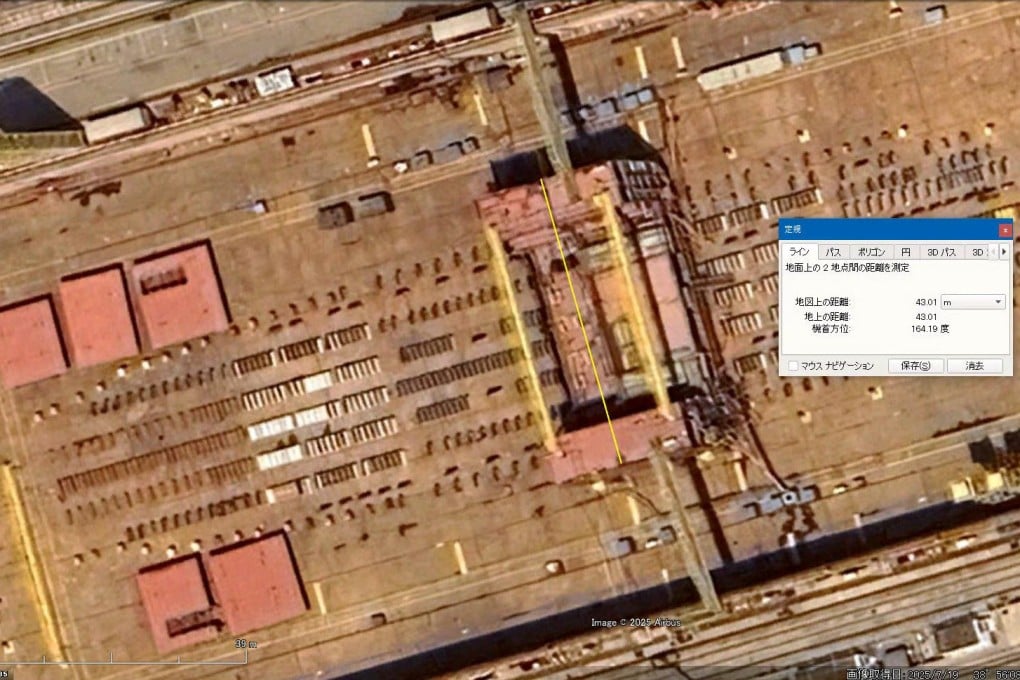
Satellite image from Sept 29: a large section had entered the dock. Via @CHINAPLA1 in X

IMG_4486.jpegIMG_4487.png
 

Images of hull sections suggest progress on China’s fourth aircraft carrier

Warship known as the Type 004 is believed to be under construction at a shipyard in Dalian, though it has yet to be confirmed by Beijing​


China’s fourth aircraft carrier, known as the Type 004, is believed to be under construction at a shipyard, in Dalian, Liaoning province. New hull sections have been seen in the latest satellite images from the site. Photo: Handout

Liu Zhen
Published: 6:00pm, 14 Oct 2025

China appears to be making progress on its fourth aircraft carrier at a shipyard in the country’s northeast, according to satellite images, another key part of the navy’s modernisation drive.

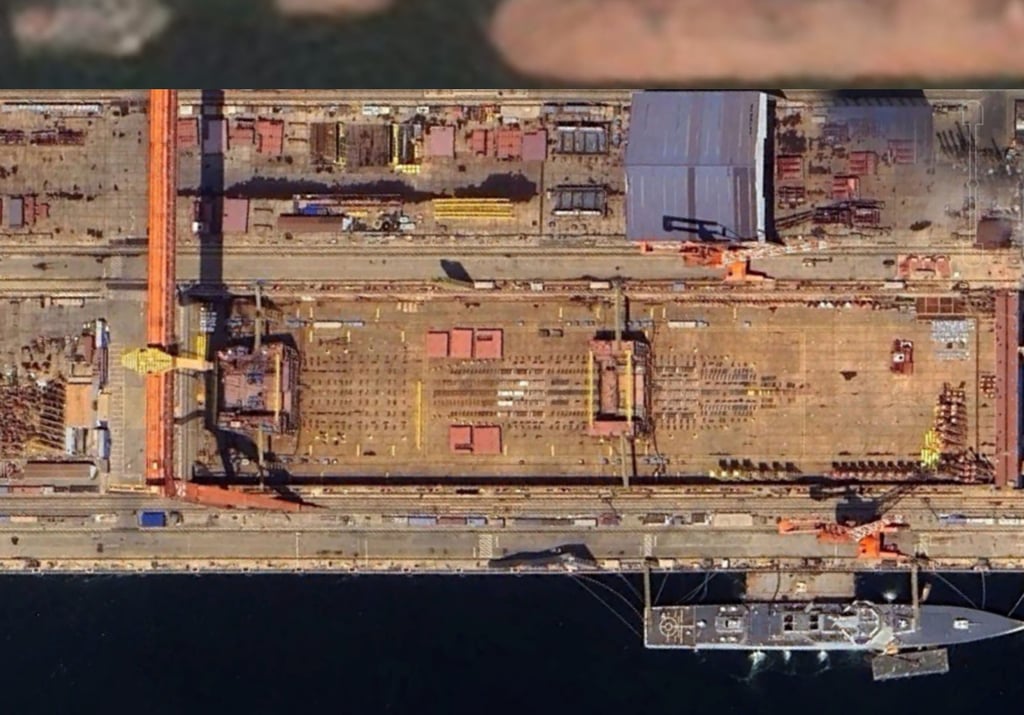
Commercial satellite images posted to Chinese social media show new hull sections at the shipyard in Dalian, Liaoning where the warship – known as the Type 004 – is believed to be being built.

The hull sections are visible in the satellite imagery from late September but were not seen in images from August.

Satellite images of the shipyard are being closely watched for signs of progress. Photo: Handout

Satellite images of the shipyard are being closely watched for signs of progress. Photo: Handout

Other hull sections believed to be for the Type 004 were first seen at the site – where China’s first two aircraft carriers were also built – in May 2024, according to images shared on social media in February.

Military observers have since been closely watching commercial satellite imagery of the shipyard for signs of progress.

It comes as the navy’s third aircraft carrier, the Fujian, is undergoing what is believed to be its final trials in the South China Sea and is expected to enter service soon. The Fujian – built by the Jiangnan Shipyard in Shanghai and the first aircraft carrier to be fully designed and made in China – was also constructed using a modular technique.

Previous satellite images from the Dalian shipyard have shown models of the navy’s aircraft carrier-based J-15 fighter jet and Z-8 helicopter.

While Beijing has never officially confirmed the existence of the Type 004, the project is widely believed to be under way. On the development of aircraft carriers, the defence ministry has said only that “comprehensive assessments will be made based on national security requirements and the progress of equipment and technology”.
 

Users who are viewing this thread

Pakistan Defence Latest

Latest Posts

Back
Top