Chinese and South Korean children grew taller in one generation: What are the learnings for parents to support height growth in kids

Beijingwalker

VIP Member
Joined
Nov 4, 2011
Messages
93,584
Reaction score
113,899
Reputation
1,996.0
Country of Origin
Country of Residence

Chinese and South Korean children grew taller in one generation: What are the learnings for parents to support height growth in kids​

TOI Lifestyle Desk / etimes.in / Updated: Jun 25, 2026, 12:03 IST

In many families, a child’s height is solely related to genetics. “Height runs in the family” is a sentence used countless times. Many believe if the parents are short, the child will also grow up to be short and if they’re tall, the child will likely grow up to be the same. However, for many years, the drastic change in height growth in some countries surprised researchers. Among the most striking examples are China and South Korea, where children and teenagers gained significant height compared to previous generations. Children whose parents were shorter grew up to be taller.

Explaining this, parenting and child development coach Hitesh M offered an important lesson for Indian parents. Giving the examples of veteran Bollywood actor Aamir Khan’s son and cricket legend Sachin Tendulkar’s son, the expert noted that height is not determined by genetics alone. If height were determined by genetics alone, their kids should have been shorter.

The study that revealed the cause​

Parenting and child development coach Hitmesh M mentioned the study that analysed height and body mass index trends among school-aged children and adolescents across 200 countries and territories.

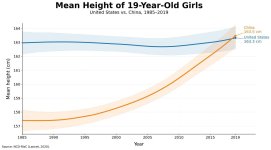
The 2020 study published in The Lancet examined data from more than 65 million participants collected between 1985 and 2019. The findings revealed substantial height gains among children in several East Asian countries, particularly China and South Korea.

The Lancet study showed how dramatically children's height can change across generations when nutrition, health, and living conditions improve.

The four horsemen of height growth​

Parenting and child development coach Hitesh M says Indian parents can learn from China and South Korea by focusing on four everyday factors to support healthy growth. These factors are:

Nutrition​

When parents consider their child’s height, they often focus on supplements, special foods, or powders. However, studies note that height growth starts with something much simpler: Nutrition. Hitesh highlights four nutrients that deserve special attention: protein, iron, zinc, and calcium. “When you provide your kids with protein, iron, zinc, and calcium, that nutrition really helps your children to grow taller,” notes Hitesh.

Some sources of these nutrients are:
Protein: egg, dairy products , chicken, fish, nuts and seeds.
Iron: green leafy vegetables, lentils, beans, meat
Zinc: Dairy products, seeds, meat, whole grains
Calcium: milk, curd, paneer, ragi, sesame seeds
The takeaway for parents​

The story of height gains in countries like China and South Korea is not really about becoming taller. It is about what happens when children grow up with better nutrition, healthier lifestyles, and improved living conditions. For Indian parents, the lesson is simple: while genes may set the blueprint, daily habits help determine how much of that blueprint becomes reality.
 
Chinese girls are experiencing super-linear height increase

 
Young Chinese female high jumpers, all above 6 feet tall


Why Japan's average height stopped growing while Korea, China surged

By Hankookilbo
  • Published Sep 21, 2026 5:11 pm KST

Nutrition, pregnancy weight limits, sleep emerge as possible factors

An image generated by ChatGPT

An image generated by ChatGPT

Japan's average height has barely changed since the 1990s, falling behind Korea and China. Researchers and media reports point to a possible combination of factors, including nutrition, maternal nutritional status and a lack of sleep.

In a report by Japanese financial daily The Nikkei on Saturday, it cited data published in the medical journal The Lancet in 2020 by the NCD Risk Factor Collaboration (NCD-RisC) that the average height of 5- to 19-year-olds in China and Korea increased at the world's fastest pace over the past 35 years, but Japan's remained stagnant.

According to the data, the estimated average height of 19-year-old Japanese males in 2019 was 172.1 centimeters and 158.5 centimeters for females. This leaves Japanese 19-year-olds about 3 to 5 centimeters shorter than their Korean and Chinese counterparts, where Korean males averaged 175.5 centimeters and females 163.2 centimeters, while Chinese males averaged 175.7 centimeters and females 163.5 centimeters.

Thirty-five years ago, the reverse was true. According to NCD-RisC estimates, Japan led the three countries in 1985 with an average height of 170.4 centimeters for 19-year-old males, compared to 168.7 centimeters in Korea and 167.6 centimeters in China.

Over the next 35 years, the estimated average height of 19-year-old Chinese males increased by 8 centimeters and Korean males by 6.8 centimeters, while Japanese males saw their height plateau, gaining just 1.6 centimeters. School health data from Japan's Ministry of Education, Culture, Sports, Science and Technology show a similar trend, with 17-year-old male students averaging 170.7 centimeters in 2000 and 170.8 centimeters in 2024.

141e2b53-0bfe-42a4-af45-f8507a261fc7.jpg

A chart generated by Gemini

Nutrition, pregnancy weight guidance, sleep examined as possible factors

Researchers point first to nutrition. Data compiled by Japan's National Institutes of Biomedical Innovation, Health and Nutrition show the country's daily per-capita caloric intake declined gradually after 1995 before leveling off.

According to statistics from U.N.'s Food and Agriculture Organization, daily per-capita energy supplies in Korea and China are 760 to 800 kilocalories higher than in Japan. The Nikkei reported that lower vegetable intake and diets deficient in calcium and vitamins among young people may also have contributed.

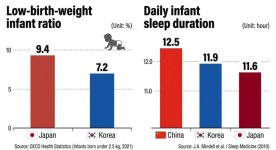
Maternal health guidelines limiting pregnancy weight gain are another leading factor. OECD data from 2021 show low-birth-weight infants — babies born weighing less than 2.5 kilograms — accounted for 10.2 percent of births in Japan, compared to 7.2 percent in Korea.

fd036f0f-448e-4a74-ad48-e00247aa8354.jpg
The Nikkei pointed out that long-standing guidance intended to limit weight gain during pregnancy to prevent hypertensive disorders may have affected fetal growth. The report also noted that dieting among young Japanese women to keep weight down may have contributed to lower birth weights.

A third hypothesis points to Japanese infants and toddlers getting less sleep. A 2010 study by researchers from the Children's Hospital of Philadelphia found Japanese children from birth to age 3 slept 11.62 hours a day, compared to 12.49 hours in China and 11.9 hours in Korea.


"We cannot draw a firm conclusion because there are no direct data, but shorter sleep duration among Japanese children may be one of several factors affecting later growth," Akifumi Kishi, an associate professor at the University of Tokyo, told The Nikkei.

The Nikkei report prompted discussion in Japan on social media platforms like X, formerly Twitter. Some users speculated without evidence that Japanese men's preference for petite women influenced the trend, in addition to the three factors highlighted in the report.

 
What happened to the Japs ? Why they sort of stopped growing ? Their country is rich for the longest time in modern East Asia. They have good supplies of nutrients in their diets as the Chinese and South Koreans do ? Maybe, it's in the genes, for recorded history, the Japs are traditionally the shortest people in East Asia. Or maybe something in their diets, eat too much unhealthy raw fish, haha.
 

Users who are viewing this thread

Pakistan Defence Latest

Country Watch Latest

Back
Top