ety
Trusted Member

Then, get out the fking AUKUS. Kangarooland is the most loyal lapdog of the US. They want to stay firmly in US led white camp. In no time, they will run back to American arms when the mad man is gone.
Follow along with the video below to see how to install our site as a web app on your home screen.
Note: This feature may not be available in some browsers.
I would not bother too much about this. Globally the security landscape is changing.Then, get out the fking AUKUS. Kangarooland is the most loyal lapdog of the US. They want to stay firmly in US led white camp. In no time, they will run back to American arms when the mad man is gone.
I think you have to get out the delusion like China is going to invade Vietnam any time soon.I would not bother too much about this. Globally the security landscape is changing.
Putin is busy with his war against Ukraine. He kills Russia, Europe, UK in the process.
Trump is busy with his war against Iran and domestic enemies, he has no time for NATO, the Pacific. US military power is an embarrassment thanks to the MAGA cleansing within the military.
Other regions accept Far East is neglectable.
The consensus is China profits the most from the chaos. The negative: an emboldened China is more dangerous for Vietnam.

 www.statista.com
China may have fewer people living in poverty than the US
One system covers basic needs for its poor while the other doesn't
https://substack.com/@haugejostein
JOSTEIN HAUGE
JUN 12, 2026
Photo by Lucas on Unsplash
Some readers might find it odd to even entertain the possibility that China has fewer people living in poverty than the US. China’s GDP per capita is about one-sixth of the US’ — one-third once you adjust for purchasing power. Given a gap that large, surely China must have far more people living in poverty, right?
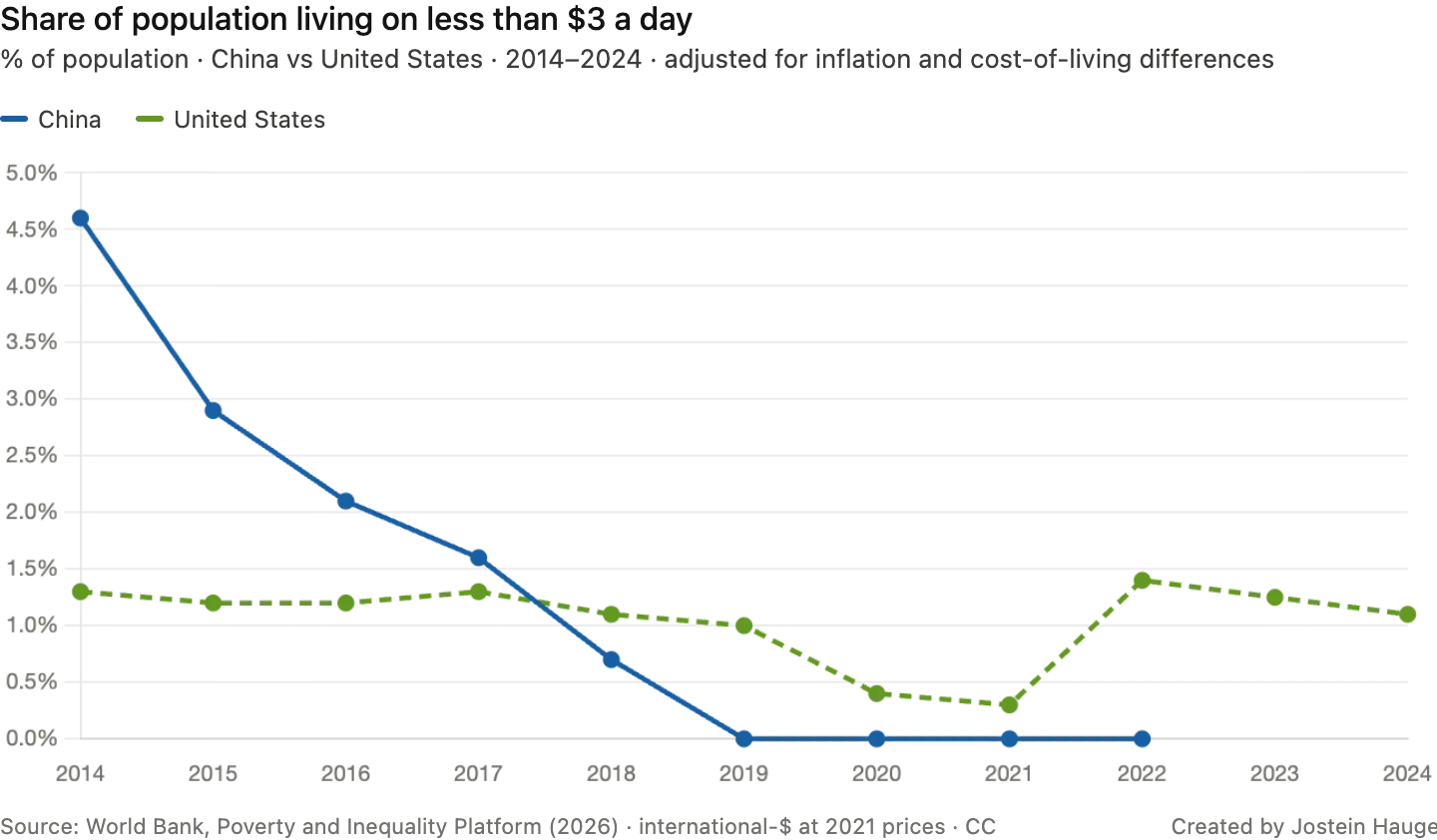
Data from the World Bank challenges this intuition. According to the Bank, extreme poverty in China was eradicated by 2019, while the rate in the US still sits at around 1%. Extreme poverty here is defined as living on less than $3 per day, adjusted for differences in cost of living. So on the World Bank’s own benchmark, more Americans live in extreme poverty than Chinese, not only as a share of the population but also in absolute numbers, seeing that China has officially eradicated poverty.
Reasons to believe poverty is understated in US
The most common objection to the comparison made above is that the poverty rate in the two countries is measured differently. The World Bank’s China numbers are calculated based on consumption (what households spend); the US numbers based on income (what households earn). An oft-cited argument is that this measurement difference overstates the US poverty rate relative to China, because the income measure in the US does not take into account government transfers like the Supplemental Nutrition Assistance Program (SNAP) and tax credits that lift households’ actual standard of living above what their paychecks suggest.
It’s a fair point, but only to a degree. There are strong counterarguments suggesting that poverty figures are often understated in the US, not overstated. The US poverty threshold was originally derived from the cost of food, then multiplied to cover everything else. It was never built around a basket that includes services that cover basic needs such as healthcare, higher education, or transport — precisely the things that are ruinously expensive in a country with privatised medicine, costly universities, and thin public transit.
Three further problems compound this. The first is that the threshold barely varies by geography. A family in Manhattan or San Francisco faces housing costs many times those in rural Mississippi, yet the poverty line is nearly identical across both. The result is that a large number of working families who clear the official bar are still, in any meaningful sense, housing poor.
The second is that an income snapshot ignores assets. A household can post a modest income while carrying heavy debt, holding no savings, and having no cushion for a sudden shock. This is not a fringe phenomenon: the share of Americans who say they could not cover a $400 emergency expense is consistently far larger than the official poverty rate. Income flow and financial security are not the same thing, and only one of them shows up in the statistics.
The third is what people report when you ask them directly. Material hardship surveys — can you afford food, utilities, medical care, adequate clothing? — routinely turn up more deprivation than the official headcount.
It should come as no surprise then that US government agencies set the domestic poverty line much higher than the World Bank’s international definition for extreme poverty. The official US poverty line, set by the Department of Health and Human Services, is an income of $32,000 a year for a family of four. This would translate to roughly $22 per day per person. By this measure, approximately 11% of Americans live in poverty. The US Census Bureau’s own Supplemental Poverty Measure, which factors in both non-cash benefits and real expenses, raises the US poverty rate to 13%.
Reasons to believe poverty — at a higher threshold — is overstated in China
When comparing the poverty rate in both China and the US, the most interesting challenge to my opening chart isn't about measurement method — it is about the international poverty line itself. There is no clear consensus on an international poverty line, but some scholars argue that around $10 per day, adjusted for differences in cost of living, is not unreasonable for capturing real deprivation. So what happens to the comparison at that threshold?
It flips. At $10 per day, 31% of China’s population falls below the line, against just 2% in the US. On this measure, poverty in China is overwhelmingly higher.
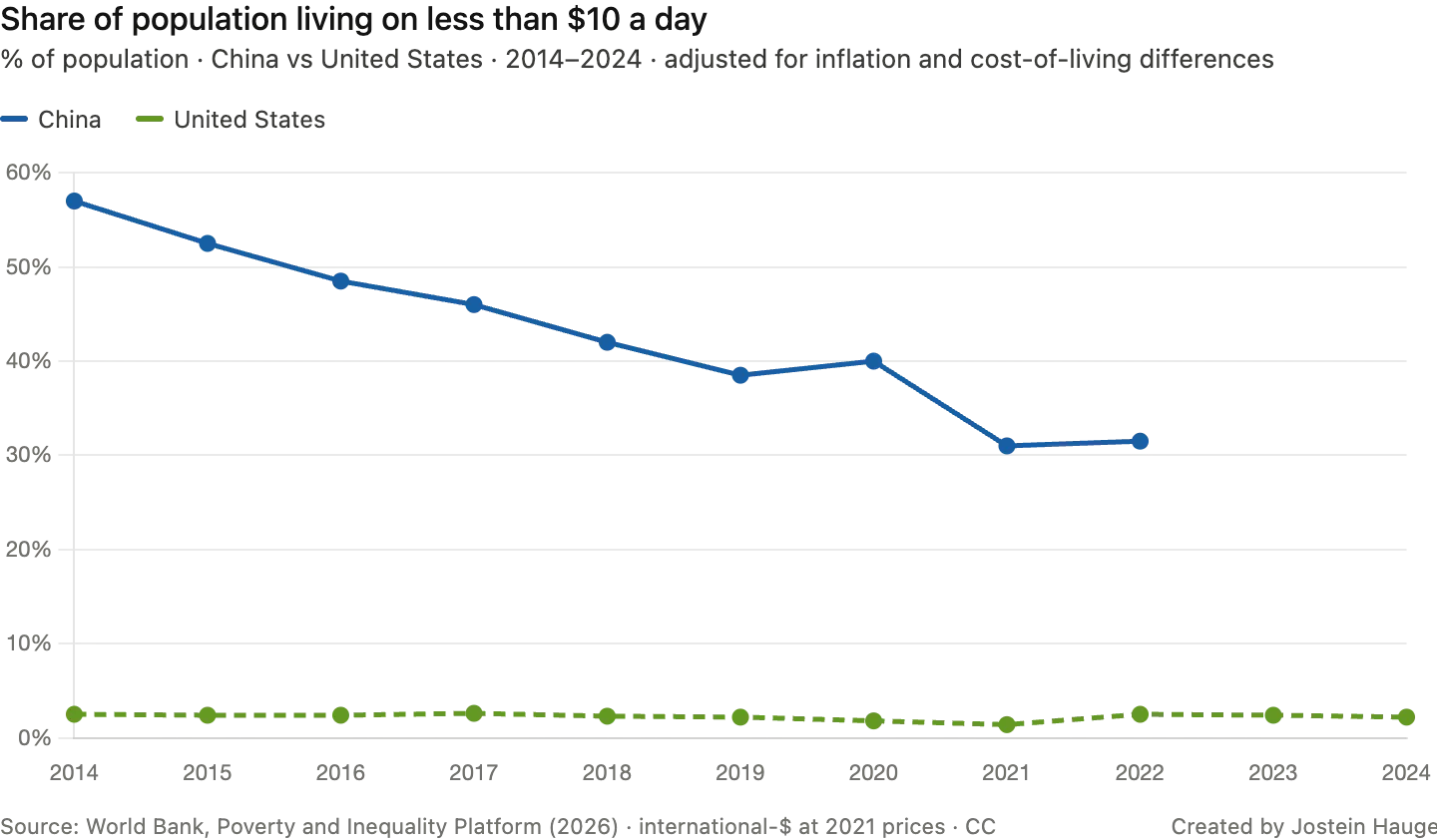
Again, the argument that the US poverty rate is substantially higher than 2%, as made in detail above — and which US government agencies also support — goes for this chart as well.
Additionally, there is reason to believe that a $10 per day line overstates true deprivation in China. Market-based poverty measures don’t fully register that poor people in China need to consume less in cash terms, because so much of what sustains a decent life is cheap or free at the point of use. This could be why the official poverty line used by the National Bureau of Statistics in China is roughly equivalent to the $3 per day line used by the World Bank.
Consider what a decent life from a material point of view generally requires: affordable housing, electricity, clean water, sanitation, internet, access to transport, nutritious food, basic healthcare, and schooling (to name a few). In China, these are now close to universal, including across the rural areas where poverty is concentrated. In the US they are not. And much of this simply doesn’t show up in a household’s measured purchasing power, whether you measure it through income or consumption.
Three things drive this gap. The first is China’s decades-long commitment to fighting poverty, with a heavy focus on building infrastructure. As an explicit part of poverty eradication efforts, China’s government has poured money into roads, railways, electrification, clean water, mobile data, and rural clinics. These government investments lift living standards far beyond what a consumption or income figure can capture, which means people are less deprived in real terms than the raw number implies. The second is the rural cost of living, which is very low. A small cash income combined with subsistence agriculture, communal land rights, and subsidised housing buys a standard of living that dollar-based comparisons systematically undersell, even when adjusted for differences in cost of living. The third is in-kind provision: the dibao minimum-income scheme, cooperative medical insurance, and free schooling all add real value that an income or consumption line never counts.
Stuff versus basic needs
None of this means the Chinese middle class out-earns the American one. It does not. A US middle-class family commands far more purchasing power over discretionary “stuff,” and is more likely to own a suburban house with a backyard than to live in an apartment block.
My main point, however, is this: the quantity of stuff you can buy — whether this is calculated based on your income or consumption patterns — is not a great proxy for material wellbeing. A family that can buy more things but lies awake over a medical bill, mounting education costs, or monthly rent that eats up the monthly paycheck is not obviously better off, in material terms, than one that buys less but rarely has to worry about sudden financial ruin.
So where does that leave the original question? Both countries have very low rates of extreme poverty — that much is clear. Push the line higher and China’s poverty rate rises above America’s in terms of money in people’s pockets. But once you account for what the US line understates and what the China line (at a higher threshold) overstates, there’s a strong case that at the bottom of the distribution — the people the term “poverty” is really meant to describe — the US has more of them as a share of the population (in line with the World Bank figures), and potentially also in absolute terms. The reason? China covers basic needs for its poor; the US doesn’t.

China may have fewer people living in poverty than the US
One system covers basic needs for its poor while the other doesn'twww.theglobalcurrents.com

 www.chinadaily.com.cn
 www.scmp.com
The United Nations Sustainable Development Goals (SDGs) consist of 17 interconnected global objectives established in 2015 as part of the 2030 Agenda for Sustainable Development. [1, 2]China ‘on track to surpass United States’ in global goals for human, planet health: UN
Report showing global progress on 17 UN Sustainable Development Goals shows gap between Chinese and US closed significantly since 2015
Published: 8:00pm, 25 Jun 2026
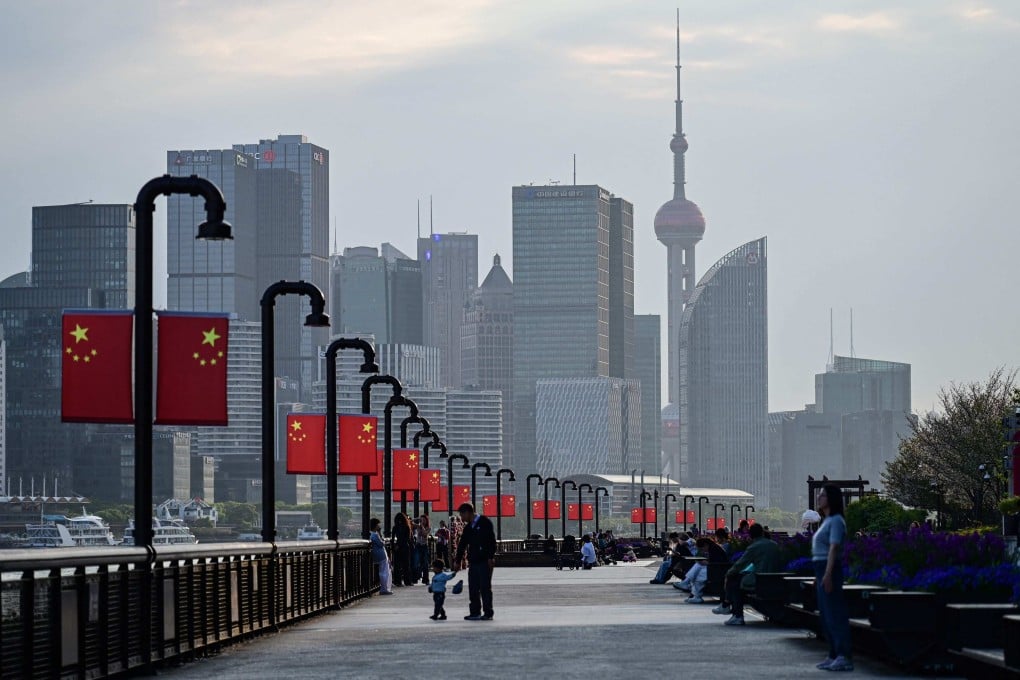
China is “on track to surpass the United States” in its efforts to eradicate poverty and protect the planet, according to a new report from the United Nations.
The “Sustainable Development Report 2026”, which tracks global progress on the 17 UN Sustainable Development Goals (SDGs), was launched on June 23. Also known as the “Global Goals”, the framework is intended to be a comprehensive worldwide blueprint for ending poverty, protecting the planet and ensuring prosperity by 2030.
“Owing to its faster pace of SDG progress over the period, China surpassed Russia in 2021, and based on current rates of progress it is on track to surpass the United States in the coming years,” the report said.
Beijing lays out its views on world order at Chinese Foreign Minister’s press conference
From 2015 to 2025, the gap between China and the US in sustainable development achievements closed significantly. The measure is scored out of 100 and the gap between the two is just 0.63 points, according to data in the report.
Produced by the UN Sustainable Development Solutions Network, the index showed that in 2015, there was “a considerable degree of distance separating the SDG performance of three of the great powers”. At that baseline, the US ranked 40th while China sat at 63rd.
Ten years later, however, the US had dropped to 45th place and China had risen to 49th. Meanwhile, Russia remained in 51st place over the same period.
The development goals were adopted by all UN member states in 2015 as part of the 2030 Agenda for Sustainable Development.
The 17 global goals – including no poverty, zero hunger, quality education, gender equality, reduced inequalities and decent work and economic growth – link environmental, social and economic dimensions of sustainable development.
China ‘on track to surpass United States’ in goals for human, planet health: UN
Report showing global progress on 17 UN Sustainable Development Goals shows gap between Chinese and US closed significantly since 2015.


 www.visualcapitalist.com
What's happening with the Japs ? The country must be near collapsing to be that poor as many say on Youtube, lol. And Switzerland must be a very rich country.China also produced lots of billionaires in the past 10 years
75% of China's billionaires were not on the list 10 years ago...
Where Billionaires Live in 2026
This visualization ranks countries by the number of billionaires living there in 2026.






Size of a carAircraft crashes into Beijing's tallest skyscraper, triggering evacuations
Story by Imogen Garfinkel
• 2h•
2 min read
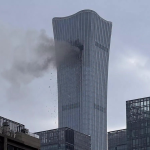
View attachment 203210
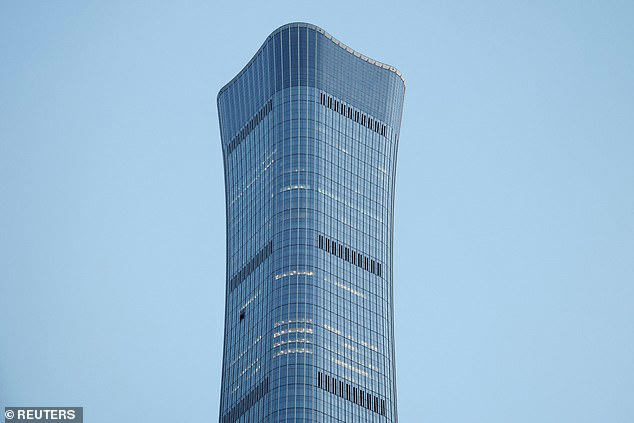
An aircraft crashed into Beijing's tallest skyscraper on Friday afternoon, triggering emergency evacuations.
The China Zun skyscraper is one of the top 10 tallest buildings in the world, measuring 528 metres.
Dramatic footage circulating on social media showed debris falling from the 109-story tower, as well as a tail section of the plane and a broken window of a taxicab on the ground.
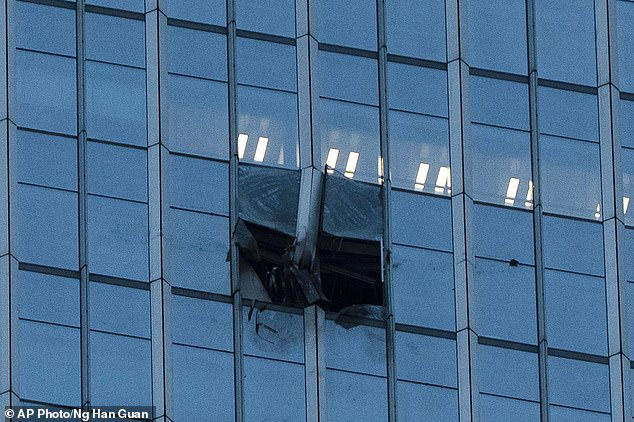
Photographs show two smashed windows in the side of the building, which is located in the capital’s busy central business district, Chaoyang District.
People were seen evacuating from the skyscraper as fire engines, dozens of police cars and an ambulance arrived at the scene.
The building, also known as the Citic Tower, is the headquarters of Citic Group, one of China's biggest state-owned financial conglomerates.
The number of casualties remains unclear.
Images showing the aircraft's registration code seemed to point to a domestically manufactured light sport plane, a Sunward SA 60L Aurora, owned by a local general aviation business.
Unverified flight data from Flightradar24 appeared to show a severely deviated flight path for the aircraft.
An aircraft crashed into Beijing's tallest skyscraper on Friday afternoon, triggering emergency evacuations
Photographs show two smashed windows in the side of the building, which is located in the capital’s busy central business district, Chaoyang District
Dramatic footage circulating on social media showed debris falling from the 109-story tower, as well as a tail section of the plane and a broken window of a taxicab on the ground
Police prevented some people from taking pictures and asked others to delete those they had taken while ushering people away from the building.
There was no immediate official comment and Beijing's municipal government did not immediately respond to a faxed request for comment from Reuters outside of business hours.
Mentour Pilot
How 150+ passengers were thrown into the ceiling at 33,000 ft
A courier said he had rushed over to CITIC Tower around 6pm local time (1000 GMT) from a nearby location after hearing a loud crash as a aircraft about the size of a car hit the building.
'It was so loud – louder than fireworks,' he said.
He added he had shot a video of the aircraft sticking out of the building, but later deleted it because he was scared of getting caught by police.
Another courier whom Reuters spoke to said he had come to the scene after seeing unverified social media images showing wreckage of a small aircraft on a road next to the building.
Social media posts of the building on Friday were quickly removed from Chinese social media.
A search of the building's name on the Xiaohongshu app returned only posts dated Thursday.
People were seen evacuating from the skyscraper as fire engines, dozens of police cars and an ambulance arrived at the scene
Images showing the aircraft's registration code seemed to point to a domestically manufactured light sport plane, a Sunward SA 60L Aurora, owned by a local general aviation business
Unverified flight data from Flightradar24 appeared to show a severely deviated flight path for the aircraft
Police prevented some people from taking pictures and asked others to delete those they had taken while ushering people away from the building
A man points a mobile phone at CITIC Tower, also known as China Zun, where damage is visible on a high floor of the exterior, in Beijing, China June 26
A police officer told Reuters journalists to depart from the scene. Asked why they had to leave, the police officer said: 'We all know why!'
Beijing maintains some of the world’s strictest controls over its airspace and restrictions are particularly tight around the capital's urban area, where drones and private light aircraft are banned from flying without special authorisation.
The Central Business District is located just a few kilometres from Zhongnanhai, the Communist Party’s leadership headquarters.
Airspace restrictions and limits on the construction of towers in the vicinity are intended in part to protect the security of the compound.
This is a breaking news story. More to follow
Missing Link: