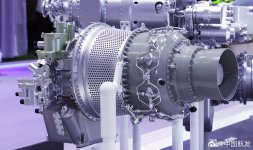
China's new hypersonic engine in development, it will revolutionize the jet engine
A new Chinese hypersonic engine could cut long-haul flights to under an hour, pushing aircraft to unprecedented speeds. This breakthrough in propulsion technology might reshape global travel and military strategy.

dailygalaxy.com
China Unveils an Engine Capable of an Astonishing 20,000 KM/H, That Can Circle the Globe in Just 2 Hours
A new Chinese hypersonic engine could cut long-haul flights to under an hour, pushing aircraft to unprecedented speeds. This breakthrough in propulsion technology might reshape global travel and military strategy.
Arezki Amiri
Published on
March 7, 2025
Read : 3 min
0
China Unveils an Engine Capable of an Astonishing 20,000 KM/H, That Can Circle the Globe in Just 2 Hours | The Daily Galaxy --Great Discoveries Channel
A
new hypersonic engine developed in China could revolutionize air travel by reducing long-haul flight times to mere minutes. Capable of reaching
Mach 16—approximately
20,000 km/h (12,250 mph)—this propulsion system represents a significant leap in aerospace engineering.
Developed at the
Beijing Power Machinery Institute, this breakthrough has been documented in the
Journal of Propulsion Technology. Researchers claim the engine is
more fuel-efficient and stable than previous hypersonic designs, overcoming some of the major challenges that have long hindered this technology.
A Major Leap Beyond Supersonic Travel
For decades, supersonic aircraft like
Concorde pushed the boundaries of speed, but their efficiency and fuel consumption issues limited their success. China’s latest development moves beyond
Mach 2 travel, bringing hypersonic flight closer to reality.
The engine operates at
30 kilometers (18.6 miles) above Earth’s surface, using a
dual-mode detonation process. At speeds up to
Mach 7, it functions through a rotary detonation system, where a continuous shockwave combusts fuel more efficiently than traditional jet engines. Once it exceeds Mach 7, it shifts into oblique detonation mode, ensuring sustained high-speed performance with greater stability.
According to researchers, this approach could achieve up to
80% energy conversion efficiency, far exceeding the
20–30% efficiency of conventional engines. Addressing fuel consumption and stability challenges, this technology moves one step closer to practical hypersonic aviation.
The engine was developed at the Beijing Power Machinery Institute. Image Scmp
A Revolution in Global Transportation
If successfully integrated into commercial aircraft, hypersonic propulsion could drastically
reduce flight times. A journey from Paris to New York could take
less than an hour, and a London-to-Sydney trip could be completed in
90 minutes instead of the usual
22 hours.
The potential extends beyond passenger travel—
cargo transport at these speeds could enable near-instantaneous global deliveries, reshaping supply chains and international trade.
The ability to transport goods across vast distances in minutes would eliminate
logistical bottlenecks, benefiting industries that depend on rapid shipments, such as medical supply chains and high-value manufacturing.
The engine operates in two modes. Image: Eurasian Times
Military and Defense Implications
The military applications of hypersonic propulsion are equally significant. Aircraft and missiles traveling at Mach 16 would be nearly impossible to intercept with current
air defense systems, raising concerns about strategic deterrence and national security.
Unlike conventional fighter jets or ballistic missiles, hypersonic vehicles move so quickly that traditional radar tracking and interception technologies may become obsolete.
China’s advancement in this field is expected to intensify competition among global superpowers. The
United States,
Russia, and
Europe are already investing heavily in hypersonic research, but China’s breakthrough may accelerate the race for high-speed military dominance.
The ability to evade detection and strike with unprecedented speed could fundamentally change the nature of warfare, forcing nations to rethink their defense strategies.
Engineering Challenges and Future Developments
Despite its potential, significant engineering challenges must be resolved before hypersonic travel becomes a practical reality.
Extreme heat and pressure at Mach 16 require advanced
thermal protection systems to prevent aircraft from breaking apart.
Materials capable of withstanding these conditions must be developed, and cooling mechanisms must be perfected to ensure structural integrity during flight.
Another major hurdle is stability and control. Previous detonation engines have struggled with shockwave management, making them difficult to operate consistently. Researchers must refine the technology further to ensure that hypersonic engines remain stable across
various speed ranges.
Economic feasibility is also a key concern. Although the engine is theoretically more fuel-efficient than traditional propulsion systems, developing
cost-effective aircraft that can safely operate at these speeds remains a significant challenge. If the technology proves too expensive, commercial adoption could be delayed for decades.