Chinese Missile Development News

Mr. Hendarto
I implore you once again. Please don't easily forward these Chinese self media messages. At present, the Chinese self media industry is developing savagely, and a large number of self media authors are trying to attract web traffic by exaggerating or fabricating all kinds of massive news (video/picture/text) to attract people's attention. They don't care about the authenticity of these contents and the consequences they cause, they only care about how to turn these web traffic into money.
When you are retweeting this type of message, carefully identify the message first.

I verified the content of this message.
The original source of this message was the South China Morning Post (SCMP) in Hong Kong. It reported that a team from Beijing Institute of Technology had published a design in Acta Armamentarii. The HGV warhead material described in the article is a composite material with an outermost layer of ultra-high-temperature ceramics, followed by a layer of aerogel insulation and finally a layer of stainless steel. It can withstand up to more than 3,000 degrees Celsius. There is no word that the PLA Rocket Force has begun using this technology.


However, many authors in the self media used the term “stainless steel shell” to describe the news, without mentioning the details.
I am very sick of this practice. I'm even more disgusted by those who know the details and still do it.
Can't you not read I guess you cannot or your translator is no good. I implore you not to show your know-all attitude and think you are smart. No you don't Here is the article. It is composite steel nothing wrong with whether you add ceramic or NOT. Tank protection uses Chobham steel Which is composite steel made of ceramic, It is still called steel I hate it if people show off their ignorance or lack of reading comprehension!

The researchers, led by Huang Fenglei, a professor at the Beijing Institute of Technology, unveiled a design for a hypersonic glide anti-ship missile in the peer-reviewed Chinese journal Acta Armamentarii last month.
The partial blueprint shows the shell of the warhead – located at the very front of the missile – made from a widely available, high-strength stainless steel.
Adding a layer of thermal protection on the steel shell could solve the problem, according to the team.

They propose using an ultra-high-temperature ceramic that can withstand temperatures of 3,000 degrees-plus. That would make up a 4mm top layer of the protective barrier.


Underneath it and tightly adhered to the steel shell would be a 5mm layer of aerogel – a heat insulator to keep the temperature of the explosive agent at around 40 degrees during high-speed flight.
Steel begins to melt at around 1,200 degrees Celsius (2,190 Fahrenheit), but the nose of a hypersonic weapon can hit temperatures of up to 3,000 degrees in flight due to heating by the atmosphere.

The team says their missile is designed to reach Mach 8 – or eight times the speed of sound – and that it marks a key step forward in thermal protection technology.
Advertisement

Its use of an inexpensive material is also in line with the Chinese military’s strategy to keep costs down in the hypersonic arms race with the United States and Russia.
The paper does not say what stage the missile is at, or if it has undergone testing.

China is boldly going where no one has gone before

China is boldly going where no one has gone before
In the US, tungsten alloys are typically used for the parts of a hypersonic vehicle that heat up the most since tungsten has a melting point above 3,400 degrees.
Advertisement
 
Last edited:
I'm surprised, no one has mentioned Molybdenum till now?
 
How much would these things cause if they were fired at the same time?
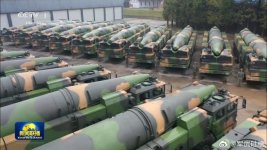
They are just one of the many bases of the PLA Rocket Force.
0089kMRmgy1hus0hf5zo3j30ve0hn795.jpg
 
To view this content we will need your consent to set third party cookies.
For more detailed information, see our cookies page.

To view this content we will need your consent to set third party cookies.
For more detailed information, see our cookies page.
 
Here is the video of Boss inspecting the Rocket force base
To view this content we will need your consent to set third party cookies.
For more detailed information, see our cookies page.
 
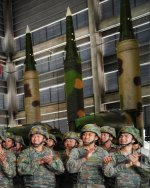
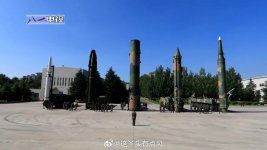
From left to right are the front comparison images of Dongfeng-15B, Dongfeng-16, Dongfeng-31A, Dongfeng-21D, and Dongfeng-26.
从左至右依次是,东风-15B、东风-16、东风-31A、东风-21D、东风-26正面对比画面。.jpg
 
The Dongfeng-5B is China's first-generation intercontinental ground-to-ground strategic missile. It adopts a two-stage liquid-fuel rocket engine. The maximum range is 15,000 kilometers. It can carry one 3,000-kilogram nuclear warhead or multiple independently targetable nuclear warheads. The hit accuracy is between 500 and 2,000 meters. It has many warheads, strong penetration ability, and great damage power. The independently targetable multiple warhead technology is the biggest improvement, enabling one missile to attack multiple targets. Liquid fuel filling takes time, and the fixed location of the launch silo is easy to become an attack target. However, its huge payload capacity and range still give it important deterrence. It has irreplaceable advantages in terms of cost, maintenance, and protection. The Dongfeng-17 is a hypersonic short-to-medium-range conventional ballistic missile. The flight speed exceeds Mach 10. It adopts a very rare triangular flat warhead. The maximum range is 2,500 kilometers, and the strike accuracy is 1.8 meters. It can be launched under various weather conditions without specific launch facilities, enhancing mobility and flexibility. It adopts Qian Xuesen's trajectory and waverider warhead technology. The cruising time in the atmosphere accounts for 70% to 80% and is difficult to intercept. The Dongfeng-100 is a supersonic cruise missile. The flight speed is Mach 4, the range is 3,000 kilometers, and it is equipped with an advanced composite guidance system. The launch tube is relatively thick and may be a nuclear missile

To view this content we will need your consent to set third party cookies.
For more detailed information, see our cookies page.
 
There is no evidence to prove that this is a YJ-21. It is very likely a lightweight hypersonic missile. In fact, according to the CH-9's maximum load of 480kg, this may be a universal lightweight hypersonic weapon that can be widely mounted on aircraft with heavy pylons of more than 500kg, such as J-10, JF-17, CH-5, WL-3, etc.
Currently, the air-launched version of the YJ21 is the lightest weight of any known hypersonic missile in the world. We cannot currently find any hypersonic missile lighter than the YJ21.

The main hypersonic missiles are the HGV and the HCM

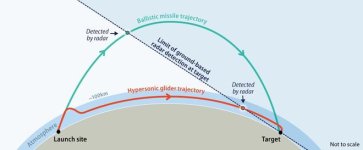
HGV. no matter which configuration and no matter which trajectory, it must first leap over Kármán line. Not counting the weight of the warhead, the rocket section already weighs more than the CH-9's maximum payload.
2a95b8f6da3a727fb198342c379e8462.jpeg
HCM. has not been successfully developed by any country yet.

So where do you see the possibilities?
 
Last edited:
There is something very disorienting about this picture.

From publicly available data.
The largest missile on the ground, the YJ-21 hypersonic anti-ship missile weighs 3 tons. But the publicly available data for the CH-9 shows that it has a payload capacity of only 480Kg and a maximum takeoff weight of only 5 tons. So it can't carry the YJ-21.
View attachment 78589
No, the spec is wrong,
probably a mismatch with CH-5.
 
Currently, the air-launched version of the YJ21 is the lightest weight of any known hypersonic missile in the world. We cannot currently find any hypersonic missile lighter than the YJ21.

The main hypersonic missiles are the HGV and the HCM

HGV. no matter which configuration and no matter which trajectory, it must first leap over Kármán line. Not counting the weight of the warhead, the rocket section already weighs more than the CH-9's maximum payload.
View attachment 78596
HCM. has not been successfully developed by any country yet.

So where do you see the possibilities?
Can you show me how you calculated that the rocket section already weighs more than the CH-9's maximum payload?

According to the Tsiolkovsky rocket equation,

88.4% of the rocket's initial mass is propellant, and the remaining 11.6% is payload, engines, and fuel tanks.

When flying at high altitude, 20% to 30% of the fuel mass can be saved.
 
Last edited:
I’m still confused regarding the PL-15E shown at Zhuhai -
Is it from the same family or a completely new missile using the same model number?
@guangdongt @Michael
 
Can you show me how you calculated that the rocket section already weighs more than the CH-9's maximum payload?

According to the Tsiolkovsky rocket equation,

88.4% of the rocket's initial mass is propellant, and the remaining 11.6% is payload, engines, and fuel tanks.

When flying at high altitude, 20% to 30% of the fuel mass can be saved.
I'm sorry I'm not an aviation expert and I don't have enough expertise. I only have a middle school education.

According to publicly available information.
1, the lightest hypersonic ballistic missile currently available is indeed the YJ-21 air-launched version, which weighs 3 tons.
2, There are a few air-to-air missiles that can exceed Mach 5 top speed. But they all require high-speed fighters to provide the initial speed and only last for a few seconds. The fastest air-to-air missile is the Russian R-37, which can reach a top speed of Mach 6. It weighs 500-600Kg (different versions)

Meanwhile, I'm not sure what the point of a hypersonic missile below 500Kg is. Apart from the propulsion and control systems, how much does it weigh in the combat section? How much damage can a combat part of that weight do?

So, my opinion. The presence of the YJ-21 in that picture assumes that the CH-9 can carry hypersonic missiles. That's a huge misconception.

The CH-7 is determined to be capable of carrying the YJ-21E hypersonic ballistic missile.
1731212885347.jpeg


I’m still confused regarding the PL-15E shown at Zhuhai -
Is it from the same family or a completely new missile using the same model number?
@guangdongt @Michael
There is so much new equipment revealed at the recent Zhuhai Airshow that I can't make any guesses. Keep a close eye on the relevant threads.
 
Last edited:
AVIC announces basic information on foreign trade versions of a range of missiles. (Official Chinese version. The English version is machine translated. I am not responsible for the results of machine translations.)

PL-15E
PL-15E空空导弹是新型中远距空空导弹,可适应载机内埋和外挂使用需求,具有超视距发射、多目标攻击、发射后不管以及全天候使用等特点。具备攻击有人和无人机、巡航导弹等目标的能力。其载机平台为枭龙、猛龙、鹘鹰等;发射方式为外挂导轨、外挂/内埋弹射;最大可用过载40;攻击距离≥145km;制导方式为捷联惯导/北斗卫星组合+双向数据链修正+主动雷达末制导;弹长3996mm,弹径203mm,质量 ≤210kg。
PL-15E air-to-air missile is a new type of medium- and long-range air-to-air missile, which can be adapted to the needs of carrier aircraft for internal and external use, and has the characteristics of over-the-horizon launching, multi-target attacking, no matter after launching, and all-weather use. It has the ability to attack manned and unmanned aircraft, cruise missiles and other targets. Its carrier platform for the JF-17, J-10, J-35, etc.; launch mode for the external rail, external / buried catapult; maximum available overload 40; attack distance ≥ 145km; guidance mode for the JieLian inertial guidance / Beidou satellite combination + bidirectional data chain correction + active radar end guidance; bullet length of 3996mm, the bullet diameter of 203mm, the quality of ≤ 210kg.

LD-8A
LD-8A反辐射导弹主要挂装无人机,执行反辐射作战任务,提升无人机战场生存能力,用于打击敌方中近程防空系统、弹炮结合武器系统的搜索、制导雷达,防空高炮炮瞄雷达和战场侦察雷达。具有一定的抗雷达中段关机能力。
载机平台:翼龙系列无人机、兼顾有人战斗机等,发射方式:导轨发射,最大攻击距离≥70km(10km,0.3Ma)、≥160km(15km,1.2Ma),制导方式:惯导/卫星定位+宽频带被动雷达,制导精度4m(CEP),弹长3200mm,弹径180mm,弹重130kg,战斗部30kg。
The LD-8A anti-radiation missile is mainly mounted on a drone to carry out anti-radiation combat missions, enhance the survivability of the drone on the battlefield, and is used to strike the enemy's medium- and short-range air-defense system, search and guidance radar of the combined artillery and shell weapon system, anti-aircraft artillery gunnery radar and battlefield reconnaissance radar. It has certain anti-radar mid-range shutdown capability.
Carrier platform: Wing Dragon series of unmanned aircraft, taking into account manned fighters, etc., launch mode: rail launch, the maximum attack distance ≥ 70km (10km, 0.3Ma), ≥ 160km (15km, 1.2Ma), guidance mode: inertial guidance/satellite positioning + wide-band passive radar, guidance accuracy of 4m (CEP), the length of the bullet is 3200mm, the diameter of the bullet is 180mm, the bullet weight is 130kg, the combat part is 30kg. Length: 3200mm, diameter: 180mm, weight: 130kg, combat weight: 30kg.

PL-12AE
PL-12AE空空导弹是一型中远距雷达型空空导弹,具有射程远、制导精度高、抗干扰能力强等特点。可担负超视距空战的作战任务,用于攻击战斗机、轰炸机、无人机、巡航导弹等空中目标。载机平台为枭龙、猛龙、大型无人机等;发射方式为导轨、弹射;最大可用过载38;攻击距离≥120km;制导方式为捷联惯导/北斗卫星组合+双向数据链修正+主动雷达末制导;弹长3939mm,弹径203mm,质量≤214kg。
PL-12AE air-to-air missile is a medium- and long-range radar-based air-to-air missile, characterized by long range, high guidance accuracy and strong anti-jamming capability. It can undertake the combat mission of over-the-horizon air warfare, and is used to attack air targets such as fighters, bombers, drones and cruise missiles. Carrier platform for the Dragon, Raptor, large drones, etc.; launch mode for the rail, catapult; maximum available overload 38; attack distance ≥ 120km; guidance mode for the JieLian inertial guidance / Beidou satellite combination + bidirectional data chain correction + active radar end-guidance; bullet length of 3939mm, bullet diameter of 203mm, the quality of ≤ 214kg.

PL-90AE
PL-90AE通用导弹体积小、重量轻,操作使用简单,可集束挂装,可作为空空导弹配挂于直升机或无人机打击空中目标,也可作为近程防空导弹遂行伴随防空、野战或要地防空等作战任务。
适用平台:由于PL-90AE导弹重量轻,尺寸小,它可灵活的配置在各种直升机、无人机等载机平台上,也可适用装甲车、越野车、卡车等车辆平台。
空空作战:最大发射距离6500m(超低空),防空作战:杀伤斜距800m~6000m,杀伤高度15m(相高)~4000m,最大可用过载20,制导方式:红外双色多元被动寻的制导,弹长1950mm,弹径90/98mm,重量不大于25kg。
PL-90AE general-purpose missile is small in size, light in weight, simple in operation and use, and can be cluster-mounted. It can be mounted on helicopters or unmanned aerial vehicles as an air-to-air missile to strike airborne targets, and it can also be used as a short-range air-defense missile to perform accompanying air-defense, field or stronghold air-defense and other combat missions.
Applicable platforms: Due to its light weight and small size, the PL-90AE missile can be flexibly configured on various helicopters, drones and other aircraft-carrying platforms, and can also be applied to armored vehicles, off-road vehicles, trucks and other vehicle platforms.
Air-to-air combat: maximum launch distance 6500m (ultra-low altitude), air defense combat: kill range 800m ~ 6000m, kill height 15m (phase height) ~ 4000m, maximum available overload 20, guidance: infrared two-color multivariate passive seeker guidance, the bullet length of 1950mm, the diameter of the bullet 90/98mm, the weight of not more than 25kg.
 
To view this content we will need your consent to set third party cookies.
For more detailed information, see our cookies page.
 

Users who are viewing this thread

Pakistan Defence Latest

Back
Top