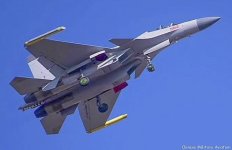
Regarding j15d, I will translate Wang Yanan's introduction to j15 from Chinese to English and publish it in English
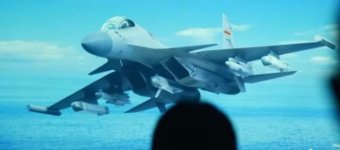
2023 marks the 74th anniversary of the founding of the People's Navy. This year, the Navy announced that the domestically produced J-15D carrier based electronic warfare attack aircraft quietly appeared in the film, indicating that the J-15D has begun to be deployed in the military. With this type of electronic warfare aircraft, the combat capabilities of domestic aircraft carriers have taken a big step forward.
[J-15D and J-16D are half siblings]
The domestically produced J-15D electronic warfare attack aircraft is a modified version of the J-15S twin seater fighter jet. It transforms the rear seat pilot into an electronic warfare system operator, while also making adaptive improvements to the aircraft's avionics system, cockpit display, data link/communication system, etc.
Although the J-15D has not made much public appearance, with only some test flight photos and CG images, it actually has a half brother, who is the J-16D of the People's Liberation Army Air Force. As tactical electronic warfare attack aircraft, the two have highly similar mission positioning, with differences mainly reflected in different platforms and daily usage environments.
The development foundation of the J-16D is the J-16, which can be traced back to the J-11BS. The development foundation of the J-15 is the J-11B, which means that the J-15D and the J-16D are also of the same lineage and origin when traced back to their ancestors. Many improvements and features of the J-16D can be seen on the J-15D.
The J-15D, like the J-16D, has eliminated aircraft guns in order to free up space for electronic systems. However, it retains the airborne active phased array fire control radar, which can carry PL-15 and PL-10 air-to-air missiles for self-defense. When necessary, the airborne active phased array fire control radar can also be used as an electronic warfare system.
The biggest feature of the J-15D and J-16D in appearance is that they both have electronic support/reconnaissance pods installed on both wing tips, and the US Navy's EA-18G Growler is also designed in this way. The function of this pair of wingtip pods is to calibrate the enemy's radiation source at a long distance, and then display the location of the enemy's radiation source on the cockpit display screen, providing overall battlefield situational awareness for electronic warfare system operators.
In addition, the wingtip pod can also provide target indication for electronic interference and anti radiation missiles of the J-15D. The entire system has been automated, and the information obtained from the electronic support/reconnaissance pod will be handed over to the mission system for identification and calibration, threat ranking, and then the electronic jamming pod will be automatically connected for jamming, or the pilot can choose to launch anti radiation missiles to perform hard kill on the target.
Although these wing tip pods may seem unremarkable, they are one of the technical challenges encountered in the development of the J-15D. Even the United States acknowledges that these pods are the biggest engineering challenge in the EA-18G project. These two pods use the short baseline time difference method to determine the position of the radiation source, which has a simple structure and high direction finding accuracy, making it particularly suitable for dealing with modern phased array radar.
However, its disadvantage is that it requires high device requirements, and its working principle is to confirm the target coordinates based on the time difference between the signals measured by two receivers, with an accuracy requirement of nanoseconds or even higher. In addition, during flight, due to repeated maneuvers and airflow, the wing tips will oscillate, and the two pods will not remain in a straight line. Instruments need to be used to measure their positional deviations and provide compensation.
(In the midst of turbulence, the two pods need to work together with nanosecond precision, and the difficulty can be imagined.)
For carrier based aircraft, there is still a challenge, as the wings of the J-15D need to be folded to reduce the space on the flight deck and hangar. This means that the connecting cables between the two pods must be disconnected at the folding point of the wings, which increases the measurement error of the system. Eliminating this error is also a headache. According to Americans, the US Navy and Boeing also put in a lot of effort to solve these problems back then, and from here we can see China's progress in related technological fields.
The J-15D has high-power electronic jamming pods hanging on both sides of the wings and in the middle of the intake, used to suppress and interfere with the opponent's radar and other electronic devices. The new generation of domestically produced jamming pods adopts a series of high-tech technologies, such as advanced digital signal processing systems, which can be reprogrammed, have the ability to integrate reconnaissance, identification, and jamming, can cover all directions, and can simultaneously interfere with multiple targets. Wide frequency, can be extended to millimeter waves, and can resist the new generation of advanced phased array radar in complex electromagnetic environments.
(Due to the narrow band of early bird of tongue missiles, different guidance heads needed to be temporarily replaced according to the situation.)
On both sides of the wings of the J-15D, there are also domestically produced Eagle Strike 91 anti radiation missiles hanging on the inner hangers. The Eagle Strike-91 anti radiation missile uses a solid ramjet engine with a long range and a large warhead, making it particularly suitable for attacking mobile radar systems like Aegis. In this way, the J-15D electronic warfare attack aircraft has integrated hardware and software electronic warfare capabilities, upgrading from air defense suppression to air defense destruction.
In the future, the J-15D may also be equipped with a new generation of domestically produced anti radiation missiles to replace the slightly bulky Eagle Strike 91. This missile has a longer range and better performance, and can suppress and destroy new surface vessels equipped with the Standard 6 ship-to-air missile from abroad.
The Fujian aircraft carrier can carry 8 aircraft
After the J-15D electronic warfare attack aircraft enters service, they will first be equipped to the Shandong and Liaoning ships. Considering the internal space limitations of the aircraft carrier, the Liaoning and Shandong ships will be equipped with one squadron of approximately four J-15D electronic warfare attack aircraft when necessary. The Fujian ship takes off using electromagnetic catapults, with a larger tonnage and a larger hangar. Therefore, it will be equipped with a J-15D electronic warfare attack aircraft squadron, totaling 8 J-15D aircraft.
Even if stealth fighters like the J-35 are in service, they will not be able to shake the deck position of the J-15D in the short term. The J-35 has not yet seen the demand and necessity for developing specialized electronic warfare models, so it will partner with the J-15D for many years. On the deck of the US aircraft carrier, the F-35 also partners with the EA-18G and has not developed a separate electronic warfare model for the F-35.
The J-15D effectively enhances the combat capability of the Chinese Navy's aircraft carrier formation. It can accurately obtain the location of enemy radiation sources within a range of hundreds of kilometers, use electronic jamming pods and anti radiation missiles for interference and suppression, and also provide relevant information to the formation command center, providing target indications for long-range attack weapons such as the Eagle Strike 21 hypersonic attack missile.
(Since the establishment of the Chinese Navy, the development in the past decade or so should have the largest span.)
In addition, it can interfere and suppress the opponent's air defense system before our attacking formation reaches the target, creating favorable conditions for our attacking formation to complete combat tasks. Considering the future battlefield environment, the J-15D will also engage in joint operations with air force combat aircraft. For example, when the Air Force's strategic bombers venture out into the ocean, the J-15D electronic warfare attack aircraft is responsible for interfering with and suppressing the electronic systems around the strategic bomber's route, providing escort for the strategic bombers to carry out long-distance combat missions.

mi.mbd.baidu.com


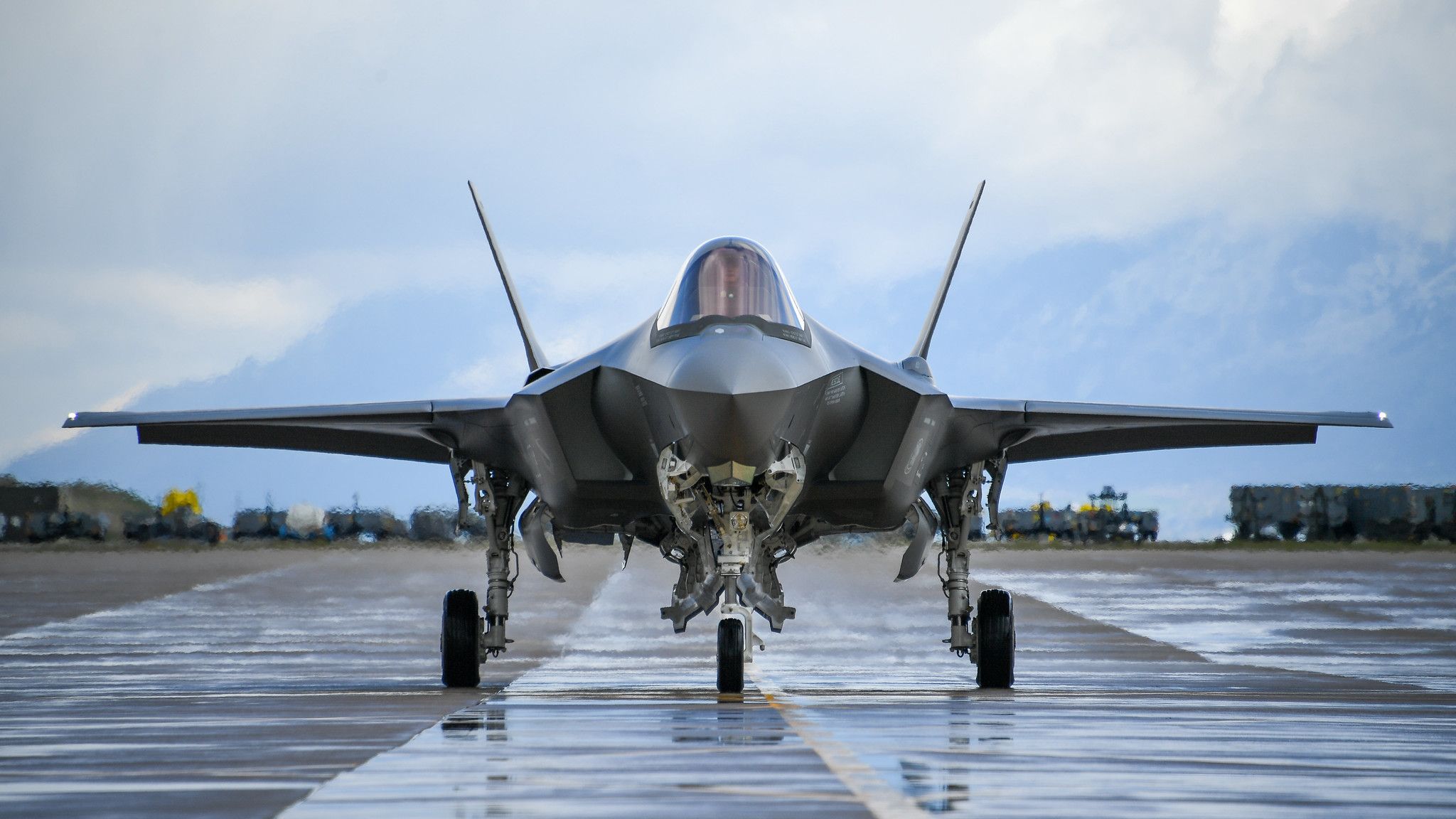 Photo: Robert Sullivan | Flickr