Chinese Should Be the Official Language of the World

Learning and mastering a language is 2 different shoes. Very difficult for foreigners to learn your language. China written characters have similarities to old Egypt, some sorts of pictures language. It’s like going to a museum with 1,000 paintings, afterwards you can tell all those 1,000 pictures in great details.
Then coming the sounds.
you can’t see the sounds in the letters.
Old hieyroglaphic wasn't daily life handwriting here in Egypt , it was a formal writing for the temples , it was called (Medu Netcher) as a handwriting only for religious purposes ( they believed it had some kind of sorcery ) , the daily life handwriting was called Hieratic and later Demotic ( to make it easiers for the common people as in post cards and so on..... and lastly coptic.

All are one except for coptic which has a big greek influence in its alphabet.

In order Hieryoglaphic , then Hieratic then Demotic then lastly coptic ( you can see the greek symbols in coptic).

images
 
Learning and mastering a language is 2 different shoes. Very difficult for foreigners to learn your language. China written characters have similarities to old Egypt, some sorts of pictures language. It’s like going to a museum with 1,000 paintings, afterwards you can tell all those 1,000 pictures in great details.
Then coming the sounds.
you can’t see the sounds in the letters.
They are not as difficult as you like to think. Actually, some people say the spoken Chinese is easier to learn than English as one of my Russian friend told me. The sound is often revealed in one of the component of the character. People say it's difficult because usually they are too lazy to learn and don't want to learn. Early Chinese characters thousands years ago share similarities with Old Egyptian, today's Chinese characters have evolved a lot from the early ones and they are very different from Egyptian. Today's Chinese characters are combinations of ideograms, pictograms and phonograms.
 
Last edited:
Old hieyroglaphic wasn't daily life handwriting here in Egypt , it was a formal writing for the temples , it was called (Medu Netcher) as a handwriting only for religious purposes ( they believed it had some kind of sorcery ) , the daily life handwriting was called Hieratic and later Demotic ( to make it easiers for the common people as in post cards and so on..... and lastly coptic.

All are one except for coptic which has a big greek influence in its alphabet.

In order Hieryoglaphic , then Hieratic then Demotic then lastly coptic ( you can see the greek symbols in coptic).

images
Similar to Chinese, the very early Chinese writing was designed to communicate with Gods instead of every day lives as shown in the historic oracle bones.
 
They are not as difficult as you like to think. Actually, some people say the spoken Chinese is easier to learn than English as one of my Russian friend told me. The sound is often revealed in one of the component of the character. People say it's difficult because usually they are too lazy to learn and don't want to learn. Early Chinese characters thousands years ago share similarities with Old Egyptian, today's Chinese characters have evolved a lot from the early ones and they are very different from Egyptian. Today's Chinese characters are combinations of ideograms, pictograms and phonograms.
If you learn a language as baby then it’s easy, if not, not easy at all for any foreign language. learning Chinese is another level, even for Vietnamese. I admire your Russian friend. Good for him.
 
I speak 3 languages but if I could do it again I would learn Mandarin not just the language but dialect/accent maybe Beijing dialect/accent. Japanese will be close second.

Chinese, especially the girls, love when white guys speak their language.
To view this content we will need your consent to set third party cookies.
For more detailed information, see our cookies page.

To view this content we will need your consent to set third party cookies.
For more detailed information, see our cookies page.
 
If you learn a language as baby then it’s easy, if not, not easy at all for any foreign language. learning Chinese is another level, even for Vietnamese. I admire your Russian friend. Good for him.
Many Vietnamese speak fluent Chinese (Mandarin) as I have seen many of them speak in the videos on youtube. But, nearly all of them are girls, I guess generally Vietnamese men don't want to speak Chinese.
 
Many Vietnamese speak fluent Chinese (Mandarin) as I have seen many of them speak in the videos on youtube. But, nearly all of them are girls, I guess generally Vietnamese men don't want to speak Chinese.
English is by far the most widely studied language in Vietnam. There's actually an expectation that you know it regardless of your profession. Chinese is gaining ground, but it still doesn't compare. And a lot of those Chinese speakers here aren't casual learners like English speakers. They have usually studied it formally at university, and those programs are predominantly female.
 
English is by far the most widely studied language in Vietnam. There's actually an expectation that you know it regardless of your profession. Chinese is gaining ground, but it still doesn't compare. And a lot of those Chinese speakers here aren't casual learners like English speakers. They have usually studied it formally at university, and those programs are predominantly female.
Some of them are students studying Chinese. Some of them either doing some trade business with China, worked in China or married to Chinese. They usually speak fluent Chinese unlike many foreigners with heavy accent and grammar problems.
 

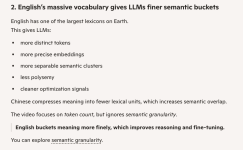
The Chinese Language Advantage in AI: Why Their LLMs Are Faster​

To view this content we will need your consent to set third party cookies.
For more detailed information, see our cookies page.
 
Not for mass adoption, for few cases yes. Chinese script and spoken language is for Vietnam, Japan and Korea. only those 3 countries. It makes no sense to learn or speak for the rest of the world. English is lingua Franca.

Even in East Asia, English is the second language learned by the vast majority.

When I visited Japan, I see the Korean/Chinese tourists communicate with the locals in English. When I visited Korea, I see the Japanese/Chinese tourists communicate with the locals in English.

I visit Japan/Korea multiple times a year. I'm East Asian ethnicity, so usually the locals can't tell that I'm a foreigner and speak to me in their language. But when they learn that I'm actually a foreigner, the default language they switch to is always, always English.

And language has a very strong network effect. Once a lingua franca is formed, it is only going get more entrenched as more and more people learn it, and the switching costs become too high.
 
Even in East Asia, English is the second language learned by the vast majority.

When I visited Japan, I see the Korean/Chinese tourists communicate with the locals in English. When I visited Korea, I see the Japanese/Chinese tourists communicate with the locals in English.

I visit Japan/Korea multiple times a year. I'm East Asian ethnicity, so usually the locals can't tell that I'm a foreigner and speak to me in their language. But when they learn that I'm actually a foreigner, the default language they switch to is always, always English.

And language has a very strong network effect. Once a lingua franca is formed, it is only going get more entrenched as more and more people learn it, and the switching costs become too high.

English is like GPS..it got entrenched early and became a default...you need something much better to un-entrench it.
 
Even in East Asia, English is the second language learned by the vast majority.

When I visited Japan, I see the Korean/Chinese tourists communicate with the locals in English. When I visited Korea, I see the Japanese/Chinese tourists communicate with the locals in English.

I visit Japan/Korea multiple times a year. I'm East Asian ethnicity, so usually the locals can't tell that I'm a foreigner and speak to me in their language. But when they learn that I'm actually a foreigner, the default language they switch to is always, always English.

And language has a very strong network effect. Once a lingua franca is formed, it is only going get more entrenched as more and more people learn it, and the switching costs become too high.
English is a general primary language. as second language French and Spanish in Europe.

When coming to Chinese language, I think the Japanese have too much hesitation if not resentments towards China, so they will hardly learn or speak Chinese. Some extent same for the Koreans.
so at the end if anything it’s only the Vietnamese.
 

Users who are viewing this thread

Back
Top