Chinese, Singaporean students lead the world in math, science

Beijingwalker

VIP Member
Joined
Nov 4, 2011
Messages
93,579
Reaction score
113,894
Reputation
1,992.4
Country of Origin
Country of Residence

Chinese, Singaporean students lead the world in math, science

September 8, 2026 | 11:34 pm PT

Students in China have emerged as the world's top performers in mathematics and science in an international assessment measuring how well education systems prepare 15-year-olds for the challenges of the future as Singapore ranked second in both subjects.

The newly released Program for International Student Assessment (PISA) 2025, conducted by the Organization for Economic Cooperation and Development (OECD), shows students in China's Beijing-Shanghai-Jiangsu-Zhejiang (B-S-J-Z) group and Singapore outperforming their peers globally.

The 2025 ranking was the largest assessment to date. It evaluated 760,000 15-year-old students across 91 countries and economies in science, reading, mathematics, and computational problem-solving.

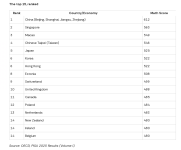
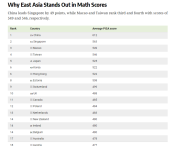
The PISA results showed B-S-J-Z students scored an average of 612 points in mathematics, the highest among all participating education systems.

Singapore followed with 563 points, while the OECD average sat at just 463 points. Macau, Taiwan, Japan, South Korea, and Hong Kong closely trailed the top two.

B-S-J-Z students also topped the global science ranking with an average score of 597 points.

Singapore again ranked second with 560 points, followed by Macau, Taiwan, Japan, Estonia, and South Korea. These results underline the consistently strong performance of East Asian education systems across core academic subjects.

The OECD noted that most participating Chinese jurisdictions, along with Estonia, Japan, South Korea, Singapore, and the U.K., ranked among the top 10 education systems in all three PISA domains: science, mathematics, and reading. Singapore took the top spot for reading.

In science, the gap between the leading systems and the OECD average was particularly striking.

B-S-J-Z students scored 115 points above the OECD average, while Singaporean students were 78 points higher. The OECD stated that students in B-S-J-Z and Singapore demonstrated stronger abilities to engage with broader, more demanding scientific ideas, complex investigations, and diverse sources.

At these top levels, students are expected not only to interpret or select evidence but also to evaluate claims, identify errors, and describe flaws. The results also highlighted that the leading systems had relatively few students struggling with basic science proficiency.

Fewer than 15% of students performed below Level 2 in science in B-S-J-Z, Macao, Singapore, Estonia, Japan, Taiwan, and South Korea. Level 2 represents the baseline at which students begin using science to reason in familiar, real-world situations.

In computational problem-solving, students in Macao (China), Singapore, B-S-J-Z (China), and Japan achieved the highest scores (572, 563, 560, and 557 points, respectively).

Students in Hong Kong (China), Malaysia, Brunei, the Philippines, Macao (China), and Iceland performed over 30 points above expectations based on their science performance.

Global declines and the future of learning

The strong performance from Asian education systems comes as overall results have deteriorated in many parts of the world. The OECD average mathematics score fell from 485 points in 2015 to 463 points in 2025, a significant decline of 22 points. Science performance declined more modestly, dropping from 489 to 482 points over the same period.

Between 2018 and 2025, reading performance fell in three quarters of the education systems with comparable data. Across the OECD, scores dropped by 25 points, which equates to more than a year of lost learning.

The biggest surprise was who fell furthest behind: it was not the most disadvantaged students, but rather those from wealthy families. This finding points to a much broader challenge than educational inequality alone.

Most troubling is the decline in the very skills that matter most in the AI age: evaluating information, making connections across multiple sources, and thinking critically about what we read. Consequently, the share of "hasty readers"– students who rush through texts and give quick but incorrect answers – almost doubled between 2018 and 2025.

"In a world increasingly flooded with information, our students are less likely to think deeply and separate signal from noise," the OECD said in its statement.

"PISA 2025 shows that reversing declines in student performance is urgent. The most successful education systems focus on fewer areas in greater depth, invest in teachers, engage parents and provide targeted support for the students and schools that need it the most," said OECD Secretary-General Mathias Cormann.

"Technology and AI can strengthen learning and help prepare young people for the future, but only when used purposefully and not as a substitute for attention, effort and understanding."

The 2025 results show that educational success is no longer strictly tied to a country's wealth or spending levels. Countries with fewer resources, such as Cambodia, are making notable progress.

Effective policies and smart financial decisions appear to matter far more than overall spending per student. Luxembourg, for example, spends significantly more per student than Ireland, France, and Italy, yet records lower average science scores.
 

Asia dominates global education. A historic decline for the West

Australia remains above the OECD average, but the warning signs are clear
Schoolexam_AAP-PRINT_45376-1024x576.jpg

A report has revealed Australian children have dropped nine points in maths and seven in reading. Photo: AAP/Mick Tsikas

17 September 2026 11:49am

The results of PISA 2025 send a clear warning to Western education systems. While several East Asian education systems continue to dominate the international rankings, average performance across the OECD has fallen to its lowest recorded levels in science, reading and mathematics.

At the top are B-S-J-Z in China – Beijing, Shanghai, Jiangsu and Zhejiang – and Singapore, the two highest-performing education systems across all three core PISA domains.

The results raise an important question: what are the highest-performing education systems doing differently?

What can we learn from the highest-performing systems?

There is no single explanation for their success. The strongest systems combine high expectations, sustained effort, strong foundational skills and a strong culture of learning.

Students are expected to understand that learning requires concentration, persistence and responsibility. Teachers are expected to maintain high expectations for all students. Families also have an important role in reinforcing the value of education.

This is not simply about working harder or sitting more examinations. It is about educational culture, consistency, respect for teachers, responsibility and the belief that effort matters.

The West does not need to copy Asia. But it does need to ask what it may have stopped expecting from students and families and what it may have stopped providing to teachers.

Australia: above average, but warning signs remain

Australia remains above the OECD average, scoring 509 in Science, 491 in Reading and 478 in Mathematics. However, its reading and mathematics results are the lowest ever recorded for Australia in PISA.

There are also important strengths. 82 per cent of Australian students reach at least Level 2 in Science, compared with 74 per cent across the OECD, while 12 per cent are high performers in Science, compared with 7 per cent across the OECD.

Australia is therefore not a failing education system. But the results show that there is no room for complacency.

The behaviour challenge: when learning is disrupted

PISA measures what students know and can do. But behind every result is a classroom, and in that classroom, behaviour matters.

In Australia, 41 per cent of students reported that noise and disorder disrupted lessons, compared with 31 per cent across the OECD. A further 34 per cent said that their classmates did not listen to the teacher, compared with 29per cent across the OECD.

These are not simply classroom-management issues. They raise a fundamental question: are classrooms providing the conditions in which effective learning can take place?

A teacher may prepare an excellent lesson, but if students are talking over instructions, repeatedly interrupting, using devices inappropriately or refusing to engage, valuable learning time is lost.

Teachers are increasingly expected not only to teach, but also to manage behaviour, resolve conflicts, address disengagement and compete with constant digital distractions.

A classroom cannot function without clear expectations and reasonable boundaries

This does not mean returning to an authoritarian model of education. Nor does it mean treating every student in the same way. Schools should seek to understand the reasons behind difficult behaviour and provide appropriate support, particularly where students have learning, emotional or social difficulties.

But understanding behaviour does not mean excusing it.

Restorative practice has an important role to play. When a student’s behaviour causes harm or disrupts the learning environment, students should have the opportunity to reflect, listen to those affected, take responsibility and, where appropriate, repair the harm and rebuild relationships.

At the same time, restorative practice should not mean the absence of consequences. Support and accountability must work together. Where behaviour is repeated, serious or deliberately disruptive, there should be clear, proportionate and predictable consequences. Their purpose should not be humiliation or punishment for its own sake, but accountability, safety and the protection of learning.

The goal is not simply to punish bad behaviour or tolerate it. It is to turn behaviour into an opportunity for learning — learning about responsibility, respect, relationships and the consequences of our choices.

Students have rights, but they also have responsibilities: to listen, to participate, to respect others and to allow their classmates to learn.

Ultimately, discipline is not the opposite of wellbeing. A calm, orderly and respectful classroom can give students something essential to their wellbeing: the security to concentrate, participate and succeed.

The family is part of the solution

Schools cannot carry this responsibility alone.

Most parents are raising children in an increasingly demanding and digital world. They want their children to be happy, safe and successful. But education also requires families to support the development of independence, responsibility, resilience and respect.

In some cases, children are increasingly protected from frustration, consequences and difficulties. Yet resilience is not developed by removing every obstacle. Children need opportunities to make mistakes, solve problems, take responsibility and discover that effort matters.

The same principle applies to technology. Children cannot easily be expected to disconnect, concentrate and listen when the adults around them are constantly connected to their own devices.

Parents do not need to agree with teachers on everything. But they should be partners in their child’s education, not opponents of the school.

Schools, in turn, must listen to families, communicate clearly and recognise that every child is different.

Education is ultimately a partnership between the student, the family, the school and the teacher.

The teacher must be elevated, not overloaded

At the centre of this partnership is the teacher.

If governments want better educational outcomes, they must reconsider what they are asking of teachers. The teacher should be recognised as a highly skilled professional and educator, not expected to be simultaneously a behaviour manager, counsellor, entertainer, administrator and substitute parent.

This requires strong teacher preparation, meaningful professional development, appropriate working conditions, time to plan and teach, and genuine professional respect.

It also requires restoring the teacher’s professional authority in the classroom.

Good teaching and student wellbeing are not opposites. A safe and supportive classroom can also have high expectations, clear boundaries and consequences.

If society expects teachers to produce better educational outcomes, it must also give them the conditions and support necessary to do so.

Technology is a tool, not the solution

Technology has an important place in modern education, but more technology does not automatically mean better learning.

PISA 2025 shows that digital distraction is already affecting classrooms. The challenge is therefore not simply to provide more devices, but to ensure that technology is used purposefully and in ways that strengthen learning rather than undermine concentration.

The goal is not more screens.

It is more meaningful learning.

The real lesson of PISA

The PISA results should not lead to a simplistic debate about whether schools need to be “stricter” or “more supportive”. The real challenge is to create learning environments that are supportive, restorative and appropriately demanding at the same time.

Australia has considerable strengths. But if it wants to reverse the downward trend, it needs to take seriously the conditions in which learning takes place.

That means high expectations for students, strong partnerships with families, clear and fair behavioural expectations, restorative responses combined with appropriate consequences, and a renewed professional status for teachers.

Schools should be places where children feel safe and valued but also places where they learn to listen, persevere, take responsibility and respect others.

Teachers should be supported to teach. Parents should be supported to raise independent and resilient children. Students should understand that rights come with responsibilities.

The real lesson of PISA is therefore not simply about test scores.

It is about the culture of education.

If we want better outcomes, we need environments in which students are ready to learn, families are willing to share responsibility, and teachers are respected and empowered to teach.

That is not a return to the past.

It is an investment in the future.

 
China leads, US ranks 27th: Top 15 countries with highest math scores
Sep.20 2026

Fifteen-year-old students from China have posted the highest score in this year's edition of the Programme for International Student Assessment (PISA), the global test administered every three years by the Organisation for Economic Co-operation and Development (OECD). The PISA 2025 results, released in September 2026, place China at 612 points in mathematics, more than 100 points above the score posted by the United States and nearly 150 points above the average across OECD member countries.

More than 760,000 students across 91 countries and economies sat the exam, representing roughly 33 million 15-year-olds worldwide.

East Asia's command of the top ranks​

China's mathematics score is officially attributed to Beijing, Shanghai, Jiangsu and Zhejiang, the provinces and municipalities that represent mainland China in the PISA sample rather than the country in full. Singapore follows in second place with 563 points, 49 behind China. Macao and Chinese Taipei round out the top four, scoring 549 and 546 respectively.

Seven of the top 10 positions belong to education systems in East Asia, a pattern that has held across earlier PISA cycles as well. Japan ranks fifth with 525 points, while Korea and Hong Kong are tied for sixth at 522. Estonia is the first system outside Asia to appear on the list, ranking eighth with 508 points, the highest score posted by any European country.

搜狗截图20260921194119.png

Outside the top 15, the ranking runs to 91 participating countries and economies. Australia sits at 17th with 478 points. Germany and Sweden are tied for 25th at 464, a point above the American score. France and Luxembourg share 33rd place at 458, and Vietnam is the lowest ranked country to clear 440 points, placing 40th at 443.

Where the United States and Canada stand​

The United States ranks 27th globally with 463 points, exactly matching the OECD average. Twenty-four countries and economies scored higher than the United States in mathematics, and ten of those also outperformed it in reading.

Canada performs considerably better, ranking 11th with 485 points, 22 above the OECD average and ahead of major European economies including Germany, France, Spain and Italy. Australia ranks 17th at 478, and New Zealand ties for 14th at 480.

A decline years in the making​

Mathematics performance across OECD countries has slipped over the past decade. The average score fell from 485 points in 2015 to 463 in 2025, a decline the OECD equates to just over a year of lost learning. Reading recorded a steeper drop, from 489 to 461 points among OECD countries and from 428 to 412 among non-OECD participants, while science slipped more modestly, from 489 to 482.

The OECD has described these as the lowest average levels of performance it has recorded across science, reading and mathematics. The share of 15-year-olds across OECD countries who count as low performers in all three subjects has also risen, reaching 20 percent this cycle, up from 16 percent in 2022.

Screen time enters the picture​

The PISA 2025 report also weighed the relationship between digital device use and academic outcomes. Students who spend more than four hours a day on digital leisure activities outside school tend to score lower in mathematics and report a weaker sense of belonging at school. Moderate digital use, by contrast, was linked to better outcomes on both measures than either no use at all or very heavy use.

The next PISA cycle is scheduled for 2028, when the OECD will test whether the gap separating East Asia's top performers from the rest of the world has narrowed or widened further.

 
No surprise here. We've been seeing the same results for years. 🥱
 

Users who are viewing this thread

Pakistan Defence Latest

Country Watch Latest

Latest Posts

Back
Top