Chinese Submarines News & Discussions

Satellite image confirms pumpjet propulsor on China's Type 095 SSN​


搜狗截图20260921195818.png

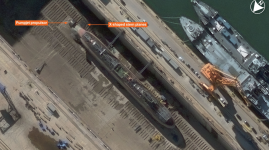
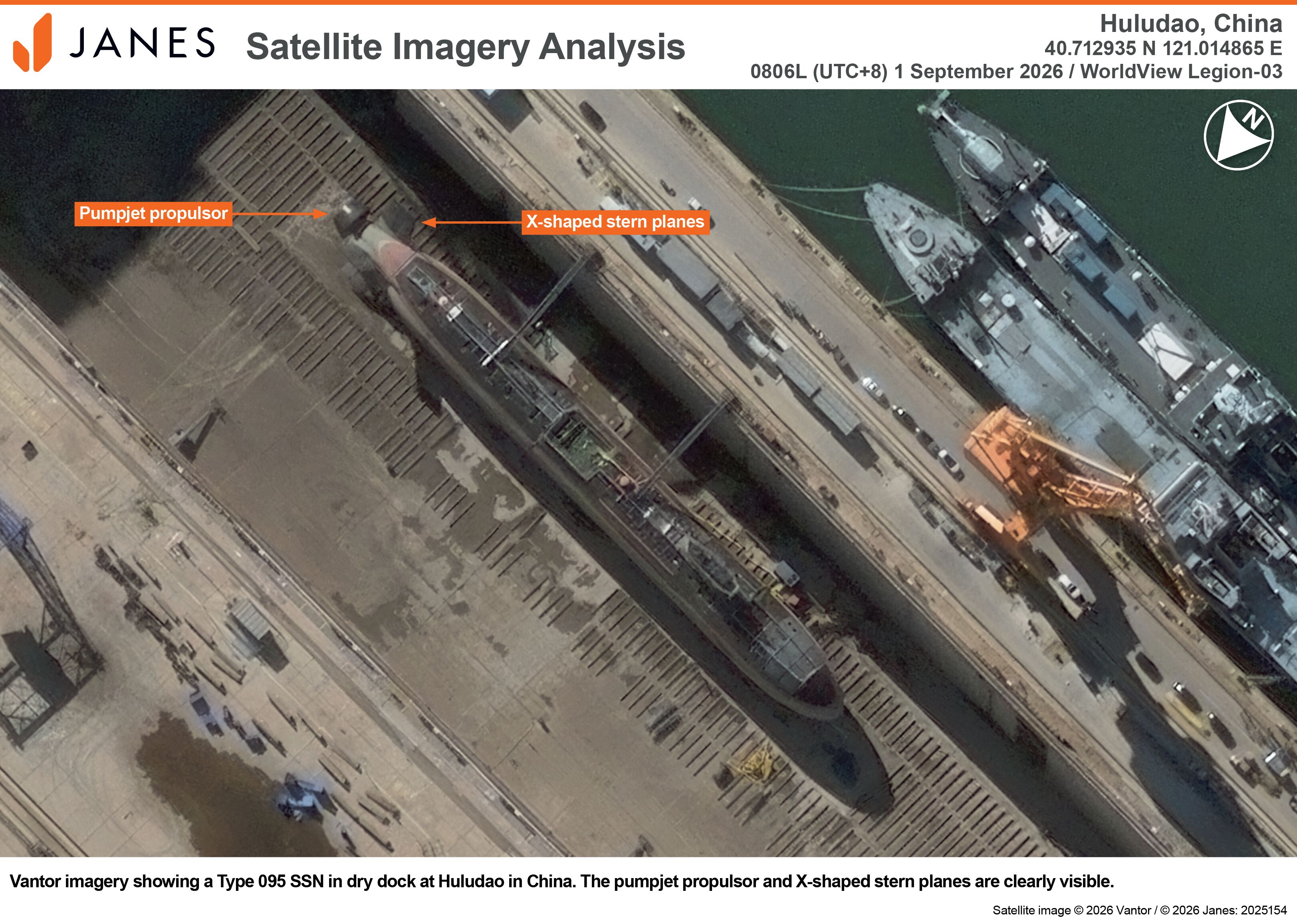
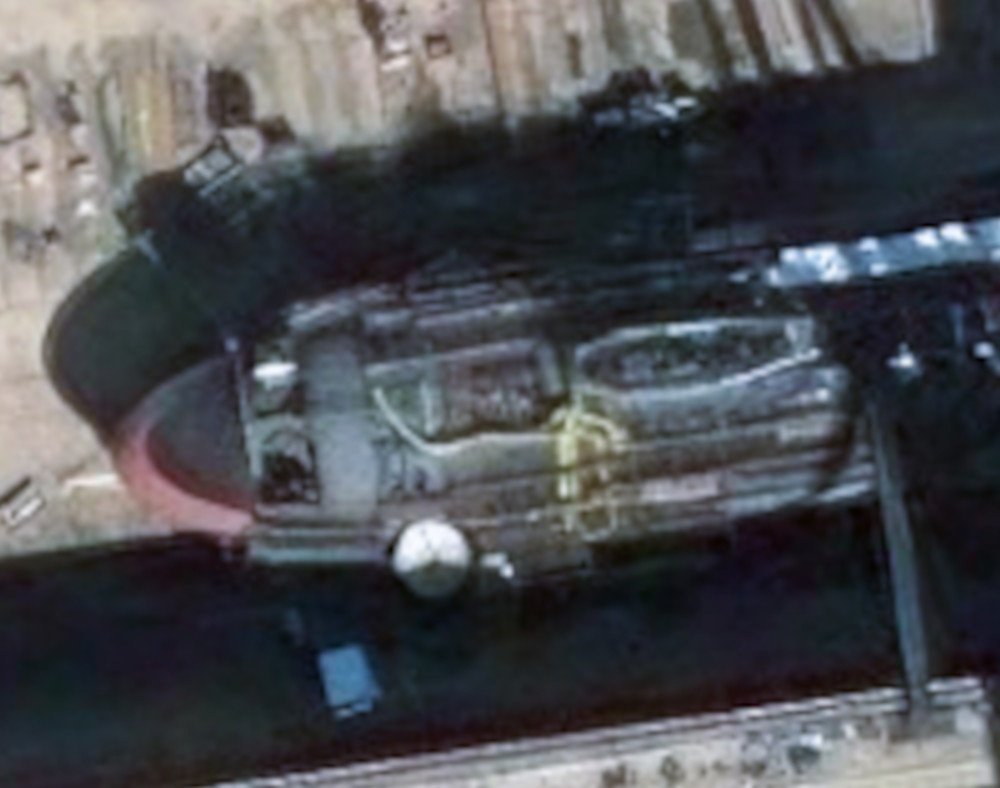
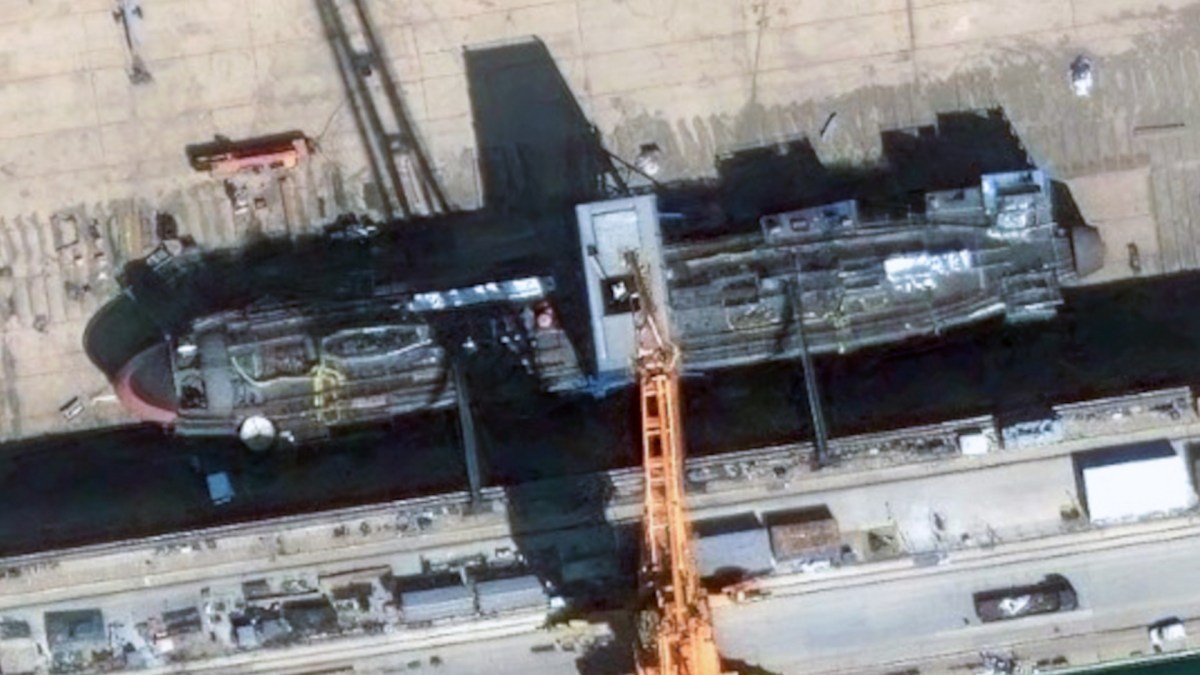
Vantor imagery shows a Type 095 SSN in dry dock at Huludao in China. The pumpjet propulsor and X-shaped stern planes are clearly visible. (Satellite image © 2026 Vantor/© 2026 Janes)

By Ridzwan Rahmat | 21 September 2026

Recent satellite imagery of a new Chinese nuclear-powered attack submarine (SSN) provides the clearest evidence yet that Beijing has opted for a pumpjet propulsor for its next-generation boat.

Imagery collected on 1 September 2026 and analysed by Janes shows the submarine in a dry dock at Huludao, allowing key features of its stern section to be observed.

In imagery analysed in February 2026, the submarine was waterborne and key portions of its stern were obscured. Its position in dry dock now provides an unobstructed view of the aft section.

This latest imagery clearly reveals a shrouded pumpjet propulsor and four stern planes arranged in an X-tail configuration.

The imagery supports long-standing assessments that China may be incorporating more sophisticated acoustic and hydrodynamic features into its latest attack submarine design.

The pumpjet propulsor is clearly discernible at the extreme stern.

Rather than employing a conventional exposed propeller, the submarine uses a ducted propulsion arrangement in which rotor and stator components are enclosed within a shroud.

Pumpjets are generally associated with noise reduction and improved propulsion efficiency at higher speeds.

The boat's stern control surfaces differ from the cruciform arrangement employed on China's previous nuclear submarine designs. This represents the first known adoption of an X-tail arrangement on a Chinese SSN.

The SSN's streamlined sail, with no visible fairwater planes, is also apparent in the latest imagery.

The imagery cannot conclusively confirm the arrangement of the submarine's forward control surfaces.


Satellite image confirms pumpjet propulsor on China's Type 095 SSN​


View attachment 216354

Vantor imagery shows a Type 095 SSN in dry dock at Huludao in China. The pumpjet propulsor and X-shaped stern planes are clearly visible. (Satellite image © 2026 Vantor/© 2026 Janes)

By Ridzwan Rahmat | 21 September 2026

Recent satellite imagery of a new Chinese nuclear-powered attack submarine (SSN) provides the clearest evidence yet that Beijing has opted for a pumpjet propulsor for its next-generation boat.

Imagery collected on 1 September 2026 and analysed by Janes shows the submarine in a dry dock at Huludao, allowing key features of its stern section to be observed.

In imagery analysed in February 2026, the submarine was waterborne and key portions of its stern were obscured. Its position in dry dock now provides an unobstructed view of the aft section.

This latest imagery clearly reveals a shrouded pumpjet propulsor and four stern planes arranged in an X-tail configuration.

The imagery supports long-standing assessments that China may be incorporating more sophisticated acoustic and hydrodynamic features into its latest attack submarine design.

The pumpjet propulsor is clearly discernible at the extreme stern.

Rather than employing a conventional exposed propeller, the submarine uses a ducted propulsion arrangement in which rotor and stator components are enclosed within a shroud.

Pumpjets are generally associated with noise reduction and improved propulsion efficiency at higher speeds.

The boat's stern control surfaces differ from the cruciform arrangement employed on China's previous nuclear submarine designs. This represents the first known adoption of an X-tail arrangement on a Chinese SSN.

The SSN's streamlined sail, with no visible fairwater planes, is also apparent in the latest imagery.

The imagery cannot conclusively confirm the arrangement of the submarine's forward control surfaces.

WELCOME BACK BRO!!! GREAT TO SEE YOU BACK!!!!!
 
The Type 095A is 123 meters long and 13.3 meters in beam width.

The surfaced tonnage should be around 11,000 tonnes, and 12,000 tonnes for the submerged tonnage.


Chinese Next-Generation Submarine Developments Spotted In New Satellite Imagery​

A Chinese submarine now taking shape at Bohai Shipyard has a number of significant features and offers new insights into China's undersea ambitions.
JOSEPH TREVITHICK, THOMAS NEWDICK
PUBLISHED SEP 21, 2026 8:29 PM EDT

Recent satellite imagery of a shipyard in northeastern China offers interesting new insights into the country’s next-generation submarine developments. The images notably show a pumpjet propulsor and other features worth examining on an example of what is generally described as a new class of nuclear-powered attack submarine, or SSN.

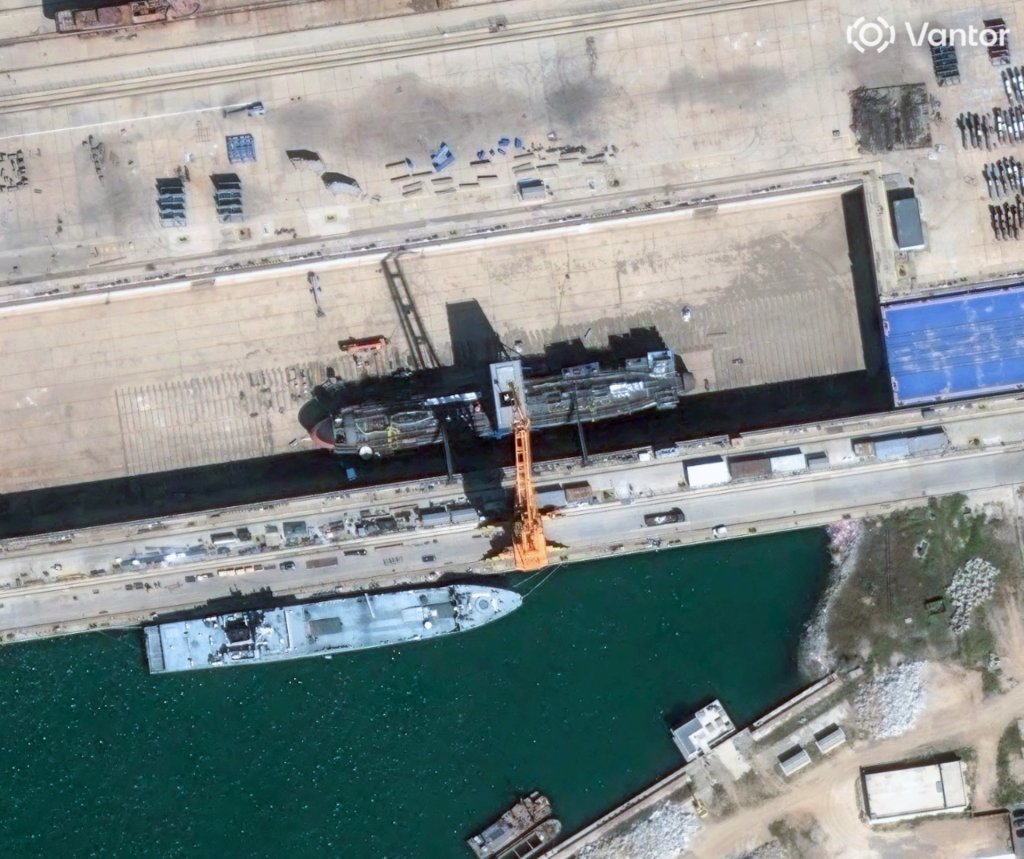
TWZ has obtained a new image taken on September 18 of the submarine in question, which is being built at the Bohai Shipyard in Huludao, from Vantor. Janes reported on this submarine earlier today, based on a separate Vantor image from September 1. The outlet also described the boat as a Type 095, a commonly used, but still unofficial designation. This is something we will come back to later on.

new-chinese-submarine-construction-bohai-260918.jpg
A wider view of the new Chinese submarine under construction at the Bohai Shipyard in Huludao on September 18, 2026. Satellite image ©2026 Vantor

As mentioned, the pumpjet propulsor immediately stands out in both images. This is also understood to be a feature on the Type 093B nuclear-powered attack submarine, a significantly improved variation on that earlier design, which first emerged in the early 2020s. Compared to traditional exposed propellers and more basic shrouded types, pumpjets offer benefits for quieter operation and efficiencies, especially at higher submerged speeds.

The recent imagery also highlights the submarine’s X-shaped stern plane arrangement. This is not found on the Type 093B, which is considered to be something of a bridge between that class and the next-generation design. Broadly speaking, an X-shaped configuration offers advantages when it comes to enhanced maneuverability, efficiency, and safety, which can be particularly useful in littoral environments. It can also provide benefits when it comes to acoustic signature reductions across significant parts of the submarine’s operating envelope compared to the cruciform stern planes.

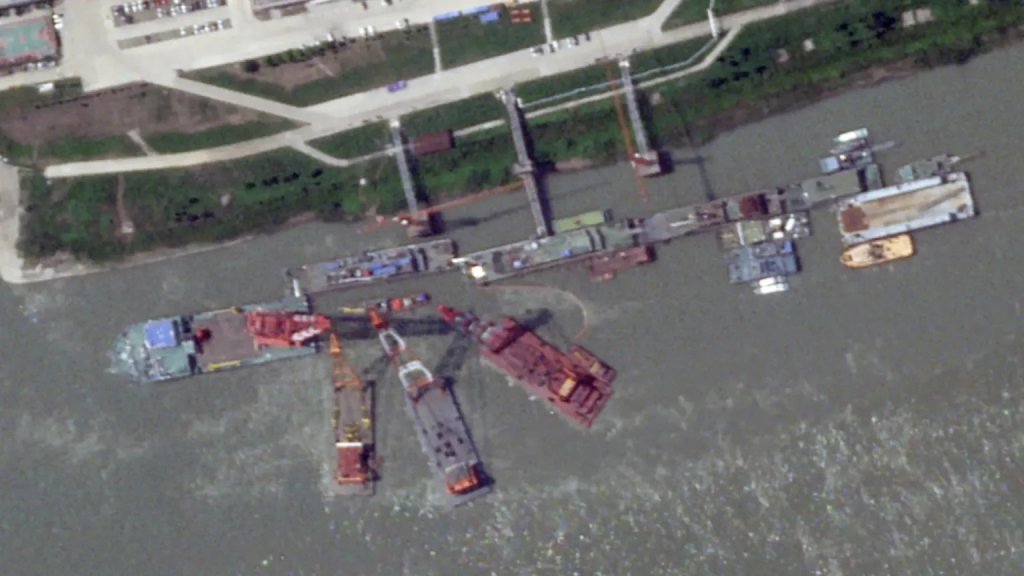
Another Chinese submarine design that emerged in 2024, currently referred to as the Type 041 or Zhou class, and that is understood to feature a hybrid nuclear/conventional propulsion system, also has an X-shaped stern configuration. The first known example of the Type 041 came to light after it appeared to have sunk in a shipyard.

crane-barges-type-041.jpg
Crane barges seen surrounding the first known Type 041 submarine after it apparently sank at China’s Wuchang Shipyard in 2024. PHOTO © 2024 PLANET LABS INC. ALL RIGHTS RESERVED. REPRINTED BY PERMISSION

An X-shaped stern arrangement also looks to be a feature on yet another new class of submarine that appeared at the JN (Jiangnan) Shipyard in Shanghai earlier this year. Initial reports also suggested that the design lacked a traditional sail. However, it has been confirmed that it has a sail, but that is very small proportionally to the overall size of the boat. Truncated sails can offer performance and other advantages, but there are trade-offs.

The image of the submarine that Janes obtained also notably shows an open rectangular-shaped section aft of the sail. The September 18 image that we received from Vantor shows a structure placed over that section of that submarine, obscuring ongoing work on that part of the boat. The Type 095 is widely expected to feature some type of vertical launch system (VLS) array able to accommodate a variety of anti-ship and land-attack cruise missiles, as well as potentially hypersonic types. The Type 095 is also sometimes referred to as a guided missile submarine, or SSGN, as a result. The open area seen in the September 1 shot could be where the VLS array is set to be fitted. It might also provide access to the reactor compartment or another area of the submarine.


Interestingly, the September 18 image also shows what look to be at least two relatively large circular openings, side-by-side, at the bow end of the submarine in front of the sail, the purpose of which is not immediately clear. There is a possibility these could also be for vertically launching munitions or other payloads. As a point of comparison, U.S. Virginia class nuclear attack submarines, starting with the Block III version, have two large-diameter Virginia Payload Tubes (VPT), one in front of the other, in the bow in front of their sails. At the same time, the openings on the submarine in Huludao also appear to be in a position that is very close to where the submarine’s main sonar array would be installed, and they could be tied to that aspect of the design, too.

construction-submarine-bohai-bow-close-260918.jpg
A close-up look at the bow end of the submarine under construction in Huludao as seen in the September 18, 2026, image. Satellite image ©2026 Vantor

“I think it’s too early to be sure about the VLS configuration from publicly available imagery. I realize people assume the large rectangular space halfway behind the sail is the VLS, but I am not sure this is the case and I’d caution to jump to conclusions. The space could also be related to work on the reactor compartment,” Alex Luck, a naval analyst who closely tracks submarine and Chinese navy developments, told TWZ. “With Type 093B, the VLS after launch was initially covered with a tarp, and then the installed launchers were readily visible quite quickly during the fitting-out process. The work process may change with these newer boats, but the different appearance during launch and fitting out needs to be considered in that regard.”

“I do expect Type 095 to have a VLS of some sort, but I am not sure as of yet what the configuration would look like, or where exactly it is located,” he added.

The bigger outstanding question may be exactly what type of submarine is currently being built now at the Bohai Shipyard. Based on a review of additional imagery from Planet Labs’ archive, the boat appears to be around 394 feet (120 meters) long. When the first example of what was assessed to be a Type 095 emerged in Huludao in February, it was estimated to have a length of roughly 361 feet (110 meters). The ‘small sail’ design that broke cover earlier this year in Shanghai is also estimated to be some 394 feet/120 meters long based on available imagery, but also looks to be narrower than the boat presumed to be a Type 095 in February.

“One significant question is the nature and difference between the boat launched by Bohai in February, and the two newer hulls launched in late May/early June both by Bohai and at Jiangnan in Shanghai,” Luck, the naval analyst, also told TWZ. “Specifically, we do not quite know whether they are for different operational roles, or rather a two step development for one final configuration of a new SSN. I think the latter is at least plausible.”

“A related question then is what boat we are looking at now with the new imagery, i.e. the February boat or the newer hull Bohai had launched,” he continued. “Without exact and reliable measurements that question for now is unresolved in the public discourse. For now we need more, and more detailed imagery, including of the different boats together, to clarify these aspects.”

“This [September 1] image reinforces my impression that the boat launched in February may have been a one off not including the full spec featured on the notional 095A launched by Bohai and Jiangnan in late May. We’ve already seen both versions side by side in Bohai,” Luck also wrote on X after Janes‘ published its report.


Regardless, the emergence in recent years of so many new, more modern submarines, and across what appear to be several distinct classes, is significant. It is no secret that China’s People’s Liberation Army Navy (PLAN) is working to significantly expand the size and capabilities of its submarine force with a clear eye toward extending operations further and further out in the Pacific, at least. In the past, U.S. officials have publicly said the overall quality of newer Chinese submarines has been getting closer in parity to American designs.

“The PLA Navy is executing a significant strategic shift from diesel-electric to all-nuclear construction, representing a fundamental departure from historical construction patterns,” U.S. Navy Rear Adm. Mike Brookes, head of the Office of Naval Intelligence, wrote in prepared remarks ahead of a hearing before members of the U.S.-China Economic and Security Review Commission in March.

In particular, the Type 095, as well as the new Type 096 nuclear-powered ballistic missile submarine, “represent next-generation platforms expected to enter service during the late 2020s through 2030s,” Brookes also wrote at that time. “These submarines will incorporate substantial advancements in nuclear reactor design, sensor performance, weapons integration, and noise quieting technologies.”

Submarine modernization efforts are just one aspect of a larger effort by the PLAN to expand its capabilities above and below the waves. Chinese shipyards have also been producing ever-more capable aircraft carriers, amphibious assault ships, destroyers, frigates, and more in recent years, as well. The pace of China’s construction of new surface ships and submarines has also been growing, creating a particularly significant and still-widening disparity in this regard with the U.S. Navy. This is something that has become increasingly concerning, as TWZ routinely highlights.

Work in Huludao, as well as shipyards elsewhere in China, is certainly already revealing interesting new insights into China’s next-generation submarine efforts.

 
Xinhua News Agency (China’s official news agency) recently published an article.

This piece is quite unremarkable; it simply reports that a Chinese nuclear-powered submarine has successfully conducted a test launch of a submarine-launched strategic missile.

But, in news reports, they are described as "third-generation" nuclear submarines.

Based on current information, the Type 091/092 nuclear submarines are classified as the first generation, while the Type 093/094 nuclear submarines are considered the second generation. Therefore, the "third-generation" nuclear submarines mentioned in this article likely refer to the Type 095/096 class.

Judging by this news, the PLA may be preparing to officially announce the entry into service of the Type 095/096 nuclear submarines.
1792308059036.png
 

China’s New Trimaran Submarine: 16 Missiles And An Unconventional Design​

Published on 28/10/2026

China-Submersible-Trimaran-Warship-UUV.jpg.webp
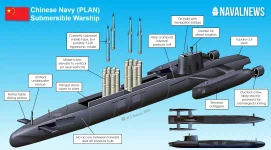
A unique trimaran vessel undergoing trials in China can be thought of as a modern interpretation of Cold War cruise missile submariners, designed to pop-up and launch a volley of powerful missiles from unexpected vectors.

China is building more submarines, of more classes, than any other country. It has several brand-new ambitious design readying for series production and is forging ahead in the uncrewed space. But this unique trimaran design appears the strangest of them all.


Somewhere in the Eastern Pacific, a snorkel mast skims the ocean’s surface, the only visible sign of a vessel lurking below. An encrypted signal arrives, carrying target data. The vessel rises, revealing a distinctive trimaran hull unlike that of any other navy’s submarine. This unique configuration provides greater stability on the surface. Moments later, two large hangars built into the central hull slide open, and 16 missile tubes rise into firing position. Nearly 1,500 km (930 miles) away, an enemy carrier battle group lies within range. This is no ordinary submarine; it is a vessel unlike any other in the world.


The above scene illustrates how new submersible warship is expected to operate. Previously described as a Semi-Submersible Arsenal Ship, it has yet to receive an official designation or Western reporting name. The vessel is currently being tested in Huludao on the Bohai Sea. Originally built in the southern city of Guangzhou, it was ferried to the north of China via the port of Dalian earlier this year.


China-Trimaran-Vantor-1024x574.jpg.webp
Satellite image of the submersible trimaran at Dalian in Northern China, 12th May 2026. Satellite image ©2026 Vantor.

It is, for sure, a completely new category of warship. Fresh analysis suggests that it is best thought of as a submersible warship, which is uncrewed, and yet needs to come to the surface to launch its weapons.


16+ Missile Tubes​

The new submersible warship built by China likely has 16 strike-length missile tubes occupying much of its central hull. Currently we can be confident that there are at least 8 tubes, but more probably 16-18 in total assuming both hangars are identical. The tubes are arranged in two circular clusters which are stored horizontally in hangars. To launch the missiles the vessel will logically have to surface, the hangar doors opened and the missile tubes elevated into a vertical position.


As is the case with secretive naval projects, vessel has not been reported or named in Chinese media. We do not have a clear official narrative on its role or status. The following observations come from what can be gleaned by open-source intelligence (OSINT), principally commercial satellite imagery.


It is likely that the missile tubes carry anti-ship or land-attack missiles. We can infer that the exact type of missile chosen, and China has many suitable types, is one which is intended for surface rather than submerged launch. This leads to the hypersonic YJ-20 missiles normally associated with the Type-055 cruiser, being a contender.


Unique Hull Form, and likely Uncrewed​

The vessel is clearly submersible but, as indicated by its prominent snorkel, is intended to run on diesels even when submerged. Its trimaran hull form, with outrigger hulls towards the stern, appears optimised for surface transit and stability on the surface. This latter factor may be a driver since the missile tubes, when erected, must make the vessel somewhat top heavy.


The outriggers also sport ducted propellers (‘screws’), possibly of a pumpjet type. Logically the vessel will have a set of screws or water jets on the main body for the diesels, and electric screws on the outriggers.


Dr. Rachel Pawling, Principal Consultant and K39 Consulting and lecturer in ship design, has calculated the vessel’s likely internal make-up. She estimates that the ship displaces around 900 tonnes fully submerged.


Dr. Pawling notes that the weapons hangars take up so much volume, that the rest of the internal space must be extremely cramped. So much so, that it appears unlikely that there is space for a crew. Yet the vessel has an open navigation bridge on top of its fin (sail). The obvious explanation is that this is only for a human pilot during entering and exiting ports. Most large uncrewed vessels have some form of bridge like this to simplify port operations.


Concept of Operations​

There has always been a blurred line between submersible warships and true submarines. There have been numerous designs designed to fight on the surface which can partly or fully submerge. Indeed until World War Two submarines were mostly surface vessels which could submerge.


Dr. Pawling suggests that the new type is similar to Cold War Soviet cruise missile submarines like the Juliett Class. That was a diesel submarine which had to surface to launch its powerful anti-ship missiles. It could pop-up to attack high-value warships from unexpected directions.


The main differences will be that modern missiles, such as the YJ-20 hypersonic missile, will have much longer ranges and be able to target both land and sea targets. This means that they will be dependent on external targeting. This makes this vessel a transporter and launcher, a small part in a larger distributed network. What is more, the Chinese vessel will carry far more weapons than the 4 SS-N-3 Shaddock carried by the Juliett Class.


This vessel will remain subject to analysis and speculation. China appears in no hurry to explain it to the outside world, and there is much which remains unclear. The ports it has been observed in do not match those associated with either China’s large uncrewed surface vessel (USV) or uncrewed submarine (XLUUV) programs, suggesting that it is distinct from either program.


Users who are viewing this thread

Country Watch Latest

Back
Top