Chinese UAVs News & Discussions

China's Wing Loong X Maritime Drone Set to Dominate Global Skies and Seas

byAero News Journal-February 16, 2026
HomeAsia-Pacific
China's Wing Loong X Maritime Drone Set to Dominate Global Skies and Seas


Singapore, February 16 - China's latest advancement in unmanned aerial technology, the Wing Loong X maritime combat drone, is drawing significant attention from defense analysts for its strong potential in the global market. Unveiled prominently at the Singapore Airshow, this new addition to the established Wing Loong family stands out for its specialized design focused on maritime surveillance and strike missions.

Unlike more high-profile manned aircraft displays, the Wing Loong X emphasizes practical, export-oriented capabilities that align with growing international demand for affordable yet effective unmanned systems in naval operations.

Developed by Chinese aerospace firms, the Wing Loong X features enhanced endurance for extended patrols over vast ocean areas, advanced sensors for detecting surface vessels and submarines, and precision strike options including potential integration of torpedoes or sonobuoys.

Analysts highlight its competitive edge in anti-submarine warfare and long-range maritime intelligence, surveillance, and reconnaissance (ISR), making it suitable for nations seeking to bolster coastal defense and offshore security without the high costs associated with traditional platforms. Its large wingspan and robust payload capacity position it as a versatile tool for modern naval forces facing evolving threats in contested waters.

Experts point to China's proven track record in exporting combat drones as a key factor driving the Wing Loong X's prospects. Previous models in the series have achieved substantial sales worldwide due to their reliability, performance, and significantly lower price compared to Western equivalents.

This cost-effectiveness, combined with improving technological sophistication, appeals to emerging and mid-tier militaries looking to modernize their maritime capabilities amid budget constraints. The drone's debut in Southeast Asia underscores Beijing's strategic push to expand its footprint in regions with heightened interest in unmanned aerial solutions for domain awareness and deterrence.

Overall, the Wing Loong X represents a calculated step in China's broader unmanned systems strategy, where maritime combat drones are poised to outpace other platforms in international adoption. As global navies increasingly prioritize affordable, high-endurance unmanned assets for persistent operations, analysts anticipate strong demand for this system, potentially cementing China's role as a leading supplier in the expanding market for advanced maritime drones.


World’s Only Ship-Based Stealth Drone To Be Deployed On China’s Biggest Aircraft Carriers

ByMI News Network
February 19, 2026


Image Credits: Wikipedia
China has revealed what it calls the world’s first and only operational ship-based stealth combat drone.

Named the GJ-11, it came from Shenyang Aircraft Corporation’s ‘Sharp Sword’ project, and was built by Hongdu Aviation Industry Group, a part of the government-owned Aviation Industry Corporation of China (AVIC).

The drone was on display at the Victory Day Parade, where it showed different manoeuvres such as folding wings, which makes it easier to fit on aircraft carriers and other naval ships.

China had been working on the development of this drone for years. The first flight of its prototype was in 2013, and it was officially revealed in 2019.

The drone is 10 m long, 14 m wide and can block radar waves from reaching the engine’s blades, thanks to its air intake capability at the top.

It has a flying wing design and a blended body, enabling it to have low cross-sectional visibility.

The drone has a turbofan engine, and it can attain a maximum speed of 690 miles per hour while carrying a payload of up to 2000 kilograms.

It has a combat range of 1500 km, making it an effective weapon to carry out key missions in Japan, Taiwan, etc., per media reports.

It has many sensors and can go on reconnaissance missions alongside strike missions.

The drone features two internal weapon bays which can carry several guided bombs.

What makes the drone unique is the fact that it can automate most of its tasks. It can fly as an escort drone and can also be launched from aircraft carriers and amphibious ships.

The ‘Sharp Sword Drones’ can also carry out missions independently, while analysing data and making decisions in real-time.

It also transmits the data to a command centre on land to ensure all-weather operations.

The drone can take off autonomously, carry out a mission and come back safely since it relies on AI for more complex functions, which eases the work of operators.

Per speculations, a naval variant of the GJ-11 Sharp Sword drone will be deployed on the Sichuan and the Fujian aircraft carriers.

 
If everyone now feels that Iran's drones are causing serious problems.The potential of mainland drone manufacturing, referencing mobile phones and small appliances, can be considered to have production potential at the tens of millions or even billions level.In other words, that flight intensity when Iran goes to war, multiplied by tens of thousands. A drone factory with 12 production lines can produce 1 million suicide drones per year, each with a 500 kg payload. Using hybrid oil-electric two-stroke motorcycle engines. The range exceeds 2,000 kilometers, and the cost per unit can be reduced to below 30,000 RMB. Paired with 500 kg-class thermobaric bombs. Deploying 1 million 500 kg-class thermobaric bombs annually could wipe out any medium-sized country on Earth.

 
If everyone now feels that Iran's drones are causing serious problems.The potential of mainland drone manufacturing, referencing mobile phones and small appliances, can be considered to have production potential at the tens of millions or even billions level.In other words, that flight intensity when Iran goes to war, multiplied by tens of thousands. A drone factory with 12 production lines can produce 1 million suicide drones per year, each with a 500 kg payload. Using hybrid oil-electric two-stroke motorcycle engines. The range exceeds 2,000 kilometers, and the cost per unit can be reduced to below 30,000 RMB. Paired with 500 kg-class thermobaric bombs. Deploying 1 million 500 kg-class thermobaric bombs annually could wipe out any medium-sized country on Earth.
Bro, there's a problem with your post.

According to publicly available information, all suicide UAVs currently produced in China have warheads weighing between 10 and 50 kg. A very few models (such as the Type PD2900) have warheads weighing around 100 kg.

Currently, there are no suicide UAVs with warheads weighing over 500 kg.

UAVs with a payload capacity of 500 kg or more are very expensive. They are not suitable for use as suicide UAVs.
 
Last edited:
Just something different, but since I got an invitation again: This year the topic is the Chinese CCAs in comparison to those under development in other countries!

1773239455855.png

 
To view this content we will need your consent to set third party cookies.
For more detailed information, see our cookies page.
 
傲游截图20260318074414.jpg

In English:
The CH-7 stealth unmanned combat aerial vehicle is a large, high-altitude, high-speed stealth unmanned combat aircraft featuring a distinctive flying wing configuration with sleek and mysterious lines. Designed specifically for high-intensity adversarial environments, it can penetrate enemy air defense systems to perform missions such as covert reconnaissance, battlefield surveillance, and the guidance and direct strike against high-value targets, either individually or in combination.

Aerodynamic Insight: The flying wing configuration of the CH-7 is the cornerstone of its stealth capabilities. The entire airframe functions as a lifting body, eliminating protruding components like vertical and horizontal tails, which significantly reduces its radar cross-section. Its air intakes are positioned on the upper surface of the fuselage, using the body to shield them from ground-based radar detection, while the exhaust nozzles are also treated for stealth. The aerodynamic challenge of this tailless design lies in flight control, which is achieved through a combination of multiple elevons to manage pitch, roll, and yaw. The wings feature a pronounced sweep angle, balancing the demands of high-speed flight with subsonic cruise efficiency.
 
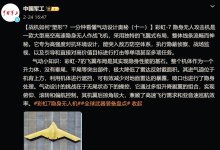
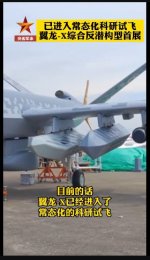
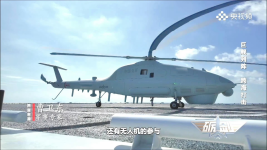
According to Tang Yong, Chief Designer of AVIC's Unmanned Aerial Vehicle (UAV) system, they are developing the Wing Loong-X comprehensive anti-submarine configuration. Submarines pose a major threat to maritime security, and the Wing Loong-X's comprehensive anti-submarine capabilities offer an effective solution to this challenge. At present, the Wing Loong-X has entered a phase of normal scientific research test flights.
傲游截图20260318101319.jpg
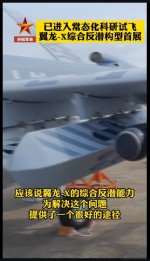
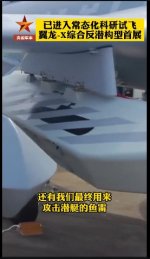
The comprehensive anti-submarine configuration, showcased for the first time, is equipped with a sonobuoy pod and the ET60 electric anti-submarine torpedo, enabling it to complete the entire anti-submarine task chain of "detection-localization-strike." By capturing submarine noise through sonobuoys, combined with data analysis to pinpoint the target, it ultimately delivers precision strikes with torpedoes.
傲游截图20260318101432.jpg
In addition to anti-submarine equipment, it can also be equipped with air-to-air missiles, air-to-ship missiles, and maritime surveillance radar pods, endowing it with air-to-air, air-to-surface, and surface-to-surface strike capabilities, achieving a true multi-role capability.

傲游截图20260318101358.jpg
With a 40-hour endurance capability, it can conduct 7×24-hour uninterrupted patrols in key maritime areas (such as the Taiwan Strait and the South China Sea), addressing the shortfall of traditional anti-submarine aircraft that require multiple units for rotation, thereby forming a sustained deterrence against submarines.


VEDIO: FROM 央视军事
 
To view this content we will need your consent to set third party cookies.
For more detailed information, see our cookies page.
 
To view this content we will need your consent to set third party cookies.
For more detailed information, see our cookies page.


This is just wrong and as so often again, armyrecognition is just shit!

It has been discussed several times already within the last days and even if indeed still a few likely "active" J-6Ws were seen in late 2025 and early 2026 at Longtian and Hui'an, this base is just the "Central Storage Center".

To view this content we will need your consent to set third party cookies.
For more detailed information, see our cookies page.
 

Users who are viewing this thread

Pakistan Defence Latest

Back
Top