Chinese UAVs News & Discussions

China test-flew a 6-ton autonomous tiltrotor drone: why this aircraft could change how remote islands are supplied​

By Adrian Villellas
Published On: July 14, 2026 at 7:45 AM

r6000-autonomous-tiltrotor-drone-flight-test.jpg

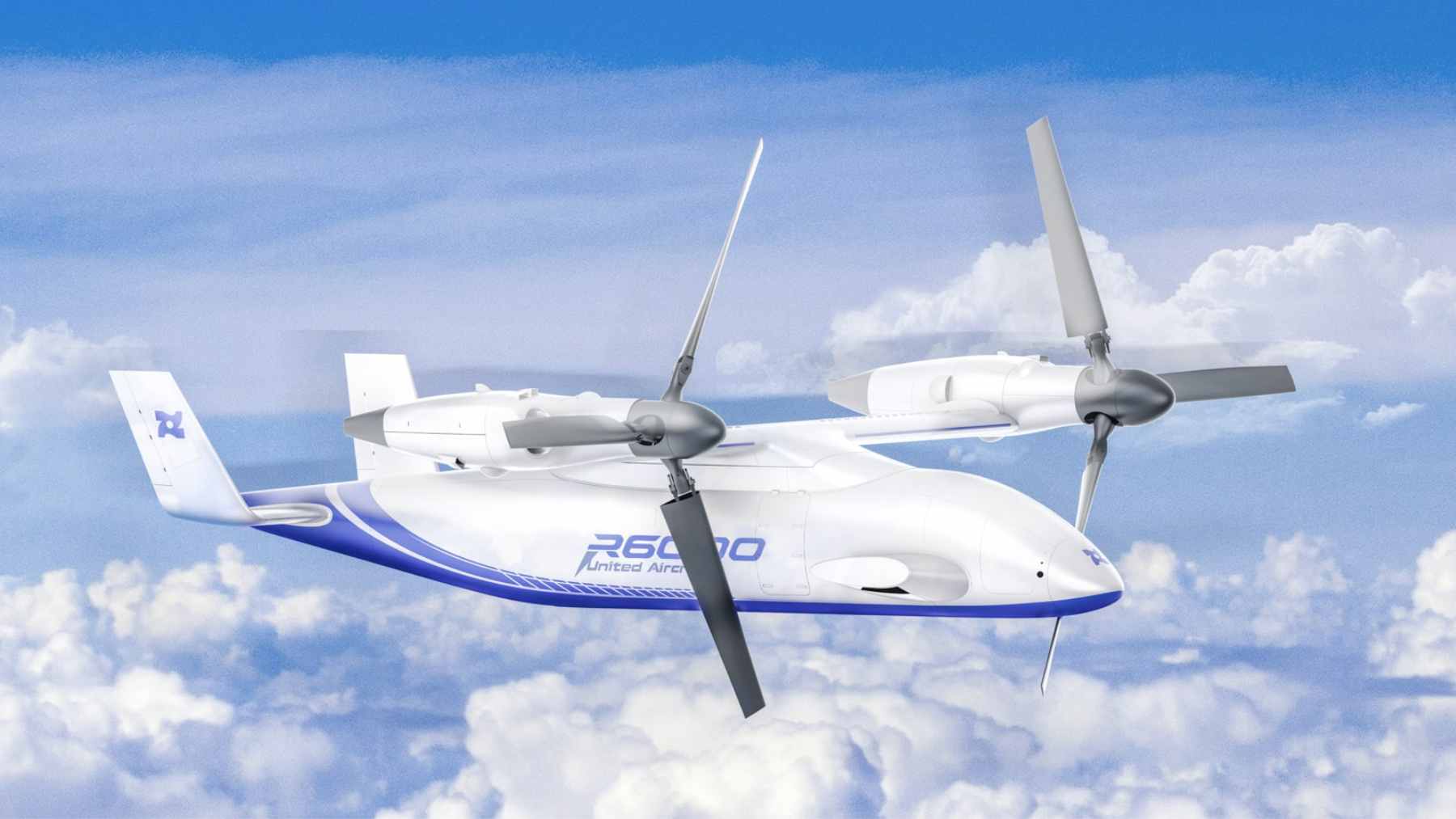
China’s R6000 autonomous tiltrotor has moved into free-flight testing, a milestone that turns the aircraft from a factory-floor concept into something much harder to ignore. New footage appears to show the large uncrewed aircraft hovering, turning in place, and then flying forward with its proprotors tilted, according to reporting by The War Zone.

The bigger story is not just that China is testing another drone, it is that this one is built around a simple but powerful idea: moving people or cargo without needing a runway. For remote islands, storm-hit communities, offshore sites, and military outposts, that could matter a lot.

A drone built for hard places​

The Lanying R6000 is a tiltrotor aircraft developed by United Aircraft. In plain English, it is designed to take off and land like a helicopter, then fly forward more like an airplane once it is in the air.

United Aircraft lists a maximum takeoff weight of 13,448 lbs., a maximum payload of 4,409 lbs., a cruising speed of 342 mph, and a maximum range of 2,485 miles. The company also lists a service ceiling of about 25,000 ft. and a mission radius of 932 miles. That is a very different picture from the small quadcopters most people imagine when they hear the word “drone.”

Why free flight matters​

Earlier imagery had shown the R6000 in tethered hover testing, which means it was still physically restrained during basic lift checks. The newer footage suggests the aircraft has now moved beyond that stage, with untethered hover, rotation, and sustained forward flight visible in the test sequence.
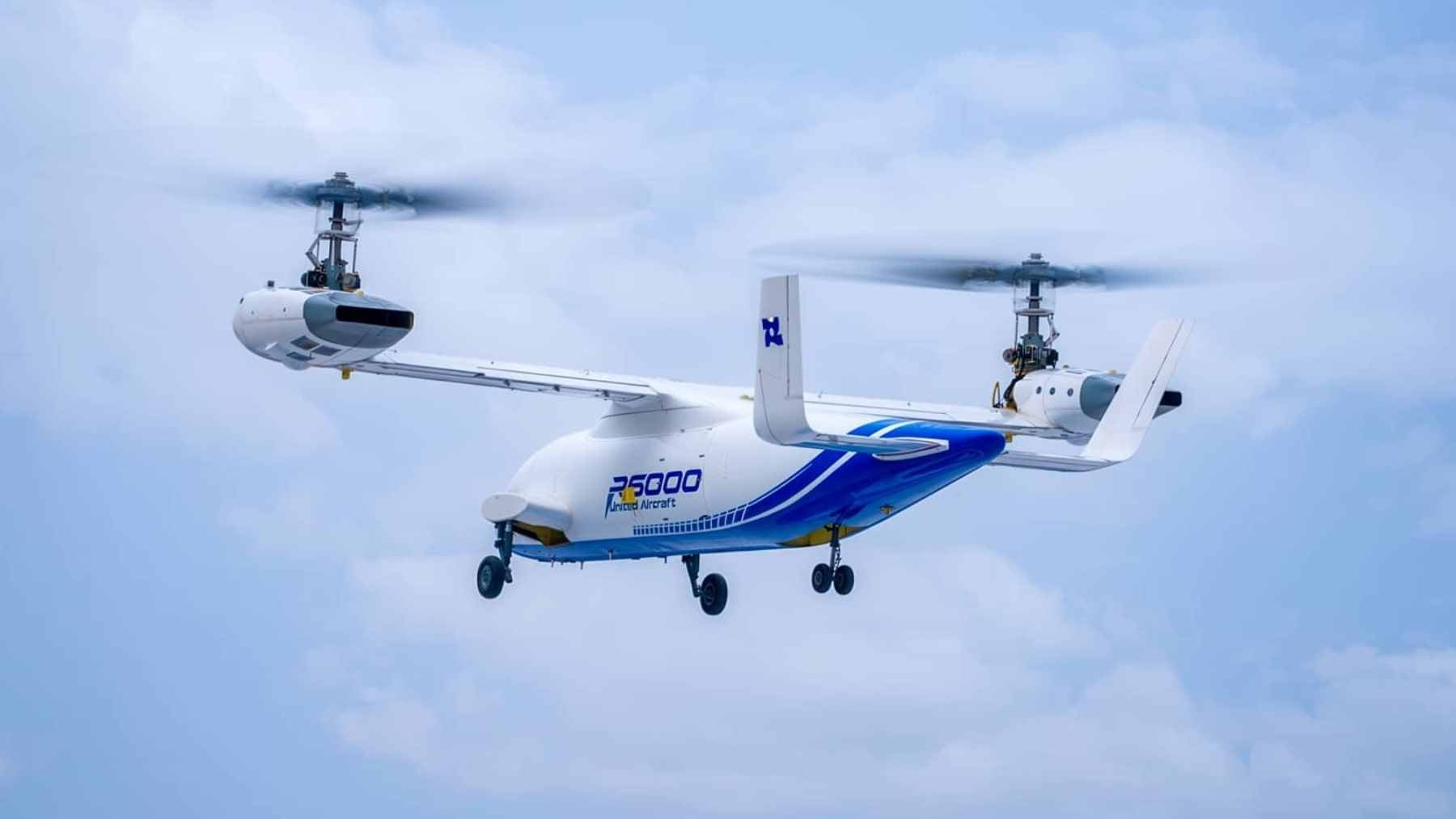
The R6000 autonomous tiltrotor drone performing a transition from hover to forward flight during untethered testing.
By combining vertical takeoff capabilities with fixed-wing cruising speed, the 6-ton R6000 aims to revolutionize logistics for remote and runway-constrained regions.
That does not mean the R6000 is ready for commercial service or military deployment yet. For a tiltrotor, free flight is a serious step, though, because the hard part is not only going up or forward, but safely managing the shift between both flight modes.

Civil pitch with an environmental edge​

Officially, United Aircraft presents the R6000 as a civil aircraft for passenger travel, logistics, emergency rescue, and all-terrain operations. The company says it can operate with less dependence on infrastructure and without traditional runways, which is why mountains and islands appear so often in its marketing.

There is an environmental angle here, but it should be handled carefully. A runway-independent aircraft could reduce the need for new roads, pads, or airstrips in fragile places, and it could move supplies after floods, fires, or hurricanes when ground routes are blocked.

On the other hand, United Aircraft has not published fuel-burn or emissions data for the R6000, so calling it “green” would be a stretch.

To view this content we will need your consent to set third party cookies.
For more detailed information, see our cookies page.


Why militaries are watching​

The same features that make the aircraft useful in a disaster also make it interesting to defense planners. The War Zone notes that a platform in this class could help sustain remote People’s Liberation Army island bases in the South China Sea, isolated border installations, and large amphibious ships such as China’s Type 076.

That is the nature of dual-use technology. A cargo bay can carry medical supplies after a storm, but it can also carry sensors, spare parts, ammunition, or communications gear. At the end of the day, the aircraft does not care what is inside the box.

A different tiltrotor choice​

The R6000 does not follow the exact design logic of the V-22 Osprey, the best-known American tiltrotor. Reporting from Global Times, citing United Aircraft, says the R6000 uses a tilting rotor shaft arrangement rather than a fully rotating engine nacelle, an approach meant to avoid some high-temperature exhaust issues during takeoff and landing.

Small detail? Not really. Heat, rotor wash, and exhaust can decide whether an aircraft can safely operate from a ship deck, a rough landing zone, or a tight urban pad. For rescue crews or island logistics teams, practical details like that can matter more than the brochure numbers.
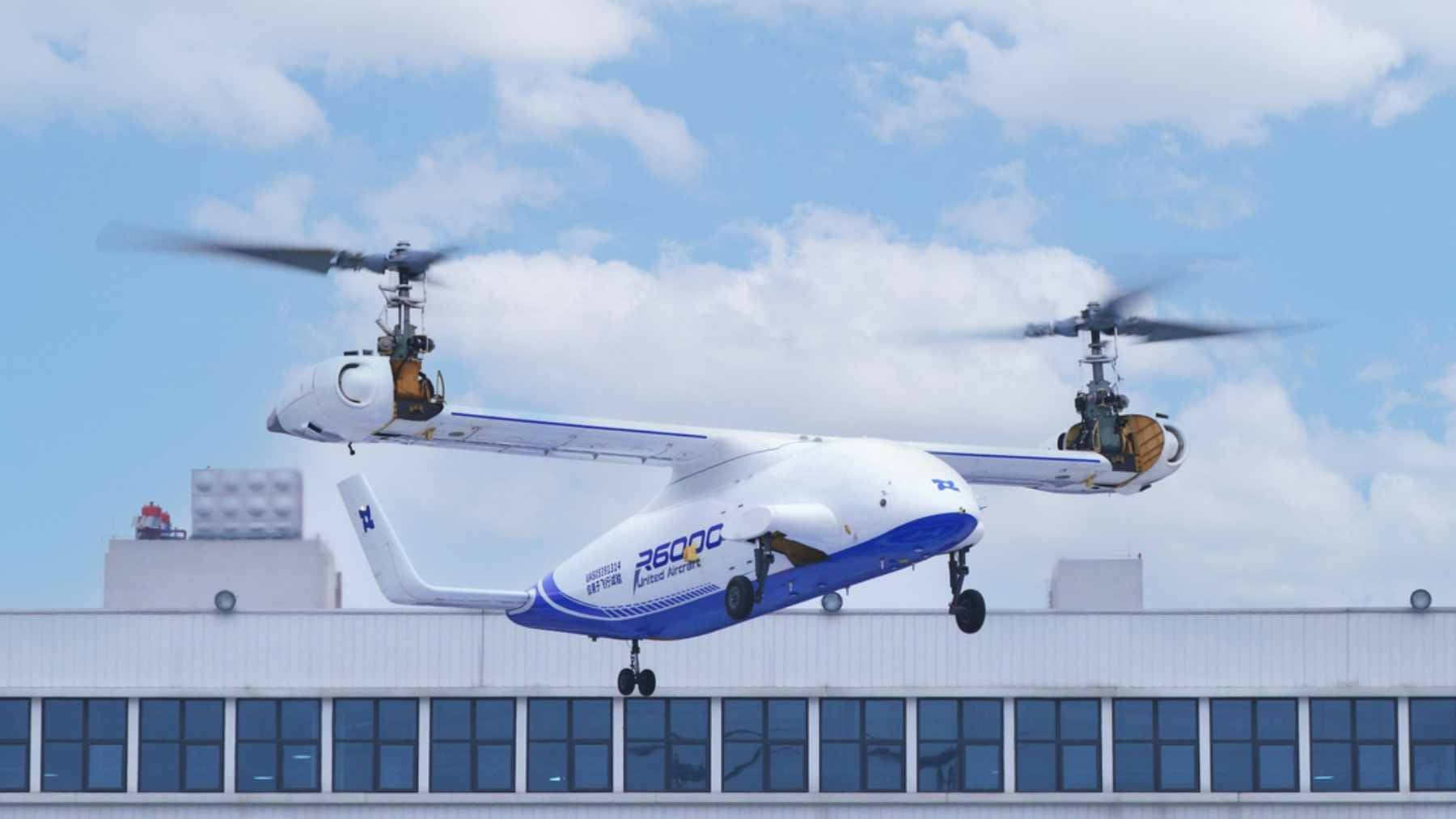
The R6000 autonomous tiltrotor drone performing a transition from hover to forward flight during untethered testing.
By combining vertical takeoff capabilities with fixed-wing cruising speed, the 6-ton R6000 aims to revolutionize logistics for remote and runway-constrained regions.

What remains unknown​

The R6000 still has plenty to prove. United Aircraft has listed headline figures, but the company has not published detailed data tied to the latest free-flight campaign, including test duration, transition profile, autonomy limits, reliability, or how range changes when the aircraft carries a heavy payload.

China Daily reported after the aircraft’s maiden flight that United Aircraft planned to pursue tilt-mode testing, full-process flight tests, and airworthiness certification work before moving into practical use cases such as business travel, logistics, and emergency response. That is the less glamorous part of aerospace, but it is where projects either mature or stall.

The runway question​

If the R6000 works as advertised, its most important feature may not be speed or payload. It may be the ability to make runways less central to logistics, whether the mission is reaching a mountain village, moving supplies to an offshore platform, or keeping a remote base alive during a crisis.

That is why this aircraft is worth watching. It sits at the crossroads of tech, business, disaster response, and defense, with real questions still hanging over safety, cost, emissions, and operational reliability.

The official product information was published on United Aircraft.


China Unveils TP200, A 24‑Hour, 3,000‑Km‑Range 'Sky Hunter' Drone To Watch Over Taiwan, US Navy?

Jul 28, 2026

To view this content we will need your consent to set third party cookies.
For more detailed information, see our cookies page.


China has successfully completed the maiden flight of its new TP200 long-endurance unmanned aerial vehicle (UAV), marking another milestone in Beijing's expanding drone development program.

Developed for high-altitude, long-range operations, the TP200 is capable of remaining airborne for more than 24 hours and operating at distances of up to 3,000 kilometers. Chinese developers say the modular UAV supports rapid payload swapping, lower operating costs, and a wide range of missions, including maritime patrol, search and rescue, disaster relief, weather modification, forest fire monitoring, and territorial mapping.
 

CHINA'S TP200 DRONE FLIES 24 HOURS FULLY LOADED​

RAFAEL SUÁREZ · STAFF WRITERJULY 29, 2026 · 08:02 ET4 MIN READ

Yitong UAV System TP200 long-endurance drone parked on a runway in Yantai, China

PHOTO CREDIT: YITONG UAV SYSTEM

China just flew a civilian drone built to stay airborne for a full day without landing. The TP200, developed by Yitong UAV System, completed its maiden flight in Yantai, Shandong province, on July 26, and the specification sheet reads like a statement of intent: more than 24 hours of endurance at full load, 440 pounds (200 kg) of payload, and a range of 1,860 miles (3,000 km).

State media called it the country’s first multi-functional long-endurance drone developed under civil airworthiness standards. That last detail matters more than the headline numbers, and we will get to why.

Yitong UAV System TP200 drone parked outside a hangar in Yantai, China

The Yitong UAV System TP200 fixed-wing drone. Photo credit: Yitong UAV System

THE NUMBERS DESCRIBE A FLYING WORKHORSE​

The TP200 is a fixed-wing, fuel-powered aircraft with a cruise ceiling around 25,000 feet (7,600 m) and a maximum cruise speed of 124 mph (200 km/h). It needs just 984 feet (300 m) to take off or land, and it can do both from unpaved strips, which is the difference between an aircraft that serves remote regions and one that only visits airports.

Fuel is the quiet hero of the endurance number. No battery chemistry on the market keeps an aircraft this size aloft for a full day, which is why the long-endurance class still burns liquid fuel while the delivery multirotors chase electrons.

The airframe carries dual air intakes above and below the rear fuselage, a tail propeller, and twin connected vertical stabilizers. The design is modular: mission payloads swap in and out, letting one aircraft work as a cargo hauler today and a sensor platform tomorrow.

During the maiden flight, climb, cruise, and handling all matched design specifications, according to the developer. A first flight that behaves is not news by itself. A first flight of an aircraft in this class, certified against airworthiness standards from day one, is China putting administrative infrastructure under its drone industry, not just engineering.

BEIJING’S MISSION LIST IS DELIBERATELY LONG​

The published mission set covers maritime patrol, offshore search and rescue, coastline monitoring, island resupply, emergency deliveries to remote mountains, drought relief and cloud seeding, weather modification, forest fire prevention, land surveying, and ecological monitoring.

Read that list twice and a pattern appears: almost every mission is government work. This is not a package-delivery drone chasing suburban rooftops. It is a state-utility aircraft, built for the long, boring, essential flights that crewed aviation does expensively: watching a coastline for 24 hours, reaching an island in a typhoon’s aftermath, seeding clouds over a drought province.

The speed of iteration is the story under the story. China’s civilian drone sector has been shipping milestone after milestone this year, including DJI’s EV50 flying to 29,072 feet on Everest. Chinese engineers are improving these platforms at a pace the rest of the industry keeps underestimating, and what gets published with numbers and test dates is, by definition, what somebody decided the world is allowed to see. I will not speculate about specific military programs, and I do not need to: the gap between what a country demonstrates publicly and what it keeps quiet is a constant of aviation history, and it never runs in the direction of less capability.


FROM CARGO IN EMERGENCIES TO PATIENTS SOMEDAY​

The mission that deserves the closest look is emergency supply delivery. A 440-pound payload flown 1,860 miles to an unpaved strip is disaster logistics in a box: water, medicine, generators, and blood products, all landing where the roads ended.

And that opens the question this airframe quietly raises: how far are we from ambulance drones built for multiple patients? Single-occupant medical aircraft have already been demonstrated, and the industry has flown first responders, defibrillators, and prescriptions. What has never existed is the flying ambulance that carries more than one injured person out of a disaster zone at once.

The TP200 is not that aircraft. It is unpressurized cargo hardware, and patients are not payload. Medical evacuation needs certification, life support, and attendants that no current civilian drone offers. But the numbers now exist in the same airframe class, endurance, range, and short-field performance, and that converts the multi-patient medevac drone from science fiction into an engineering adaptation problem. Those tend to get solved.

DRONEXL’S TAKE​

The TP200’s most impressive specification is not the 24 hours. It is the certification path. China is building civil airworthiness scaffolding under aircraft in this class while most of the world still argues about waivers, and the country that industrializes the paperwork wins the market long before anyone counts motors.

I fly DJI hardware, and I have watched this pattern for years: the West discusses, China ships. When the shipping happens with published numbers, test dates, and state media coverage, that is the version meant for export catalogs and evening news. My read, and I own it as a read: whatever sits behind the curtain at the military level is a generation past what Yantai showed this weekend. The visible curve is steep enough.

The adaptation I keep circling as an optimist is this endurance-and-payload class rebuilt around patients instead of parcels. The first single-person medical drones have flown. The multi-patient air ambulance is now a matter of somebody deciding the market is worth it, and disasters, unfortunately, keep making the case.

Watch whether the TP200 moves from maiden flight to type certification, and how fast. That timeline, not the endurance number, will tell you how serious China is about owning this category.


Users who are viewing this thread

Pakistan Defence Latest

Country Watch Latest

Back
Top