Navigation
Install the app
How to install the app on iOS
Follow along with the video below to see how to install our site as a web app on your home screen.
Note: This feature may not be available in some browsers.
More options
Style variation
You are using an out of date browser. It may not display this or other websites correctly.
You should upgrade or use an alternative browser.
You should upgrade or use an alternative browser.
Chinese UAVs News & Discussions
- Thread starter SiliconBit (silicon0000)
- Start date
More options
Who Replied?


FuturePAF
THINK TANK: CONSULTANT


It will be interesting to see Chinese firms couple robot dogs to UAVs (which they can carry on their backs in a retractable manner) that can cover long distance (100-150 km), high altitudes, or hot and humid littoral areas. A concept many think China will soon employ in the future, possible dropped from unmanned transport planes near a battlefield. It would be shock and awe with Chinese characteristics; all unmanned AI warfare.

Michael
VIP Member

“UAV + robot dog” collaborative combat mode.It will be interesting to see Chinese firms couple robot dogs to UAVs (which they can carry on their backs in a retractable manner) that can cover long distance (100-150 km), high altitudes, or hot and humid littoral areas. A concept many think China will soon employ in the future, possible dropped from unmanned transport planes near a battlefield. It would be shock and awe with Chinese characteristics; all unmanned AI warfare.
This has already been incorporated into the daily training of the PLAGF's regular forces. Note: This refers to regular forces, not elite forces, special forces, experimental forces, or other small units, but rather large-scale regular forces.
The main units that carry out this type of operation are:
Light Composite Brigades
Special Operations Brigades
Amphibious Composite Brigades
Mountain Composite Brigades
Border Defense Forces
As well as:
PAP and Special Police
These armed forces conduct such joint operations training as part of their regular training.

chinasun
Registered Member
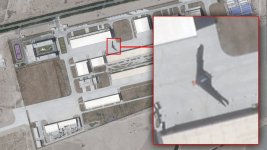
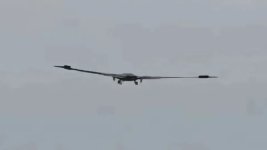
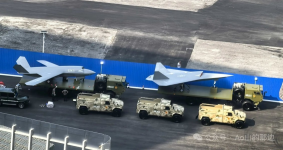

iblini
Trusted Member

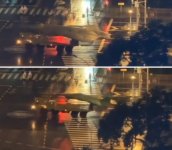
The first one on the right is the bottom one in the below pic?
Michael
VIP Member
Maybe......
I don’t know!
yusheng
Registered Member
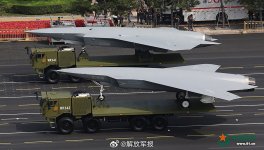
Our nation ( China )has built a combat machine unlike any other in human history.
Equipped with an afterburning high-thrust engine, a standard internal weapons bay, supersonic flight capability, and air-to-air combat prowess, this unmanned intelligent fighter is a marvel of modern warfare.
Previously, American and French fighter pilots still harbored illusions of challenging the J-36, attempting to close in for dogfights within visual range, as they continued to view aerial combat as a battle between humans.
But in the face of today's unmanned air dominance aircraft, the entire history of human aerial warfare, the art of air combat, and the concept of the knight of the sky have all become meaningless—turned into a closed chapter.
This machine is utterly stealthy and invisible, possesses absolute situational awareness, and far surpasses human limits in withstanding G-forces. Moreover, its consciousness can be infinitely replicated and upgraded.
A human, even with thousands of hours of combat experience, iron will, and unwavering faith, can only die once.
This machine is indifferent to life and death—every "death" only makes it stronger.
This is not an opponent that humans can challenge.
from: https://weibo.com/u/1601173705
yusheng
Registered Member
The aerial drones displayed by China during its military parade and the US Air Force's Collaborative Combat Aircraft (CCA) program represent the pinnacle of current global drone technology. However, they exhibit significant differences in design philosophy, technical characteristics, and intended operational applications. Below is a detailed comparison across various dimensions.
 Design Philosophy & Role
The Chinese drones reflect a "high-end air dominance" philosophy. They are designed to be UCAVs capable of independently or collaboratively conducting air superiority missions alongside manned fighters, and even performing deep strike tasks. This aligns them more closely with traditional fighter roles.
The US CCA program is fundamentally centered on "collaboration" and "empowerment". It acts as an extension of manned aircraft (like the F-35 or NGAD), serving as their "eyes" and "magazine." Its core functions are to extend the sensing range (external sensor) and weapon engagement range (external weapons bay) of the human pilot. The US Air Force explicitly categorizes them as "attritable" (expendable), prioritizing scalable numbers at a controllable cost.
 Aerodynamic Design & Stealth
The Chinese drones feature highly advanced aerodynamic design:
 Propulsion & Performance
 Mission Capability & Autonomy
 Program Status & Cost
In essence, the Chinese aerial drones and the US CCA represent two divergent paths in advanced drone development:
| Design Philosophy & Role | High-end Unmanned Combat Aerial Vehicle (UCAV), emphasizes independent/collaborative air dominance, multi-role capable. | "Loyal Wingman", acts as a force multiplier for manned aircraft (sensor & weapons node). |
| Size & Weight | Large (~10-ton class) | Medium-Small (YFQ-44A ~2.2 tons, XQ-67A ~8 tons) |
| Design & Stealth | All-aspect stealth, tailless, diamond/Lambda wing design. | Emphasis on forward-sector stealth, most retain tails (e.g., V-tail on YFQ-42A). |
| Propulsion & Performance | Presumed medium-thrust turbofan (e.g., WS-13/19), emphasis on supersonic/high-speed performance. | Mostly use commercial turbofans (e.g., FJ44), focus on subsonic speed and endurance (e.g., XQ-67A ~4000km range). |
| Mission Capability | Multi-role (air dominance, strike, reconnaissance, electronic warfare). | Current focus on ISR (Intelligence, Surveillance, Reconnaissance) and limited strike. |
| AI & Autonomy | Emphasis on high-end autonomous air combat capabilities. | Human-supervised autonomy, enabled by systems like Skyborg. |
| Status & Deployment | Identified as in active service. | Prototype testing/demonstration phase (YFQ-42A first flight Aug 2025), initial deployment planned for 2028. |
| Cost & Scale | No explicit low-cost claim; presumed higher unit cost. | Explicitly强调 low-cost (target $25-30M per unit), plans for mass procurement (1000+ units). |
Design Philosophy & RoleThe Chinese drones reflect a "high-end air dominance" philosophy. They are designed to be UCAVs capable of independently or collaboratively conducting air superiority missions alongside manned fighters, and even performing deep strike tasks. This aligns them more closely with traditional fighter roles.
The US CCA program is fundamentally centered on "collaboration" and "empowerment". It acts as an extension of manned aircraft (like the F-35 or NGAD), serving as their "eyes" and "magazine." Its core functions are to extend the sensing range (external sensor) and weapon engagement range (external weapons bay) of the human pilot. The US Air Force explicitly categorizes them as "attritable" (expendable), prioritizing scalable numbers at a controllable cost.
Aerodynamic Design & StealthThe Chinese drones feature highly advanced aerodynamic design:
- Tailless + Diamond/Lambda Wing: Removing vertical tails significantly reduces the Radar Cross-Section (RCS) from the side, achieving all-aspect stealth. The wing design is conducive to supersonic flight.
- DSI/CARET Intakes: Details like the Electro-Optical Targeting System (EOTS) under the nose and DSI intakes indicate a pursuit of extreme stealth and high-speed performance.
- Emphasis on Forward-Sector Stealth: Their shaping (e.g., sawtoothed inlets and fuselage design on the YFQ-42A) is primarily optimized against head-on radar waves, sufficient for penetrating enemy air defenses.
- Most Retain Tails: Most models (e.g., YFQ-42A) retain tail surfaces like V-tails. This aids flight stability and control efficiency, especially at subsonic speeds, but involves some compromise for all-aspect stealth.
Propulsion & Performance- Chinese Drones: Their large (~10-ton) size suggests the need for medium-thrust turbofan engines (e.g., WS-13 or a future WS-19). This propulsion could provide the potential for supersonic cruise and high maneuverability, necessary for intense air combat.
- US CCA: Current models largely use commercial turbofan engines derived from business jets (e.g., Williams FJ44). This grants them good endurance (e.g., the XQ-67A claims a 4000 km range) but limits their speed primarily to high subsonic regimes. Maneuverability is not a primary design driver.
Mission Capability & Autonomy- Chinese Drones: Their large size and high-end configuration enable multi-role capabilities, including air dominance, strike (air/land/sea), reconnaissance, and electronic warfare.
- US CCA (Current Phase): The initial focus is more heavily weighted towards Intelligence, Surveillance, and Reconnaissance (ISR) and limited strike missions (e.g., stand-off missile launch). Their role as a "missile truck" is more pronounced.
- China: Their drones would require a higher degree of autonomous air combat decision-making to cope with highly dynamic aerial engagements.
- US: The core AI for CCA (e.g., the Skyborg program) currently emphasizes autonomous teaming, target identification, and data fusion under human supervision. Higher-level kill decisions are still intended to be made by the human pilot.
Program Status & Cost- China: Equipment displayed in parades is officially described as "active service, main combat equipment," indicating they have at least entered initial operational service.
- US: The CCA program is still in the prototype flight test and demonstration phase (the YFQ-42A just had its first flight on August 27, 2025). Initial deployment (Increment 1) is expected around 2028.
- A core US Air Force requirement for CCA is low cost, targeting a unit price of $25-30 million, with plans to procure over 1000 units to achieve mass.
- China's large air dominance drones, due to their larger size, more complex structures, and pursuit of higher performance, likely have a significantly higher unit cost than the US CCA.
 Summary
In essence, the Chinese aerial drones and the US CCA represent two divergent paths in advanced drone development:- The Chinese drones are akin to "unmanned fighter jets," pursuing high performance and comprehensive air combat capabilities to create high-end aerial nodes.
- The US CCA is positioned as a "collaborative sensor/shooter," emphasizing low cost, attritability, and mass to multiply the combat power of manned platforms through networked teamwork.
iblini
Trusted Member
The TWZ Newsletter
The massive military parade in Beijing yesterday has provided us with a much closer look at some of the country’s new air combat drone initiatives, the gradual emergence of which, in the run-up to the event, prompted much discussion. Of these various drone designs, one, in particular, stands out. This is a low-observable tailless design that is also very large, broadly equivalent in size to China’s J-10 medium-weight fighter. Overall, its design is indicative of high performance, pointing firmly to a true uncrewed stealth fighter, while its appearance suggests that it may well already be flyable — or is otherwise a very authentic mock-up.
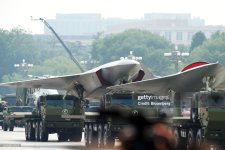
The airborne unmanned warfare formation marches through Tian'anmen Square during a military parade in Beijing, capital of China, Sept. 3, 2025. China on Wednesday held a grand gathering to commemorate the 80th anniversary of the victory in the Chinese People's War of Resistance against Japanese Aggression and the World Anti-Fascist War. (Photo by Chen Bin/Xinhua via Getty Images)
The new fighter-type UCAV seen on parade in Tian’anmen Square, Beijing, on September 3, 2025. Photo by Chen Bin/Xinhua via Getty Images Xinhua News Agency
While the designation of the new drone remains unknown, there have been claims that it is provisionally named Unmanned Air Superiority Fighter. Meanwhile, for the sake of clarity, China-watchers have taken to referring to this design as the Type B drone.
The drone in question was shown among other uncrewed designs on the back of a flatbed truck during the September 3 parade marking the 80th anniversary of China’s victory over Japan in World War II. Seen now in full, and uncovered, the drone is significantly bigger than the other previously unknown designs that had been seen ahead of the parade, in satellite imagery and covered with tarpaulins during rehearsals.
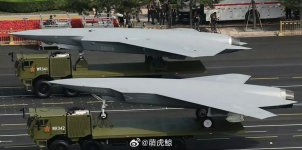
Collectively, the various new drone designs — at least five in total — were widely considered to be something akin to Chinese equivalents of the U.S. Air Force’s Collaborative Combat Aircraft (CCA). The Type B, however, has all the hallmarks of a higher-performance fighter-like uncrewed combat air vehicle (UCAV), of a kind that the U.S. Air Force is notably not developing — at least, in the unclassified realm.
The new UCAV-like Type B drone is tailless with a modified delta wing. The wing is broadly diamond-shaped, with cropped tips. There are two large control surfaces evident on each wing’s trailing edge. The nose has a very distinct chine that extends back to the side-mounted engine intakes before merging with the wing leading edge. The side intakes are in contrast to those found on at least some of the other newly emerged Chinese drone designs, which are mounted on top of the fuselage. These forward-raked, diverterless supersonic intakes (DSI) have much in common with those found on new-generation crewed fighter designs, outright pointing to supersonic performance. The intakes feed a single engine, with the variable-geometry nozzle (presumably for an afterburning engine) projecting beyond the wing trailing edge. The nozzle is serrated, including both the outer sleeve and actual nozzle, like on the F-35 and new Chinese fighter designs. Pointed extensions of the trailing edge, again F-35-style, are found on either side of the engine nozzle.
Besides performance, the other major driver is low observability. As for the exposed, round engine nozzle, which would adversely affect this, at least from the rear aspect, this is a known practice for stealth fighter designs, the result of a tradeoff between performance, complexity, weight, affordability, and low observability. The serrations on the nozzle help with the radar signature in certain radar bands. It could also be the case that this is an early iteration, and a stealthier, two-dimensional engine nozzle, possibly with thrust vectoring, will appear on the Type B in due course. This would parallel the development of Russia’s S-70 Okhotnik UCAV, and the Chinese GJ-11 Sharp Sword also underwent a redesign that left it with enhanced low-observable features.
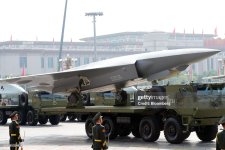
To preserve its low observability, there are signs that the Type B drone has extensive internal capacity for weapons. Underside views of the drone suggest large weapons bays below its fuselage.
The underside of the Type B drone appears to include plenty of space for internal weapons. Photo by Zhao Wenyu/China News Service/VCG via Getty Images
Interrupting what is otherwise an overall smooth profile, the Type B drone also has a prominent chin-mounted electro-optical sensor, likely analogous to the F-35’s Electro-Optical Targeting System (EOTS). Similar kinds of fairings also appear on the Chinese J-20 and J-35 stealth jets and further point to this drone being intended for fighter-style missions.
To be continued in the original article....
The massive military parade in Beijing yesterday has provided us with a much closer look at some of the country’s new air combat drone initiatives, the gradual emergence of which, in the run-up to the event, prompted much discussion. Of these various drone designs, one, in particular, stands out. This is a low-observable tailless design that is also very large, broadly equivalent in size to China’s J-10 medium-weight fighter. Overall, its design is indicative of high performance, pointing firmly to a true uncrewed stealth fighter, while its appearance suggests that it may well already be flyable — or is otherwise a very authentic mock-up.
The airborne unmanned warfare formation marches through Tian'anmen Square during a military parade in Beijing, capital of China, Sept. 3, 2025. China on Wednesday held a grand gathering to commemorate the 80th anniversary of the victory in the Chinese People's War of Resistance against Japanese Aggression and the World Anti-Fascist War. (Photo by Chen Bin/Xinhua via Getty Images)
The new fighter-type UCAV seen on parade in Tian’anmen Square, Beijing, on September 3, 2025. Photo by Chen Bin/Xinhua via Getty Images Xinhua News Agency
While the designation of the new drone remains unknown, there have been claims that it is provisionally named Unmanned Air Superiority Fighter. Meanwhile, for the sake of clarity, China-watchers have taken to referring to this design as the Type B drone.
The drone in question was shown among other uncrewed designs on the back of a flatbed truck during the September 3 parade marking the 80th anniversary of China’s victory over Japan in World War II. Seen now in full, and uncovered, the drone is significantly bigger than the other previously unknown designs that had been seen ahead of the parade, in satellite imagery and covered with tarpaulins during rehearsals.
Collectively, the various new drone designs — at least five in total — were widely considered to be something akin to Chinese equivalents of the U.S. Air Force’s Collaborative Combat Aircraft (CCA). The Type B, however, has all the hallmarks of a higher-performance fighter-like uncrewed combat air vehicle (UCAV), of a kind that the U.S. Air Force is notably not developing — at least, in the unclassified realm.
The new UCAV-like Type B drone is tailless with a modified delta wing. The wing is broadly diamond-shaped, with cropped tips. There are two large control surfaces evident on each wing’s trailing edge. The nose has a very distinct chine that extends back to the side-mounted engine intakes before merging with the wing leading edge. The side intakes are in contrast to those found on at least some of the other newly emerged Chinese drone designs, which are mounted on top of the fuselage. These forward-raked, diverterless supersonic intakes (DSI) have much in common with those found on new-generation crewed fighter designs, outright pointing to supersonic performance. The intakes feed a single engine, with the variable-geometry nozzle (presumably for an afterburning engine) projecting beyond the wing trailing edge. The nozzle is serrated, including both the outer sleeve and actual nozzle, like on the F-35 and new Chinese fighter designs. Pointed extensions of the trailing edge, again F-35-style, are found on either side of the engine nozzle.
Besides performance, the other major driver is low observability. As for the exposed, round engine nozzle, which would adversely affect this, at least from the rear aspect, this is a known practice for stealth fighter designs, the result of a tradeoff between performance, complexity, weight, affordability, and low observability. The serrations on the nozzle help with the radar signature in certain radar bands. It could also be the case that this is an early iteration, and a stealthier, two-dimensional engine nozzle, possibly with thrust vectoring, will appear on the Type B in due course. This would parallel the development of Russia’s S-70 Okhotnik UCAV, and the Chinese GJ-11 Sharp Sword also underwent a redesign that left it with enhanced low-observable features.
To preserve its low observability, there are signs that the Type B drone has extensive internal capacity for weapons. Underside views of the drone suggest large weapons bays below its fuselage.
The underside of the Type B drone appears to include plenty of space for internal weapons. Photo by Zhao Wenyu/China News Service/VCG via Getty Images
Interrupting what is otherwise an overall smooth profile, the Type B drone also has a prominent chin-mounted electro-optical sensor, likely analogous to the F-35’s Electro-Optical Targeting System (EOTS). Similar kinds of fairings also appear on the Chinese J-20 and J-35 stealth jets and further point to this drone being intended for fighter-style missions.
To be continued in the original article....
iblini
Trusted Member
It's easily notable that both design resemble SAC J-50 and CAC J-36, lambda and delta wing, it is a clear sign that these are part of China's next gen air combat eco system from both manufacture, and we don't know how much will it evolve when both the manned jets enter service.
I'll say this is one of the most important system displayed during the parade.
I'll say this is one of the most important system displayed during the parade.
The aerial drones displayed by China during its military parade and the US Air Force's Collaborative Combat Aircraft (CCA) program represent the pinnacle of current global drone technology. However, they exhibit significant differences in design philosophy, technical characteristics, and intended operational applications. Below is a detailed comparison across various dimensions.
Design Philosophy & Role High-end Unmanned Combat Aerial Vehicle (UCAV), emphasizes independent/collaborative air dominance, multi-role capable. "Loyal Wingman", acts as a force multiplier for manned aircraft (sensor & weapons node). Size & Weight Large (~10-ton class) Medium-Small (YFQ-44A ~2.2 tons, XQ-67A ~8 tons) Design & Stealth All-aspect stealth, tailless, diamond/Lambda wing design. Emphasis on forward-sector stealth, most retain tails (e.g., V-tail on YFQ-42A). Propulsion & Performance Presumed medium-thrust turbofan (e.g., WS-13/19), emphasis on supersonic/high-speed performance. Mostly use commercial turbofans (e.g., FJ44), focus on subsonic speed and endurance (e.g., XQ-67A ~4000km range). Mission Capability Multi-role (air dominance, strike, reconnaissance, electronic warfare). Current focus on ISR (Intelligence, Surveillance, Reconnaissance) and limited strike. AI & Autonomy Emphasis on high-end autonomous air combat capabilities. Human-supervised autonomy, enabled by systems like Skyborg. Status & Deployment Identified as in active service. Prototype testing/demonstration phase (YFQ-42A first flight Aug 2025), initial deployment planned for 2028. Cost & Scale No explicit low-cost claim; presumed higher unit cost. Explicitly强调 low-cost (target $25-30M per unit), plans for mass procurement (1000+ units).
The Chinese drones reflect a "high-end air dominance" philosophy. They are designed to be UCAVs capable of independently or collaboratively conducting air superiority missions alongside manned fighters, and even performing deep strike tasks. This aligns them more closely with traditional fighter roles.
The US CCA program is fundamentally centered on "collaboration" and "empowerment". It acts as an extension of manned aircraft (like the F-35 or NGAD), serving as their "eyes" and "magazine." Its core functions are to extend the sensing range (external sensor) and weapon engagement range (external weapons bay) of the human pilot. The US Air Force explicitly categorizes them as "attritable" (expendable), prioritizing scalable numbers at a controllable cost.
The Chinese drones feature highly advanced aerodynamic design:
Current US CCA designs show a more pragmatic stealth approach:
- Tailless + Diamond/Lambda Wing: Removing vertical tails significantly reduces the Radar Cross-Section (RCS) from the side, achieving all-aspect stealth. The wing design is conducive to supersonic flight.
- DSI/CARET Intakes: Details like the Electro-Optical Targeting System (EOTS) under the nose and DSI intakes indicate a pursuit of extreme stealth and high-speed performance.
- Emphasis on Forward-Sector Stealth: Their shaping (e.g., sawtoothed inlets and fuselage design on the YFQ-42A) is primarily optimized against head-on radar waves, sufficient for penetrating enemy air defenses.
- Most Retain Tails: Most models (e.g., YFQ-42A) retain tail surfaces like V-tails. This aids flight stability and control efficiency, especially at subsonic speeds, but involves some compromise for all-aspect stealth.
- Chinese Drones: Their large (~10-ton) size suggests the need for medium-thrust turbofan engines (e.g., WS-13 or a future WS-19). This propulsion could provide the potential for supersonic cruise and high maneuverability, necessary for intense air combat.
- US CCA: Current models largely use commercial turbofan engines derived from business jets (e.g., Williams FJ44). This grants them good endurance (e.g., the XQ-67A claims a 4000 km range) but limits their speed primarily to high subsonic regimes. Maneuverability is not a primary design driver.
Regarding AI and Autonomy, both heavily rely on Artificial Intelligence:
- Chinese Drones: Their large size and high-end configuration enable multi-role capabilities, including air dominance, strike (air/land/sea), reconnaissance, and electronic warfare.
- US CCA (Current Phase): The initial focus is more heavily weighted towards Intelligence, Surveillance, and Reconnaissance (ISR) and limited strike missions (e.g., stand-off missile launch). Their role as a "missile truck" is more pronounced.
- China: Their drones would require a higher degree of autonomous air combat decision-making to cope with highly dynamic aerial engagements.
- US: The core AI for CCA (e.g., the Skyborg program) currently emphasizes autonomous teaming, target identification, and data fusion under human supervision. Higher-level kill decisions are still intended to be made by the human pilot.
Cost is one of the most striking differences:
- China: Equipment displayed in parades is officially described as "active service, main combat equipment," indicating they have at least entered initial operational service.
- US: The CCA program is still in the prototype flight test and demonstration phase (the YFQ-42A just had its first flight on August 27, 2025). Initial deployment (Increment 1) is expected around 2028.
- A core US Air Force requirement for CCA is low cost, targeting a unit price of $25-30 million, with plans to procure over 1000 units to achieve mass.
- China's large air dominance drones, due to their larger size, more complex structures, and pursuit of higher performance, likely have a significantly higher unit cost than the US CCA.
In essence, the Chinese aerial drones and the US CCA represent two divergent paths in advanced drone development:
There is no absolute superiority between these paths; they largely reflect choices based on differing military strategies, operational concepts, and industrial bases.
- The Chinese drones are akin to "unmanned fighter jets," pursuing high performance and comprehensive air combat capabilities to create high-end aerial nodes.
- The US CCA is positioned as a "collaborative sensor/shooter," emphasizing low cost, attritability, and mass to multiply the combat power of manned platforms through networked teamwork.
Can we please stop spreading AI-generated nonsense!??
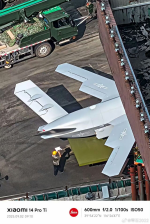
By the way, unfortunately this CCA wasn‘t shown yesterday, but here is at least a clearer image of the rear section.
RajaBaja
Trusted Member
The TWZ Newsletter
The massive military parade in Beijing yesterday has provided us with a much closer look at some of the country’s new air combat drone initiatives, the gradual emergence of which, in the run-up to the event, prompted much discussion. Of these various drone designs, one, in particular, stands out. This is a low-observable tailless design that is also very large, broadly equivalent in size to China’s J-10 medium-weight fighter. Overall, its design is indicative of high performance, pointing firmly to a true uncrewed stealth fighter, while its appearance suggests that it may well already be flyable — or is otherwise a very authentic mock-up.
The airborne unmanned warfare formation marches through Tian'anmen Square during a military parade in Beijing, capital of China, Sept. 3, 2025. China on Wednesday held a grand gathering to commemorate the 80th anniversary of the victory in the Chinese People's War of Resistance against Japanese Aggression and the World Anti-Fascist War. (Photo by Chen Bin/Xinhua via Getty Images)
The new fighter-type UCAV seen on parade in Tian’anmen Square, Beijing, on September 3, 2025. Photo by Chen Bin/Xinhua via Getty Images Xinhua News Agency
While the designation of the new drone remains unknown, there have been claims that it is provisionally named Unmanned Air Superiority Fighter. Meanwhile, for the sake of clarity, China-watchers have taken to referring to this design as the Type B drone.
The drone in question was shown among other uncrewed designs on the back of a flatbed truck during the September 3 parade marking the 80th anniversary of China’s victory over Japan in World War II. Seen now in full, and uncovered, the drone is significantly bigger than the other previously unknown designs that had been seen ahead of the parade, in satellite imagery and covered with tarpaulins during rehearsals.
View attachment 144614
Collectively, the various new drone designs — at least five in total — were widely considered to be something akin to Chinese equivalents of the U.S. Air Force’s Collaborative Combat Aircraft (CCA). The Type B, however, has all the hallmarks of a higher-performance fighter-like uncrewed combat air vehicle (UCAV), of a kind that the U.S. Air Force is notably not developing — at least, in the unclassified realm.
The new UCAV-like Type B drone is tailless with a modified delta wing. The wing is broadly diamond-shaped, with cropped tips. There are two large control surfaces evident on each wing’s trailing edge. The nose has a very distinct chine that extends back to the side-mounted engine intakes before merging with the wing leading edge. The side intakes are in contrast to those found on at least some of the other newly emerged Chinese drone designs, which are mounted on top of the fuselage. These forward-raked, diverterless supersonic intakes (DSI) have much in common with those found on new-generation crewed fighter designs, outright pointing to supersonic performance. The intakes feed a single engine, with the variable-geometry nozzle (presumably for an afterburning engine) projecting beyond the wing trailing edge. The nozzle is serrated, including both the outer sleeve and actual nozzle, like on the F-35 and new Chinese fighter designs. Pointed extensions of the trailing edge, again F-35-style, are found on either side of the engine nozzle.
View attachment 144615
Besides performance, the other major driver is low observability. As for the exposed, round engine nozzle, which would adversely affect this, at least from the rear aspect, this is a known practice for stealth fighter designs, the result of a tradeoff between performance, complexity, weight, affordability, and low observability. The serrations on the nozzle help with the radar signature in certain radar bands. It could also be the case that this is an early iteration, and a stealthier, two-dimensional engine nozzle, possibly with thrust vectoring, will appear on the Type B in due course. This would parallel the development of Russia’s S-70 Okhotnik UCAV, and the Chinese GJ-11 Sharp Sword also underwent a redesign that left it with enhanced low-observable features.
To preserve its low observability, there are signs that the Type B drone has extensive internal capacity for weapons. Underside views of the drone suggest large weapons bays below its fuselage.
The underside of the Type B drone appears to include plenty of space for internal weapons. Photo by Zhao Wenyu/China News Service/VCG via Getty Images
Interrupting what is otherwise an overall smooth profile, the Type B drone also has a prominent chin-mounted electro-optical sensor, likely analogous to the F-35’s Electro-Optical Targeting System (EOTS). Similar kinds of fairings also appear on the Chinese J-20 and J-35 stealth jets and further point to this drone being intended for fighter-style missions.
View attachment 144616
To be continued in the original article....
One of these 5th gen stealthy drones should become Pakistan's PFX manned jet! PFX is the next evolution of the JF-17 project. We'll save millions of dollars and years of time because China has already done R&D on these platforms and they exist now. Perfect way to jump from JF-17 block III straight to single engine 5th gen stealthy aircrafts with J-35 forming the hi.

Mighty_Dragon_Strike
Banned
The TWZ Newsletter
The massive military parade in Beijing yesterday has provided us with a much closer look at some of the country’s new air combat drone initiatives, the gradual emergence of which, in the run-up to the event, prompted much discussion. Of these various drone designs, one, in particular, stands out. This is a low-observable tailless design that is also very large, broadly equivalent in size to China’s J-10 medium-weight fighter. Overall, its design is indicative of high performance, pointing firmly to a true uncrewed stealth fighter, while its appearance suggests that it may well already be flyable — or is otherwise a very authentic mock-up.
The airborne unmanned warfare formation marches through Tian'anmen Square during a military parade in Beijing, capital of China, Sept. 3, 2025. China on Wednesday held a grand gathering to commemorate the 80th anniversary of the victory in the Chinese People's War of Resistance against Japanese Aggression and the World Anti-Fascist War. (Photo by Chen Bin/Xinhua via Getty Images)
The new fighter-type UCAV seen on parade in Tian’anmen Square, Beijing, on September 3, 2025. Photo by Chen Bin/Xinhua via Getty Images Xinhua News Agency
While the designation of the new drone remains unknown, there have been claims that it is provisionally named Unmanned Air Superiority Fighter. Meanwhile, for the sake of clarity, China-watchers have taken to referring to this design as the Type B drone.
The drone in question was shown among other uncrewed designs on the back of a flatbed truck during the September 3 parade marking the 80th anniversary of China’s victory over Japan in World War II. Seen now in full, and uncovered, the drone is significantly bigger than the other previously unknown designs that had been seen ahead of the parade, in satellite imagery and covered with tarpaulins during rehearsals.
View attachment 144614
Collectively, the various new drone designs — at least five in total — were widely considered to be something akin to Chinese equivalents of the U.S. Air Force’s Collaborative Combat Aircraft (CCA). The Type B, however, has all the hallmarks of a higher-performance fighter-like uncrewed combat air vehicle (UCAV), of a kind that the U.S. Air Force is notably not developing — at least, in the unclassified realm.
The new UCAV-like Type B drone is tailless with a modified delta wing. The wing is broadly diamond-shaped, with cropped tips. There are two large control surfaces evident on each wing’s trailing edge. The nose has a very distinct chine that extends back to the side-mounted engine intakes before merging with the wing leading edge. The side intakes are in contrast to those found on at least some of the other newly emerged Chinese drone designs, which are mounted on top of the fuselage. These forward-raked, diverterless supersonic intakes (DSI) have much in common with those found on new-generation crewed fighter designs, outright pointing to supersonic performance. The intakes feed a single engine, with the variable-geometry nozzle (presumably for an afterburning engine) projecting beyond the wing trailing edge. The nozzle is serrated, including both the outer sleeve and actual nozzle, like on the F-35 and new Chinese fighter designs. Pointed extensions of the trailing edge, again F-35-style, are found on either side of the engine nozzle.
View attachment 144615
Besides performance, the other major driver is low observability. As for the exposed, round engine nozzle, which would adversely affect this, at least from the rear aspect, this is a known practice for stealth fighter designs, the result of a tradeoff between performance, complexity, weight, affordability, and low observability. The serrations on the nozzle help with the radar signature in certain radar bands. It could also be the case that this is an early iteration, and a stealthier, two-dimensional engine nozzle, possibly with thrust vectoring, will appear on the Type B in due course. This would parallel the development of Russia’s S-70 Okhotnik UCAV, and the Chinese GJ-11 Sharp Sword also underwent a redesign that left it with enhanced low-observable features.
To preserve its low observability, there are signs that the Type B drone has extensive internal capacity for weapons. Underside views of the drone suggest large weapons bays below its fuselage.
The underside of the Type B drone appears to include plenty of space for internal weapons. Photo by Zhao Wenyu/China News Service/VCG via Getty Images
Interrupting what is otherwise an overall smooth profile, the Type B drone also has a prominent chin-mounted electro-optical sensor, likely analogous to the F-35’s Electro-Optical Targeting System (EOTS). Similar kinds of fairings also appear on the Chinese J-20 and J-35 stealth jets and further point to this drone being intended for fighter-style missions.
View attachment 144616
To be continued in the original article....
this size/dimension also mean, it can be mass produced quickly!
Users who are viewing this thread
Total: 1 (members: 0, guests: 1)
Pakistan Defence Latest


Country Watch Latest
-
 Iran - Israel/US War: Israel-US declare war on Iran, Iran responds (104 Viewers)
- Latest: Zhuge Liang
-

-
-
TF-X / KAAN / Hürjet Turkish Fighter & Trainer Aircrafts News & Discussions (4 Viewers)
- Latest: hyperman
Latest Posts
-
Iran - Israel/US War: Israel-US declare war on Iran, Iran responds (104 Viewers)
- Latest: Zhuge Liang
-
India Emerges as key diesel supplier to Turkiye amid Russia Middle East disruptions (5 Viewers)
- Latest: r3alist
-
 Makkah Defence Alliance: Turkey, Saudi Arabia, and Pakistan, news & updates (10 Viewers)
- Latest: RocketLaw
-
-
"Roses Are Red, Violets Are Blue, & Polar Vortex Is Coming For You" (3 Viewers)
- Latest: Davey Crockett