Civil Protection in War Time

Status
Not open for further replies.

RescueRanger

Meme Lord
Joined
Sep 20, 2008
Messages
33,385
Reaction score
77,517
Reputation
35,346.9
Country of Origin
Country of Residence
--
For all Pakistani Members
--
Before you begin reading this guide - remember that please stay tuned to a local radio to TV channel for regular updates from NDMA and NCMC - your local emergency services such as police and ambulance/fire/rescue (1122) will operate as normal - should you live in an area that is subject to an evacuation order your local civil defence and police will assist you in evacuation to nearby shelters or temporary camps.

Kindly cooperate with emergency services and your local and provincial government.
--
  1. Emergency Plan
  2. Emergency Grab Bag
  3. Emergency First Aid
  4. Public Warning System
  5. Steps to take when you hear the siren
  6. Steps to take if you are NOT at home
  7. Preventing Damage
  8. Blackout Procedures
  9. Navigating Check posts
  10. Avoiding Crush Injuries
  11. UXOs/Suspect Devices
  12. Chemical Threats
  13. Shelter In-Place
  14. Decon Procedures
 
Source:
Self
Last edited:
Emergency Plan
One of the most important tools you and your family can have to protect yourself in possible emergencies is a family emergency plan.

It is important that you plan ahead as a family for all types of emergencies and responses. Everyone in the family should understand what to do, where to go and what to take in the event of an emergency.

Be Informed
• Find out what disasters are most likely to happen in your area and the history of their occurrence.
• Stay informed of any specific instructions or information you may need to know regarding these specific disasters.

Establish an Evacuation Procedure
• Know your installation’s evacuation plan.
• As a family, discuss where you will go in the event of an emergency.
• Discuss where your children will go if they are in school at the time of the emergency, and make sure they understand where you will intend to be.
• Be aware that in the event of an emergency, phone lines and cell phone towers may be out. It may be necessary to have a contingency plan for reaching each other. Consider using text messaging if normal communication options are not available.
• Plan how you will evacuate family members with special needs.• Include pets in your family plan. Develop a Family Communications Procedure
• Develop a comprehensive procedure as a family for communicating in the event that you are separated during an emergency.
• Create a sheet or card with all the phone numbers and information every individual in the family may need, including an in-case-of-emergency (ICE) name and number.
• Make sure every member of the family has a copy of the communications procedure.
• Save the ICE information in everyone’s cell phone.
• Be aware that in the event of an emergency, phone lines and cell phone towers may be out. It may be necessary to have a contingency plan for reaching each other.

Practice Your Plan
• Set up practice evacuations or shelter-in-place drills for your family to ensure everyone knows what to do and where to go in the event of an emergency.
• Keep your emergency supply kit up to date, replacing water and perishables periodically. Make sure everyone knows where it is and to take it when sheltering or evacuating.
• Check your smoke alarms regularly.
 
Last edited:
Emergency Grab Bag
If you need to evacuate your home at short notice or need to survive for a length of time without supplies.

Why is this important you say?

A theoretical study in the UK 'Life without lorries‘ study (McKinnon, 2006), considered the effects of a complete shut-down of road haulage in the UK for 1 week, In the study, there was insufficient time for retailers to switch from centralised systems to local sources , so rationing of some foods was necessary after three days. It also found that supplies to many hospitals would break down within 1 day.

In the event of a major incident, whether it is a result of a natural or man-made disaster, the authorities may become overwhelmed with the scale of the response. During these times, the emergency services will not be able to respond to the immediate needs of everyone. Response times could stretch from minutes to hours or it may be days before help arrives.

It is, therefore, vital that you can support yourself and your family for at least three days in the event of a major incident. In 2010/2011, severe flooding in Pakistan left thousands of people without power and clean water supplies for many weeks.

Employers and Businesses alike should plan to support their guests and staff in these situations. In short, plan to be self-sufficient for at least three days in the aftermath of a disaster. You may need to survive, in adverse weather, without electric power, heat, gas or communication for 72 hours or longer.

Contents of a Emergency Grab Bag:

First thing’s first, no amount of fancy equipment will aid you unless you have a clearly laid out plan – Make a plan – Laminate it and keep a copy of the plan in your grab bag. (Be sure to test your plan, regularly, get everyone involved and turn it into a family game).

When considering preparing an emergency kit, you need to break down the items you will need into specific categories, these are:

  • Communication
  • Food & Water
  • Medical & Hygiene
  • Tools
  • Shelter & Good to have.

Communication:
  • Plan: Keep a copy of your plan in your grab bag and make sure that if you are making mini grab bags for your family members, these bags have a copy of the plan. Make sure everyone in your family know the plan.
  • Map: Keep a map of your local area, nowadays google maps can print highly detailed street maps of Pakistani cities which can be laminated and placed in your bag.
  • Photographs: Keep photographs of yourself and your family members and place their names on the back of the photographs. (You can show these to emergency workers and others in the area if you get separated).
  • Insulation tape: This is a cheap bit of kit that comes in many colours and can be used to mark rendezvous points. Assign a colour to each family member for example blue for yourself and red for your wife, and green for your child. Always plan to have 3 or more rendezvous points if you become separated, if one of you arrive at that location first and have to move on due to an emergency or other untoward situation stick a strip of your colour coded insulation tape on the door/wall/ tree/ prominent place to say you were here and have moved on to location 2.
Spare phone: It is always a good idea to keep a cheap dependable phone in your grab bag, in case your primary phone becomes lost or damaged. Always write the phone number on the back of the phone cover and make sure all primary and secondary phone numbers are placed on your family plan.

A good dependable option is the Nokia 1100 true to its name retails for about 1000/1100 rupees and is rugged and will easily provide you with 72 hours battery time or standby. Always keep a spare battery and make sure that this is charged (wrap in plastic to avoid discharge).

Out of city contact: In the event of a major disaster or emergency, the local cellular or fixed line networks may become congested due to traffic volume, however it would still be possible to contact people in other parts of the country who may be unaffected by network congestion. In this case it is a good idea to keep an out of city contact (or 2) on your plan. You can contact them and let them know of your condition, location and current situation.

Pens, Markers, Chalk, notepads and a (can of spray paint in orange or red) : The need for pens and notepads should be self-explanatory should you need to note down important information or pass information to someone, the SPRAY PAINT CAN may be used to spray HELP, SOS or WARN others. Orange is a high visibility colour is better than darker colours.

Whistle: The saying “Old is gold” applies here, one of the oldest methods of alerts or signalling others, and still the most effective. A very good tool if you need to signal someone or get their attention (like a passer-by, rescue boat, ambulance or police officer).

Radio: Most phones now have built in radios – radios are good to keep up to date with news, alerts and weather updates.

A plastic mirror or highly polished reflective metal sheet: This can be used to reflect the light from the sun to get the attention of helicopters or aircraft flying overhead.

Food, Water & Welfare:

Food:
When planning your emergency rations make sure you choose food you will actually eat, but don’t go overboard. The daily calorie intake for men is 2500, 2000 for women and 1400 for children.

Choose non-perishable ready to eat food that is low in salt (avoid dehydration) and high in energy, there are several options available to suit all budgets, for example; you can buy ready made Daal-makhni that you can eat out of the packet for 180 rupees. If you are thrifty, you can make your own ready meal by emptying the contents of an instant noodle packet in a zip lock bag and all you will need to add to have a warm meal is hot water….

Pack some comfort foods like instant coffee, tea bags and milk powder, chocolate and trail mix.

An example of Pakistani made MRE: Meal ready to eat:

10620669_10152764626243594_4718005290184173995_n.jpg


Water: The average person requires 3 litres of water a day to keep well hydrated, storing this much water in a grab bag may become a problem….. So the easier option is to keep a small supply of potable water (1 litre) and have a water purification kit to purify available water in the event of an emergency…

How to source water in an emergency? Water can be sources from many places in the event of sudden emergency, such as roof top and underground water tanks, the boiler of a gas geezer and even the “top tank” of a toilet flush (just remember to bleach it first) :enjoy:

How to purify water? You can purify water by boiling the water, by using available commercial purification products or if you are really desperate you can use household bleach, 3 drops of bleach will purify 1 litre of water.

Medical & Hygiene

First Aid Kit:
There are many commercially available first aid kits in Pakistan, with most starting at 800 rupees and rising, it is always a better idea to build your own kit rather than buy a ready made product.

A simple first aid kit should have the following items:

1x Tweezers

1x Scissors (preferably blunt tip)

6x safety pins

2x sterile eye pads

1x Crepe Bandage 5cm x 4.5cm

2x packets of sterile gauze swabs 5 x 5cm

1x Fabric tape or Micropore tape 1.25cm x 5m

10x Alcohol prep swabs

2x Disposable latex gloves

1x Pack of assorted plasters

1x Pack of analgesic plasters

1x Forehead thermometer / digital thermometer


(Once you have these items you can pack them in a small container like an old purse or even a lunch box).

Personal Medical Needs: Everyone has some form of personal medical need such as prescription glasses, prescription medication etc. If anyone wears glasses in your family, keep a spare set in a protective case in your kit.

Hygiene supplies: Toothbrush, toothpaste, anti bacterial soap (Dettol/Safeguard) , insect repellent, hand sanitizer, paper towels, tissue paper, wash cloth, antiseptic liquid = Dettol, some Vaseline, a small amount of bleach in a secure container, remember, disposable gloves, surgical masks (10 minimum per person), safety goggles (personal needs may vary from person to person and from gender to gender)

Tools
Lighting:
2x flashlights (with extra batteries), candles, and matches (keep them waterproof by placing them in a container such as a 35mm film canister), lighters.

Dust Masks: Different from your surgical face mask, these are made of paper and are very good to protect from dust, sediment and other particulates that may cause breathing difficulties.

Duct Tape: Also known as elephant tape, this is very strong adhesive tape and will secure anything to anything, in fact it is so good it was used fix the broken water tanks at the Fukushima nuclear power plant. Excellent you need to make an emergency shelter and also can be used to sure bandages. Squash the roll by stomping on it to make it easier to pack in your bag.

Multi Tool / Pocket Knife: A knife has many uses and there are many times of knives available, choose a reliable and good blade, a sensible option is a multi-tool which contains a plier, saw, knife and other useful tools and can be picked up for around 500/1500 rupees.

Nylon rope – Good quality rope can be used for a number of emergency situations such as securing objects, making your shelter, making a stretcher or for access. Minimum of 5 meters.

Aluminium foil: This is a very versatile bit of kit and can be used to create a solar oven, an electricity free refrigerator or even used as a signal mirror to signal rescue boats/ helicopters.

Zip Lock Bag: These are cheap resalable bags good for storing almost everything and can also be used as a porta-potty in extreme circumstances.

Shelter
Plastic Sheet:
12 feet by 12 feet plastic sheet (2 millimetres in thickness) – This is very easy to acquire in Pakistan and can be picked up for no more than a couple of hundred rupees, it’s primary use is to help you create a temporary shelter and even help in collecting water or acting as an emergency stretcher.

Good to have (optional goodies)

Sewing Kit:
A good sewing kit is very useful to mend clothes and with some ingenuity, you can also use the needle make a makeshift compass.

A book: Once the chaos passes, this is one bit of your kit that will comfort you and take your mind of things, it can be any kind of book such as a religious or spiritual book or something that gives you comfort.

Your child’s favourite toy or a Board game/Colouring in book: You may wonder, why on earth you would put this in an emergency kit, but you must understand that children cope differently to adults in an emergency and it is vital that they see that parents are in control and things are normal, such little things will keep their mind of matters around them and allow you to engage with them and reassure them.

Once you're done with your kit, pack it in an easy to carry back pack. You can use a large school bag, however a decent quality rucksack can be purchased for about 1500 rupees.

s-l1600.jpg
 
Last edited:
Public Warning System
The PWS is a network of sirens placed by the Civil Defence at strategic points across every tehsil, UC, Town and City to warn the public of imminent threats that may endanger lives and property. The PWS will be used to warn the public of military attacks and disasters
SIGNALHOW IT SOUNDSSITUATIONWHAT DO YOU NEED TO DO
AlarmWailing SirenAn Air Raid or Danger is approachingMove to a CD shelter immediately if available to do so.
All ClearContinuous BlastThe threat is overLeave the Shelter in an Orderly Manner
Important MessagePulsating BlastAn important message will be broadcast on Radio/TVTune into any local/national TV/Radio station

What does a civil defence siren sound like?

To view this content we will need your consent to set third party cookies.
For more detailed information, see our cookies page.
 
Steps to take at home when you hear the siren
1. Turn off all gas and water supplies before heading to the shelter.
2. Bring in your radio, mobile phones/devices*, Ready Bag(s) and items such as water and food for your stay in the shelter. The Grab bags should be pre-packed.
3. Move quickly and calmly into the shelter and close the door.
4. Sit away from the door and walls of the shelter and do not lean on them
5. Tune in to the local free-to-air radio or TV channels using portable radio set or mobile phones/devices for important messages
 
When you are not at home and you hear the siren
1.
Move fast towards your nearest Public Shelter but do not push; if you are in a vehicle, park it at the side of the road, lock up and head for the nearest shelter.
2. Follow directions given by officials and security forces personnel.
3. If you are with your family, move as a unit to avoid anxiety and help the handicapped, children and the aged.
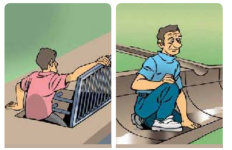
4. If you are unable to reach a shelter you can seek temporary shelter in a tunnel, underpass, basement, ditch or open drain.
1746582095243.png
 
Preventing Damage:
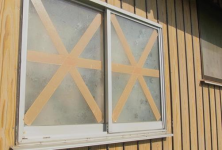
Although we cannot prevent the use of weapons (e.g. bombs and other projectiles) that cause damage during wartime, there are measures we can take to minimise damage to property, such as:
•Reinforcing all glass surfaces with tape to reduce shattering.
•Removing all objects hanging on the walls and sitting on balconies and windowsills.
1746582223826.png
 
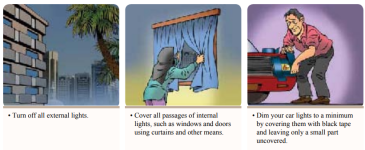
Blackout Measures:
Although blackouts do not prevent enemy air raids or bombings, they can diminish their chances of success by affecting their capacity of determining and identifying targets. In such cases, follow the below instructions:
1746582300254.png
 
Navigating check posts:
When approaching a police check post:

1653344811297.png


  • Slow down
  • Avoid any brusque movements in the car, and keep your hands clearly up and visible.
  • Stop the car a few yards from a barrier, but always keep the engine running unless ordered otherwise.
  • If there is more than one vehicle, the next one keeps a certain distance
  • Take off sunglasses so that people can see your face and eyes
  • Put the window down; just about 2/3” enough for you to pass your id badge if needed.
  • After dark, avoid using High-Beam headlights when approaching check posts
  • After dark turn on the light inside the car cabin so that all passengers are clearly visible
  • Be polite and comply with the officer's questions. No need to get offended and be rude.
 
Avoiding Crush Injuries:
  • If you are caught up in the crowd, stay clear of glass shop fronts, stay on your feet and move with the flow
  • If you are swept along in the crush, create a space for yourself by grasping your wrists and bracing your elbows away from your sides; bend over slightly – this should allow you breathing room
  • If pushed to the ground, try to get against a wall and roll yourself into a tight ball and cover your head with your hands until the crowd passes
  • Remember to keep calm – the crowd should sweep past in a short space of time
  • If there is gun fire, drop to the ground and cover your head and neck, and lie as flat as you can
If possible, move away from any walls, pillars and fences.
1653346855106.png

Figure 1: High pressure zones (in red) during a crowd crush. Always avoid walls/barriers/ corners during a large crowd!
 
Unexploded Ordinance / Suspect Devices and or Items
If you discover a suspicious item or any unexploded ordinance what do you do?
A) inspect it?
B) evacuate and call for help?
If you chose option B, well DONE!
To view this content we will need your consent to set third party cookies.
For more detailed information, see our cookies page.

Slow motion footage of a briefcase bomb explosion generated by 2 oz (57 grams) of military plasticized explosive.

Remember that unlike the movies it takes lengthy training and use of correct PPE and tools such as x-ray, hook, and line etc to safely dispose of UXOs/IEDs. If you cannot identify something, you CANNOT handle it! Simple as that.
  • Vacate the area and inform security/police
  • Do Not use cell phones or CB radios in close proximity to the device
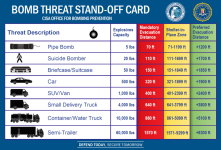
  • Evacuate the area minimum 200 meters, try to get behind a solid building away from any glass or falling hazards and do not return until the police have made the area safe. Terrorists are known to use primary explosions to stage an assault or gather a crowd before detonating a secondary IED.
1746582836768.png
 
Chemical Threats
A chemical agent attack is the deliberate release of hazardous chemical substances to kill, seriously injure or incapacitate people. Numerous chemical agents can be dispersed in an attack via improvised explosive devices, spray devices, military weapons and other means. Such agents include nerve, blister, blood and choking agents.


SIGNS OF A POSSIBLE CHEMICAL AGENT ATTACK

Many people in the same area displaying symptoms such as:
•Watery eyes or dim vision
•Headaches or giddiness
•Shortness of breath
•Dryness of throat, coughing or extreme irritation to the respiratory tract
•Nausea or vomiting
•Salivation
•Chest tightness
•Redness of skin with severe pain and formation of blisters upon contact
•Muscle twitching, seizures or convulsions
Incontinence (inability to control the discharge of faeces or urine)
•Unconsciousness
•Three or more people collapsing for no apparent reason.
•Many sick or dead birds and small animals in the affected area


IN THE EVENT OF A CHEMICAL AGENT ATTACK
If possible, quickly determine the areas affected or where the chemical release is coming from.

If the attack occurs indoors, cover your mouth and nose with a damp cloth (e.g. wet towel) and quickly evacuate the building without passing through the contaminated area(s).

If the attack occurs outdoors and you are in the open, cover your mouth and nose with a cloth and move away from the affected areas(s).

Seek shelter as soon as possible and perform Shelter In Place; and do not walk into the wind as it may carry along the hazardous chemicals.

If you are in your vehicle when the attack occurs, head to your home, office, or public building immediately if they are very nearby; otherwise, perform In-Place Protection in your vehicle

Do not leave the safety of the shelter to help others until the authorities say that it is safe to do so.

IF YOU HAVE BEEN EXPOSED TO A CHEMICAL AGENT

If you experience any abnormal symptoms such as those listed above, you may have been exposed to a chemical agent. You should wait to be decontaminated by Rescue 1122 or Civil Defence. If this is not possible:

1. Look for the nearest water source
2. Strip immediately and cut off the contaminated clothing. If possible, do not remove the contaminated clothing over the head to avoid contact with your eyes, nose and mouth. Tie up the contaminated clothes in a bag, if available, for proper disposal later on as instructed by the authorities.
3. Rinse yourself thoroughly; use soap if it is available.
4. Seek immediate medical assistance, if possible.
5. Dial 911 for the Rescue 1122 informing them that you may have been exposed to a chemical agent and your location.
6. Stay calm and await assistance from the authorities.

IF YOU SUSPECT THAT SOMEONE HAS BEEN EXPOSED TO A CHEMICAL AGENT
Do Not
attempt to provide them first aid - call 1122 and wait for professionals to assist them.


Last edited:
Shelter in Place
You may be required to observe Shelter In-Place (SIP) procedure when hazardous substances are released into the environment intentionally or otherwise. Shelter in Place serves to minimise the infiltration of hazardous materials into premises such as homes, schools and workplaces. If you are outdoors when hazardous substance is released, seek shelter and perform shelter in place immediately.

When instructions are given by the authorities to carry out the shelter in-place procedure via the sounding of the Public Warning System’s ‘Important Message’ signal and the ‘Important Message’ broadcast over the free-to-air PTV/Public TV and radio stations, adopt the following procedures:

1. Get In:
  • Go indoors immediately;
  • Close all doors and windows, including blinds and curtains; and
  • Switch off all ventilation and air-conditioning units
2. Stay In
  • Grab your handphone, some cloths/ big towels and tapes;
  • Choose a room with minimal windows/exterior openings;
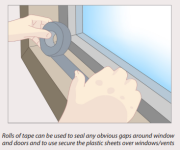
  • Use cloths/towels to seal off gaps between the door and floor;
  • Close all windows in the room; and
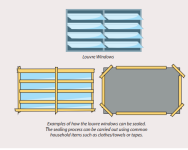
  • If there are louvre windows (or openings of similar design),seal the gaps with common household items such as cloths/towels or tapes.
3. Tune in
  • Tune in to the free-to-air PTV/Radio Stations - Rescue 1122/Civil Defence social media platforms for updates on the latest situation and/or instructions from the authorities; and
  • Leave the room only when instructed by the authorities
1746584196963.png
1746584585838.png

If you are in your workplace:
If your children are in school, they will be sheltered. Schools that are within the affected area will be notified to carry out the shelter in-place procedure. Unless instructed by the authorities, do not go to the school and bring your children home. Transporting them from the school will put all of you at risk.

If you are in your vehicle:
If a vehicle is caught in a hazardous chemical release plume:
1. Close all windows and switch off the air-conditioning unit/ventilation system. Ensure that the air re-circulation vent is closed;
2. Drive away from the affected area; and
3. Tune in to free-to-air TV station/PTV/Radios on the latest situation and / or instructions from the authorities.
4. Once out of the affected area, switch on the air-conditioning unit/ventilation system fan speed to high and open the air-circulation vent.
5. If you are unable to drive out of the affected area, close the all windows, switch off the engine and remain in the vehicle or move into the nearest indoor premises and carry out shelter in-place procedures.
 
Last edited:
Decontamination Procedure:
Step 1:

1746584715349.png
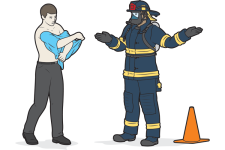
At the direction of the emergency responders, casualties disrobe.

1746584788467.png
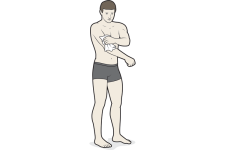
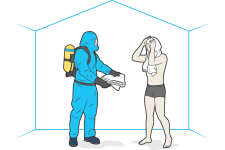
The casualties use dry, absorbent materials provided by Rescue 1122/CD to wipe chemicals off themselves. This step can be repeated while victims wait to walk through a cold-water spray.

1746584885146.png
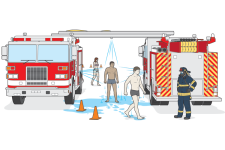
They pass between two fire trucks which provide a cold-water spray

1746584931637.png
Casualties enter a special tent where they dry themselves with towels.

1746584964181.png
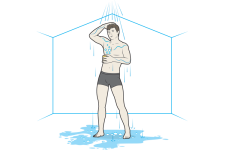
The take a final shower with soap and water as part of the decontamination procedure.
 
Status
Not open for further replies.

Users who are viewing this thread

Back
Top