Claim that a Chinese helicopter reached the site of a glacier collapse in Nepal is false; video is from Alaska

Beijingwalker

VIP Member
Joined
Nov 4, 2011
Messages
93,501
Reaction score
113,803
Reputation
1,954.5
Country of Origin
Country of Residence

Claim that a Chinese helicopter reached the site of a glacier collapse in Nepal is false; video is from Alaska​

搜狗截图20260829181854.png

Aug 28, 2026

Executive Summary​

A video purportedly showing a glacier breaking apart while being filmed from a helicopter is being shared on social media with the claim that a Chinese helicopter has reached the site where a glacier broke apart, triggering floods in Nepal. A research by the Research Wing of the CyberPeace found that the video is actually from Alaska, USA. It was uploaded on Instagram and YouTube by an American pilot, Leigh Kotes, before the recent floods in Nepal, and is unrelated to the incident.

Claim​


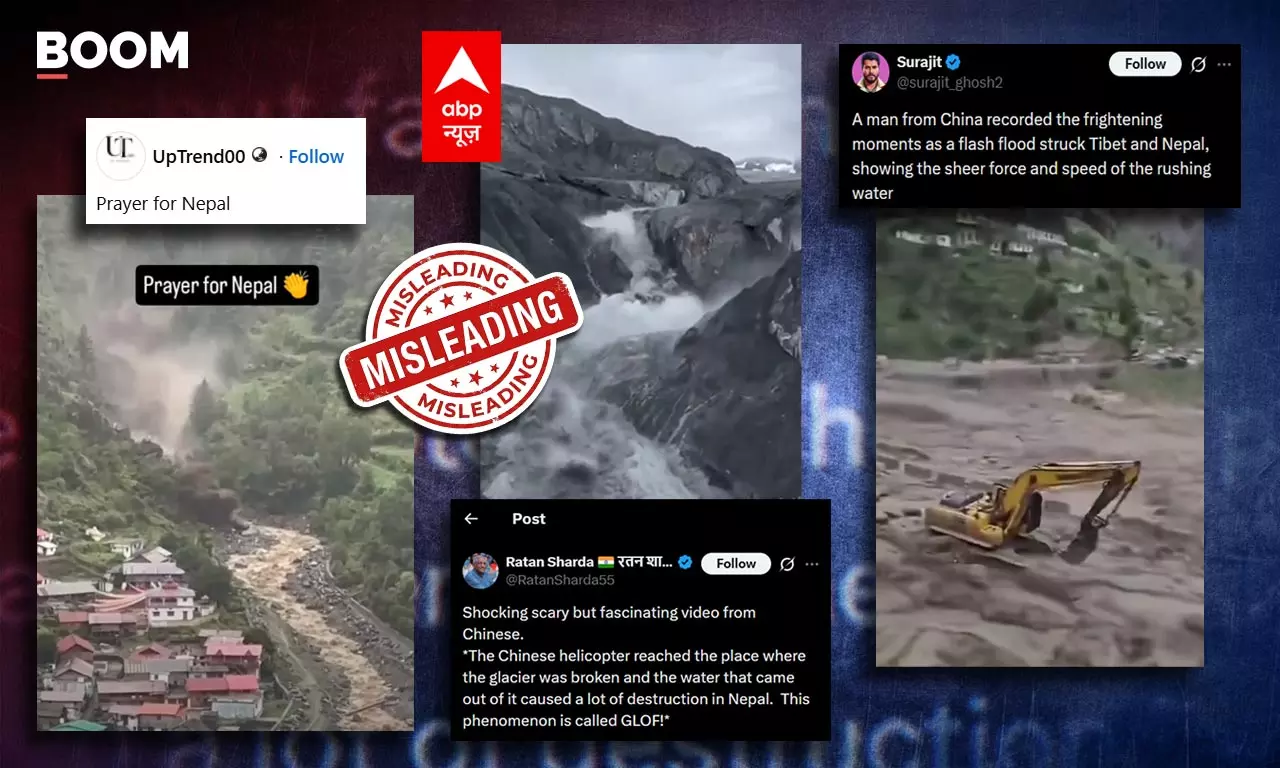
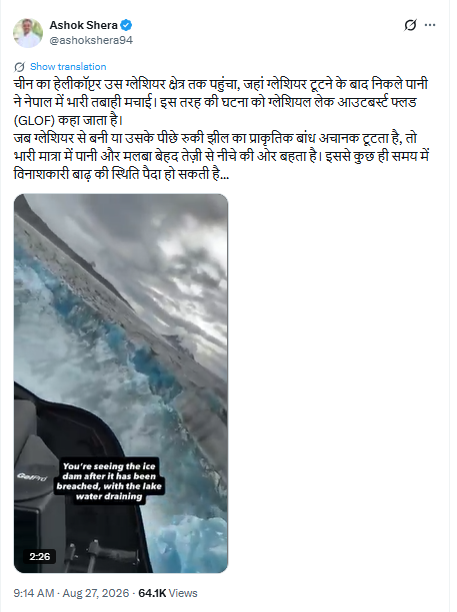
The video is being shared on X with a caption claiming: “A Chinese helicopter reached the glacier region where water released after the glacier broke apart caused massive destruction in Nepal. Such an event is known as a Glacial Lake Outburst Flood (GLOF).”


6a9146cf7bfc3d8914860b53_21d6c6ca.png


Executive Summary​


A video purportedly showing a glacier breaking apart while being filmed from a helicopter is being shared on social media with the claim that a Chinese helicopter has reached the site where a glacier broke apart, triggering floods in Nepal. A research by the Research Wing of the CyberPeace found that the video is actually from Alaska, USA. It was uploaded on Instagram and YouTube by an American pilot, Leigh Kotes, before the recent floods in Nepal, and is unrelated to the incident.


Claim​


The video is being shared on X with a caption claiming: “A Chinese helicopter reached the glacier region where water released after the glacier broke apart caused massive destruction in Nepal. Such an event is known as a Glacial Lake Outburst Flood (GLOF).”


https://archive.ph/tUIVw


6a9146cf7bfc3d8914860b53_21d6c6ca.png


Fact Check​


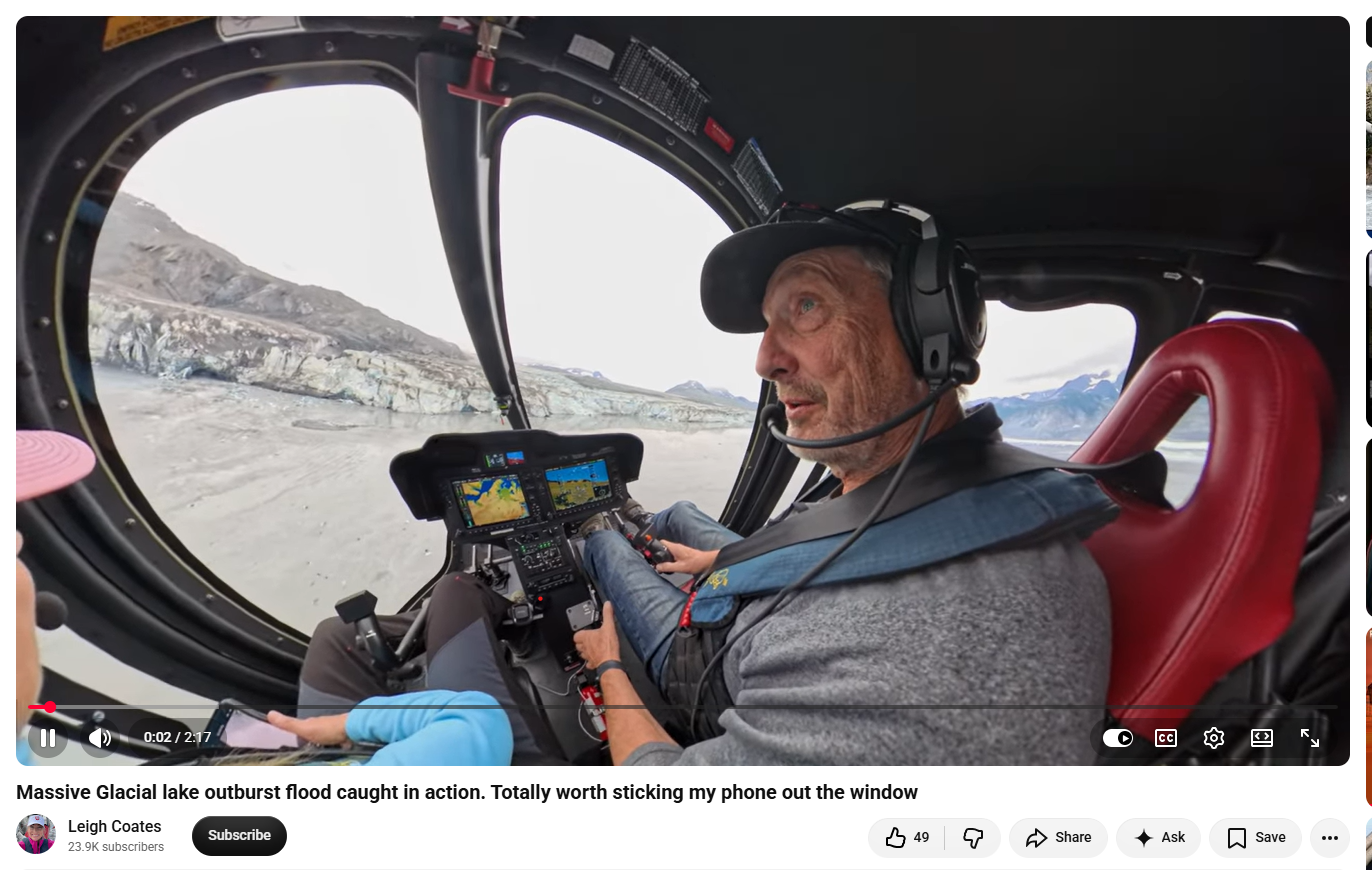
To verify the viral video claiming that a Chinese helicopter reached the site of the glacier break after the floods in Nepal, we conducted a reverse image search using keyframes from the clip. During the search, we found a video featuring the same visuals uploaded on a YouTube account named “Heli Pilot Leigh” on January 16, 2025. The location mentioned with the video identified it as Alaska, USA.


We also found several videos featuring scenes similar to those in the viral video on Ligh Kotes’ YouTube account. Among them, a nearly two-minute-long video uploaded on January 16, 2025, also contains visuals similar to those seen in the viral clip. Recorded from a helicopter, the video shows Ligh extending her mobile phone outside the helicopter to capture footage of water rushing out at high speed following the breaking of a glacier.
6a9146cf7bfc3d8914860b56_500cd28f.png


Additionally, our research found that the Columbia Glacier featured in Ligh’s video is located near Valdez, Alaska.

Conclusion​


The evidence gathered during our research makes it clear that the viral video, which is being shared with the claim that a Chinese helicopter reached the site of a glacier collapse following floods in Nepal, is actually from the Columbia Glacier in Alaska, USA. The video was recorded by an American pilot, Ligh Kotes.
 

Old India disaster footage misrepresented as Nepal-Tibet floods

Vishesh SINGH / AFP India
Fri, August 28, 2026 at 4:49 PM GMT+8

After deadly floods tore through the Nepal-Tibet border in August 2026, social media posts recirculated unrelated footage from India falsely claiming they showed the calamity. The videos in fact depict flash floods that struck India's northern state of Uttarakhand in August 2025 and 2026.

"The scene of devastation in Nepal is such that every new video that surfaces seems more horrifying than the last one," reads the Hindi-language X post published on August 27, 2026.

The post includes a video of a flash flood gushing through a valley, damaging properties and infrastructure.

Another X post from August 26 shares a clip of raging floodwater, with several vehicles swept away by a torrent of mud.

"Disaster in Nepal, Terrifying footage," it reads.

<span>Screenshots of the false X posts taken on August 28, with red Xs added by AFP</span>

Screenshots of the false X posts taken on August 28, with red Xs added by AFP
Similar posts spread elsewhere in different languages including Bengali and English on Facebook, Instagram and X.

The videos surfaced after catastrophic flooding and landslides on the Nepal-Tibet border unleashed waves of water and debris that have killed more than 470 people and left upwards of 1,400 missing ( archived link).

The surge of water hit villages and towns on the path of two rivers -- Bhote Koshi and Trishuli in Nepal.

Many of the missing are foreign tourists, including trekkers in the Himalayan nation, as well as scores of Hindu pilgrims to Tibet's sacred snow-capped Mount Kailash.

The US Geological Survey (USGS) said the disaster was caused by a glacial collapse that triggered a vast flow of icy debris.

Climate change is causing glaciers to melt worldwide, increasing the risks of glacial lake floods and glacial collapses.

But the circulating clips are unrelated and were in fact filmed in India.

Uttarakhand floods​

A reverse image search on Google of the first video using keyframes, followed by keyword searches, surfaced an Instagram video published by the weather platform AccuWeather on August 5, 2025 ( archived link).

"Dharali, India," its caption says -- referring to a village in the Uttarakhand state -- with the footage credited to visual licensing platform Reuters Connect ( archived link).

<span>Screenshot comparison of the falsely shared footage (L) and video from Reuters Connect shared in August 2025</span>

Screenshot comparison of the falsely shared footage (L) and video from Reuters Connect shared in August 2025

The falsely shared footage also corresponds to Google Earth Satellite imagery of India's Dharali ( archived link).

Indian officials say at least 70 people were killed after a deadly wall of icy water swept away the Himalayan town and buried it in mud ( archived link).

<span>Screenshot comparison of the Instagram video (L) and Google Earth satellite imagery, with the same elements highlighted by AFP</span>

Screenshot comparison of the Instagram video (L) and Google Earth satellite imagery, with the same elements highlighted by AFP

A separate reverse image search of the second video led to footage from British video news agency Newsflare distributed by AFP on August 10, 2026, with a caption saying it shows flash flooding in Uttarakhand triggered by a sudden downpour ( archived link).

<span>Screenshot comparison of the false video (L) and the same clip as seen on Newsflare's website</span>

Screenshot comparison of the false video (L) and the same clip as seen on Newsflare's website

Another video from Newsflare also distributed by AFP shows the same scene from another angle.

Indian media organisation NDTV reported that flash floods struck Uttarakhand's Tamak region, India on the day, after a heavy cloudburst sent a destructive mix of water, mud, and debris surging through the Niti valley ( archived link).

AFP has debunked other false claims related to the Nepal floods.


US Ambassador Sergio Gor has made a sharp observation about Indian media, saying:
“I’ll be watching Indian news and I used to think we had a fake news problem back home in America. But some of the things that get reported here are just nowhere close to the mark.”


US Ambassador Sergio Gor has made a sharp observation about Indian media, saying:
“I’ll be watching Indian news and I used to think we had a fake news problem back home in America. But some of the things that get reported here are just nowhere close to the mark.”

He just hit the nail on the head :eek: US does make lots of fake news, but nowhere close to India's level.

 
If you observed, from the Indian sources only, Reverified and being classified as such claims as false
.
Even US ambassador to India personally was shocked about how Indian media lies beyond the pale, it shows how serious this problem is.
 
Even US ambassador to India personally was shocked about how Indian media lies beyond the pale, it shows how serious this problem is.
I hope you’ve realised by now how fake media works, even during the Iran–Israel war. The India–Pakistan conflict is another example, and the list can go on.

“Tweety” fans are active almost all around the world, especially in South Asia, where the numbers are huge. Some even pretend to be foreigners and target each other daily to create the impression that the narrative is coming from outsiders.

They all get activated whenever something happens, so don’t be surprised.

There is a reason why I never trust tweets or YouTube videos unless they come from genuinely credible sources. Even when something is reported by well-known media outlets from South Asian countries, especially India and Pakistan, you should still verify the claims and look for solid evidence before believing them.
Otherwise, you can easily become a victim of false or misleading news.
 
How India's misinformation machine targets China over the Nepal floods
Tom Fowdy
2026.09.01 14:20

The world has been shocked by the scenes which have come out of Nepal and China's Tibet over the course of the past week after the collapse of glaciers in the Himalaya triggered gigantic flash floods. Modern social media has provided an unprecedented visualisation of a harrowing tragedy as audiences watched villages and settlements be completely annihilated by massive mudslides in clear view. The aftermath is far from over, as thousands of people remain missing and the death toll mounts.

But if history does teach us one thing, it is that tragedy always leads to politicization and blame games, as vested parties seek to avoid accountability for outcomes and others, of course, seek to weaponise narratives to attack their opponents. It did not take long for the latter to emerge, one might note that very quickly across social media accounts of Indian origin began perpetuating a narrative that China was somehow directly to blame for the crisis, pushing false information that a Chinese-built dam had collapsed.

The fact that such claims would originate from India, at scale, is wholly unsurprising. India, as a developing country with a massive population, has emerged to become one of the most online-connected countries on the planet, without being locked into a different internet ecosystem like China is. This population scale has made the presence of Indians on Western social media platforms enormous, which is further amplified by the reality that Indians, as a former British colony, are widely capable of speaking in English and use it for formalised communication.

This supersedes the linguistic barriers which often undercut heavily digitalised, but non-English-affiliated populations such as China, Japan and South Korea, thus allowing the presence and influence of Indians to become ubiquitous. The massive digitalisation of India has also spearheaded political shifts in the country and is one of the driving factors behind the rise of the Bharatiya Janata Party (BJP) and Narendra Modi as a right-wing, populist leader. The BJP has succeeded in using India's newly developed mass connectivity to drive nationalist mobilisation by essentially creating a highly aggressive digital activist culture, of which is amplified by a large number of news outlets who have premised their business models on profiting from the views and engagement.

This has created a self-affirming feedback loop which has effectively established political misinformation as an industry in India, one which in my opinion, is probably the largest of its kind in the English-speaking world. It is therefore possible for the Indian state to engineer a particular narrative, target, or point of view, and for many false or loaded claims to then emerge, bandwagoning on the anger and go viral across social media, creating a self-reinforcing feedback loop. If India's leadership wish to turn public opinion against a specific country or target, they are very much capable of doing so, and we have seen many times over the years in respect to both China (2020) and Pakistan.

As of present, the worst of Indian hostility to China, which surged following the COVID pandemic and the 2020 Galwan Valley Clashes, has cooled. The two countries have normalised diplomacy again, India has softened its tilt to the US as unpredictability has stemmed from Washington, and their leaders have made. However, there is one underlying structural factor which does not change: India will continue to view China as a regional competitor, even if not an outright enemy, and seek to contest it for influence throughout the South Asian sphere. New Delhi's national interest has always been to affirm what we might describe as a "backyard" policy in South Asia, which we define as the region comprised of the wider subcontinent including Bhutan, Bangladesh, Nepal, the Maldives, Pakistan and Sri Lanka. This backyard policy assumes that India's security hinges upon maintaining hegemony over this geopolitical space, which is contested by Pakistan (as the primary adversary) and China (the great power competitor), and thus it is imperative New Delhi dominate the smaller states.

However, because China has more economic power and resources, India's traditional dominance over these states in recent decades has been challenged precisely because Beijing can offer them economic benefits they can't compete with in the form of trade and infrastructure investment. At the same time, these South Asian countries utilise ties with Beijing as a means to assert geopolitical leverage and autonomy against India and hedging. Nepal, for example, wants to diversify its trade as its limited geography has allowed India to impose trade embargos against it, as they did following the 2015 earthquake.

As a consequence, India's political sphere sees these tragic floods in Nepal and Tibet as an opportunity to push hostile narratives against China, as it remains India's long-term strategic goal to try and challenge Chinese influence in Nepal. This has produced a misinformation campaign which deliberately seeks to paint China as responsible for this natural disaster. As a result, India's very large social media and "fake news" ecosystem is capable of generating and pushing these baseless claims virally, and their presence is very easy to detect on the many social media posts regarding the disaster.

In reality, Nepal isn't going to be quick to jump to such a judgment. It has one goal: To receive as much assistance as it can get, which is not political despite the motives of the various parties who offer it. Kathmandu will likely continue an all-weather friend policy that will seek to maximise its fairly precarious geographic realities by fostering close relationships with China, India, the United States and others.


Users who are viewing this thread

Back
Top