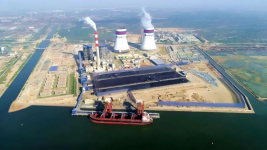
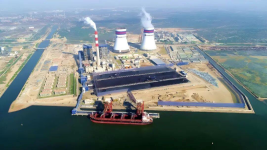
Coal Based Power Plants

ghazi52

THINK TANK: CONSULTANT
Joined
Mar 21, 2007
Messages
159,724
Reaction score
209,043
Reputation
9,249.7
Country of Origin
Country of Residence

3 imported coal-based IPPs to Thar coal: PPIB seeks details of Chinese Ad hoc Working Group on conversion

Mushtaq Ghumman
November 9, 2024

672e9ad7a802e.jpg


ISLAMABAD: The Private Power and Infrastructure Board (PPIB) has sought details of Chinese Ad hoc Working Group constituted to negotiate conversion of three imported coal-fired Chinese power plants established under the China-Pakistan Economic Corridor (CPEC) to local coal i.e. Thar coal, sources close to Managing Director PPIB told Business Recorder.

Sharing the background, the sources said, in a follow-up to the high level visit of Prime Minister Shehbaz Sharif to China from June 4-8, 2024, a delegation of Chinese experts visited Pakistan from July 30 to August 06, 2024, to assess the challenges in Pakistan’s power sector.

The Chinese experts prepared a detailed report of the visit, which was shared by the Embassy of China in Pakistan on 0ctober 7, 2024 with the Ministry of Foreign Affairs (MoFA) and copied to Power Division.

The report has recommended addressing both efficiency and management improvements of Pakistan’s power system and conversion of imported coal based IPPs to Thar coal in parallel. Furthermore, the report indicated that the Chinese energy expert team had drafted an outline of research aimed at alleviating the challenges faced by China sponsored, imported coal-based power plants within the CPEC. However, the draft outline of research has not been shared with the Pakistani side.

Regarding conversion of imported coal based IPPs to Thar coal, Minister of Energy (Power Division) during his visit to China on July 24-26 2024, proposed Vice Administrator of National Energy Administration (NEA) to establish an Ad-hoc Joint Working Group to facilitate further discussions on the conversion.

Accordingly, Parep Beijing through an email dated August 20, 2024 noted that NEA has agreed in-principal to establish an Ad-hoc Working Group in which Chinese side would be represented by officials from NEA’s department of International Cooperation, its Planning Department as well as Chinese Enterprises operating IPPs in Pakistan.

On August 26, 2024, Minister of Energy (Power Division) constituted a Committee to coordinate and work with stakeholders on conversion.

According to Shah Jahan Mirza, the Committee after convening meetings with stakeholders now intends to engage with the Chinese Ad-hoc Working Group for further deliberations. However, the Committee on conversion lacks information regarding the status of Ad-hoc Working Group on the Chinese side, including its members, Terms of Reference (ToRs) and any focal person(s) nominated by the NEA.

After explaining the background, PPIB has requested Power Division to approach Embassy of China in Pakistan through Ministry of Foreign Affairs to acquire details regarding the Ad-hoc Working Group, including its members, ToRs, and NEA’s designated local person(s) for the conversion. Furthermore, ‘Outline of research on alleviating the difficulties faced by China -sponsored, imported coal-based power plants within the CPEC’ may also be solicited to facilitate in-depth research on this initiative and to expedite the finalisation of the joint study.

Finance Ministry is also engaged with local banks to convince them to finance the much desired plan, as the government hopes that this step will reduce overall tariff by Rs 3.5 per unit.

Power Division argues that coal conversion is critical to improve generation capacity and reduce fuel payments per unit, and enable scaling up Thar coalfields, reducing cost of coal per ton, while enhancing energy security.

Initial study was conducted by M/s Fichtner of Germany which supported conversion of plants from imported coal to local Thar coal.

Copyright Business Recorder, 2024
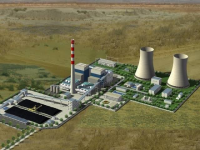
 
Thar Coal Block-1 Project.

1731187232627.png
 
Engro Thar Block II Power Plant, Pakistan

Engro Thar Block II power plant is a new coal-fired power station located in the Tharparkar district, Sindh,
.
Project Type.... Coal-fired power plant
Capacity........... 660MW (2x330MW)
Developer........ Engro Powergen Thar and China Machinery Engineering Corporation (CMEC)
Location........... Thar Block II, Sindh province,
 
Thar Block II power plant make-up

The coal-fired subcritical power plant is located 5km away from Thar Block II near Thar coalfields in the Sindh province. It consists of two 330MW subcritical units, which integrate circulating fluidised bed (CFB) boilers, tandem compound steam turbine units, and generators.

CFB is an ideal option for the low calorific value Thar lignite coal. It helps to regulate the plant’s environmental footprint by reducing nitrogen oxide emissions and capturing sulphur oxides.

The 20kV, 50Hz, three-phase intercooled generators feature a hydrogen-cooled rotor and stator core, as well as water-cooled rotor windings.

The power plant is also equipped with associated equipment and systems such as cyclones, air pre-heaters, and water walls.


Coal supply to Engro Thar Block II power plant

Sindh Engro Coal Mining Company (SECMC) supplies approximately 3.8 million tonnes per annum (Mtpa) of coal for the coal-fired power plant from a new opencast mine.
 
Pakistan’s power sector will remain vulnerable to exchange rate fluctuations for up to eight years due to dollar-indexed investments, particularly projects under the China-Pakistan Economic Corridor (CPEC).

On Wednesday, the federal government sealed a financing deal of Rs1.225 trillion with 18 commercial banks in a bid to retire the power sector’s ballooning circular debt.

However, Federal Minister for Power Sardar Awais Leghari said on Friday that power plants commissioned after 2015, with a generation capacity exceeding 11,000 megawatts, were financed in US dollars and have locked-in tariffs and debt servicing tied to the dollar.


“Dollar-linked debt will remain sensitive to exchange rate fluctuations for the next 7–8 years,” he said, noting that when contracts were signed under the PML-N government, the exchange rate stood at Rs100 to a US dollar.

“The Rs18 per unit capacity charge today would have been Rs8–9 lower if the rate had remained unchanged.”

Leghari did not comment on whether the government plans to revise post-2015 contracts as it had done with pre-2015 IPPs and state-owned plants, noting that Islamabad has sought concessions from Beijing on CPEC power terms with limited success.
 
It is common sense that when USD goes up, everything goes up, not just electricity costs.
 
Once loan is paid off in 7-8 years for CPEC IPPs then capacity charges will reduce by 50%.
 
that monster is created by them.they know it . They are bunch of idiots not policy makers cuz policy maker always think aboout present as well as future.
 
@hydrabadi_arab

Hydra bro,

noting that Islamabad has sought concessions from Beijing on CPEC power terms with limited success.

Knowing your taller than mountain friend, you are unlikely to get a single paise reduction from them.

Regards
 
Pakistan can retire some imported coal assets early and still save money. A new report shows the move could be economically viable. Moreover, it could offer a model for wider coal phaseout.


Between 2014 and 2019, Pakistan fast-tracked a coal power buildout under the China-Pakistan Economic Corridor. The push added roughly 3.6 gigawatts of coal capacity quickly. Overall, nine projects promised about 10.4 gigawatts of imported coal capacity. Those plants eased load shedding. However, they also created costly take-or-pay liabilities.

The Sahiwal coal plant illustrates the problem. The 1,320 megawatt Sahiwal plant began operations in October 2017. China’s Huaneng Shandong Ruyi Energy built the plant under a 30-year power purchase agreement. The deal guarantees a 27.2 percent return on equity and a 50 percent minimum off take.


Almost a decade of debt service has passed. Yet utilization at Sahiwal fell below 20 percent.

Cheaper rooftop solar and weak industrial demand cut dispatch. Meanwhile, receivables in the single buyer market exceeded PKR82.7 billion. That is roughly $294 million based on current exchange rates.

The report models early retirement pathways for Sahiwal. It finds that closure can occur with a compensation range of $0.4 billion to $1.5 billion under modest five to ten-year acceleration scenarios.


In one scenario, the upfront cost could be under $100 million. That contrasts with an estimated $5 billion in capacity payments if the plant runs under existing terms through 2046. Therefore, early retirement looks financially sensible in several cases.

The analysis highlights two primary pathways.

First, an upfront buyout. Under this option, the government pays a lump sum to compensate owners for foregone future cash flows. Second, a negotiated reduction in the return on equity. That accelerates equity value recovery while lowering future payouts.

In both cases, policymakers can redirect funds from coal to clean projects. That would benefit investors and the state.


The climate case also supports retirement.

Stopping Sahiwal early could avoid 27 million to 38 million tons of carbon dioxide over a 10-year reduction window.

Thus, the move could attract climate and transition finance. Both Western and Chinese financing channels could supply funds. Energy Transition Mechanisms used in the Philippines and Indonesia offer precedents.

Nevertheless, challenges remain. Pakistan faces complex fiscal and contractual obligations. Sovereign guarantees and dollar-indexed tariffs complicate negotiation. Also, systemic fiscal stress and circular debt limit fiscal space. Thus, careful design will matter.


Still, the timing could help. Debt amortization on some plants is near completion. Equity returns now dominate cash flows. That makes Sahiwal a logical pilot for a wider program. If successful, it could unlock repeatable deals for other plants.

Finally, the report calls for clear policy steps.

First, adopt transparent valuation methods for buyouts. Second, set technical standards for emissions accounting. Third, mobilize blended finance and transition credits.

Together, these measures could make early retirement both bankable and scalable.
 
And what will become of the trillions of dollars of coal in Thar we've been hearing about for 20 years?
 
But What About All The Underhanded Kickbacks And Commissions Earned By The Government Who Signed These???The People Who Paid These Kickbacks ,How Else Will They Recover Their Money???


Oops I Am Sorry, My Bad The Only Corruption Is Buying Gifts From Toshakhana At Below Market Price Something Which Pretty Much Everyone Has Done
 
1785514910661.png

Recently, the Automatic Generation Control (AGC) system at POWERCHINA’s Port Qasim Power Plant in Pakistan successfully completed its first closed-loop joint commissioning on the very first attempt, smoothly passing all inspections by the National Energy Grid of Pakistan.

The entire commissioning process took only four hours, setting a new record for the fastest testing among similar units in Pakistan.

During the test, facing consecutive load adjustment instructions from the grid dispatcher, the units responded swiftly and operated stably, with all performance metrics meeting or exceeding testing requirements.

To guarantee seamless execution, the project team proactively coordinated thermal, electrical, and operational specialists to optimize plans and mitigate risks well in advance.

The successful operation of the AGC system will further enhance the plant's load responsiveness and operational flexibility, providing even stronger and more reliable support for the safe and stable operation of Pakistan’s power grid.


1785515023057.png
 

Thar coal switch to save $3.24b​

Jamshoro Unit-01 conversion yields 1.8x cost-benefit ratio, cuts imported fuel reliance


ISLAMABAD:
Pakistan is poised to save $3.239 billion over the next 26 years – including $2.113 billion in foreign currency savings – by converting the Jamshoro Unit-01 power plant from imported coal to 100% indigenous Thar lignite, according to the Ministry of Energy (Power Division).


A bankable feasibility study prepared by Dornier Group and EY Parthenon confirms the transformation is technically feasible, economically compelling and environmentally manageable. The conversion involves targeted engineering modifications rather than a large-scale boiler retrofit, preserving the value of the existing ultra-supercritical plant asset.

The project delivers a cost-benefit ratio of 1.8x, remaining favourable across all sensitivity scenarios. Total net benefits over the 26-year project life comprise $1.720 billion in power sector benefits – including generation cost savings of $1.051 billion and Thar mine expansion benefits of $669 million – alongside $1.519 billion in government savings from reduced interest costs on foreign borrowings. Conversion capital expenditure is estimated at $86.2 million, with total project cost of $116.6 million.


Federal Power Minister Sardar Awais Ahmed Khan Leghari was briefed on the study, which was made possible with support from K-Electric (KE), Jamshoro Power Company Limited (JPCL) and the Private Power and Infrastructure Board (PPIB). A high-level steering committee convened 38 sessions to monitor and expedite the completion of the initiative, with the minister personally chairing 15 of them.

The initiative flows from the Prime Minister's Power Sector Reform Plan and reflects sustained efforts to advance fuel indigenisation. The project is structured as a bankability-led brownfield modification with a stage-gate implementation approach that introduces no new coal capacity.

Beyond direct financial savings, the shift to Thar lignite carries transformative economic co-benefits. It will catalyse expansion of coal mines in Tharparkar, generating employment and accelerating infrastructure development in one of Pakistan's most underserved regions. By eliminating reliance on imported coal – subject to international price fluctuations, exchange rate volatility and supply chain disruptions – Pakistan will move decisively towards energy self-sufficiency.

Following the study's presentation, the ministry will proceed to implementation readiness. Next steps include obtaining final policy approval, initiating the lender-consent workstream, preparing the regulatory consent and contract matrix, and launching basic design tender verification including modelling, mill tests and balance-of-plant modifications.

The government remains committed to timely and bankable implementation of this landmark project, which represents a cornerstone of the energy sector's transition towards indigenous resources, fiscal sustainability and long-term energy security, says the ministry.
 

Users who are viewing this thread

Back
Top