The broadcast offers fresh evidence that Chinese developers are designing advanced chips that could replace imports.

www.scmp.com
Alibaba-developed AI processor on par with Nvidia’s H20 chip, CCTV report shows
The broadcast offers fresh evidence that Chinese developers are designing advanced chips that could replace imports
Published: 9:00pm, 17 Sep 2025
Alibaba Group Holding’s
semiconductor design unit,
T-Head, has developed an
artificial intelligence chip with capabilities that are on par with
Nvidia’s
H20 graphics processing unit (GPU), according to a report by state broadcaster
China Central Television (CCTV).
The report, which aired on Tuesday, showed T-Head’s PPU, an application-specific integrated circuit, being compared with Nvidia’s H20 and
A800 GPUs in a performance benchmark during Premier
Li Qiang’s visit to a
data centre operated by
China Unicom in northwestern Qinghai province.
Li was briefed by China Unicom on the use of mainland-developed chips in the telecommunications network operator’s infrastructure.
This marked the first time that Alibaba’s proficiency in semiconductor design was highlighted in a state broadcast, which offered fresh evidence that Chinese developers are designing advanced chips that could replace imports like Nvidia’s GPUs. Alibaba owns the South China Morning Post.
Alibaba’s
Hong Kong-listed shares closed 5.28 per cent higher at HK$161.60 on Wednesday, as the CCTV report seized the market’s attention.
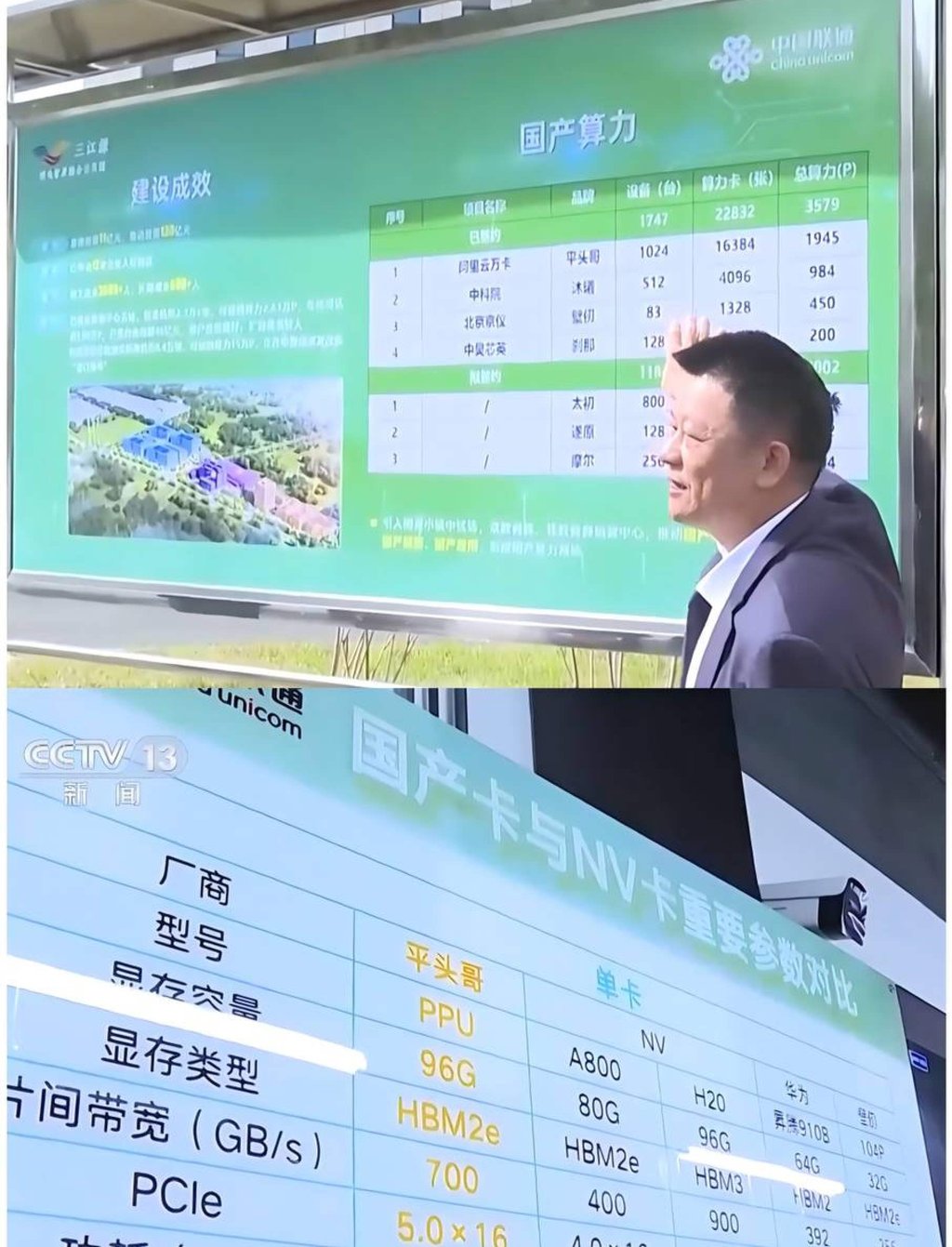
A China Central Television report on Tuesday shows Alibaba Group Holding’s PPU, an AI chip developed by the company’s T-Head semiconductor design unit, being compared to Nvidia’s H20 and A800 processors in a performance benchmark during Premier Li Qiang’s visit to China Unicom’s data centre in northwestern Qinghai province. Photo: CCTV
The footage aired by CCTV showed a chart that compared a number of locally designed AI accelerators with Nvidia’s two GPUs, which were tailored for China to comply with
US tech export restrictions.
T-Head’s PPU card, which had 96 gigabytes of high-bandwidth memory per unit, matched Nvidia’s H20 and surpassed
Huawei Technologies’
Ascend 910B, according to the CCTV footage. Alibaba’s PPU card also featured chip-to-chip bandwidth of 700 gigabytes per second, high-speed Peripheral Component Interconnect Express standard, which connects hardware components within a computer; and a 400-watt power consumption, which was lower than what the H20 needed.
Another chart shown on the broadcast listed China Unicom’s contracts with four domestic chip providers, which totalled 22,832 cards that provided 3,579 petaflops, a measure of computing speed. A petaflop is equal to 1,000 trillion calculations per second.
T-Head’s PPU cards accounted for 16,384 units, which provided 1,945 petaflops.
The other suppliers to China Unicom were MetaX, a GPU start-up that collaborates with the Chinese Academy of Sciences;
Biren Technology, a
Shanghai-based AI chip designer; and Zhonghao Xinying Technology, founded by former
Google tensor processing unit engineer Yanggong Yifan.
Other chip suppliers mentioned in the CCTV report as potential partners included Tecorigin, a company based in Wuxi in eastern Jiangsu province, as well as
Moore Threads Technology and
Tencent Holdings-backed
Enflame.
China’s growing number of mainland AI chip suppliers gave credence to Alibaba CEO
Eddie Wu Yongming’s assurance during the firm’s earnings call last month that the company had prepared “backup plans” to secure AI chip supplies amid US restrictions and heightened geopolitical tensions.
China’s demand for high-performance computing has grown rapidly alongside the expansion of AI development projects. This has prompted local governments and telecoms network operators to invest in large-scale data centres for AI-related projects.
Li visited China Unicom’s 2.77 billion yuan (US$389 million) Sanjiangyuan Green Energy Intelligent Computing Centre, which broke ground in August 2024. It covers an area of 5.3 hectares, where the facility will be built in four phases and provide a total capacity of more than 20,000 petaflops when completed, according to a report by the local Qinghai Daily.
Alibaba Group secures China Unicom as a customer for its AI chips.

www.cryptopolitan.com
Alibaba lands China Unicom as flagship client for its AI chips
- Updated: September 17 2025 10:47 AM UTC
Alibaba Group Holdings has won China Unicom as a client for its AI chips. Per CCTV report late Tuesday, China’s second-biggest wireless carrier will use Alibaba’s Pingtouge, or T-Head AI accelerators.
The carrier will place the chips in its expansive new data center in northwestern China, together with accelerators from MetaX and Biren Technology, which are already in use. Alibaba’s recent interest in T-Head and chip development aligns with Jack Ma’s stepped-up participation in the company’s strategy this year.
Alibaba has been advancing its development in AI infrastructure
Alibaba has recently invested more in
AI infrastructure to compete with Chinese tech companies like Huawei and reduce its dependence on Nvidia Corporation’s designs. So far, it has committed 380 billion yuan ($53.5 billion) to the initiative over three years. Alibaba Cloud has also begun delivering large volumes of AI chips to Unicom’s data facilities, though more details have not been disclosed.
Nonetheless, more information about its AI chip efforts surfaced earlier this week during CCTV’s coverage of Premier Li Qiang’s visit to Qinghai. The report briefly showed a billboard at Unicom’s Sanjiangyuan data center outlining the telecom’s deployment of Alibaba chips. In a separate briefing, Unicom added that Alibaba’s AI chip outperforms Huawei’s Ascend 910B in several key hardware metrics, including more advanced memory.
https://www.cryptopolitan.com/china-anti-dumping-probe-on-us-analog-chips/
However, Huawei is introducing the more powerful Ascend 910C for its part. Nevertheless, last month, the Wall Street Journal also revealed that Alibaba has designed an AI chip that can operate AI services, including DeepSeek’s R1 and its Qwen series.
As recently reported by
Cryptopolitan, DeepSeek has delayed the launch of its latest AI model after encountering persistent technical challenges with Huawei’s Ascend processors.
The Chinese artificial intelligence company had been encouraged by authorities to use Huawei’s chips instead of US-made Nvidia products after the successful release of its R1 model in January. Still, the firm ran into major issues during the training phase of its R2 model. These issues forced DeepSeek to rely on Nvidia chips for training, while using Huawei’s Ascend chips for inference.
Meanwhile, Alibaba’s push into chipmaking parallels similar initiatives by other Chinese tech giants working on homegrown AI silicon amid restrictions on Nvidia’s most advanced products. Nvidia’s AI accelerators are considered the industry standard for training next-generation models from OpenAI and Anthropic. Baidu said in August that it had landed a 10 billion yuan deal to deliver servers using its Kunlun chips to China Mobile, Unicom’s bigger rival.
Alibaba, Baidu begin using own chips to train AI models, The Information reports
Tencent, Alibaba, Baidu turn to local AI chips, shaking Nvidia's grip
Huawei unveils chipmaking, computing power plans for the first time
September 18, 202512:31 PM GMT+8Updated 22 mins ago
SHANGHAI, Sept 18 (Reuters) - Huawei said on Thursday it would roll out four new iterations of its Ascend AI chip over the next three years, breaking years of secrecy to reveal its chipmaking progress and ambitions to compete against Nvidia
(NVDA.O), opens new tab for the first time.
The Chinese technology giant has been one of the key players in leading efforts to develop a domestic semiconductor manufacturing industry, aiming to reduce reliance on a supply chain dominated by the United States.
After the launch of the Ascend 910C in the year's first quarter, Vice Chairman Eric Xu said the company plans to launch next year two variants of its successor, the Ascend 950, and follow up with the 960 version in 2027 and the 970 in 2028.
"Computing power has always been, and will continue to be, key to artificial intelligence, and even more so to China's AI," Xu told the annual Huawei Connect conference in the commercial hub of Shanghai, the company said.
The Ascend 950 chip would be powered by the company's own proprietary high-bandwidth memory, he said, revealing that it had overcome a key bottleneck China faced in the technology, limited for years to South Korean and U.S. suppliers.
Huawei also plans to roll out new computing power supernodes called the Atlas 950 and Atlas 960, which Xu described as the world's most powerful, supporting 8,192 and 15,488 Ascend chips respectively.
The chips are successors to the Atlas 900, also known as the CloudMatrix 384, which uses 384 of Huawei's latest 910C chips.
On some metrics, the Huawei product outperforms Nvidia's GB200 NVL72, which uses 72 B200 chips, research group SemiAnalysis has said.
Huawei says the system uses "supernode" architecture that allows the chips to interconnect at super-high speeds.