DeepSeek, China's AI model: News & Discussion

Rumours are DeepSeek v4 is imminent, as early as tomorrow.

With trumpy going senile and a DeepSeek 4 release markets tomorrow could be in turmoil.
 
To view this content we will need your consent to set third party cookies.
For more detailed information, see our cookies page.
 

Huawei Cloud official launch MaaS in Thailand and introduce Full-Stack AI Capabilities to Drive Thailand's Intelligent Transformation​

07 Apr, 2026, 15:45 CST

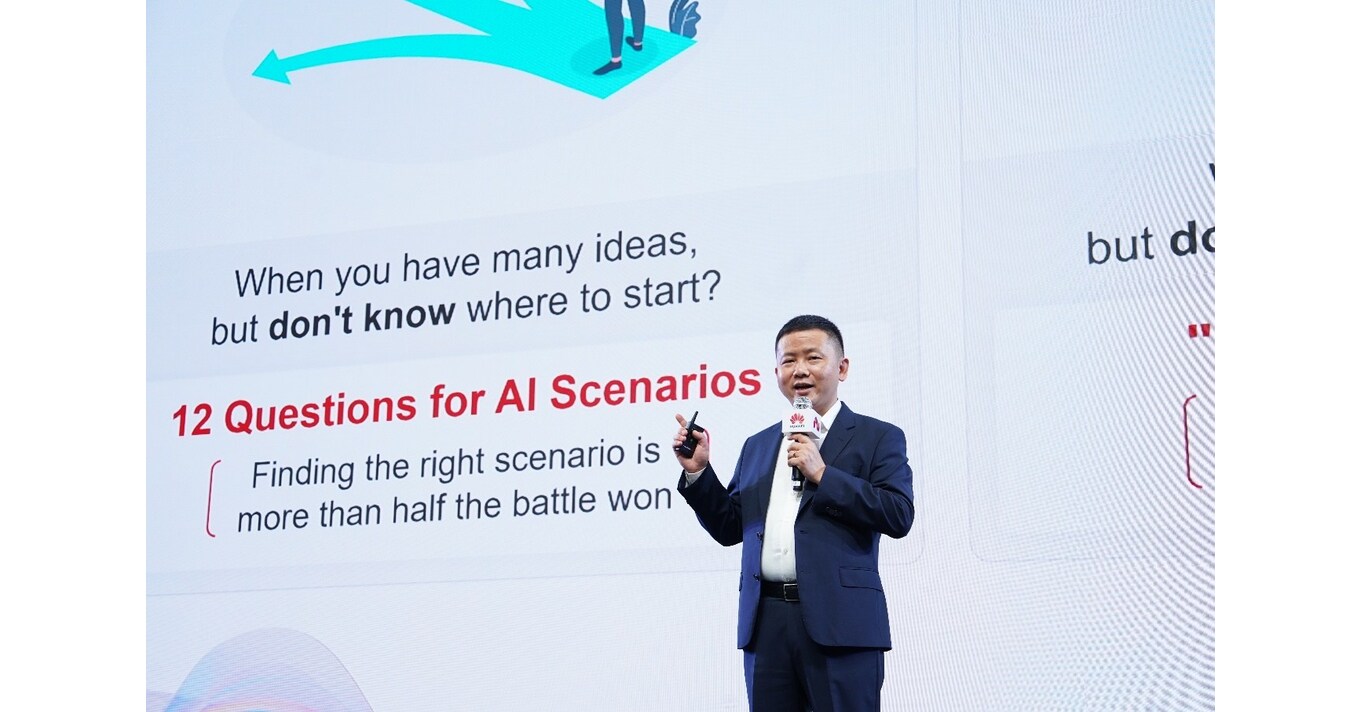
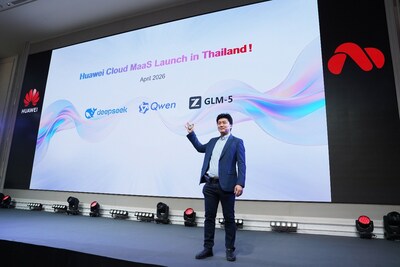
BANGKOK, April 7, 2026 /PRNewswire/ -- Huawei Cloud hosted Huawei Cloud Thailand AI Boost Day 2026, showcasing its vision for advancing the next generation of artificial intelligence through the introduction of Agentic AI—a new paradigm that is redefining the boundaries of AI applications, from passive response systems to intelligent agents capable of proactive planning and executing complex tasks, alongside the official launch of Model as a Service (MaaS) in Thailand, Huawei Cloud's MaaS is designed to address key enterprise scenarios, including large language models, coding, and multimodal applications. Built on Huawei's proprietary acceleration engine, the platform delivers optimized performance, faster response, and enhanced stability, while supporting leading industry models to provide a high-quality and reliable token-based service experience. The service has already been adopted by leading enterprises across multiple industries.

Mr. Surasak Sanichwatphibun, CTO of Huawei Thailand Cloud Business

Notably, the launch of MaaS also supports the recently introduced GLM-5 model, which has achieved state-of-the-art performance in coding and agent capabilities among open-source models. With strengths in handling complex system engineering and long-context agent tasks, GLM-5 serves as a strong foundation for building enterprise-grade general-purpose AI agents.
 

As AI race with US intensifies, China’s Alibaba launches 10,000-card computing cluster
Cluster in Shaoguan powered by domestically developed Zhenwu chips latest evidence that China is doubling down on home-grown infrastructure

Published: 2:30pm, 8 Apr 2026

China is ramping up efforts in the AI race, as tech giants Alibaba Group Holding and Huawei Technologies deploy massive computing clusters in the push to develop home-grown infrastructure.

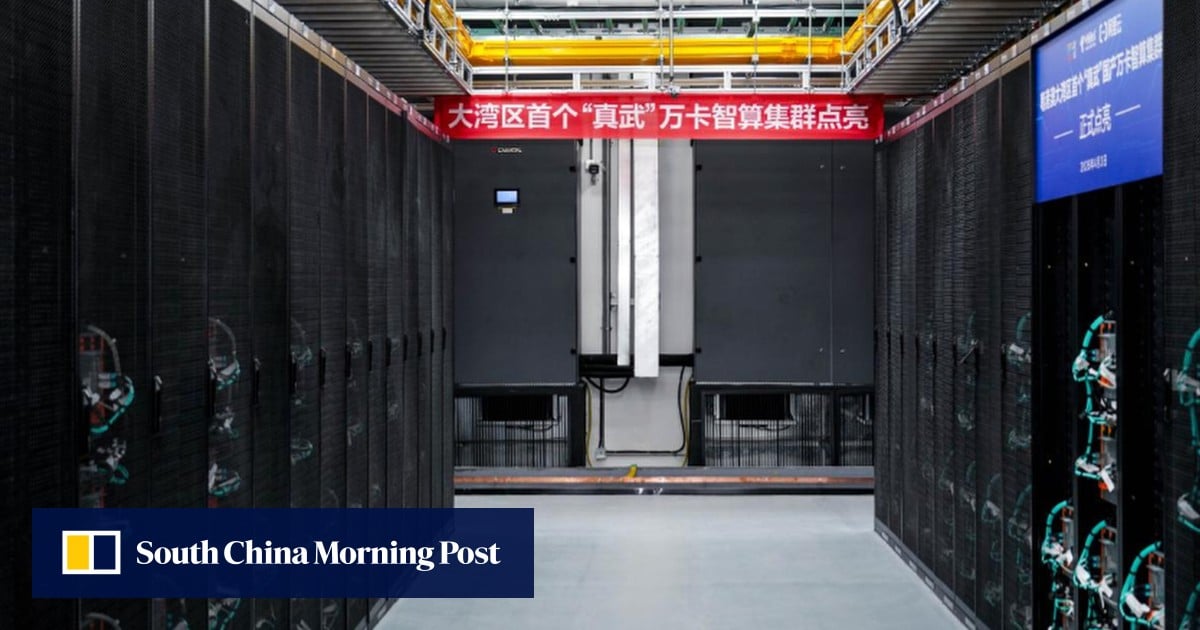
E-commerce giant Alibaba has announced the deployment of a 10,000-card intelligent computing cluster powered by the Zhenwu AI chips developed by its T-Head semiconductor design arm.
Launched in collaboration with China Telecom in the Shaoguan data centre in Guangdong province, the “fully domestic” cluster was the first Zhenwu-powered project of such scale in the Greater Bay Area, Alibaba’s cloud unit said in a statement issued on Tuesday.

The Zhenwu-powered cluster is the latest evidence that China is doubling down on home-grown infrastructure to supercharge rapidly evolving AI development and meet surging demand as the artificial intelligence race with US rivals including Meta, Microsoft and Elon Musk’s xAI intensifies.

The announcement of the Alibaba-backed cluster followed the activation of the country’s first 10,000-card intelligent computing cluster, built with Huawei’s Ascend 910C AI chips, in Shenzhen, Guangdong, late last month.

The new cluster showed China’s advanced computing power was “moving from high-end performance breakthroughs to large-scale industrial implementation”, Alibaba Cloud said in its statement on Tuesday.

The [government] sector’s rigid demand for data sovereignty and security has driven the fastest deployment
Charlie Zheng, Samoyed Cloud Technology

Charlie Zheng, chief economist at Samoyed Cloud Technology Group Holdings, said the recent launches of domestic computing clusters came as China’s AI industry was shifting from “hardware replacement” to “software collaboration”.

He said such domestic technology-based computing clusters were now seeing rapid deployment in the government service and city governance sector, which had the highest requirements for home-grown computing power.

“The sector’s rigid demand for data sovereignty and security has driven the fastest deployment,” Zheng said.

Alibaba said the Zhenwu cluster promised ultra-low latency of 4 microseconds thanks to its next-generation high-performance networking architecture, which allowed the 10,000 chips to work as a single supercomputer and train models with hundreds of billions of parameters.

It said the cluster could deliver 30 per cent higher training and inference efficiency, with single-card throughput increasing by nearly 10 times.

The cluster has already been deployed in healthcare and advanced manufacturing industries, the company said. Small and medium-sized enterprises could now access its computing power through China Telecom’s platform and pay by the card or hour, it said.

Alibaba also revealed plans to expand the scale of the cluster to 100,000 cards, to further lower costs and improve the efficiency of computing resources. Alibaba owns the South China Morning Post.

While the individual chips developed by Chinese tech giants still trail behind those of global leaders such as Nvidia, Beijing is looking to catch up with large-scale computing clusters, banking on innovative and efficient network architecture to improve computing performance.

Beijing included intelligent computing infrastructure in the country’s 15th five-year plan last month, pledging to boost the supply of high-performance computing resources and push the construction of ultra-large-scale intelligent computing clusters.

A State Council AI action plan released in August emphasised the buildout and optimised distribution of computing resources across China.

Local governments have quickly devised plans to boost intelligent computing facilities. In its computing road map for the next three years, the southern Chinese tech hub of Shenzhen made “autonomous controllability” a top priority and vowed to build a full-stack ecosystem by engaging the supply chain, hyperscalers and AI model operators.

By the end of June last year, the country’s total computing power reached 962,000 petaflops, commanding 21 per cent of the world’s total capacity on the back of a 73 per cent year-on-year increase, according to the China Academy of Information and Communications Technology.
The Ascend-powered cluster in Shenzhen has a computing capacity of 11,000 petaflops, and has been combined with a 3,000-petaflop cluster activated last year.

In eastern China, Shanghai’s AI infrastructure efforts are being anchored by Shanghai Intelligent Computing Technology, a subsidiary of state-owned INESA, with a 10,000-card cluster compatible with a range of domestic chips, the Shanghai media outlet ThePaper.cn reported on Monday.
 
To view this content we will need your consent to set third party cookies.
For more detailed information, see our cookies page.
 

Alibaba Token Hub Is Behind Viral AI Video Model HappyHorse

(Yicai) April 10 -- HappyHorse, an artificial intelligence video generator that has gone viral after storming global rankings, was developed by Alibaba Token Hub, a business group set up last month by Chinese internet giant Alibaba Group Holding to bring a laser-like focus to its AI strategy.

HappyHorse-1.0 is in the internal testing phase, but its application programming interface will be made available in the near future, Token Hub told Yicai today. The group's innovation arm has launched an exploratory plan for a new interactive paradigm for the AI era, with video generation one part of that effort and more products to follow., it noted.

HappyHorse recently surpassed the Elo scores of ByteDance's Seedance 2.0, Kuaishou Technology's Kling AI, and even Google's Veo 3 Fast, according to Artificial Analysis’ Video Arena leaderboard.

1775794857813
 

China’s Alibaba shifts towards revenue over open-source AI​


Move may affect a global developer community that relies on Qwen models from the Chinese company

ftcms%3Aa4c1040a-2fed-4c3f-a845-68d7cee1f8fc

Zhou Jingren, left, was brought in to lead AI model training by Alibaba chief executive Eddie Wu, right © FT montage/Getty Images

Chinese tech giant Alibaba has brought in a business veteran to lead its AI division as part of a strategic shift towards models it can monetise.

Zhou Jingren, the former chief technology officer of Alibaba Cloud, has taken control after internal disagreements over strategy led to the departure of senior figures from its flagship Qwen team, according to two people with knowledge of the matter and a memo sent to staff.

Qwen is one of the most popular open-source options so Alibaba’s focus on models it can monetise may affect AI development worldwide. Meta has made a similar shift of focus away from its Llama open-source models.

“The market dynamics are evolving,” said Brian Wong, a former Alibaba executive and author of The Tao of Alibaba. “If you’re only building models and relying on APIs or open-source ecosystems, you’re going to be in a difficult position.”

The moves reflect a growing consensus across the industry that, with value shifting to AI applications such as coding and agents, simply building powerful models is not enough to succeed.

Alibaba currently generates the bulk of its AI-related cloud revenue from leasing out graphics processing units (GPUs) to customers. But it is now seeking to capture a greater share of spending by offering its proprietary models and integrating AI tools across its ecommerce ecosystem.

Chief executive Eddie Wu said in last month’s earnings call that its nascent “model-as-a-service” would become a key driver in the cloud division.

MaaS, where companies pay based on usage of AI models, currently accounts for only a small share of Alibaba’s cloud revenue and remains low margin due to intense competition.

Wu last month announced the formation of the Alibaba Token Hub, a business unit combining its model training team and enterprise and consumer applications under a single structure designed to accelerate commercialisation.

The internal shake-up — which includes a new leadership committee on AI strategy headed by Wu — comes as Alibaba faces rising competition from ByteDance, the creator of TikTok.

ByteDance has shaped its cloud sales strategy around the consumption of “tokens”, the units of data processed by AI models.

The rapid rise of “agentic” AI systems, which are capable of executing multi-step tasks and independently planning with limited human supervision, requires far more computing resources than traditional chatbot queries and is driving a surge in token consumption.

Duncan Clark, founder of consultancy BDA, said Alibaba’s pivot amounted to “an attempt to reposition itself as the ‘Google of China’ — anchoring its business around cloud infrastructure, proprietary models and in-house chips”.

“Monetisation from models is small and low margin for now,” Clark said. “But rising use of agentic AI is providing supportive momentum.”

The shift comes amid a broader change in investor sentiment, as enthusiasm for model performance gives way to scrutiny over returns.

Many investors now believe advances in large language models are becoming incremental, while the real opportunity lies in embedding them into products that drive sustained usage and revenue.

Among those who have left Alibaba are Lin Junyang, Qwen’s former technical lead, and Hui Binyuan, a researcher focused on coding. Lin was a leading proponent of Qwen’s open-source approach, offering free, downloadable models that run efficiently on devices at low cost.

The strategy won strong support from the global developer community and positioned Alibaba as a leader in China’s open-source AI push.

However, it also raised concerns internally about the lack of a clear path to commercialisation, according to several people familiar with the matter. Those concerns intensified as investor focus shifted from benchmark performance to monetisation.

Lin had come under increasing pressure from senior management about the large resources being spent training open-source models, particularly after rival Chinese labs — including MiniMax, Zhipu and Moonshot — released new models around the lunar new year that outperformed Qwen in coding, a fast-growing area of AI demand.

“Junyang’s team was too focused on benchmark rankings and open source, which doesn’t provide value for the cloud business,” said a person familiar with Alibaba’s strategy.

They added that Zhou would prioritise aligning model development with the company’s cloud and revenue goals. Alibaba has already released a flurry of closed-source models this month, keeping its leading models proprietary for customers accessing them through its cloud business.

The person added that Alibaba planned to continue releasing advanced open-source models in some areas.

Earlier this week a popular, new open-source AI video generation model called Happy Horse was released anonymously, but was developed by Alibaba, according to the person.

One Alipay AI engineer who has worked with Zhou described the executive as “highly technical” and well-positioned to redirect its training efforts.

“People have been carried away by Qwen’s reputation and academic success. But Jingren is capable and in control of the team, with support from Alibaba leadership,” said the person familiar with Alibaba’s strategy.

Alibaba declined to comment.

https://www.ft.com/content/b39da303-3188-447b-8b65-3dd8dad8b59a
https://removepaywalls.com/https://www.ft.com/content/b39da303-3188-447b-8b65-3dd8dad8b59a
 
I like Deepseek even more. Last year just when a chat was going good, I got the error "discussion had reached maximum limit" (meaning they ran out of memory, tokens or whatever).

Luckily I didn't delete that discussion thread and can now continue it some more.
 
There's plenty about China that don't check out in reality.

You would expect a company like Huawei, who's mastered 5G technology to be proficient in WiFi/short range communication as well.

Nah, Huawei's only WiFi6 router couldn't even serve a small-sized home, it had LITERALLY 1/2 the range of a Redmi router (cheapest sub-brand from Xiaomi). It was after that I started seeing China's "dominance" in certain tech sectors as merely myths!
 
Deepseek is only second to Claude for me. Claude's interactive HTML generation + content creation is great.

1. Claude
2. Deepseek
3. Chatgpt
4. Gemini
5. Perplexity
Copilot is shit tbh.
 
have u notice the recent shitification of claude , its making dumb mistakes like chatgpt and less credits ,
i fear they are running out of money
Yeah it has been doing that sometimes lately. I hope the throttle was not intentional (high chances it is though).
 
I hope the throttle was not intentional (high chances it is though).
i fear it is
they are running out of venture capital money , we were in the honeymoon period and now they will slowly walk back on the performance to save money
 

Users who are viewing this thread

Pakistan Defence Latest

Latest Posts

Back
Top