Navigation
Install the app
How to install the app on iOS
Follow along with the video below to see how to install our site as a web app on your home screen.
Note: This feature may not be available in some browsers.
More options
Style variation
You are using an out of date browser. It may not display this or other websites correctly.
You should upgrade or use an alternative browser.
You should upgrade or use an alternative browser.
DeepSeek, China's AI model: News & Discussion
- Thread starter Beijingwalker
- Start date
More options
Who Replied?

Watandar
SpeedLimited


It was a flop in the US as well. People are tired of superhero genre.I was in Shanghai a few weeks ago. This movie's poster was occuping the 4-6 main posters at the entrance of every in-mall theater I passed by.
I am shocked despite such in-your-face advertisment movie only made a cumulative of 1.07 million USD over 9 days of screening in China.
ChillVein
Registered Member
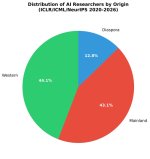
Mainland Chinese researchers now make up 43.1% of all elite AI authors globally—virtually matching Western researchers (44.1%). When you factor in the broader diaspora, researchers of Chinese origin make up 55.9% of the world's top AI talent pool. The country with more Chinese researchers will win in the end.

Beijingwalker
VIP Member

- Thread starter
- #653
China just erased America's AI lead
Illustration: Annelise Capossela/Axios
America's commanding lead in advanced AI is gone.
- A Chinese moonshot — literally and figuratively — has caught up to models that defined the U.S. frontier just weeks ago, at a substantially lower price.
Beijingwalker
VIP Member
- Thread starter
- #654
China Has Caught Up in Frontier AI
by Ryan FedasiukJuly 17, 2026
What’s left is an industrial systems competition.
This week, Beijing-based Moonshot AI made history with the release of its latest model, Kimi K3. At 2.8 trillion parameters, K3 is the largest open-weight model ever released—and by early accounts, it is not only competitive with America’s best closed systems, but trades blows with Anthropic’s Claude Opus 4.8 on mainstream benchmarks.
For years, the conventional wisdom held that Chinese frontier models trailed their American counterparts by six to eight months. That gap has now closed to something approaching a matter of weeks.
Chinese AI labs—and the Communist Party—claim to be democratizing access to near-frontier capabilities, but this is only partially true. Kimi K3 is not exactly downloadable to your laptop. In fact, very few organizations on Earth will be able to host it locally—and understanding this fact reveals a deeper, important trend in the direction of the Sino-American contest to deploy AI services.
K3 is a large model, and large models demand large quantities of compute to run on. Just to hold K3’s 2.8 trillion parameter model weights in silicon—and run it at workable quality—you would need between 1.4 and 2 terabytes of onboard memory. That is roughly equivalent to the memory of dozens of Mac Studios, or a cluster of Nvidia’s Blackwell AI accelerators—an entire server rack in a top-of-the-line data center. For now, that means running Kimi K3 locally requires a compute setup costing hundreds of thousands of dollars, not counting the cost of electricity, cooling, or labor.
When Anthropic released its Mythos model earlier this year, I made this point for The National Interest: China’s model weights may be free, but the infrastructure required to run them is still incredibly costly. This matters enormously for U.S. strategy:
On the one hand, the race to train the most capable model has reached a sort of equilibrium. Chinese labs will distill, replicate, and then open source frontier capabilities within months of their closed-source American counterparts.
On the other hand, the race is now on to build industrial quantities of computational power needed to serve these models at scale. To serve K3 to millions of monthly active users, Moonshot will likely spend billions of dollars on chips and energy to power them—chips that Chinese companies still struggle to produce at scale. Denying Chinese AI labs (or cloud providers) access to high-end compute degrades their ability to directly serve AI to global publics.
What’s more, by open sourcing the frontier, Chinese AI labs have effectively pushed compute costs onto their consumers. Every organization that cannot afford its own NVL72 rack is still forced to access K3 in the same way it accesses ChatGPT or Claude: through someone else’s data center, over someone else’s API. This is why we should expect compute to remain a soft barrier between the capabilities of individuals and those of organizations—and why U.S. offerings will remain competitive for enterprise customers.
The bottom line is that Washington would do well to stop measuring victory in the AI race according to model benchmarks—where China has achieved semi-permanent parity—and start paying attention to the industrial variables that will determine which AI labs are capable of serving intelligence to global publics. These factors include high-bandwidth memory production, advanced packaging capacity, data center construction timelines, and resilient energy grids with spare capacity and high uptime.
Where industrial competition is concerned, the Trump administration’s instincts up to this point have been sound. The administration has aggressively pursued foreign partnerships where American compute can be installed to host American AI workloads. The task now is to keep export controls tight on the memory and chipmaking equipment that China cannot yet make at scale, and to keep building infrastructure in markets friendly to the U.S. tech stack.
Kimi K3 is an important milestone in the U.S.-China AI competition, and Americans should treat it as one—not as a Sputnik moment demanding panic, but as the formal close of the era in which model capability alone conferred lasting advantage.
Frontier AI is quickly becoming a commons. The race now is to build industrial systems that put the frontier to work.


Beijingwalker
VIP Member
- Thread starter
- #655
Stocks in Asia and the United States fell Friday after technological advances announced by a Chinese artificial intelligence company intensified concerns that the AI spending spree driving this year’s market rally could be at risk.
The announcement came from Chinese company Moonshot, which unveiled Kimi K3, its most capable AI model, and one it said closed much of the gap with models such as OpenAI’s ChatGPT and Anthropic’s Claude.
Taiwan’s benchmark stock index closed down more than 6%, while markets in Japan closed down 4% on the news. South Korean markets were closed Friday for a national holiday. The Nasdaq dropped 1.5% Friday, while the S&P 500 fell 0.7%. The Dow was down 60 points, or 0.1%.
Moonshot said Kimi K3 is nearing the performance of cutting-edge models like Anthropic’s Claude Fable 5, resurfacing concerns about competition from companies in China.
Kimi K3 is the world’s largest open-source model, according to Moonshot. Open-source models can pose problems for US AI companies that are trying to charge subscriptions to access their closed-source models. That can also hurt the chipmakers that are betting on a continued AI spending spree.
Chipmakers tumbled, continuing a recent bout of volatility after soaring in recent months. A popular index tracking semiconductor stocks fell more than 2% Friday, putting it down more than 20% since hitting a record high in late June. Chipmaker Micron (MU) is down about 30% since hitting a record high in late June but is still up almost 200% this year.
Competition from alternative, open-source models could hurt forecasts for AI companies’ growth and complicate plans for massive infrastructure spending, which could hurt revenue projections for chipmakers and companies betting on the AI boom.
Breakthroughs by Chinese AI companies have rattled US markets in the past, such as in January 2025, when Chinese artificial intelligence company DeepSeek unveiled a model that challenged assumptions about US dominance in the technology sector.
While Kimi K3 rattled markets Friday, some investors said it needs to be seen just how impactful it will be. US stocks quickly recovered from the DeepSeek scare in January 2025, and tech companies continued to spending on the AI infrastructure buildout.

A Kimi K3 logo on a mobile phone in Suqian, Jiangsu, China, on Friday.
CFOTO/Future Publishing/Getty Images
Shares of Google parent Alphabet (GOOG), which tumbled 4% Thursday after reports it is delaying the launch of a flagship AI model, slipped another 2% Friday.
Nvidia shares (NVDA) were down almost 2% Friday. The company’s market value briefly fell as low as $4.86 trillion, dipping below Apple’s and returning Apple to the status of the world’s most valuable company. Apple shares (AAPL) were down 1%, but are up 14% this month.
It’s been six weeks since the S&P 500 and Nasdaq hit records highs. The S&P is down about 2% since then, while the Nasdaq is down about 6%. Nerves about whether investors were overpaying for AI and tech stocks were already resurfacing in recent weeks, and the announcement of new AI model that could rival the top US models adds to the anxiety.
All told, the S&P 500 is still near record highs. Investors have also rotated into other sectors like financials while moving away from tech stocks. An exchange-traded fund tracking tech stocks is down 7% this month while one tracking financials is up 6%.
Another headwind for stocks was a continued rise in oil futures on US attacks overnight in Iran raising fears about the flow of oil from the Persian Gulf again being cut off. Rising oil prices could drive new inflation concerns which had abated as oil fell since early June on hopes of the war there being over.
Annual inflation measured 3.5% in June, compared to 4.2% in May, according to Consumer Price Index data released Tuesday by the Bureau of Labor Statistics. That came after a steep decline in gas prices as tensions eased in the Middle East.
But oil futures moved back above $85 a barrel in Friday trading, and the US average price of a gallon of regular gas is approaching $4 for the first time in a month, hitting $3.98 in the latest reading from AAA.
“That combination of concerns around tech and inflation has really put a dent in the more buoyant narrative after the soft US CPI report earlier this week,” said Deutsche Bank Research in a note to investors Friday.
Beijingwalker
VIP Member
- Thread starter
- #656
The next DeepSeek? A surprise AI breakthrough in China is rattling US market heavyweights.
By Jennifer SorCN-STR / AFP via Getty Images
Kimi K3 is giving the US AI bulls anxiety.
The new AI model built by Chinese startup Moonshot is the latest headwind pushing against the US AI trade in recent weeks. Kimi K3 is said to rival some of the most advanced AI models built by OpenAI and Anthropic, despite using fewer advanced AI chips. If that sounds familiar, it's a strong parallel to DeepSeek, the Chinese AI model that upended at the beginning of 2025.
Selling picked up steam in the chip sector on Friday as investors digested the news along with ongoing concerns about whether tech giants have been spending too much on AI hardware and what a pullback in capex could mean for the wider ecosystem.
The Philadelphia Semiconductor Index fell 4% on Friday. The index, which just logged its best-ever first half of the year, is down 19% from its recent peak, nearing the threshold for a technical bear market.
The release of Kimi K3 is sparking fears of a "DeepSeek 2.0," JPMorgan strategists wrote, referring to the $1 trillion rout in tech stocks last year as investors fretted over the open source model that was reportedly built with cheaper hardware.
"Whatever gap existed between American and Chinese frontier AI just got a lot smaller, and it happened on the exact morning Wall Street was busy convincing itself AI economics don't add up," Mark Malek, the CIO of Siebert Financial, wrote about the market's reaction on Friday.
"While the broader rotation out of AI CapEx receivers has been underway for several weeks, today's move was likely catalyzed by Chinese AI startup Moonshot releasing its new open-weight model, Kimi K3," Kent Fung, the vice president of market intelligence at Fundstrat, wrote in a note.
All three major indexes were dragged into the red as the sell-off rocked global stocks. The tech-heavy Nasdaq 100 tumbled nearly 2%.
The next DeepSeek? A surprise AI breakthrough in China is rattling US chip stocks
Kimi K3, a new AI model in China, rivals advanced US models, sparking fears of another "DeepSeek" moment in markets.
 www.businessinsider.com
Beijingwalker
VIP Member
- Thread starter
- #657
Beijingwalker
VIP Member
- Thread starter
- #658
A Chinese AI Model Just Shot to Number One on the Charts, Sending Shockwaves Through the American Tech Industry
US tech execs are shaking in their boots.By Joe Wilkins
Published Jul 17, 2026 11:54 AM EDT
While Wall Street was fast asleep, a Chinese-made large language model quietly leapfrogged 16 other models to become number one on the AI charts.
The model is called Kimi-K3, developed by Beijing-based firm Moonshot AI. On Thursday, the AI benchmark platform Arena.ai announced that Kimi had gone from number 17 in the “Frontend Code Arena” — a measure of an LLM’s ability to perform multi-step web development tasks — to number one, surpassing the buzzy Claude Fable 5 and GPT-5.6 Sol by a mile.
In the “Text Arena,” a measure of an LLM’s ability in text-to-text tasks like creative writing, Kimi-K3 earned the number nine spot, a significant improvement from Moonshot AI’s previous model, Kimi-K2.6, which held number 38.
The news comes as investors are facing a major reckoning, with US semiconductor stocks plummeting on Friday morning and the tech-heavy Nasdaq composite sliding by 1.4 percent. Those losses are extending a horrible week for tech stocks, which had been driven by concerns over an all-American AI bubble.
The moniker, “Moonshot,” might be an understatement. The major catch here is that not only did a Chinese AI model surpass every US-designed model in front-end coding in a benchmark, it did so using a dramatically different approach.
Just like DeepSeek, a similar Chinese AI model that rankled the US stock market last year, Kimi is an open-weight model, meaning its inner workings are viewable to the public. Compared to proprietary models like GPT-5.6 that are kept under lock and key, open models cost users on average six times less, though their performance has historically been ever-so-slightly worse than their closed counterparts.
Responding to the news, Xiaoyin Qu, former Meta senior product manager turned AI entrepreneur, posed an important question: “When the best open weight model exceeds the best closed-source model, how does [Anthropic] justify its Fable pricing? Why would anyone pay for that?”
Even before Kimi-K3 dropped, the proposition of paying up to six times more for the slight performance boost offered by closed models was already pushing US companies toward Chinese AI. Now that the performance gap is closing fast, there’s even less reason for companies or individuals to pay exorbitant prices associated with Silicon Valley’s frontier models.
That simple math is bad news for the US tech industry, which has spent years insisting that it will take trillions of dollars to make AI work.
As Qu observed, “Kimi’s most recent funding round values the company at $20 Billion as of two months ago. Anthropic is worth almost 1 trillion, 50x. Why?”
A Chinese AI Model Just Shot to Number One on the Charts, Sending Shockwaves Through the American Tech Industry
An open-source large language model developed in Beijing just shot to the top of the leaderboard for front-end coding tasks.
 futurism.com
冖_冖
Registered Member
Sacks warns US risks losing AI edge after new Chinese model launch
Former White House AI and cryptocurrency czar David Sacks argued Friday that the U.S. is “tying itself in knots” over AI and risking its competitive edge, following the release of a new Chinese model.
Kimi K3, a new model from the Chinese startup Moonshot AI, sent shockwaves through the American AI industry Thursday after its developers claimed it could perform on par with Anthropic and OpenAI’s leading models.
The AI evaluator Arena also bumped Kimi to the top of its rankings for front-end coding, prompting Sacks to describe the development as “concerning.”
“Meanwhile America is tying itself in knots: politicians and bureaucrats are banning new data centers, piling on state regulations, and pushing for new federal agencies to pre-approve frontier models,” the venture capitalist wrote in a post on social platform X.
“This is how you lose the AI race,” he continued. “The rest of the world won’t play by our rules if we bog ourselves down. Permissionless innovation is how America won the internet and became the technological envy of the world. We can do it again with AI — while addressing risks in a targeted way — or we’ll watch our lead evaporate.”
Sacks, who announced his departure from the White House in late March, has at times appeared at odds with portions of the Trump administration’s recent approach to AI regulation.
In the face of new, more powerful models, the White House has struggled to balance its avowed commitment to unhampered innovation with growing cybersecurity concerns.
President Trump signed an order in early June to create a voluntary testing framework in which AI companies could share their models with the government up to 30 days before releasing them publicly. It marked a scaled-back version of an order that Sacks reportedly opposed.
However, following the release of Anthropic’s new Fable and Mythos models last month, the administration hit the company with an export control order, prompting the firm to pull both models. The White House ultimately lifted the restrictions in late June.
OpenAI separately announced it would first roll out its new GPT-5.6 model to a limited group of partners at the request of the government. It publicly released the model several weeks later in July.
The White House emphasized at the time that it did not give the company a “green light” approval to release its models and that “no such permission is required or granted.”
Users who are viewing this thread
Total: 3 (members: 0, guests: 3)
Pakistan Defence Latest
-
PTI Murad Saeed in Afghanistan, was 'controlling KP govt' from there: Rana Sanaullah (23 Viewers)
- Latest: HAIDER
-

-
 Federal cabinet gives nod to imposition of emergency in KP; summary sent to president (12 Viewers)
- Latest: Meengla
-

-

Country Watch Latest
-
 DRDO successfully conducts maiden flight tests of Integrated Air Defence Weapon System (6 Viewers)
- Latest: Faceless
-

-
-
Latest Posts
-
 Makkah Defence Alliance: Turkey, Saudi Arabia, and Pakistan, news & updates (50 Viewers)
- Latest: Starlord
-
PTI Murad Saeed in Afghanistan, was 'controlling KP govt' from there: Rana Sanaullah (23 Viewers)
- Latest: HAIDER
-

-

-