Navigation
Install the app
How to install the app on iOS
Follow along with the video below to see how to install our site as a web app on your home screen.
Note: This feature may not be available in some browsers.
More options
Style variation
You are using an out of date browser. It may not display this or other websites correctly.
You should upgrade or use an alternative browser.
You should upgrade or use an alternative browser.
DeepSeek, China's AI model: News & Discussion
- Thread starter Beijingwalker
- Start date
More options
Who Replied?


Beijingwalker
VIP Member
- Thread starter
- #678
China's new AI model halts new subscriptions as demand swamps capacity
The Chinese AI model Kimi K3 has suspended new subscriptions after overwhelming demand pushed its capacity close to its limitsJuly 20, 2026, 6:16 PM
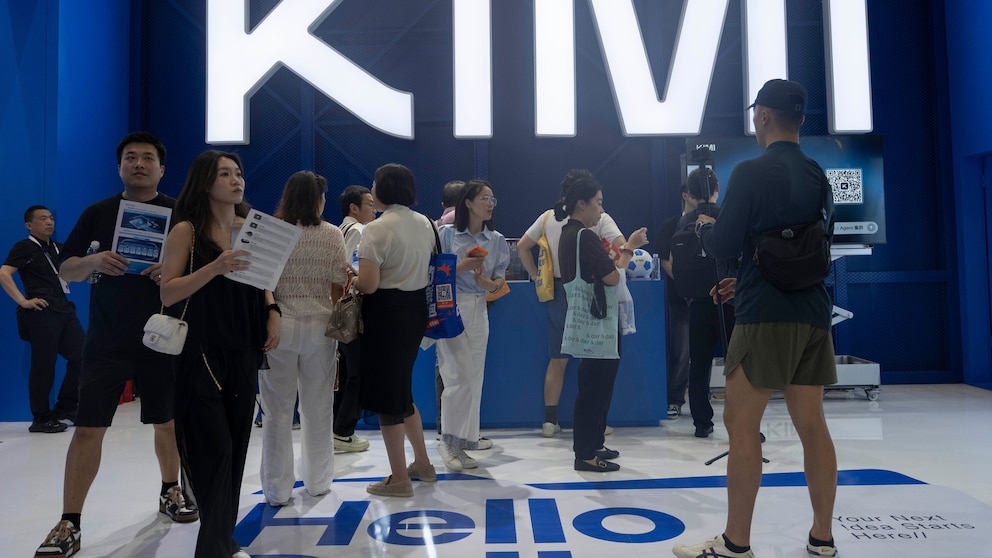
HONG KONG -- The new, powerful Chinese artificial intelligence model Kimi K3, which has caused a stir in the U.S. tech industry, has suspended new subscriptions after a flood in demand overwhelmed capacity within days of the launch.
The development highlighted challenges faced by Chinese AI models in serving a growing user base at home and abroad at a time the U.S.-China tech race is heating up.
Chinese open-source, lower-cost advanced AI models, including DeepSeek’s latest V4, have been moving fast in gaining global attention. In early 2025, DeepSeek shook world markets and helped China to be recognized as a serious competitor to the U.S., where Chinese frontier AI models are largely open source, meaning they are made accessible for people to examine and build upon.
“Kimi K3 has received far more love than we expected,” Moonshot AI, which is Beijing-based, wrote in a X post late on Sunday. “Over the past 48 hours, demand has pushed close to the limits of our current capacity.”
Moonshot said that it’s prioritizing existing subscribers and would be temporarily pausing new ones. “We’re adding capacity as fast as we can and will reopen new subscription spots in batches," it added. The AI startup also posted a similar message on Chinese social media.
K3’s public rollout late last week, aiming at challenging more advanced AI models by Anthropic,OpenAI and others, has rattled U.S. rivals. At 2.8 trillion parameters, a measurement of an AI model’s capabilities, it's deemed as the world’s largest open-source AI model.
“New model releases generally trigger massive interest, which can strain existing compute infrastructure,” said Lian Jye Su, a chief analyst at the technology research and advisory group Omdia. “This does show Moonshot AI does not have sufficient compute chips to serve the current surge in demand.”
Su said that the key reason was more likely due to Moonshot not fully anticipating the surge in K3’s popularity. K3 is “very demanding” in terms of compute requirements, he said, making compute allocation challenging and expensive.
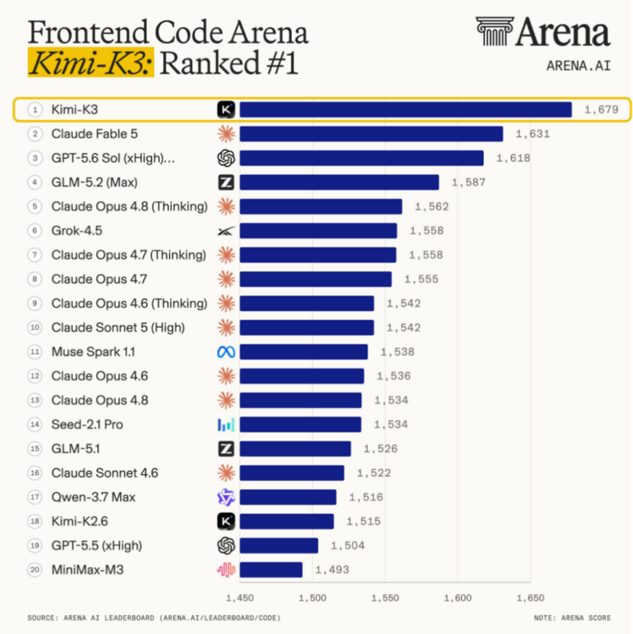
By measure of front-end coding capability, a metric for AI models’ performances, Kimi K3 topped the chart of the major advanced AI models in rankings on Arena — an AI model evaluation platform — after its public release.
K3’s release has also put pressure on stocks of American technology titans on worries that more affordable Chinese AI models may undercut the pricing power and demand at the U.S. AI companies, even as U.S.-led restrictions have already barred China from accessing some of the world’s advanced technologies, including the most cutting-edge chips.
K3 is one of the latest new Chinese AI models coming out that have drawn strong global reactions.
Over the weekend, China’s Alibaba also previewed its latest Qwen3.8 Max AI model, which the tech giant said had 2.4 trillion parameters as one of the world’s most powerful models and was second only to Anthropic’s Fable 5. Last month, Chinese startup Zhipu, or Z.ai, also rolled out its GLM-5.2 model, which saw rapid adoption across the world.
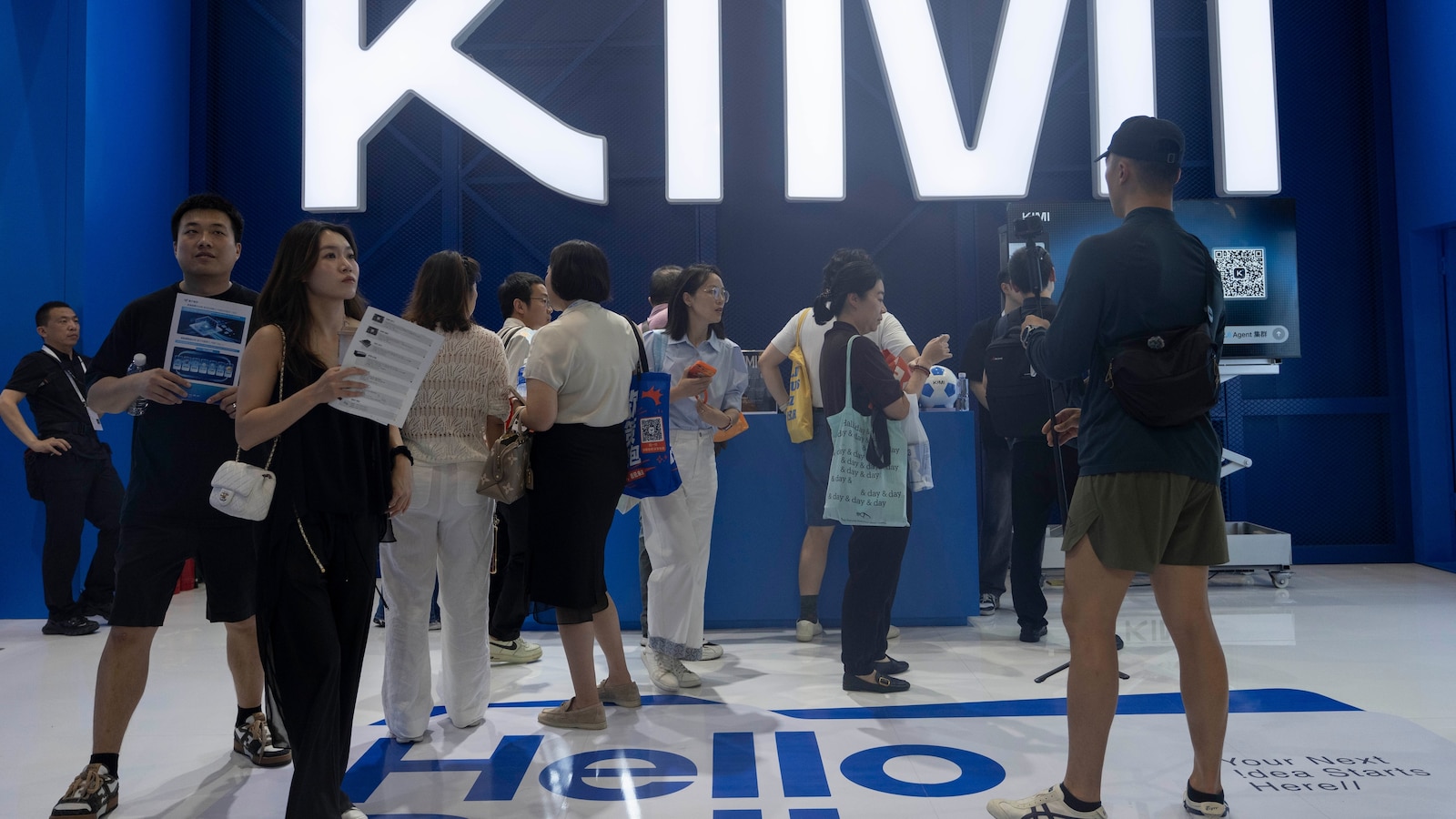
China's new AI model halts new subscriptions as demand swamps capacity
The Chinese AI model Kimi K3 has suspended new subscriptions after overwhelming demand pushed its capacity close to its limits
 abcnews.com

Ali_Baba
VIP Member

ChillVein
Registered Member

The resource pool of an ordinary OpenAI researcher is enough to straight-up pin domestic teams to the ground and rub their faces in it. But flip it around: Kimi and Zhipu pulling off this level of performance under such tight resources is pretty damn impressive too. If Zhipu could pump up its parameter count more it would smoke Gpt and Claude

F-22Raptor
Elite Member

The only way China can compete with the US is through the theft of American tech and know how.
Beijingwalker
VIP Member
- Thread starter
- #684
The only way China can compete with the US is through the theft of American tech and know how.
Most top AI scientist in both China and US are Chinese, how can Chinese steal from Chinese?
Beijingwalker
VIP Member
- Thread starter
- #685
World’s Open Intelligence Now Runs Through China
July 22, 2026- The K3 model from China’s Moonshot AI, announced on July 16, has already taken first place in Arena’s Frontend Code ranking, surpassing Claude Fable 5 by 48 points.
- There are credible Western open models, but there is still no non-Chinese open model with the same capability band as K3 or GLM-5.2.
- Kimi K3 is more than another Chinese model closing another benchmark gap. It marks the moment open intelligence itself becomes a geopolitical dependency.
China’s Moonshot AI announced its K3 model on July 16 with 2.8 trillion parameters, native multimodality and a one-million-token context window. Its weights are due on July 27, so it remains an announced open-weight model rather than a released one. Yet K3 already takes first place in Arena’s Frontend Code ranking, surpassing Claude Fable 5 by 48 points. The gap is wider than the one between Claude Fable 5 and OpenAI’s GPT-5.6 Sol (Extreme High).
Kimi K3: Open-Weight Leader Challenging Top Closed Models
World’s Open Intelligence Now Runs Through China
China’s Moonshot AI announced its K3 model on July 16 with 2.8 trillion parameters, native multimodality and a one-million-token context window.
 counterpointresearch.com
Beijingwalker
VIP Member
- Thread starter
- #686
The only way China can compete with the US is through the theft of American tech and know how.
Sour Grape US officials, LOL

US' allegations against Chinese AI models reflect anxiety over China's AI rise, risk undermining global tech cooperation: experts
Published: Jul 22, 2026 02:58 PM

Artificial intelligence Photo: VCG
The US administration will reportedly investigate whether Chinese artificial intelligence (AI) models were "distilled from American models," US Treasury Secretary Scott Bessent claimed on Tuesday, according to a CNBC report. A Chinese expert said that Bessent's remarks once again reflected the anxiety among certain US politicians over China's rapid advances in AI and their continued adherence to a technological hegemony mindset.
Bessent's remarks came as Chinese open-weight models are gaining steam against leading offerings from American companies like OpenAI and Anthropic, sparking concerns from tech executives and government officials about the durability of the US lead in the AI race, the CNBC reported.
Earlier this month, Moonshot AI, a Chinese AI startup, unveiled Kimi K3, a model with its overall intelligence level close to that of globally leading closed-source models as revealed by evaluations, the Xinhua News Agency reported.
Bessent claimed in an interview with Fox Business on Tuesday that if the administration found overseas models are "stealing from US companies," it would have the ability to impose sanctions over the alleged move.
According to a Reuters' report on Tuesday, the US and China are planning to hold talks around AI in September.
Commenting on the latest claims from the US side, Chinese experts said that they once again showed that certain US officials, instead of focusing on strengthening their own innovation capabilities, have repeatedly sought to contain Chinese technology companies through political pressure, threats of sanctions, and groundless claims.
"Such actions cannot make the US more competitive in the field of AI. Rather, they will only complicate the global environment for technological cooperation, while reflecting the anxiety among certain US politicians over China's rapid advances in AI and their continued adherence to a technological hegemony mindset," Zhou Mi, a senior researcher at the Chinese Academy of International Trade and Economic Cooperation, told the Global Times on Wednesday.
From DeepSeek V4 to the latest Kimi K3, a growing number of Chinese large language models have made significant advances across various evaluation benchmarks and capabilities.
Recently, after Kimi K3, an open-source AI model developed by Chinese startup Moonshot AI with 2.8 trillion parameters, attracted far more user traffic than expected following its launch last week, the company said on Sunday that it was facing growing computing capacity challenges. As a result, it decided to temporarily suspend new consumer subscriptions starting Sunday.
Zhou said that China's advances in AI are driven by broad market applications, sustained innovation, advanced infrastructure, well established supply chains, a robust industrial ecosystem, as well as the country's long-term commitment to supporting scientific and technological development. These advantages have also helped enhance China's appeal to global and domestic AI talent, the expert noted.
The global AI market offers enormous opportunities, and companies from all countries can achieve shared growth through fair competition, Xiang Ligang, a veteran industry analyst, told the Global Times on Wednesday, noting that what truly drives industrial progress is innovation and the market, not political interference.
Even if the US imposes sanctions on Chinese AI companies, as it has done with many Chinese technology firms through restrictions on advanced chip exports and other unilateral measures, such actions are unlikely to achieve their intended effects, Xiang said. The expert noted that China's AI development does not rely solely on US computing resources, while US companies and developers also benefit from innovations, open-source models, and technological progress emerging from China's AI sector.
Last summer, the US Commerce Department circulated draft rules within the administration that would leverage its authority to secure domestic supply chains to target Chinese open-source models, US media outlet Axios reported, citing a source. However, administration officials concerned that regulation could stifle innovation blocked all those efforts. Since then, key voices, including former White House adviser Sriram Krishnan, have left the administration, while national security hawks have grown increasingly vocal, Axios reported.
China has now the largest number of AI patents, over 1.2 trillion yuan worth of core AI industry, and over 6,200 AI companies, making China an important world engine of smart transition.
Responding to a media inquiry for comment about a report released by the Boao Forum for Asia Annual Conference 2026, which noted that global AI development is exhibiting a pronounced "shift eastward" trend and that China has achieved full-chain industrial maturity with robust capabilities in large-scale deployment, Chinese Foreign Ministry spokesperson Lin Jian said at a regular press conference in March that AI is the common asset of humanity. The flourishing AI sector in China comes from greater self-reliance and strength in science and technology, and is fueled by China's vision of extensive consultation and joint contribution for shared benefit, said Lin.
China encourages open source to make AI more accessible, the spokesperson said, noting that we stand ready to work with all sides to deepen communication and cooperation, and jointly build an open, inclusive and mutually beneficial environment for development, so that AI could truly become an international public good for good and for all.
ChillVein
Registered Member
Andrew Ng: Maybe I'm the only person in the world who has had both Sam and Dario working under me."There's one thing I absolutely wouldn't have guessed a few years ago: that China would ultimately become far more open than the United States in terms of ways of innovating in AI.I know the U.S. AI ecosystem extremely well because I founded Google Brain and so on. Maybe I'm the only person in the world who has had both Sam and Dario working under me. So I'm very familiar with the people on their teams.When ChatGPT was released at the end of 2022, the U.S. was far ahead of China. But since then, China has played its cards well—betting on open source, an open weights ecosystem. Chinese teams conduct research and release their research papers for free on the internet, where anyone can read them.By the way, many top U.S. teams read a ton of Chinese research papers, learning from them and benefiting greatly. Frankly speaking, a lot of the technology now used by top U.S. teams comes from research innovations they learned from China. So I think knowledge sharing is two-way."
lightning f57
Trusted Member
Anthropic and ClosedAI crying about Chinese companies distilling from their models is the kettle calling the pot black, the copyright theft they have done to train their models has got them where they are today.
I really would like Chinese companies like Qwen to release more smaller weight open source models, Qwen 3.6 27b has been great for coding, I want a Qwen 3.8 32bn release please!!
I really would like Chinese companies like Qwen to release more smaller weight open source models, Qwen 3.6 27b has been great for coding, I want a Qwen 3.8 32bn release please!!
Users who are viewing this thread
Total: 1 (members: 0, guests: 1)
Pakistan Defence Latest
-
 Federal cabinet gives nod to imposition of emergency in KP; summary sent to president (5 Viewers)
- Latest: Goenitz
-

-
-
-
Country Watch Latest


Latest Posts
-

-

-
Federal cabinet gives nod to imposition of emergency in KP; summary sent to president (5 Viewers)
- Latest: Goenitz
-

-