
MNZGamerX
Registered Member

July 18, 2026
By: Kristian Alexander
Recent reports of Israeli intelligence penetration of Iran’s ruling elite reveal the tensions within its regime-change strategy.
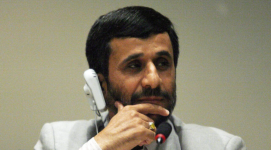
The reported Israeli effort to cultivate former Iranian president Mahmoud Ahmadinejad as a possible leader of a post-Islamic Republic Iran appears improbable. According to investigations by The New York Times and Haaretz, Mossad allegedly cultivated Ahmadinejad over several years because, despite his estrangement from Iran’s leadership, he retained revolutionary credentials, populist appeal, and domestic name recognition that exiled opposition figures lack.The allegations remain largely unverified and rely heavily on anonymous intelligence sources. For his part, Ahmadinejad denied that he had worked with Israeli intelligence and dismissed the New York Times reporting as “psychological warfare.” Whether or not every operational detail is accurate, however, the reporting raises broader questions about Israeli regime-change strategy, political legitimacy and the growing overlap between intelligence operations and information warfare.
If the reporting is accurate, it suggests Israel viewed regime change more pragmatically than ideologically. Rather than seeking a democratic reformer, planners may have prioritized someone with some revolutionary legitimacy who could stabilize a post-conflict Iran while redirecting its strategic orientation. Ahmadinejad’s value lay not in his policies but in his political identity. Unlike exiled opposition figures, he retained symbolic and popular weight inside Iran and understood the institutions of the Islamic Republic. The implication is that Israeli planners saw a form of political continuity, not democratic transformation, as the best chance of avoiding the instability that followed Iraq and Libya.
If the reporting is broadly accurate, it also exposes an important contradiction in Israel’s public messaging.
Israeli officials have frequently suggested that military pressure would encourage Iranians opposed to the regime to revolt against it. However, cultivating Ahmadinejad would imply that Israeli intelligence itself doubted whether liberal or Western-oriented opposition movements possessed sufficient domestic legitimacy to govern after regime collapse.
Instead, Israel appears to have hedged its bets among multiple scenarios: a popular uprising, fragmentation within the ruling elite, or a controlled political transition led by an insider with revolutionary credentials. Those scenarios are not mutually exclusive, but they point to uncertainty rather than confidence regarding who would ultimately succeed the current leadership.
More fundamentally, the alleged operation illustrates a recurring limitation of externally driven regime change. Intelligence services may successfully weaken or even dismantle an adversarial regime, but they cannot easily manufacture political legitimacy. Similarly, military success does not automatically translate into a viable political order.
An obvious question concerns Iranian counterintelligence. As a former president, Ahmadinejad’s foreign contacts would likely have attracted the attention of Iran’s intelligence services. One possibility, largely unexplored in the reporting, is that he appeared receptive to Israeli approaches while simultaneously informing Tehran. In that scenario, Mossad’s apparent recruitment could instead represent a controlled counterintelligence operation, or simply Ahmadinejad attempting to play both sides. Intelligence history offers many such examples. The available evidence cannot distinguish between these possibilities.
An equally plausible interpretation is that the disclosure itself forms part of a broader information campaign.
Even if the alleged operation ultimately failed or never existed exactly as described, its publication serves important strategic purposes. It reinforces Mossad’s reputation for penetrating the highest levels of the Iranian system while simultaneously encouraging suspicion within Iran’s political elite.
The accusation is particularly damaging because it involves a former president who once embodied the Islamic Republic’s revolutionary identity. If Israel could cultivate someone like Ahmadinejad, then almost any senior Iranian official becomes a potential suspect of collaboration.
This reflects a broader characteristic of modern intelligence competition: covert operations increasingly produce value even after they become public. Once operational secrecy is lost, disclosure itself can become a weapon. Stories of penetration force governments to investigate their own officials, deepen factional mistrust and consume political attention.
Whether entirely accurate or selectively presented, the Ahmadinejad story may therefore generate strategic effects regardless of its ultimate factual completeness.
Israel clearly benefits if the reporting intensifies distrust inside Iran’s leadership while advertising Mossad’s intelligence capabilities. Even an unsuccessful recruitment effort can become a successful psychological operation if it forces Tehran to question the loyalty of senior figures.
The Iranian leadership may also derive advantages. If Ahmadinejad retains a meaningful political following, allegations of cooperation with Mossad could discredit a troublesome rival and justify his further marginalization.
American officials may still have different motivations. Leaking aspects of Israeli contingency planning could either demonstrate that military action was accompanied by political planning or, conversely, expose the unrealistic assumptions underlying Israeli expectations of rapid regime collapse.
These interests are not mutually exclusive. The same story can simultaneously serve Israeli psychological objectives, Iranian factional politics and American bureaucratic debates.
Whether the allegations about Ahmadinejad prove correct or not, they highlight an enduring limitation of intelligence operations.
Israel has demonstrated remarkable operational reach inside Iran through sabotage, assassinations, intelligence penetration and covert action. Those successes may have encouraged confidence that political outcomes could also be shaped from the outside. Nonetheless, penetrating a security establishment differs fundamentally from reconstructing an entire political system.
Iran remains a large, highly nationalistic society in which opposition to the Islamic Republic does not necessarily translate into acceptance of foreign intervention. Many Iranians critical of clerical rule would almost certainly reject a leader perceived as having been installed by Israel. This creates an inherent paradox. Ahmadinejad’s political value depended upon his nationalist credibility. If that credibility rested on the perception that he remained independent, any confirmed relationship with Mossad would likely destroy precisely the legitimacy Israel hoped to exploit.
The episode therefore illustrates the distinction between destabilization and reconstruction. Intelligence services may excel at weakening adversaries and exploiting elite divisions, but creating a broadly legitimate post-conflict political order requires forms of political authority that covert action alone cannot provide.
The Ahmadinejad story should not be understood simply as a question of whether the reporting is true or false. Several explanations remain plausible. Israel may genuinely have cultivated Ahmadinejad while exaggerating the sophistication of its regime-change planning. Ahmadinejad may have attempted to manipulate both Israeli and Iranian intelligence simultaneously. Iranian authorities may have monitored the relationship, while the public disclosure itself may represent a deliberate effort to deepen elite mistrust inside Iran.
Perhaps the most important lesson is that intelligence operations and information warfare have become increasingly intertwined. A failed recruitment effort can become a successful psychological operation. A partially true story can produce strategic effects regardless of whether every operational detail is accurate. The uncertainty itself becomes part of the weapon.
Ultimately, the episode reveals both the strengths and the limitations of Israeli strategy toward Iran. Mossad has repeatedly demonstrated extraordinary capabilities to penetrate Iranian institutions and exploit internal vulnerabilities. Yet influencing political succession is considerably more difficult than infiltrating security services. Intelligence can destabilize regimes, but it cannot easily manufacture legitimacy.
Whether the Ahmadinejad affair represents a genuine recruitment operation, a sophisticated Iranian counterintelligence effort, or a carefully timed information campaign, it underscores a broader reality of the Israeli-Iranian shadow war: In today’s intelligence competition, perceptions are often as strategically valuable as facts, and uncertainty has become one of the most powerful instruments of statecraft.


