Beijingwalker
VIP Member

DJI and Insta360 Command 87% of Global Handheld Camera Shipments; GoPro's Share Drops Below 6%
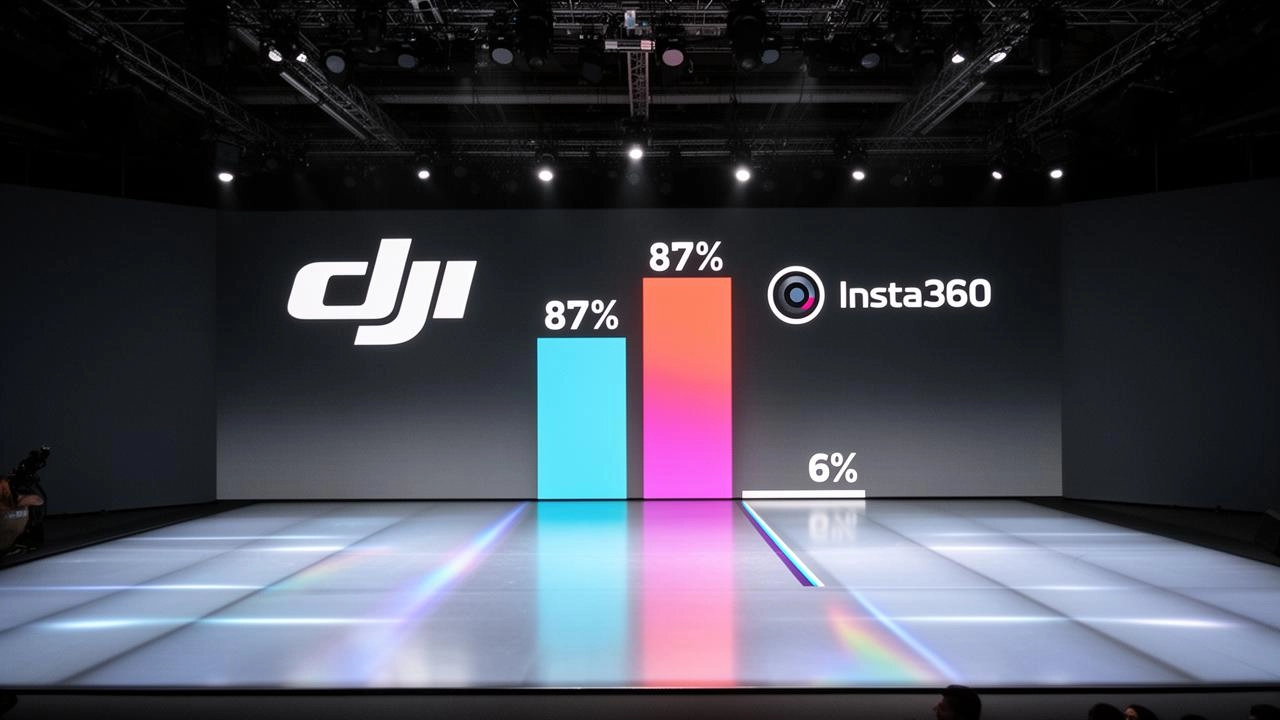
2026-06-27 03:07 (GMT+8)Global handheld smart camera shipments reached 4.14 million units in Q1 2026, up 33% year-over-year, with sales exceeding 10.5 billion yuan (approximately $1.5 billion), according to IDC. Chinese manufacturers DJI and Insta360 have cemented their dominance, capturing a combined 87% market share by volume. DJI led with 2.7 million units shipped and a 65% share, while Insta360 followed with 900,000 units and a 22% share, posting the fastest growth among major brands at 66%. GoPro's shipments plummeted 33% to just 300,000 units, with its market share falling below 6% for the first time, effectively pushing it out of mainstream competition. In sub-segments, DJI and Insta360 together claimed over 85% of sales revenue in the broader action camera market, while Insta360 maintained a 71% revenue share in 360 cameras. IDC projects the global market will surpass 40 million units by 2030, with a five-year compound annual growth rate approaching 18%, and China accounting for more than half of all shipments.
Key Elements
The global handheld smart camera market is accelerating into a new era dominated by Chinese manufacturers. According to the latest report from International Data Corporation (IDC), global handheld smart camera shipments reached 4.14 million units in the first quarter of 2026, up 33% year-over-year, with sales exceeding 10.5 billion yuan (approximately $1.5 billion), a 20% increase. Against a backdrop of sluggish recovery in the broader consumer electronics market, this niche segment has demonstrated remarkable growth resilience.
Chinese companies DJI and Insta360 continue to lead with overwhelming dominance, together capturing 87% of shipment market share, while former industry benchmark GoPro has been further marginalized, with shipments plunging 33% year-over-year and its market share falling below 6% for the first time, leaving it with a survival space of roughly just 6%.
Concentration at the Top Intensifies as GoPro Retreats to the Fringe
IDC data shows that in Q1 2026, DJI maintained its position as the global leader with 2.7 million units shipped, commanding a 65% market share and growing 38% year-over-year, outpacing the industry average. Insta360 ranked second with 900,000 units shipped and a 22% market share, achieving a 66% year-over-year growth rate — the fastest among major brands.
GoPro's decline trajectory has steepened considerably. During the quarter, its shipments totaled approximately 300,000 units, with market share sliding from 10.8% for full-year 2025 to just 6%, representing a 33% year-over-year drop. The remaining brands collectively shipped around 240,000 units, accounting for roughly 7% of the overall market. Industry resources are further concentrating at the top, with the top three brands now commanding over 93% of the market combined.
Compared to full-year 2025 data, when DJI, Insta360, and GoPro held shipment shares of 62.4%, 20.4%, and 10.8% respectively, the two Chinese brands have both significantly expanded their share in just one quarter, while GoPro's share experienced a cliff-like decline. From a revenue perspective, GoPro's contraction is even more alarming — its global revenue share was approximately 17% in Q1 2025, shrinking to single digits by Q1 2026, effectively exiting mainstream competition. Over the same period, DJI's revenue share climbed from 52% to 61%, gaining 9 percentage points year-over-year.
Two-Horse Race in Sub-Segments; 360 and Thumb Cameras Become Growth Engines
In the broader action camera market, DJI and Insta360 are locked in a two-horse race. Combining IDC report data with e-commerce sales figures, the two companies hold 43.8% and 41.2% of sales revenue market share respectively, together commanding over 85% of the market, while GoPro is left with just 10.7%.
Insta360 continues to hold the dual crown for global sales volume and revenue in the 360 camera segment, with a revenue market share of 71%, an improvement from 2025. Its wide-angle action camera sales revenue grew 77% year-over-year, 360 camera sales revenue rose 46%, and the thumb camera category achieved a 116% year-over-year sales revenue increase, driven by new product launches.
DJI, leveraging its full-category portfolio advantage, is simultaneously pushing forward across multiple tracks including action cameras, gimbal cameras, and wearable cameras. Its Action series action cameras have rapidly penetrated the traditional action camera market, the Pocket series gimbal cameras continue to lead the pocket gimbal segment, and the wearable Osmo Nano product is quickly capturing emerging markets. The IDC report specifically notes that in the detachable action camera (thumb camera) category, DJI's Osmo Nano single-product shipment market share exceeds 50%, achieving a leap from market entrant to shipment leader.
Looking at sub-segment market sizes, global action camera shipments approached 2.01 million units in Q1 2026, up 39% year-over-year, though the average unit price declined 11% year-over-year to 2,149 yuan (approximately $316). The primary wave driving high-speed market growth stems from strong sales of hit products from DJI and Insta360, along with aggressive promotional pricing on previous-generation products. Among these, detachable action camera (thumb camera) shipments grew over 350% year-over-year, making it the fastest-growing category. Gimbal camera shipments grew over 18% year-over-year, with an average unit price of 2,840 yuan (approximately $418), down 12.5% year-over-year. 360 camera shipments exceeded 500,000 units, growing over 55% year-over-year, with Insta360 maintaining its top position in this segment with over 68% shipment share.
Technology Migration and AI Empowerment Broaden Market Boundaries
The advantage of Chinese manufacturers is reflected not only in market share but also in deep technological accumulation. IDC analysis indicates that DJI has migrated core technologies from the drone sector — multi-axis gimbal stabilization systems, imaging and multi-sensor fusion technology, flight and motion control systems — to handheld smart imaging devices, creating a full-series product matrix with high reliability and ease of use. A well-established supply chain system ensures excellent cost resilience and the ability to customize upstream core components. Demand for its Pocket4 new product during the pre-sale period was strong, and third-generation products maintained high sales momentum after strategic price adjustments.
Insta360, leveraging years of technological accumulation in the 360 camera field, has built unique competitive moats in differentiated application scenarios and software. Its system application software has gained widespread recognition among a massive user base for stitching algorithms, multi-scenario stabilization, deep subject tracking, and AI one-click editing. In the non-detachable action camera segment, the AcePro2 street photography kit has been a hot seller, with shipment market share reaching a record high exceeding 17%.
AI is becoming the core variable in the evolution of handheld smart imaging terminals. Currently, AI functions are mainly concentrated on functional applications such as scene depth perception, intelligent noise reduction, multi-frame synthesis algorithms, low-light image enhancement, and post-production intelligent clip editing. IDC predicts that the future vision for AI integration into handheld smart imaging terminals is to become the foundation and brain of intelligent imaging robot terminals, evolving from passive image recording terminals into super intelligent agents capable of proactively generating creative content based on massive data collection and user demands.
China Accounts for Half the Market; Global Penetration Remains Low
From a regional market perspective, China has become the largest market for handheld smart cameras. In 2025, China contributed more than half of global shipments, and this trend continued with an even greater contribution in Q1 2026. Outside of China, the United States, Western Europe, Asia-Pacific, and Japan are the top four global markets. Product channel marketing in overseas markets is one of the core areas where Chinese manufacturers are investing resources.
IDC offers an optimistic long-term outlook, projecting that global handheld smart camera market shipments will exceed 40 million units by 2030, with a five-year compound annual growth rate approaching 18%. The report notes that penetration of the handheld smart camera market remains low, and the market maintains high enthusiasm whether from the perspective of industrial capital and upstream/downstream supply, or from end-user consumers. Every sub-product line has a projected five-year compound growth rate exceeding 15%.
The underlying logic of the market's high-speed growth is a two-way convergence of user demand and product form. The traditional digital SLR camera market is on a downward trajectory, with its audience concentrated among professional photography enthusiasts and plagued by pain points of insufficient portability and high average prices. Handheld smart cameras precisely address the imaging needs of a vast number of content creators for lightweight, intelligent, shoot-and-use devices, with product forms covering diverse scenarios from extreme sports to daily vlogs to panoramic recording, accelerating the transition from a niche "geek toy" to a "universal second imaging system." Continuous technological investment by leading manufacturers is constantly expanding category boundaries, with rapid iteration of features such as gimbal stabilization, AI editing, and multi-camera collaboration lowering the barrier to high-quality image creation and further opening up space in the mass consumer market.
Due to seasonal factors following major e-commerce promotions in the fourth quarter of last year, the market size in Q1 2026 experienced a normal sequential decline, but the core year-over-year growth trend remains unchanged, and the industry as a whole is still on an explosive growth trajectory. With Insta360's new gimbal camera shipping globally in the second quarter, and GoPro's market performance following the release of its M1 series next-generation action camera and the Max2 panoramic new product still to be observed, variables remain in the competitive landscape of the global handheld smart camera market, but the dominant position of Chinese manufacturers has become increasingly entrenched.