DRDO successfully conducts maiden flight tests of Integrated Air Defence Weapon System

Raj-Hindustani

Elite Member
Joined
May 4, 2019
Messages
9,837
Reaction score
8,162
Reputation
1,591.1
Country of Origin
Country of Residence

.DRDO successfully conducts maiden flight tests of Integrated Air Defence Weapon System​

“This unique flight test has established the multi-layered air-defence capability of our country and is going to strengthen area defence for important facilities against enemy aerial threats,” says Rajnath Singh​

Updated - August 24, 2025 10:54 am IST - New Delhi
The Hindu Bureau
GzFrSrPWAAAt_v1.jpg

DRDO successfully conducted maiden flight tests of the Integrated Air Defence Weapon System off the coast of Odisha. Photo: X/@rajnathsingh


The Defence Research and Development Organisation (DRDO) successfully conducted the maiden flight test of the Integrated Air Defence Weapon System (IADWS) on Sunday (August 23, 2025) at 12.30 hours off the coast of Odisha.The Defence Research and Development Organisation (DRDO) successfully conducted the maiden flight test of the Integrated Air Defence Weapon System (IADWS) on Sunday (August 23, 2025) at 12.30 hours off the coast of Odisha.
According to DRDO, the IADWS is a multi-layered air defence system, entirely developed indigenously, and comprises Quick Reaction Surface-to-Air Missiles (QRSAMs), Advanced Very Short Range Air Defence System (VSHORADS) missiles, and a high-power laser-based Directed Energy Weapon (DEW).

Defence Minister Rajnath Singh congratulated DRDO, the Armed Forces, and the Indian Defence industry on this achievement.

“This unique flight test has established the multi-layered air-defence capability of our country and is going to strengthen area defence for important facilities against enemy aerial threats,” posted Mr. Singh on X.

On August 20, the Ministry of Defence announced that India successfully test-fired the Intermediate Range Ballistic Missile Agni-5 from ITR Chandipur, Odisha. All operational and technical parameters validated. Launch conducted under the aegis of Strategic Forces Command.


.DRDO successfully conducts maiden flight tests of Integrated Air Defence Weapon System​

“This unique flight test has established the multi-layered air-defence capability of our country and is going to strengthen area defence for important facilities against enemy aerial threats,” says Rajnath Singh​

Updated - August 24, 2025 10:54 am IST - New Delhi
The Hindu Bureau
GzFrSrPWAAAt_v1.jpg

DRDO successfully conducted maiden flight tests of the Integrated Air Defence Weapon System off the coast of Odisha. Photo: X/@rajnathsingh


The Defence Research and Development Organisation (DRDO) successfully conducted the maiden flight test of the Integrated Air Defence Weapon System (IADWS) on Sunday (August 23, 2025) at 12.30 hours off the coast of Odisha.The Defence Research and Development Organisation (DRDO) successfully conducted the maiden flight test of the Integrated Air Defence Weapon System (IADWS) on Sunday (August 23, 2025) at 12.30 hours off the coast of Odisha.
According to DRDO, the IADWS is a multi-layered air defence system, entirely developed indigenously, and comprises Quick Reaction Surface-to-Air Missiles (QRSAMs), Advanced Very Short Range Air Defence System (VSHORADS) missiles, and a high-power laser-based Directed Energy Weapon (DEW).

Defence Minister Rajnath Singh congratulated DRDO, the Armed Forces, and the Indian Defence industry on this achievement.

“This unique flight test has established the multi-layered air-defence capability of our country and is going to strengthen area defence for important facilities against enemy aerial threats,” posted Mr. Singh on X.

On August 20, the Ministry of Defence announced that India successfully test-fired the Intermediate Range Ballistic Missile Agni-5 from ITR Chandipur, Odisha. All operational and technical parameters validated. Launch conducted under the aegis of Strategic Forces Command.


What is unique about it? All indigenous aspect or something else?
The weapons used are all new or old ones employed in this role?
 
What is unique about it? All indigenous aspect or something else?
The weapons used are all new or old ones employed in this role?
I believe systems like Akash, Spyder, Barak-8, and S-400 mainly provide layered protection along the borders. They’re already integrated with radars and command-and-control networks to detect and intercept incoming threats at different ranges.

The newly tested setup adds another layer of protection, but its role is more focused: defending specific high-value assets such as major cities, strategic bases, and military installations. Here, the combination of QRSAM, VSHORADS, and even directed-energy weapons provides close-in, multi-tiered defence against drones, missiles, and low-flying aircraft that slip past the outer shield
 
I think and this is pure speculation on my part
This is an Integrated Air Defence System for the Army as part of their push for Integrated Battle Group,
This particular system is designed against Drones and other Low Level Targets.

I had seen some slides from a restricted presentation by the DRDO on this very topic but I Refrained from sharing it anywhere but since cat is out of the bag I will share some more info about this.

There are a lot of pieces still missing, if I remember correctly the full system was supposed to have a
• A new missile Vehicle for QRSAM (with a range of 15 km) similar to SoKo LAMD
• A Dedicated Software Kill Anti Drone EW vehicle
• A <5 km Range Missile (the picture showed Brargavastra from Solar Industries)
There were a few more but I can't remember them at the moment

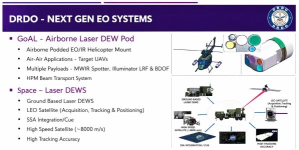
One of the most interesting proposal was a Dedicated Anti Drone Helicopter armed with
• 2 3-5kW Heli Borne Lasers
• 2 APKWS equivalent Anti Drone Rocket Pods
• And Special Anti Drone Ammo for the Main Gun
1756025774866.jpeg
 
Last edited:
I believe systems like Akash, Spyder, Barak-8, and S-400 mainly provide layered protection along the borders. They’re already integrated with radars and command-and-control networks to detect and intercept incoming threats at different ranges.

The newly tested setup adds another layer of protection, but its role is more focused: defending specific high-value assets such as major cities, strategic bases, and military installations. Here, the combination of QRSAM, VSHORADS, and even directed-energy weapons provides close-in, multi-tiered defence against drones, missiles, and low-flying aircraft that slip past the outer shield
Amongst host of other poor decisions by Indian defence policy makers, the creation of potent AD stands out for foresight and good planning.

Akash Teer and the IACCS are potent and capable systems. Inclusion of this system would go a long way to fill the gaps.

Directed energy weapon appears to be a leap ahead to take care of saturation attacks by drones.
Has any other country operationalised directed energy kinds?
 
I think and this is pure speculation on my part
This is an Integrated Air Defence System for the Army as part of their push for Integrated Battle Group,
This particular system is designed against Drones and other Low Level Targets.

I had seen some slides from a restricted presentation by the DRDO on this very topic but I Refrained from sharing it anywhere but since cat is out of the bag I will share some more info about this.

There are a lot of pieces still missing, if I remember correctly the full system was supposed to have a
• A new missile Vehicle for QRSAM (with a range of 15 km) similar to SoKo LAMD
• A Dedicated Software Kill Anti Drone EW vehicle
• A <5 km Range Missile (the picture showed Brargavastra from Solar Industries)
There were a few more but I can't remember them at the moment

One of the most interesting proposal was a Dedicated Anti Drone Helicopter armed with
• 2 3-5kW Heli Borne Lasers
• 2 APKWS equivalent Anti Drone Rocket Pods
• And Special Anti Drone Ammo for the Main Gun
View attachment 142683
As I was saying Anti Drone Helicopter

1788142532029.png
 
As I was saying Anti Drone Helicopter

View attachment 213351

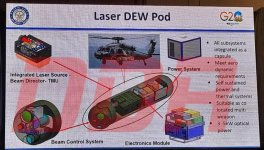
More Information on Airborne Laser DEW for Anti Drone Applications
1792291133193.png
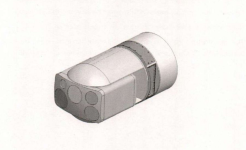
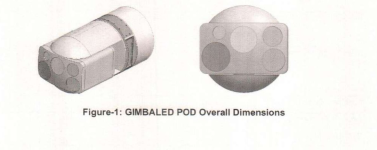
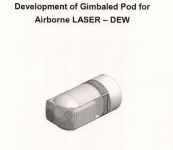
EXCLUSIVE | IRDE Dehradun is seeking development partners for an airborne LASER-DEW gimbaled pod.

The system will integrate a 2-axis gimbal, EO sensors, laser rangefinder, illuminator, beam director optics and beam transport system to precisely direct laser energy at airborne targets.

 
AIRBORNE LASER DEW POD ⭐--IMP for AIRBORNE COUNTER UAS

IRDE Dehradun has issued a spec for a Gimbaled Pod for Airborne LASER DEW,

➡️ It is a 36-month development programme with two units, a Proto and a SOFT (Safety of Flight Test) unit.
36 months in total:T0+5: detailed design review
T0+24: Proto delivered, integrated with the laser at CHESS, and CDR
T0+27: ATP (acceptance test)
T0+32: SOFT unit delivered
T0+36: SOFT qualification by CEMILAC and field testing

➡️The pod is a mass stabilised 2 axis (Az/El) gimbal:
Sensors are an MWIR imager ( 1280×1024+) ++ 1080p CMOS day camera and a laser illuminator && Beam Director Channel

⭐CHESS,Hyderabad will be supplying the Laser illuminator to the vendor

Field testing is “as per CHESS plan”

➡️ The design target is a 1.2 m × 0.2 m UAV at up to 40 m/s, tracked at 0.5–5 km and engaged at 0.5–2km

The POWER IS NOT STATED (but most probably between 2 - 5 kW)


SOURCE ---> IRDE Dehradun, Broad Technical Specification Document for Gimbaled Pod for Airborne LASER-DEW, published on GeM.

Thermal imager (MWIR) is to get the heat signature, so it gives day and night detection and tracking. It is one of the two sources for the automatic tracker

Day camera (CMOS, 0.43–0.75 )is to give high resolution visible imaging for daytime tracking. The spec requires zoom and focus from the joystick and a switch between thermal and day camera

Modes are Position, Park, Manual, Scan, Track, Calibration and BIT.
1792333950672.png
1792333940701.png
 

Users who are viewing this thread

Back
Top