Navigation
Install the app
How to install the app on iOS
Follow along with the video below to see how to install our site as a web app on your home screen.
Note: This feature may not be available in some browsers.
More options
Style variation
You are using an out of date browser. It may not display this or other websites correctly.
You should upgrade or use an alternative browser.
You should upgrade or use an alternative browser.
Education: State of Schooling in Pakistan 🇵🇰
- Thread starter Fatman17
- Start date
More options
Who Replied?


Fatman17
Moderator
- Thread starter
- #62
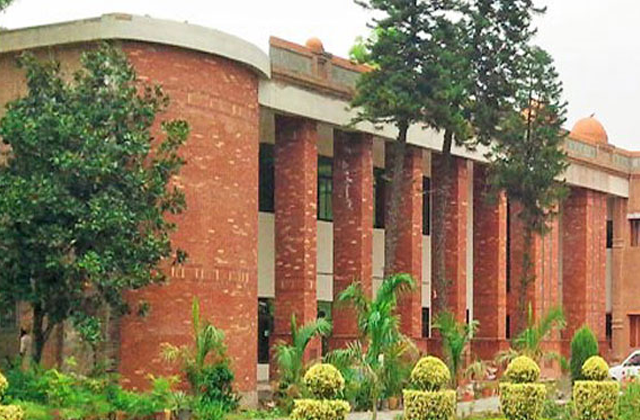
Medical colleges struggle to fill seats | The Express Tribune
Medical colleges struggle to fill seats
 share.google

Distant_Observer
Trusted Member

Even the royalties payments are not made. Centre owes KPK 4400 billion rupees. Just imagine what KP can achieve with this much money. Its like 2 years of KP budget.
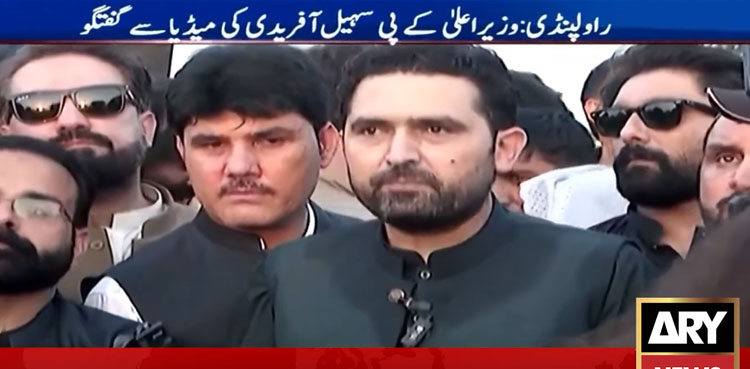
Over 4,400 billion KP funds payable by federation: Sohail Afridi
Chief Minister of Khyber Pakhtunkhwa blasting the Punjab and federal governments Tuesday said that there is 'civil martial law' in Punjab.arynews.tv
Federal government have also stopped support for ex-FATA regions which it was supposed to do. Federal gocernment have just dumped FATA on KP while retaining its due share as well. So KP is being fcuked up by both sides. More people to support and helding back its share of money.
By the way, because this thread is on education so I will state a comparison here. Last year, KPK spend 21% of its annual budget on education, while Punjan spend 17.7%. Not much difference. But one year before that , punjab education budget was just 14% of its total budget. Its good thing that they went from 14% to 17.7% in one year. Hope in this budget they touch 20%.
Like PPP in Sindh, majority of the spend is on ghost schools with ghost teachers and money going into the blackhole of corruption.
Punjab is not spending enough but the money does go where it should be going to mostly.
Very frustrating how Pakistanis are unable to self audit themselves. There should be no compromises when it comes to health and education.
RealNapster
Elite Member
Like PPP in Sindh, majority of the spend is on ghost schools with ghost teachers and money going into the blackhole of corruption.
Punjab is not spending enough but the money does go where it should be going to mostly.
Very frustrating how Pakistanis are unable to self audit themselves. There should be no compromises when it comes to health and education.
Have you ever been to KP, or talked to someone ? Are you even aware of ground situation ?
In KPESE, there is a thing called "Independent Monitoring and Data Collection Unit (IMDCU)" , 800 monitoring staff were hired by KP elementary school system in 2014. Since then this unit regularly pay surprise visits to schools. Check teachers attendance register, count teachers. Report any discrepancies.
Do you know that to take leave for a day, a teacher is supposed to ask for that leave not from his/her principle but district education office (DEO) ? So incase monitoring came to school and one teacher is absent and she/he didn't take leave from DEO office, then action is taken against that teacher by DEO office and monitoring team.
2 of my family members are govt school teachers in KP. I am sure i know more than you. Here a teacher cant take leave without first asking written permission and waiting for its approval from DEO office. And you saying KP have ghost schools ? You need to give some proof of the ghost schools in KP. Maybe some recent census or some report or something.

Monitoring system for govt schools
PESHAWAR, Feb 3: The Khyber Pakhtunkhwa Elementary and Secondary Education Department has decided to put in place a new monitoring system to check the performance and attendance of teachers and students in all schools of Khyber Pakhtunkhwa, according to s
www.dawn.com
KpK largely resolved it's ghosts schools issue back in 2017-19. It was largely due to small masjid level schools in far away areas. They were largely non-functional but still staff were drawing salaries. So KP shut them down and merged them with nearby primary schools.
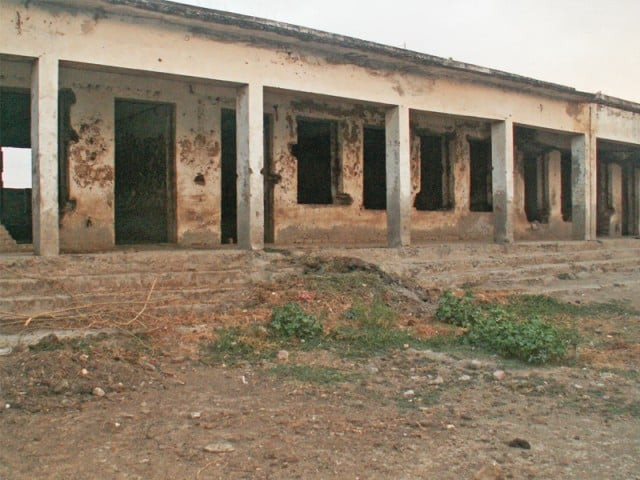
K-P govt shuts down 672 ghost, mosque schools | The Express Tribune
Number of state-run schools has fallen from 28,178 to 27,506
tribune.com.pk
Last edited:
Fatman17
Moderator
- Thread starter
- #65

Pakistan’s human capital future
The benefits of investing in childcare, however, extend far beyond supporting working parents.
share.google
Fatman17
Moderator
- Thread starter
- #66

Education divide behind CSS failures | The Express Tribune
In competitive examinations such as CSS, success depends on uniform preparation, comparable educational standards
share.google
Fatman17
Moderator
- Thread starter
- #67
QS university rankings expose regional disparities in Pakistan's higher education
Punjab, Islamabad dominate while other regions lag behind; Quaid-i-Azam University retains status as country's highest-ranked institution.
share.google
Fatman17
Moderator
- Thread starter
- #68
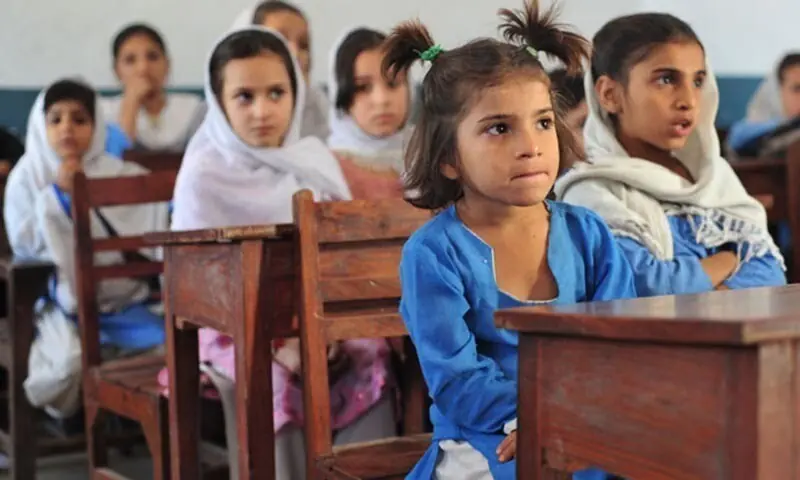
Govt school in Hyderabad among top 10 finalists for world’s best school prizes
Only two schools from Pakistan, the other being a private school from Punjab, shortlisted for the global award.
share.google
RealNapster
Elite Member
Summary of budget allocation for education by each province (as % of their total 2026-27 presented budget.
KPK = 21.5%
Sindh = 17.5%
Punjab = 15%
Baluchistan = 13-14%
Pakistan (Federal) = 0.63%
KPK = 21.5%
Sindh = 17.5%
Punjab = 15%
Baluchistan = 13-14%
Pakistan (Federal) = 0.63%
RealNapster
Elite Member
This is a year old article. Couldn't find latest one. Sharing it for info.
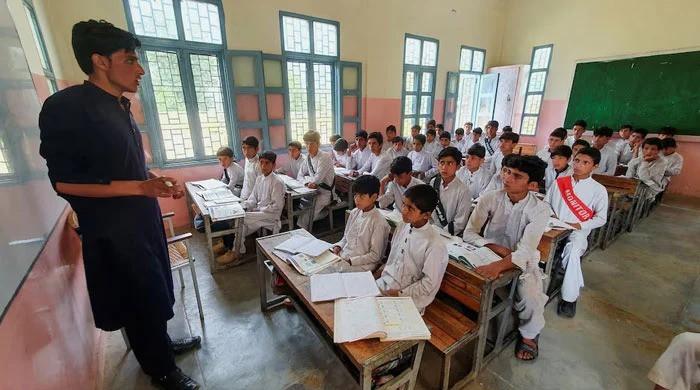
Over 10,000 schools in KP deprived of basic facilities: report
Thousands of children enrolled in over 10,000 government schools across 28 settled districts of Khyber Pakhtunkhwa remain without access to basic infrastructure, including boundary walls, electricity, washrooms, and clean drinking water, a provincial Education Department report has revealed.
The findings highlight widespread deficiencies in the region’s public school infrastructure. More than 5,000 schools lack electricity, over 2,000 have no access to safe drinking water, and a comparable number are without washroom facilities and protective boundary walls.
According to the report, 2,211 primary schools are still without electricity, with Mansehra (344) and Upper Kohistan (252) reporting the highest shortfalls. In Upper Kohistan alone, 208 schools lack clean drinking water, while 1,253 primary schools are operating without functional washrooms.
Of the 160 middle schools in the province, 136 are without boundary walls, 71 lack clean drinking water, and 57 have no washrooms. In the provincial capital Peshawar, 21 schools are without electricity, 15 lack clean drinking water, 17 have no washrooms, and 8 are without boundary walls.
Khyber Pakhtunkhwa’s Information Advisor Barrister Muhammad Ali Saif, said the provincial government was making efforts to address the lack of basic amenities in government schools. He noted that education remained a top priority, and that Chief Minister Ali Amin Gandapur had taken notice of the issue and issued directives accordingly.
He added that more resources would be allocated in the next budget to ensure that no government school remained without washrooms and drinking water facilities.
Saif also mentioned that districts with over 50% out-of-school children would see an educational emergency declared. In areas with an urgent need for school facilities, the government intended to establish schools in rented buildings to bridge the gap.
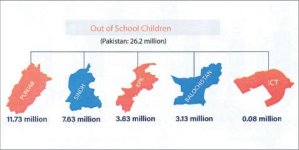
These efforts come against the backdrop of alarming figures recently released by the provincial education department, which show that 37% of children in KP remain out of school.
The earlier report paints a concerning picture, revealing that 4.92 million boys and girls across the province are currently deprived of formal education.
The problem is most acute in Kolai-Palas Kohistan, where 80,333 children are out of school. The neighbouring districts of Lower and Upper Kohistan also record alarmingly high rates, with 79% of children not enrolled in any educational institution.
In contrast, Upper Chitral emerges as the province’s best-performing district, with only 10% of children out of school.
The provincial capital, Peshawar, has more than 500,000 out-of-school children, including 319,000 girls, underscoring a major gender gap in education access.
 www.thenews.com.pk
Over 10,000 schools in KP deprived of basic facilities: report
Thousands of children enrolled in over 10,000 government schools across 28 settled districts of Khyber Pakhtunkhwa remain without access to basic infrastructure, including boundary walls, electricity, washrooms, and clean drinking water, a provincial Education Department report has revealed.
The findings highlight widespread deficiencies in the region’s public school infrastructure. More than 5,000 schools lack electricity, over 2,000 have no access to safe drinking water, and a comparable number are without washroom facilities and protective boundary walls.
According to the report, 2,211 primary schools are still without electricity, with Mansehra (344) and Upper Kohistan (252) reporting the highest shortfalls. In Upper Kohistan alone, 208 schools lack clean drinking water, while 1,253 primary schools are operating without functional washrooms.
Of the 160 middle schools in the province, 136 are without boundary walls, 71 lack clean drinking water, and 57 have no washrooms. In the provincial capital Peshawar, 21 schools are without electricity, 15 lack clean drinking water, 17 have no washrooms, and 8 are without boundary walls.
Khyber Pakhtunkhwa’s Information Advisor Barrister Muhammad Ali Saif, said the provincial government was making efforts to address the lack of basic amenities in government schools. He noted that education remained a top priority, and that Chief Minister Ali Amin Gandapur had taken notice of the issue and issued directives accordingly.
He added that more resources would be allocated in the next budget to ensure that no government school remained without washrooms and drinking water facilities.
Saif also mentioned that districts with over 50% out-of-school children would see an educational emergency declared. In areas with an urgent need for school facilities, the government intended to establish schools in rented buildings to bridge the gap.
These efforts come against the backdrop of alarming figures recently released by the provincial education department, which show that 37% of children in KP remain out of school.
The earlier report paints a concerning picture, revealing that 4.92 million boys and girls across the province are currently deprived of formal education.
The problem is most acute in Kolai-Palas Kohistan, where 80,333 children are out of school. The neighbouring districts of Lower and Upper Kohistan also record alarmingly high rates, with 79% of children not enrolled in any educational institution.
In contrast, Upper Chitral emerges as the province’s best-performing district, with only 10% of children out of school.
The provincial capital, Peshawar, has more than 500,000 out-of-school children, including 319,000 girls, underscoring a major gender gap in education access.
Over 10,000 schools in KP deprived of basic facilities: report
Thousands of children enrolled in over 10,000 government schools across 28 settled districts of Khyber Pakhtunkhwa remain without access to basic infrastructure, including boundary walls,...
www.thenews.com.pk
Last edited:
RealNapster
Elite Member
As of 2024
RealNapster
Elite Member
From April 2026
KP unveils plan to tackle out-of-school crisis through data-driven strategy
The Khyber Pakhtunkhwa government has unveiled a comprehensive, multi-departmental initiative aimed at systematically reducing the number of out-of-school children across the province through coordinated planning, real-time data collection and targeted social support interventions.
The initiative, developed under the provincial government’s Good Governance Roadmap, was reviewed at a high-level meeting jointly chaired by Minister for Elementary and Secondary Education Arshad Ayub and Chief Secretary Shahab Ali Shah at the Chief Secretary’s Office.
The meeting was attended by secretaries of the Elementary and Secondary Education and Social Welfare departments, along with representatives from the Health and Local Government departments and officials of UNICEF.
A detailed briefing outlined a proposed province-wide survey mechanism designed to generate accurate, village council-level data on out-of-school children. The survey will identify children aged five to 16 who are not attending school, estimate future enrolment needs for those aged up to five, and compile comprehensive data on children already enrolled in both public and private educational institutions.
Officials said the in-school dataset would cover students enrolled in provincial and federal government schools, private institutions, madrassas, non-formal education centres and other special education initiatives operating across the province.
According to the briefing, the 2023 census estimated approximately 4.9 million out-of-school children in Khyber Pakhtunkhwa. However, authorities expect the forthcoming household- and school-level survey to yield more precise and actionable data, enabling the education department to better align planning, budgeting and resource allocation with area-specific needs.
The Health and Local Government departments are expected to play a central role in the exercise by supporting data collection through their existing grassroots outreach systems. Officials noted that the integrated database would facilitate real-time mapping of out-of-school children and support future enrolment projections.
The meeting was also informed that the Social Welfare Department has been designated as a key partner to support vulnerable families whose children remain out of school due to poverty and livelihood pressures. The department is tasked with developing targeted assistance mechanisms to reduce financial barriers to education.
Education officials told the meeting that the existing public sector infrastructure has the capacity to accommodate up to 25 per cent additional students through immediate enrolment measures.
They added that a 100-day implementation plan has already been prepared, under which the government aims to enrol nearly 60 per cent of out-of-school children in the short term. Achieving enrolment targets for the remaining 40 per cent, however, will require additional resources, infrastructure expansion and a strategic realignment of development planning and budgeting priorities.
Welcoming the proposed strategy, Chief Secretary Shahab Ali Shah directed all relevant departments to finalise memorandums of understanding (MoUs) to ensure formal coordination among stakeholders. He further instructed that the 100-day plan be presented to the provincial cabinet for approval and formal launch.
Minister Arshad Ayub emphasised the role of the private sector, stating that the government would create an enabling environment to maximise its contribution to the initiative.
“We are committed to ensuring that every child in the province has access to school and is able to complete basic education without delay,” he said.
 www.nation.com.pk
KP unveils plan to tackle out-of-school crisis through data-driven strategy
The Khyber Pakhtunkhwa government has unveiled a comprehensive, multi-departmental initiative aimed at systematically reducing the number of out-of-school children across the province through coordinated planning, real-time data collection and targeted social support interventions.
The initiative, developed under the provincial government’s Good Governance Roadmap, was reviewed at a high-level meeting jointly chaired by Minister for Elementary and Secondary Education Arshad Ayub and Chief Secretary Shahab Ali Shah at the Chief Secretary’s Office.
The meeting was attended by secretaries of the Elementary and Secondary Education and Social Welfare departments, along with representatives from the Health and Local Government departments and officials of UNICEF.
A detailed briefing outlined a proposed province-wide survey mechanism designed to generate accurate, village council-level data on out-of-school children. The survey will identify children aged five to 16 who are not attending school, estimate future enrolment needs for those aged up to five, and compile comprehensive data on children already enrolled in both public and private educational institutions.
Officials said the in-school dataset would cover students enrolled in provincial and federal government schools, private institutions, madrassas, non-formal education centres and other special education initiatives operating across the province.
According to the briefing, the 2023 census estimated approximately 4.9 million out-of-school children in Khyber Pakhtunkhwa. However, authorities expect the forthcoming household- and school-level survey to yield more precise and actionable data, enabling the education department to better align planning, budgeting and resource allocation with area-specific needs.
The Health and Local Government departments are expected to play a central role in the exercise by supporting data collection through their existing grassroots outreach systems. Officials noted that the integrated database would facilitate real-time mapping of out-of-school children and support future enrolment projections.
The meeting was also informed that the Social Welfare Department has been designated as a key partner to support vulnerable families whose children remain out of school due to poverty and livelihood pressures. The department is tasked with developing targeted assistance mechanisms to reduce financial barriers to education.
Education officials told the meeting that the existing public sector infrastructure has the capacity to accommodate up to 25 per cent additional students through immediate enrolment measures.
They added that a 100-day implementation plan has already been prepared, under which the government aims to enrol nearly 60 per cent of out-of-school children in the short term. Achieving enrolment targets for the remaining 40 per cent, however, will require additional resources, infrastructure expansion and a strategic realignment of development planning and budgeting priorities.
Welcoming the proposed strategy, Chief Secretary Shahab Ali Shah directed all relevant departments to finalise memorandums of understanding (MoUs) to ensure formal coordination among stakeholders. He further instructed that the 100-day plan be presented to the provincial cabinet for approval and formal launch.
Minister Arshad Ayub emphasised the role of the private sector, stating that the government would create an enabling environment to maximise its contribution to the initiative.
“We are committed to ensuring that every child in the province has access to school and is able to complete basic education without delay,” he said.
KP unveils plan to tackle out-of-school crisis through data-driven strategy
Peshawar - The Khyber Pakhtunkhwa government has unveiled a comprehensive, multi-departmental initiative aimed at systematically reducing the
www.nation.com.pk
Fatman17
Moderator
- Thread starter
- #73

Pakistan among nine countries with over 50 varsities in Times ranking
Of the 52 Pakistani institutions included in the rankings, 33 are public-sector universities while 19 belong to the private sector.
share.google
Fatman17
Moderator
- Thread starter
- #74
Pakistan among nine countries with over 50 varsities in Times ranking
Of the 52 Pakistani institutions included in the rankings, 33 are public-sector universities while 19 belong to the private sector.
share.google

RescueRanger
Meme Lord
Sir, majority of young people now don't see medicine as a stable and prosperous career path in Pakistan. My own baby cousin completed MBBS and is now running a Gym and Weight reduction clinic because he earns more there injecting wealthy Pakistanis with one dose of Monjaro than he would make in a month.Medical colleges struggle to fill seats | The Express Tribune
Medical colleges struggle to fill seats
Average costs of MBBS program in Pakistan;
Annual fee 1,800,000-2,800,000.
Total tuition fees (5 years) between 9,000,000 - 14,000,000
Hostel charge: 160,000-300,000 (per year)
Lab charges: 100,000 per year
This doesn't include cost of text books, transport, feeding and miscellaneous costs and workshop fees, or cost of MDCAT exams and prep.
Average salary of Junior Doctor in Pakistan 50,000- 120,000 PKR.

Another niece recently did a coding boot camp after her Bachelors and is currently freelancing as a coder for a medical transcription company based in the US, she works from home and earns 4500 USD sitting in Pakistan.
Users who are viewing this thread
Total: 1 (members: 0, guests: 1)
Pakistan Defence Latest
-
-

-
-
 Exclusive: Pakistan and Indonesia closing in on jets and drones defence deal, sources say (3 Viewers)
- Latest: K2RULEZ
-

Country Watch Latest
-
-

-
-
And it’s official: India in talks with France to join 6th Gen fighter programme FCAS (7 Viewers)
- Latest: peacemaker99
-


