Elon Musk’s Starlink Launches 1st-Ever Cell Service Satellites

logoO_positivo.jpg

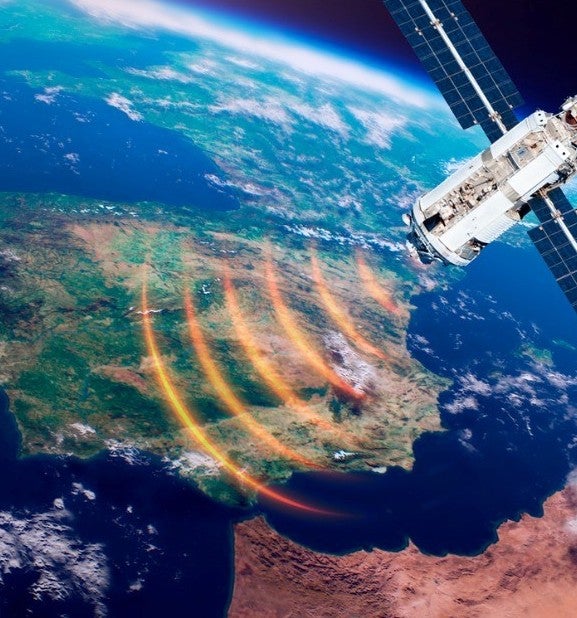
MasOrange to Trial Starlink Direct-to-Cell in Spain​

Mas-Orange-Starlink.jpg

Spanish telco MasOrange will trial Starlink’s Direct-to-Cell service under a new agreement with SpaceX announced Monday.

The Spanish regulator, the State Secretariat for Telecommunications and Digital Infrastructure, granted approval for spectrum assigned to MasOrange to be used for Starlink Direct-to-Cell. This is often called supplemental coverage from space (SCS).

MasOrange plans to carry out a technical pilot in the Spanish province of Valladolid. The telco did not specify timing of the trials or what phones are eligible. Users will be able to use data on their devices to use certain applications as well as messaging services. MasOrange said that Starlink Direct-to-Cell will serve as a network complement, particularly in remote, high mountain, or coastal environments.

“We are very pleased to announce this agreement with Starlink, which reinforces our commitment to innovation and to always offering the best services to our customers through the use of all available technologies,” said Meinrad Spenger, CEO of MasOrange.

Ukrainian telco Kyivstar rolled out service late last year, and Virgin Media has a customer rollout planned for 2026 for a new service in the U.K. enabled by Starlink D2C called O2 Satellite.

MasOrange is partially owned by French telco Orange, which recently announced a deal to acquire the remaining 50% stake from Lorca. That purchase is expected to close in the first half of 2026. Orange currently offers a satellite messaging service working with Skylo on certain Google Pixel smartphones.
 
Walter Isaacson reveals he has Starlink direct to cell on his phone

To view this content we will need your consent to set third party cookies.
For more detailed information, see our cookies page.
 
Walter Isaacson reveals he has Starlink direct to cell on his phone

To view this content we will need your consent to set third party cookies.
For more detailed information, see our cookies page.


I have some exposure to SpaceX via Scottish Mortgages, this will be an insane IPO. My guess is even though valuation of $2 Trillion may be too high, it may still well top out at above $3 Trillion at the end of the first days trading. Then possibly dip again, that is when I intend to buy. Early July should see another boost when Index tracker funds have to buy SpaceX too
 

Madagascar prepares to launch Starlink direct-to-cell mobile services​


Madagascar is preparing to introduce Starlink’s direct-to-cell satellite connectivity services as part of a wider African rollout led by SpaceX and telecom operator Airtel Africa, a move expected to significantly improve mobile coverage in remote and underserved regions of the island nation.

The initiative forms part of Airtel Africa’s partnership with SpaceX to deploy Starlink Direct-to-Cell technology across 14 African markets beginning in 2026. Madagascar is among the countries expected to benefit from the satellite-based service, which allows compatible smartphones to connect directly to satellites without requiring additional hardware or ground-based cellular towers.

The technology is designed to extend connectivity to areas where conventional mobile infrastructure is difficult or uneconomical to deploy. According to Airtel Africa, the first phase of the service will support text messaging and selected data applications, with broader voice and broadband capabilities expected to follow as the satellite network expands.

The system will complement existing terrestrial infrastructure while improving resilience during outages and emergencies.

SpaceX has been rapidly scaling its direct-to-device ambitions through Starlink, launching hundreds of specialised satellites capable of communicating directly with standard smartphones. The company first demonstrated the technology in early 2024 by successfully sending text messages through Starlink satellites using mobile spectrum from telecom partners.

Since then, Starlink has expanded partnerships with telecom operators worldwide, including agreements with VEON in Eastern Europe and Central Asia, while Ukraine is also preparing to launch mobile satellite services using the same technology.

Recent testing carried out by Airtel Africa and SpaceX reportedly demonstrated successful messaging services, light-data applications, and mobile financial transactions through direct satellite links in areas lacking terrestrial coverage.

The rollout comes amid accelerating investment in satellite-to-phone connectivity globally, with SpaceX continuing to expand the Starlink constellation following regulatory approvals for thousands of additional satellites dedicated to next-generation communications services.

Executives at Airtel Africa have described the initiative as a major step toward improving service availability across the continent, while SpaceX has increasingly positioned Starlink Mobile — formerly known as Direct-to-Cell — as a complementary layer to traditional telecom networks rather than a replacement for them.
 
I need to go find the link again. T-Mobile is supposedly offering the service on their phones and network.

If A&T does, then I am set wherever in the world I happen to be at the moment.
 

Globe achieves first Philippine video call via Starlink direct-to-cell service​


Ayala-led Globe Telecom Inc. on Thursday demonstrated its first direct-to-cell (DTC) service with Starlink, linking Obando, Bulacan to Basilan through a video call and short message service (SMS).

According to Globe, a video call was made between Department of Information and Communications Technology (DICT) Secretary Henry Aguda, who was in a remote community school some 30 minutes by boat from the Isabela Port in Basilan, and Undersecretary June Vincent Manuel Gaudan, who was in Obando, Bulacan.

The call was made during President Ferdinand “Bongbong” Marcos Jr.’s Brigada Eskwela visit to the Binuangan Elementary School in Bulacan on Thursday morning.

“Connectivity becomes even more meaningful when it reaches communities that have long remained underserved,” Globe president and chief executive officer Carl Cruz said in an emailed statement.

“Satellite-to-mobile technology can help strengthen digital inclusion by supporting access to communication services in areas where traditional infrastructure alone may not be enough,” he added.

Starlink’s DTC service is a satellite-to-mobile wireless technology developed by SpaceX, Starlink’s parent company. It provides connectivity in remote areas where traditional terrestrial networks are unavailable, using LTE-enabled phones that connect directly to satellites acting as “cell towers in space.”

Globe chief commercial officer Darius Delgado said Starlink Mobile will initially be made available for Android users and offered in two packages — P99 for 30 days and P299 for 90 days — starting in June.

Globe completed its first live trial of Starlink Mobile in March, with testing conducted in parts of Rizal, Batangas, and Bataan. The company said the tests confirmed the service’s feasibility.

The partnership was first announced in January and aims to expand mobile signal and internet access to underserved and remote areas, particularly across the Philippines’ more than 7,600 islands.

To view this content we will need your consent to set third party cookies.
For more detailed information, see our cookies page.
 

Starlink to trial Direct-to-Cell in Malaysia: Works with normal 4G phones, no satellite phone required​


Malaysia may soon conduct trials of Starlink’s Direct-to-Cell (D2C) satellite technology, which aims to extend mobile coverage to areas without existing telco towers.

Communications Minister Fahmi Fadzil revealed that Starlink representatives have informed him of their intention to conduct a Direct-to-Cell trial in Malaysia. The technology is seen as a potential solution to mobile dead zones in rural and underserved areas.

According to Fahmi, the Malaysian Communications and Multimedia Commission (MCMC) has also invited local mobile network operators to explore the technology with Starlink.

If implemented, Direct-to-Cell could provide mobile connectivity in locations without existing telecommunications towers and in areas where building new towers is not economically viable due to the small number of users.

Fahmi added that the satellite-based solution could be deployed much faster and at a lower cost compared to building new telecommunications towers, which typically take between 18 and 24 months to complete.

What is Starlink Direct-to-Cell?​


260801-starlink-direct-to-cell-connectivity-2048x1220.jpg


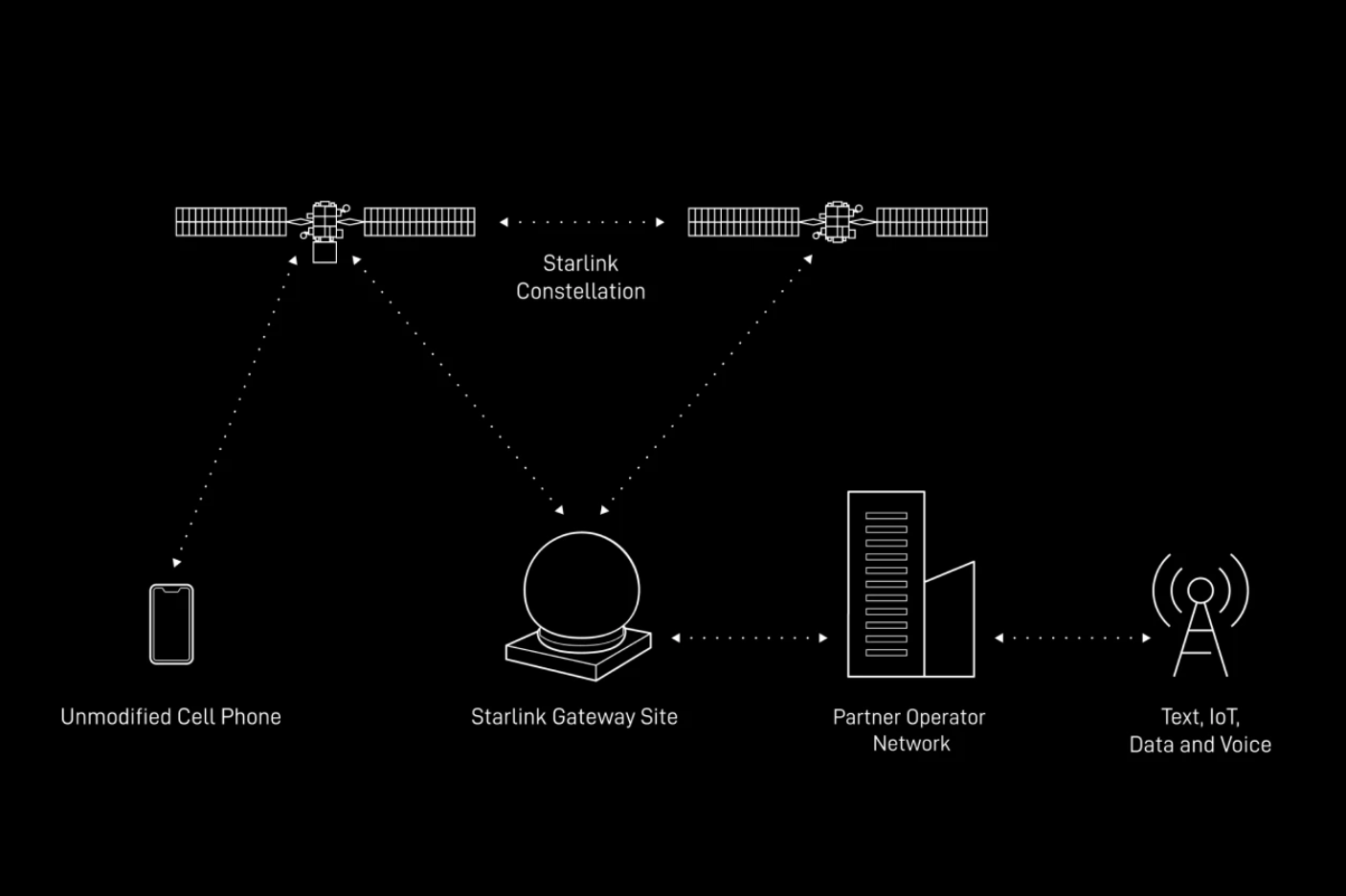
Unlike Starlink’s satellite broadband service that requires a dedicated satellite dish, Starlink Direct-to-Cell works with existing 4G LTE smartphones and doesn’t require any additional hardware or a dedicated satellite phone.

Instead of providing internet directly to a satellite dish, Direct-to-Cell essentially extends your mobile operator’s network from space.

260801-starlink-direct-to-cell-how-it-works.png


When your phone is outside your telco’s mobile tower coverage, it can connect directly to a Starlink Direct-to-Cell satellite in Low Earth Orbit. The satellite acts like a 4G LTE base station in space and connects back to your mobile operator’s core network using its existing licensed LTE spectrum.

This means users can continue using their existing SIM card, phone number and compatible 4G smartphone, while the mobile operator retains control of the network.

260801-starlink-direct-to-cell-v1-v2.jpg


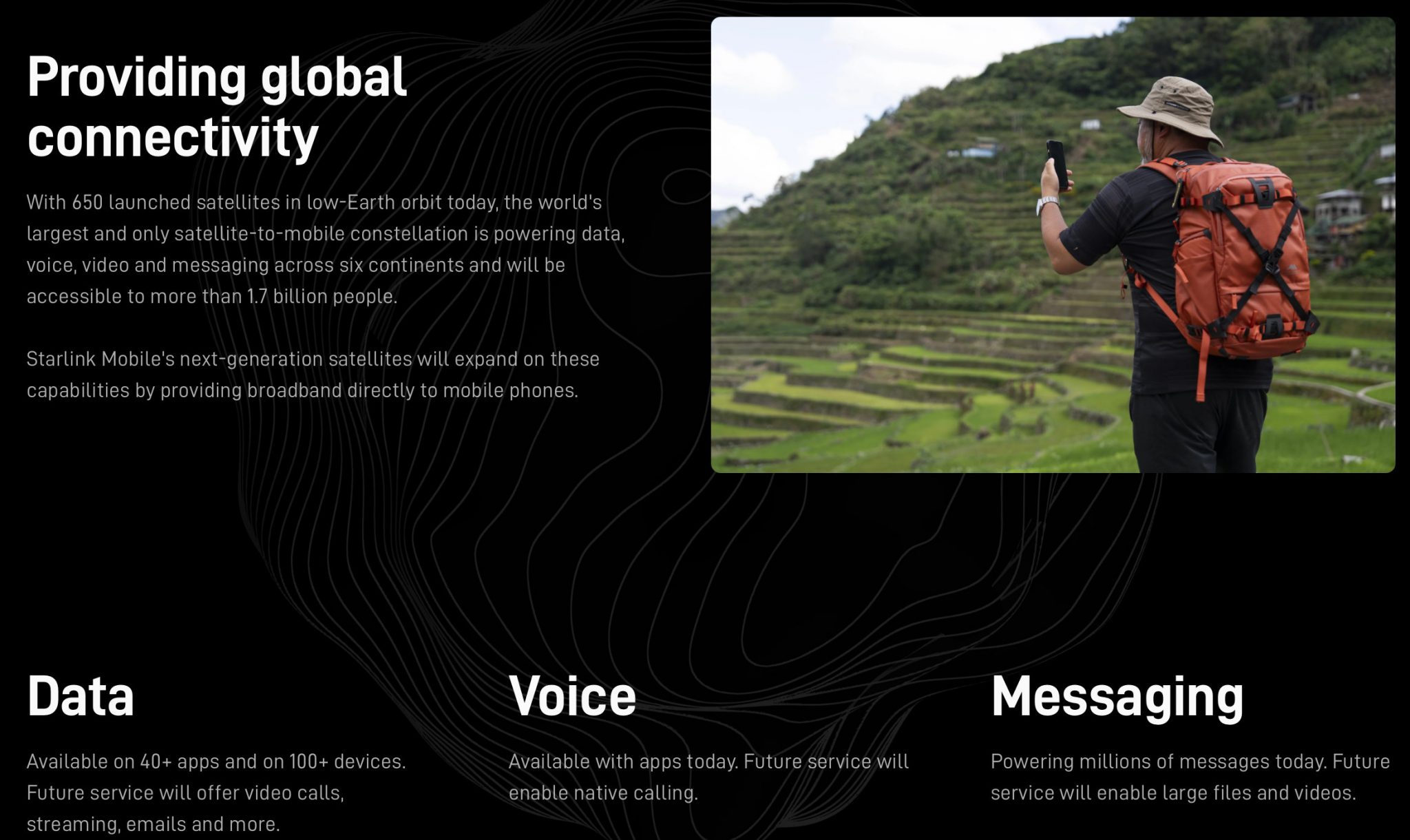
SpaceX has already deployed more than 650 first-generation Direct-to-Cell satellites, forming one of the world’s largest space-based 4G LTE networks designed to extend mobile coverage beyond the reach of terrestrial cell towers.

It’s next generation of Starlink Mobile satellites (V2) aims deliver full cellular coverage with the highest performing satellite-to-mobile network every built. Utilising custom Space-X designed silicon and phased array antennas, the new satellites are designed to support thousands of spatial beams and higher bandwidth, which would enable about 20x the throughput of its current first-generation satellites.

Starlink claims with its V2 connectivity, telcos can invest less in terrestrial networks while enabling seamless service in rural areas and enable total coverage everywhere.

Designed to complement existing mobile networks​


Starlink Direct-to-Cell is not intended to replace existing 4G and 5G networks. Instead, it acts as a complementary coverage layer for areas where deploying conventional telecommunications infrastructure is impractical or too costly.

Since the satellites orbit about 500 to 600km above Earth, users will generally require a clear view of the sky. The service is primarily designed for outdoor connectivity in rural areas, highways, offshore locations. It isn’t designed to provide indoor coverage.

Due to the greater distance between a smartphone and a satellite compared to a conventional 4G or 5G tower, lower LTE frequency bands are generally preferred for better reception.

In Malaysia, Direct-to-Cell would work best with lower-band spectrum such as 900MHz or 1800MHz. It is likely that the actual spectrum used will depend on the participating telco and subject to regulatory approvals.

Of course, users shouldn’t expect the same speeds and latency as a conventional 4G network. Instead, it is intended to provide essential connectivity such as messaging, voice calls, emergency communications and limited mobile data when users are off the grid. This makes it particularly crucial during emergencies, natural disasters or when travelling in remote locations.

Southeast Asia’s first Starlink Direct-to-Cell rollout in the Philippines​

In our region, Globe Telecom is the first telco in Southeast Asia to roll out Starlink Direct-to-Cell services in the Philippines. The feature is available on both prepaid and postpaid plans which start from PHP99 (RM6.60) for a 2GB plan with 100 satellite text to all networks, valid for 30 days.

260801-starlink-device-to-cell-2048x981.png


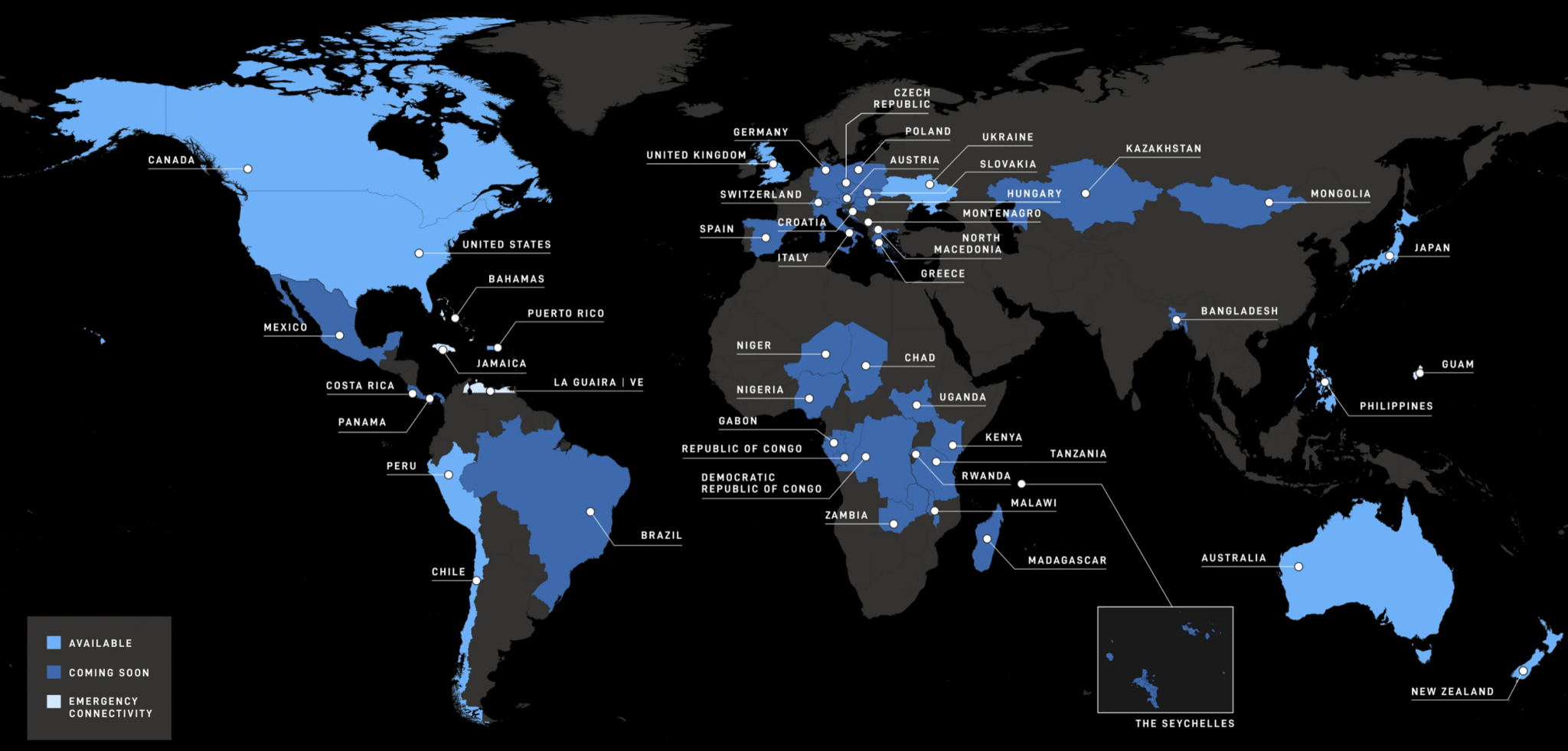
The service is aimed at extending mobile coverage to remote islands and underserved communities where deploying mobile infrastructure is difficult or uneconomical. Similar partnerships have also been announced in countries including the United States, New Zealand, Australia, Canada and Japan.

According to a recent Ookla analysis, Direct-to-Cell adoption is gaining momentum across the Asia-Pacific region, with the Philippines accounting for the largest share of detected Starlink Direct-to-Cell users among APAC markets monitored during the second quarter of 2026.

If Starlink’s proposed trial proceeds, our local telcos could tap on the satellite technology to extend mobile coverage to underserved and unserved rural areas, remote highways and offshore locations.
 

Starlink Mobile Lands in Italy: 5 Details That Matter​

5cedd33ece70e1d3c98503e8afdf2adc.jpg


Starlink Mobile is officially coming to Italy. On July 16, SpaceX's Starlink announced a partnership with FASTWEB — operating as Fastweb+Vodafone — to bring Direct to Cell satellite connectivity to Italian customers in areas where traditional mobile networks simply don't reach. Here's what the deal actually means

1. This Is Italy's First Direct to Cell Pilot​

The Fastweb partnership marks the first time Starlink's Direct to Cell (D2C) technology will be tested in Italy. Rather than requiring a dedicated satellite dish, D2C uses Starlink's low-Earth-orbit satellites — sitting roughly 360 km above Earth — as space-based cell towers. Standard 4G phones connect directly to the constellation without any hardware modifications. For Italy, that's a meaningful shift: the country has significant rural and mountainous terrain where terrestrial cell infrastructure is either uneconomical or physically impractical to build.

2. The Apennines Are the Opening Test Bed​

According to reporting from mondomobileweb.it, the initial experimentation will take place in the Apennine mountains of central Italy — exactly the kind of terrain where hikers, rural residents, and emergency responders lose signal entirely. If the pilot performs well in that environment, the case for broader rollout across Italy's coastline and southern regions becomes much easier to make. The Apennines are a credible stress test: high elevation, complex topography, and sparse population density all at once.

3. Your Existing Phone Works — No New Hardware Required​

One of the more practical details: standard 4G devices connect to the service without any modifications. Customers won't need a new SIM, a satellite-specific handset, or any additional equipment. The hybrid network is designed to automatically switch to satellite coverage when the terrestrial signal drops. That seamless handoff is the core value proposition — users in a coverage gap shouldn't need to do anything differently. WhatsApp, Google Maps, SMS, and MMS are all supported services in the initial rollout, according to telecompaper.com.

4. Traditional Phone Calls Aren't Supported Yet​

This is the limitation worth flagging clearly: traditional voice calls via the telephone network — including emergency calls — are not currently supported through the satellite connection. The service covers data and messaging, not voice. That's a real constraint for anyone thinking of this as a full safety net in remote areas. Emergency services in Italy still depend on terrestrial coverage or dedicated satellite phones. Starlink's D2C technology has been working toward voice support, but it isn't part of this pilot as announced.

5. FASTWEB Has Been Circling This Deal Since March​

The partnership didn't come out of nowhere. Fastweb was briefly listed as a Starlink Mobile partner as far back as March 2026, before that mention was quietly removed — likely while the formal agreement was being finalized. The July 16 announcement represents the official, confirmed version of what was apparently already in negotiation. For Fastweb+Vodafone, adding satellite fallback coverage strengthens its competitive position in a market where rural connectivity gaps are a known weakness across all Italian operators.

The pilot's success in the Apennines will likely determine how quickly Fastweb pushes D2C coverage to other underserved regions. For now, the service is a meaningful first step — and a sign that Starlink's carrier partnership model is continuing to expand across Europe. Follow our SpaceX coverage for updates as the pilot progresses.
 

Users who are viewing this thread

Pakistan Defence Latest

Latest Posts

Back
Top